Story Spark Day 41 - Stop Start Continue
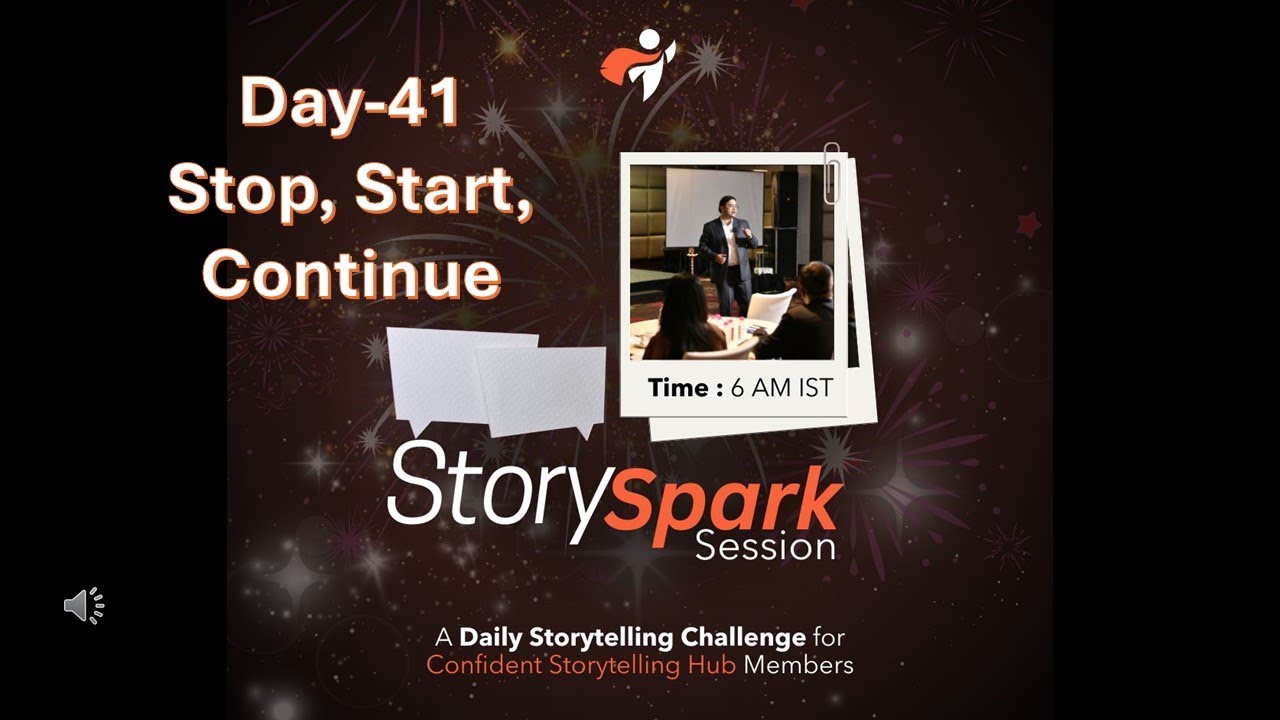
In this 41st StorySpark session, facilitator Haritosh Srivastav leads participants Dr. Alka and Venkat through a storytelling exercise followed by a structured feedback round using the Stop‑Start‑Continue framework. After a brief period for participants to write or recall a story, Haritosh explains the three feedback dimensions: what the storyteller should stop doing, start doing, and continue doing. The session then proceeds with Dr. Alka presenting a story about vision boards for entrepreneurs, followed by Venkat sharing a personal story about waking up early. For each story, the group provides concrete feedback—identifying distracting habits (e.g., filler words, unnecessary pauses, preaching), suggesting improvements (adding context, using dialogue, following a clear story arc of hook‑conflict‑cure‑change‑resolution), and reinforcing strengths (showing up, writing stories, using a hook). Haritosh also emphasizes delivery skills such as body language, eye contact, and pacing. The session concludes with logistical announcements about upcoming Day 42, a special mastermind session, and the final “Storython” event, as well as a reminder about PSA’s video‑submission opportunity. The overall aim is to iteratively improve both story content and delivery through focused, actionable peer feedback.
Chapters
Awesome, welcome everyone to day 41 of StorySpark session. We have come a really, really long way and now into the week 8. So another day, another interesting activity we are going to do. So we know the importance of taking the feedback and continuously improving. So in today's activity, what we are going to do is I'm not going to tell now. What we are going to do is first write a story and then I am going to— once we have written a story, I am going to give a framework, another framework for giving feedback. This framework is very precise, to the point. So once we have written the story, then I'm gonna come back and show you what exactly we need to give before you start delivering the story. So let's write the story for next 2 minutes. I'm gonna play the music and share the screen, write down the story, and then we'll come back and go with the framework and the actual Story Delivery.
Any story?
Any story, yeah. It could be the one previously used or it could be a new one as well. All right, are we done with the story writing? Okay, great. Venkat, are you done? Not yet? Okay, let's give 30 more seconds to Venkat.
Yes, Haritosh Srivastav.
Awesome. So let me share the framework and then we'll go through the storytelling, story sharing part. So the framework is called Stop, Start, and Continue. And what do we mean by that is whenever a speaker is speaking, a storyteller is sharing the story, we want— I want others to actually look at 3 parameters. Number 1 is stop. What is something that you want the storyteller to stop doing? Because there may be something that is not required, that is distracting. So one thing, not too many things, but one thing that they should stop doing. Number 2 is start doing, so something they may not be doing but that would be worth trying, is that no, something they should start. So one thing that they can start to try. And the third is continue, continue doing something they are doing really well and they should keep doing. So we will use this particular framework for providing the feedback today after the storytellers have shared their story. So now with that, let's start with Dr. Alka. So go ahead with your story.
It's a continuation of yesterday. I just improvised on that. So in the last week of December, I was taking a workshop for entrepreneurs, and because at the end of the day I asked them a question, we coming to the end of 2024, and I want you to write your vision for 2025? And these people looked at me in blank. They were looking at me so blankly. So I cajoled them, I counselled them, I gave them some more ideas that the vision is something that you see when you're going from point A to point B. Vision is something that you see at the end of point B. Then they started telling me, we have this problem, we don't have money, we don't have infrastructure, I can't do it, I'm not good enough. 'And I want to tell you one thing,' I told them. And then they came out with a to-do list. Vision is not a to-do list. Vision is not a strategic plan. Vision is not something you write on a piece of paper and put it on a wall and just forget about it. Vision is a picture which makes you crazy, which makes you move forward in your life, which makes you go through your obstacles. This is what I want to share with everybody. Write your vision. This is 2025 now. This is 2025 now. Go ahead and write your vision. I didn't make any actions. I completely forgot.
It's all right, it's all right. Okay, everybody writes SPTY— Story Power To You. And let's straight away go to the feedback part of it. So Venkat, What is one thing that Dr. Alka should stop doing?
I am not sure, Haritosh, because I concentrate on the story and, uh, thinking about my story. And yeah, I understand, lot of us are into our own zone.
Oh, next I need to present, but that is my turn, so I need to tell my story.
So I'm thinking about my story, all of us.
But yeah, I think this is why this exercise is very important— be in the moment. Uh, giving feedback also requires you to be mindful of what is happening. Of course we have thoughts running and next is my turn, but it also requires you to be here, observe what is happening, and then— so I think one thing, uh that Dr. Alka should stop doing, uh, is that again the conflict— I can see because you used it yesterday, so the conflict was there. But maybe I think what you should stop doing is to end up fast. It could have been taken to a more logical conclusion. What happened afterwards? So there was conflict today, there was cure also that no, it is not about to-do list, it's about having the weekend. But what happened afterward, the change part is missing. So maybe work on that. I don't know whether it will come under stop or start, but yeah. Okay, one thing that, uh, Dr. Alka should start doing.
I feel context sticks more in this, uh, Alka's story. To start their, uh, their stories somewhat after the context.
So give more context, start adding like little bit more context. Fair enough. Yeah, I think you also gave explanation of a few people in the room, but I think what you can also start doing is, uh, Instead of written language, use the speaking language, which is then I said, they said. Use dialogue instead of that. No, this is— I did not— I didn't ask you to create to-do list. Vision board is not a to-do list, it's the vision, right? So instead of saying I said, they said, she said, we can try to use more of dialogue. So that, that is one thing that you can start doing. And I won't say you have not done that, but yeah, today, as you already pointed out Little bit more gesture would have. And this is why this is important. These sessions are important because one day we focus on content and then we forget about body language, gesture. Then we focus on body language and then we mess up the content. By doing one piece every single day, it becomes much better. Okay, what is one thing that Dr. Alka should continue?
Conflict part and change part. Change part is, I think, I couldn't find change part. So she can continue the part somewhat long.
I, I think, yeah, first of all, continue joining the sessions. But jokes apart, I think continue writing the story because you are off to a great start. You're working on the content, so continue doing the content along with whatever we share in the session. So the gestures, the body language, the eye contact, all of these things should start, but continue writing the story. That will give you a lot of stories to share. Awesome. So let's now go to Venkat. Share with us your story.
Every day I plan to wake up early morning. If, if we wake up early morning, the length of the day would be long. We can do more things, so we can achieve some of our to-do list activity. Sometimes we cannot achieve all, but many times we can achieve, um, 75%. So every day I plan, try to to wake up early morning. If we wake up early morning, I can achieve my first to-do list of waking early morning, but I regret because it— I can fix my wake-up time, but I cannot fix my starting sleeping. It can come naturally. We cannot start force to sleep at 11 o'clock, 10 o'clock. It comes whenever, uh, it starts. So if I push to wake up early morning, I achieve my first to-do list of waking early morning, but I mess up all the whole day. So I conclude this. I realized that enjoy each and every moment. Waking early morning is not a, um, first to-do list. To-do list— our goal is to complete the whole day with happy. That is the, uh, my conclusion from this.
Awesome, everybody, right? SPDI Story Power to You, Venkat. And let's go to the feedback round. So let's start with stop. What is one thing Venkat should stop, Dr. Alka?
I'm missing the structure actually, so I don't know what he must— in start, I can say the structure should be made according to what you have taught us. But it should stop is maybe the, the filler words. Think of Haritosh Srivastav.
The two things I also noted down, one is, uh, stop unnecessary pauses in between the sentences because that looks little unnatural. And how you can do is whenever you are— now I know you are doing a lot of book reading now, so what I want you to do is start a new practice of reading out loud the at least one page, right? And when you are reading out loud, make sure that you're not pausing unnecessarily in between words because that makes it look little awkward. So when you have the book, it is very easy to continue reading for the whole page, and that way you stop only when there is a full stop or a comma. So you need to consciously do that because what has happened is unconsciously you have developed this habit of stopping at every other word, which sometimes feel unnatural and it can make people feel awkward that why are you pausing without any reason. Another thing is, uh, this was preaching. Yes, this was not a story. You started and I was hooked. Okay, so I will talk about what you can continue, but, uh, I would say stop preaching, start telling story. Right, so let's now go to start. What should Venkat start doing?
Writing a proper structure, scripting the proper structure like what you taught us— the context and the challenge, then the cure, the change, and then the resolution. So that would help him to make it into a more structured, purposeful story.
Yes, absolutely. So when you put a structure And then comes the— you have 3 things, right? So you have the content, you have delivery, you have engagement. So on the content part, you have to work, which is like she said. So how can you do in this case? Instead of saying that, no, and you started with a good hook, right? Every day I like to wake up in the morning, but I'm not able to. That was a hook. And I'm like, yeah, I can think about it. A lot of people can correlate. But then you got into preaching. So you can add like, no, okay, every day I struggle and It is getting painful day by day. I start the day, but it doesn't, it doesn't work out. I feel so sad, and I had to do something. And then I found this book or podcast or tool or whatever it is, The Cure. And then I took that, okay, I'm not going to wake up 1 hour early, I'm going to wake up 5 minutes before. Then I wake up 10 minutes before, and this is how I have been able to wake up 1 hour earlier. In, in a matter of month. So the takeaway message, you can say that, no, you don't have to do drastic change overnight. Do incremental change, and over the period of time, you will have a major shift in your identity, major shift in the way, right? So this way, there is a context, there is a conflict, there is a cure, there is a change and carry out message, right? This is a story. Uh, what you said was, okay, do this and this and this, this is why this is not to be done, this is why to be done.
So it became a lot of, lot of preaching, and people don't like preaching, right?
Okay, what is one thing that Venkat should continue doing?
Continue writing stories.
It is easy as well, right?
See, I like the way he shows up every morning. He is one of my inspiration, I should say. Wow. Venkataraithumujebi anahi hai. Merko kaibika bhi bohot problem hota hai, but I said, Venkat is there, I am also going to—
This is going to be the tagline today.
Yeah.
Yeah.
Thank you. Thank you. Thank you.
We learn from everybody.
Absolutely. We learn from each other. So I'm learning from both of you. I think both of you should continue to show up. I think that is inspiring for me. And also I love the way you have started to think in terms of story. So you started with the hook. I was like, yeah, this is off to something. It didn't work out. That is separate and that's not a problem. But at least you have shifted from just preaching to starting with a hook. And making people, okay, this is up to something, like this is really interesting. So why do we tell story instead of preaching? Is we want to make it interesting, right? If you say, yeah, every day I struggle and I didn't know, this is that you should get up every, every day early morning, nobody likes that. But when you start telling story, that's when it gets interesting. Even if you're saying the same thing of waking up early, you add a story, it becomes far more effective. So I see where you have started to go. You started with the hook, just continue doing that and you are off to a great journey.
Awesome. Haritosh, in my story, is the hook good enough? Not very good, no? I'm saying it was the last day of the entrepreneurial session. Entrepreneur session.
No, it was good. I think in your case also the hook was good because I wanted to know what happened in the entrepreneurs. Give little bit more context. Right now, who were there? Like, no, you said entrepreneurs. What kind of entrepreneurs? Well, it could be budding entrepreneurs or established entrepreneurs and things like that, but not too much as well. We could give too much information, that's also confusing for people. So you can say, yeah, I was addressing a group of budding entrepreneurs or established entrepreneurs, and that was good. I like that.
Yeah.
The hook was good. Your conflict was also coming where you wanted them to, and I like when you put that visual that, okay, I asked them to create the vision board and what I saw was blank eyes staring at me and they had no idea what I'm talking about. So that was good because a lot of people, if they don't know what is this, they'll be like, wow. So I actually went to one of stationery shops outside my apartment. I asked him that, okay, I need a canvas, so I am creating my vision board. So he said, okay sir, do you paint? I said, no, I am not an artist, I don't paint. Then why do you need canvas? I said, I'm doing something called vision board. And he started looking, what is a vision board? Now we continue to talk, so I said, okay, you should go and Google what exactly is a vision board because I need a little bigger canvas. And he said, yes, I am definitely going to do that, and it is an interesting concept I've never heard. And yeah, and now he's ordering a big canvas for me to do my vision board for 2025. So the point is that some people may not know what you are trying to do. At that time they will have blank stare, but then you can put the cure in form of introducing a guru or tool or device or podcast, whatever it is, to bring the cure and the change.
So I'm not having any cure. I'm just telling them this is— it is not a to-do list, it is not a plan, it is a— it's something that you see in your mind.
How did you know this?
How did I know this? Hmm, actually I do it every day.
But you do it every day?
I cannot preach it.
And right, but who told you to do this every day?
Nobody told me. It's just that I do it.
So did you get certain, uh, inspiration from somewhere?
Yeah, I can tell one. There is one story that I have in my life when the cement factory had gone off. You know, I don't know if you have shared this with you. At that time, I was building my clinic premises, my second clinic premises, and not second means my new clinic. And suddenly, during the construction, the cement factory went on strike, and then my, my What is his name? My contractor rang me up and he said that nothing is going to happen now, madam, we are leaving your site. And I said, no, no, no, you can't leave my site. He said, no, madam, when there's no cement in the market. So I called up the cement factory and there was a lady on that side. She said, what is your company's name? If you have a company only, we'll give you cement. So then I got an idea that time. I said, yes, yes, let me make a company. I didn't have a company that time, so I made a company's name. Let me say what my company name is. And then I told her, what do I want to give to my company or to my people? Hope. Okay, I want to give care. And then I— there and then I strategized my name as Hope and Care Center. So this is one story that I looked at my vision and then I gave it to her and I established my brand and it established— I went through the crisis also.
So this is great because your story, your one story can be the cure for another story which is running. So what you are happening is There's a story inside a story, right? So your story where you are having a conflict of people don't understand the vision board, maybe you would have told this story itself, right? That, okay, this is how you can envision. Don't just create a to-do list, you have to envision. And this is how I got my first vision and vision board, right? So your story— and this is a great point as well, right? So a lot of time we see a lot in movies and other places where you have a story inside story going on, right? So this can be another thing that your story, one story can be the cure for another story and that way they have shifted. Ultimately what you're looking for is a change in the thinking pattern, change in thought process, right? So based on your story they got the insight that okay, so if Dr. Alka could create the whole hospital with this care thing, I can also create a vision for myself. And then this is where the change starts to happen, and they start creating their vision board.
So next day I received all the vision boards on email.
Ah, that is what happened.
Sometimes I'm very— I get confused about the end.
So what, so what did they actually do after you told them to create vision board?
They started writing.
They started writing, right? And then did any of them come back to you and say thank you, or, or Of course, of course.
Maybe 2 or 3 only. So, but I can always say that they came back with the email, they sent me the emails of this.
Did you actually receive the email?
Just 2 or 3, not many.
You received 2-3 emails? Okay, yeah. So what I'm not— what I'm against is lying. So don't say if you didn't receive it. Yeah, but, but yeah, you, you can say, yeah, you received multiple emails. Afterwards, people saying that, no, I could visualize, I could create my vision board. And then your takeaway, what could be the carryout message.
So what are you waiting for? Create your vision board.
Yeah, something like that, right? So think about what you want to build your life, right? Your vision builds your life, something like that, to give them like, okay, they can also create vision board or something like that. Okay, great, great, great conversation today. Welcome. All right, so that's pretty much it for today's 2E Spark Session. We have completed day 41. We'll meet again tomorrow. For day 42. And yeah, I'm planning something special for Tuesday. Some more things are in plan, so based on that we'll have a session on Tuesday. And then we'll have the last story— yeah, Storython session. There's so many things happening, I'm getting confused myself. So Storython session will happen on Thursday evening. So we'll have Monday, Tuesday, Wednesday for our Story Spark session. Tuesday we'll have a special mastermind session, and Thursday we'll have our Storython session, final. And there is a few surprises being planned, so I will reveal that in the Storython session. All right, see you tomorrow. Have a great day.
And as I say every time, Haritosh Srivastav, in PSA, I know we have launched one speaker. You have to submit, anybody from outside PSA can submit a 3 to 5 minute video. And there's a price for it. And, uh, I want to send it to you first, and if you find it is okay to put it in the group, then you put it in the group. Otherwise, if you find—
sure, please share with me.
I'll share it with you.
All right.
Okay.
As I say every time, until next time, keep learning, keep growing, and keep going out of your comfort zone. See you tomorrow. Have a great day.
That is your vision. That's your correct vision.
Yes.
Thank you.
Thank you.









