Success Story with Communication Coach Devi
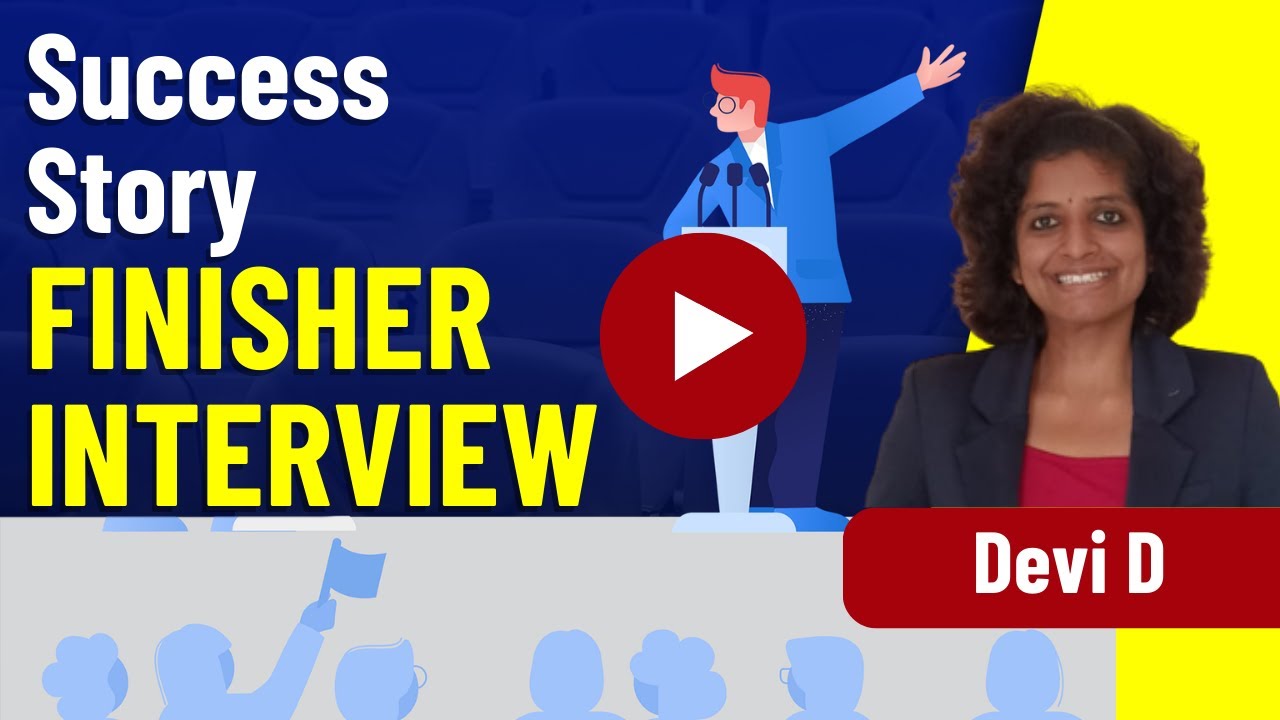
In this live interview, host Haritosh Srivastav welcomes communication coach Devi D to discuss her unconventional career path, the lessons she learned from failure, and her current work helping professionals improve their communication. Devi explains how she moved from engineering to UPSC preparation, then pivoted to public speaking and business writing after missing a civil‑service interview. She highlights the importance of mentors and collaboration, citing her own UPSC experience as a catalyst for seeking a coach. Devi describes her coaching focus: public speaking (business presentations, assertive meeting participation) and business writing (MOMs, case studies, blogs) for IT professionals. She contrasts the challenges of writing versus speaking, noting that writing is permanently recorded while speaking is more forgiving, yet both require deep subject knowledge. The conversation shifts to why she chose Haritosh as a coach—his openness, sincerity, and supportive demeanor—and the key takeaways from that partnership: overcoming perfectionism, establishing a clear coaching process, and building a mastermind‑style delivery model. Devi shares the boost she felt after landing her first paid client, exceeding her revenue goal in the first month. Looking ahead, she announces new training material tailored specifically for IT professionals, aiming to address their communication pain points. Finally, she offers concise advice to young IT professionals: ask questions instead of assuming, and learn to say no assertively using positive language. The interview concludes with details on how to connect with Devi across social platforms and her WhatsApp business line, and Haritosh congratulates her on becoming a certified public‑speaking coach.
Chapters
Hello everyone, welcome back. It's been long since we did a live interview, so we are right now live on Facebook, LinkedIn, as well as on YouTube. Please drop in the chat from where you are joining and how is it going. So today is a very special interview. I'm going to interview someone who I know for few months now, but it feels like I know her for years. Uh, somebody who's a great friend and amazing communication coach, and somebody who I worked with in finding out how she can go to the next level. Ladies and gentlemen, please welcome Devi D, communication coach. Devi D today in this interview success story. So Devi, welcome once again.
Thank you so much, Haritosh Srivastav. Really humbled listening to that, you know, wonderful introduction. And same here with me. Like, it's, it's like, it looks like I know you from ages, not from few months.
Absolutely. Absolutely. So Devi, why don't we start with your introduction? Like, no, uh, what all kind of things? I know 2 minutes is gonna be really short, so let's cover more on the professional front. What kind of things you have done and what has been your journey like?
Yeah, yeah, definitely, definitely, Haritosh Srivastav. So I, I hope I can cover it in just 2 minutes. I'll keep it short and crisp. So far my life has been a, you know, complete roller coaster ride. I graduated as an engineer but worked for some time as a software engineer and then started off with UPSC preparation. It was a hard grind preparing for UPSC, but finally I couldn't you know, go to that last leg, missed out on a small aspect in the interview and couldn't get into the prestigious service. So that was when I took a 360-degree turn in my career. I took up public speaking and I took up writing as well, and these two careers really paid off well for me. And I realized that these two are the areas that I'm passionate about. And when you convert your passion to your profession You give it your 100%. And after a few years, and I thought, why not give back the skills or give back the knowledge that I have? That's when I decided to be a trainer and I decided to be a communication coach because communication is something which I can relate to, which I had initial difficulties, which has cost me business presentation interview. So I thought, why not guide the next generation? And make them more confident in communication. That's how I took up communication coaching and training, and I was fortunate to have found Haritosh Srivastav on the way, who gave me an extra push and, you know, extra guidance to go to the next level. So that is my story so far for all of you.
Awesome, awesome. Thank you so much, uh, Devi, and this is amazing. Uh, guys, uh, if you are having any question for Devi, feel free to put it in the chat. And we'll try to cover as many questions as possible. Now, Devi, um, I know you have a history and you came from different background, but I want to talk about one thing which I— we learned the most, and that is some of our failures, some of the things that nobody teaches. So tell us about one or two of your failures. No, what was your failures, and also more importantly, your learnings out of that.
Yes, it's a very good question, very pertinent question, and this is something very close to my heart because once upon a time I was totally into UPSC preparation and being a civil servant was my greatest dream. And I did put in all heart and soul for 5 years and prepared for the exam, but finally because of interview goof-up I couldn't make it. Now when I look back, what I learned from this failure was UPSC, especially UPSC failure. Number one was, from the beginning of a new journey, you should have the right mentors and right coach. I remember when I was preparing for UPSC, initially I was preparing all alone in isolation, and I wish I had a mentor and a coach right from the beginning. Probably it might path or trajectory would have been different. That is one thing. Second is you should go always— whatever venture you are doing, you should always go for more collaboration. Um, UPSC also, initially I was just preparing on my own, sitting in a small room. You require more collaboration, more discussion with people. And now as a coach, as a trainer, I don't want to repeat the same mistakes. That's why I got a coach, and he is none other than Haritosh Srivastav. Then also, I'm looking for more collaboration with people, learning from a lot of people. So who all are listening to this, never make this mistake. If you are on a new venture, get a coach or a mentor to guide you and look forward to collaboration and networking. It will really take you to great heights.
Wow, that's an amazing, amazing, amazing sharing, Devi, and totally agree to that. I think, uh, Coach is someone who can really stop us from committing the mistake they have done, or they know that people do. So I know, and I owe a lot of my success to my coaches because I had a number of coaches and they stopped us from committing the same mistake that either they did or they learned from somebody else. So very, very important to have coach and mentor and some role models to you. Now, uh, what exactly, uh, because when we talk about communication, it's such a vast area. Uh, it is written communication, oral communication, uh, communication or video. So if I have to ask you, what is the area that you specialize on, what would you say?
Yeah, this is again a very good question, and you have rightly put it, communication is a vast topic. If you ask me what I specialize in, one is public speaking. That is, how do you give a proper business presentation? How do you, how do you give a well-structured speech? How do you handle a team meeting? How do you speak assertively in a team meeting? Because assertiveness is again another skill— how you handle the questions, how you put forth the points. So one is public speaking. And the number two aspect which I specialize in is basically business writing. So in our workplace, we have to write, and especially now that I am focusing more on IT professionals, we have to write a lot of business documents. We need to write MOMs, case studies, blogs, and these are the areas where I help people to write in a precise and crystal clear manner. How to structure your sentences, How to structure your paragraphs well, how to identify that weak verbs, adjectives, and make your writing more crisp. So in a nutshell, if I have to say, the two things that I specialize in is public speaking and the other one is business writing.
Very nice, very nice, amazing. So let me ask you a very, very interesting question, uh, and it just came to my mind. Tell us, uh, two similarity and two dissimilarity between these two things.
Okay, so this is, this is a good question. Let me, let me try to answer it as honestly and let me do the justice to this similarity. Now let me come to the differences first, it's much easier to tackle. So if you take writing So writing, I feel, is more challenging compared to speaking because whatever you write is recorded and it is there on the document. People can come back and check your grammar, check your punctuation, check your sentence formation. So it's, it's so challenging to write error-free sentences and paragraphs. But when it comes to speaking, whatever you have spoken, maybe people will remember, maybe they don't remember. They'll remember one word one, they don't pay too much attention to your grammar. So speaking is comparatively more easier compared to writing. But the similarity, let me tell you, both of these requires you to have in-depth knowledge of the subject. If you are writing on some concept, if you are speaking on some concepts, you should have knowledge, otherwise you will stammer, you will stumble. Be it writing also, you won't do justice to your write-ups, you may put in wrong facts. Even while speaking, you cannot put the arguments well. So I hope I have answered the question to the maximum.
Very nice, very nice. I love that answer. Yeah, even though those are similar, they are vastly different areas, and you need to know obviously whatever you speak. Yeah, it is, uh, a lot of people have this fear of public speaking, but I don't know whether they have done a survey of whether people have a fear of writing. I, I do believe a lot of people fear from writing. Good emails and writing, no, effective emails, effective communication on written part as well. So great points. So let's move on.
And one point, since you told about emails, so based on my research and of my target audience, what I found is people really have that something blocks them from responding to email, especially if it is higher-ups. Managers, that mind block comes into picture. Okay, if my grammar is wrong, what will they think of me? Just a small punctuation, and because of that they don't respond to the email for days together. So it is a mindset issues again when it comes to writing.
Very nice. Absolutely, absolutely. Uh, let's change gear now. Let's talk about, uh, the process that you go So let me ask you right now, uh, you would have had met multiple people when you were seeking for a coach. Uh, why did you choose me?
This is an interesting question. I will be as honest as possible. One was I already knew Haritosh Srivastav from Phoenix Literature Festival, and we have interacted closely, and I really like the commitment of Haritosh Srivastav, the sincerity which he brought forth, and always that williness to help genuinely, because whenever I got in touch with him, he all— he was never reluctant to share knowledge. So we need somebody to guide us who's, you know, open-minded, who is there to guide us at every stage. So your open-mindedness, your ability to help out people in need, and that calm and kind demeanor— I think that's what made me approach you. I knew that I can you know, speak my heart out to you. Any problem, you'll be there to help out. So that's what is needed in a coach— always being there for the coachee and always guide them on the right path. And so far, I, I can confidently say that I've taken that right decision, and always Haritosh Srivastav was here to guide me across.
Thank you so much. Thank you. Uh, so if I ask you, what were, uh, 2 to 3 major learnings out of this whole process, what would you say?
Okay, so one learning that I had is especially with respect to mindset and beliefs. So sometimes we go into that perfectionism route, and it happens with me. I will wait for things to be perfect and then start something. So a coach like you, you pushed me, okay, go out there and start your journey. Don't wait to be perfect. That is one thing that I— that's a major takeaway for me. Second is the right process and the right path you showed me. I had this plan of helping people with coaching, but I hadn't thought about it, what process to put in place. Okay, this is the mastermind group I need to create, this is the webinar I need to do, this is the workshop I need to do. I got an entire process and path. So I think that was very good enough to get started with coaching.
Very nice. It's, it's, yeah, absolutely. It's very, very important because, uh, yeah, if you don't follow the process, if you don't know where you're heading, then you don't know whether you are on the right path or you're going backwards. So it's very important to have that. So, uh, so let's talk about a little bit in terms of business, like, you know, what has been the impact in terms of— now, if you don't want to share the actual numbers, that's also Fine, uh, but I do want to know because I remember when we had the first conversation, what was your experience like when you got your first paid client?
This is a very interesting question and which it's close to my heart because I can still relate the feeling when I got my first paid client. And I have said it even in my videos which I have made for other platforms. Yeah, so I, at that point, I never thought that I'll get a client so quickly, within 10-15 days. And when the person came, started taking my coaching, I was seriously— my confidence level went up by, I can say, 10-20 times. So I knew I can teach, but quickly getting a paid client and they trusting me, that was really a very amazing feeling. And if I have to tell more about the numbers, like in the first month when I set the goal, in fact, I went more than 100%. I could meet the goal. So that was only possible. The mentor pushed me, coach pushed me, made me believe in myself. So that was a good experience. The starting month itself, I could cross the limit.
Very nice. And I can tell you, uh, not everybody goes, gets a similar result because not everybody puts in the same amount of effort. You have been one of the most dedicated coachee I had over the time where, no, whatever I told you, even if it was not making sense to you at that particular time, you said, yeah, I trust you, I'm gonna do that, we'll see how it happens. So that's, that's how. So it's, it's always a two-way process. It's not only coach mentoring coaching. A lot of time coachees also teach a lot of things to coach, and it's the dual both-way commitment that helps. So, so, so proud of you. So Devi, what is next for Devi? I know Devi is always doing something new, uh, bringing some more value to her client and, and some more flavors coming up. So what is it for Devi for, let's say, for rest of the year and then 2023?
Very, very good question, Haritosh Srivastav. So what I am now doing is more— now I have realized that the client base that I have consists more of IT professionals. So I'm more targeting them, one target audience. And in fact, I have done an in-depth research analysis of their problem, and I am looking at ways to serve them better. In fact, I've come up with the training material exclusively for IT professionals, and I'll be releasing it probably by the end of today. So, and that caters to IT professionals' problem and what is the best way to overcome it. And I hope people will enjoy it and they'll get an idea how to go about, especially IT professionals, where they are stuck up, where, how should they actually go about improving both their verbal communication and written communication. So I think this is the next big thing and important thing for me so that I can serve my target audience better.
Very nice. Very nice. Amazing. And if I'm not wrong, this is the first public announcement you're making. So I will take it as a credit to our interview. So congratulations, first of all, all the best. The world needs to know more about you. The world needs more people who are there to help others. We all are there to work, but we all need more people who can help others, coaches. So guys, we're going to put all the links of Devi in the chat, in the show notes and other places. Uh, one last question, Devi, for you. And yes, I promise this is the last one, but if you have to give, uh, say somebody is not able to reach out to you, if you have to give them 2 to 3 advice for any young professional, let's say you're targeting IT professional, uh, so if you have to give advice about communication skills to a young IT professional, what would you say to them?
Yes, this is a very, very interesting another question. So let me, let me— I have a lot of, you know, points in my head, but I'll squeeze it to 1, 2 to 3 points. So one is what happens in the workplace is we tend to assume a lot of things instead of asking questions. We assume, and that results in miscommunication. So if you are a new IT professional Yeah, it's natural to have some shyness that, no, I shouldn't ask my manager, I shouldn't ask my team member. Don't, don't— just remove those inhibitions. Keep asking more questions. See, this is based on my survey of IT professionals. Many of them have told me that they feel that shyness. What will my colleagues think? They'll think I'm naive and inexperienced. Let me tell all of you, leave that out of your head. This is your learning stage. Initial few years, you need to learn more, grasp more. Stop assuming, start asking maximum questions, and this is the best way to go about and learn. Second one, advices— this also people have asked me— how to say no politely. Yeah, I know saying no is really tough. You feel, what will the other person think? Will I lose hold of my opportunities. Again, my advice to all of you is sometimes saying no is really essential, but how you say no matters. Not what you say, but how you say matters. You can always say assertively in a positive language. Even if you disagree, you can say— I— let me give an example. In a sandwiched way, you can say first acknowledge what the other person has said. I understand your viewpoint and I even respect your viewpoint, but I have a little differing view I hope you can hear this out. So put it across politely as possible, and if you do so, nobody will take offense. So go out there, say no in the right situation, but in an assertive manner.
Wow, this is awesome. Uh, very, very important that, yeah, asking for help is not a sign of weakness, it's a sign of strength. Because yeah, only people who have that guts and courage that, yes, I can go out there and That also comes back to coaching or any, any field. Yeah, you need to ask for help. There's nothing wrong and nothing— no inhibition. And then yes, uh, how you say is more important than what you say. Absolutely bang on. So lovely, lovely, Devi. Uh, do let us know how can people reach out, and if they want to connect, please let us know.
Uh, definitely, Haritosh, and I'm there on almost all social media platforms. I'm there on LinkedIn, and there on Facebook, Instagram, and YouTube, and all places, my account is public. So all of you can follow me, send me connection request, friend request, and even if you are just following, you can see the activities, sessions that I conduct, and always feel free to join. And even my WhatsApp business number is public, and if you want to personally reach out as well, you feel free to reach out to me.
Awesome. Awesome, awesome. And Devi, before you go, I just had to share this. No, uh, congratulations once again on becoming a certified public speaking coach. We are so, so proud of you. So once again, congratulations. We, from the whole, uh, family— we have a family of our own tribe— from the— on behalf of the whole family, we wish you all the best. May you achieve next level of milestones, newer heights. And yeah, keep us posted. And yes, I'm gonna be tagging and putting you everywhere. So thank you so much. And thank you so much everyone for watching, whoever is watching it live or will watch the replay. As I say every time, until next time, keep learning, keep growing, and keep going out of your comfort zone. This is Haritosh Srivastav. Maybe I'll come back with another success story next month. Until then, take care, stay safe, stay blessed.









