The Real Talk: How to Be Successful in Life | Hinglish Video | #CoachHaritoshSrivastav
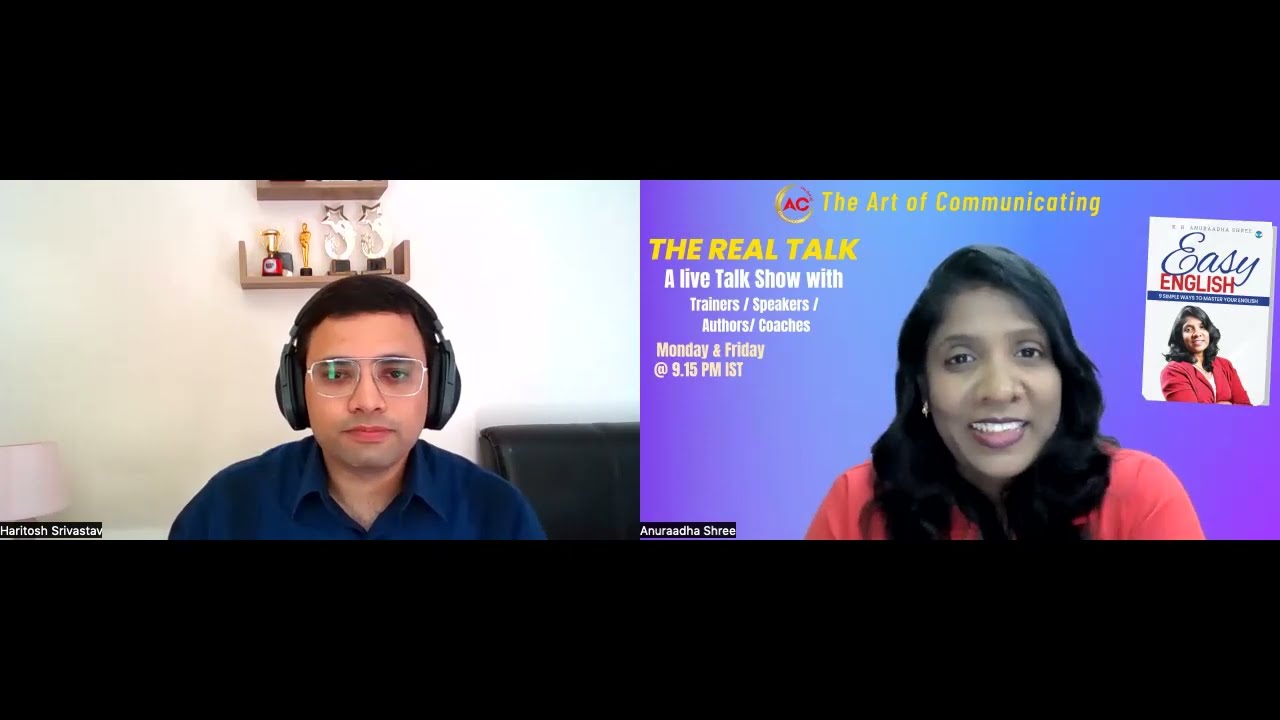
Coach Haritosh Srivastav talks about using storytelling to succeed in presentations and life. He shares two story models: Then-Now-How and the Pixar model, plus how to build a personal story bank. Srivastav is a public speaking coach and author of Small Town Bigger Dreams.
Chapters
Good evening, viewers. A very warm welcome to The Real Talk Show. I, Arvada Ashri, a corporate communication coach, entrepreneur, and author of my book Easy English, would be delighted to be hosting this conversation today. This show is on every Monday and Friday at 9:15 Indian time in the evening. The Real Talk Show is to bring the educational leaders from around the globe in order to transform education via the exchange of ideas for change. So it's a great pleasure for me to introduce our speaker today, Mr. Haritosh Srivastav, who's a public speaker coach who's going to talk to us about the power of storytelling in presentation. But before we invite him, let me tell you about his achievement, his interest, and the mission. Well, as you all know, uh, Srivastav, Haritosh Srivastav, is from England and his hobby is to talk about these stories. Why he has taken this, let me open the screen. You will also enjoy. Hold on, please, just give me a minute. I'm just doing it. So Mr. Haritosh Srivastav is also an author, is a bestseller author. Well, about him, take a little time to open up on the screen. Well, he's a public speaking coach, certified mentor, as well as a passionate storyteller. He is an award-winning speaker having won Accolades in India, the US, as well as the UK. He loves to mentor and coach young professionals and students in their endeavors, making the journey better and beautiful. He is also, as I told you, author of the Amazon bestseller Small Town, Bigger Dreams. Lovely title, which was launched in 2021 and have been among the top 5 personal time management bestseller Amazon bestseller books in Amazon India. At the same time, there's something very interesting. He is also an IT professional with 15+ years of industry experience and is currently working with TCS, where he is playing the role of an IT project manager managing a Fortune 50 pharma customer. He believes in the power of storytelling and says anyone can become a great storyteller if they follow the process. He firmly believes during these trying times, the world needs more storytellers who can share their message with the world and bring the good forward. So ladies and gentlemen, please join with me and welcome Mr. Haritosh Srivastav.
Thank you so much, Coach Anuradha. It is an honor and pleasure to be here. And hello everyone, thank you for watching. Uh, really looking forward to this conversation.
It's a pleasure to have you taking your time. Well, Hari, I mean, the very first question is, you are an IT project— I'm just looking out for edification, I couldn't get it— you're an IT project manager and at the same time you're a public speaking coach. It's quite tough, I feel it. Even that job is quite heavy, and even public speaking coach, you know, that is, you need lots and lots of practice. Could you please tell us how do you balance this both? Great question.
All right, it's not an, uh, it's not the first time that I've been hearing this question. At least I've heard this question 15-20 times this year itself. And the key here is that, uh, when you are passionate about something, when you really like doing something, you take the time out of it. Uh, so I love when I am helping people learn about public speaking and storytelling and other things. So that's my passion, which I'm slowly transferring into making it bigger. Yes, TCS is there, project manager is there. It's a lot of squeezing in and out. I like to study about productivity. I like to apply some other things, having to-do list, having calendar set up. So if somebody says that, can we have a quick meeting? I'll say, okay, let me check my calendar. Also, it is a lot of hard work. So I'm not gonna say it's a, it's a just a magic wand that you now you are ready. Now you are a coach. Now you're a project manager. It is a lot of hard work. So yeah, I wake up quite early. I spend a couple of hours on my skills, on my client. And then even in the evening time after my day job, I do these kinds of things. So I don't watch a lot of TV or a lot of news and things like that. I try to focus myself and then yeah, at times it stretches over weekend as well. So on, at least on Saturday or Sunday, I'm doing a lot of client call, uh, my public speaking client call or, or working on my skill. So it is a lot of hard work and you also have to manage your work smartly. So, uh, that, that's a hustle. Uh, it's a continuous hustle, but it's a hustle that I've chosen. So I enjoy when I'm able to squeeze time in, out and, and work on something which I'm really passionate about.
Thank you, wonderful. Hari, here I can call you Hari, right?
Yeah, absolutely.
Haritosh Srivastav is quite big for me. Okay, uh, Hari, your question here is like, see, when it comes to communication, people do formal, like sometimes going on a stage and all this. When it comes to public speaking, it's another real task. I mean, quite a challenging type. And here you mentioned, uh, the power of storytelling in a presentation. Why are you— why have you taken this particular point here? Absolutely. Presentation is common, right? In your office it's common. So, uh, how did you involve this storytelling in this presentation?
Absolutely. So in office we have to do a lot of presentation, and typically there are two types of presenters. One is that, no, they are reading from the slide, they're looking at all the graphs and buttons and figures, and you're like, yeah, he's doing okay, or she's doing okay. But then there are other kind of presenter. When they come and present, people like amazed. They, they like, no, looking forward to what next he's gonna share. And one of the key differentiator between the first type of speaker and second type of speaker is they are trying to put in a story. For example, I'll give you— I'm from IT world. We do a lot of demos and presentation to customer that, okay, we have this new product build up and this is the feature. And also I'll see a lot of people doing, okay, this is the new button, this is the new function, this is the new feature. But then there are people who tell— come and tell a story about that. No, why was it that we came up with this particular design? Why? How is it gonna affect your bottom line? How is it gonna help you in generating more revenue? How is it gonna impact your business? And when you tell stories about that, how is it impacted my previous customer? What is it that, no, uh, we missed last time and what have we learned from there? So when you— story doesn't have to be all the, you know, mythological story. Even the corporate stories, when you put in there, it, it brings in more attention and impact to your presentation. That's why even in corporate presentation, including stories, whether it's a short story or long story based on the context, it can really, uh, pull in life in your life, in your presentation.
So who was your first inspiration?
Who was my first?
Yeah, obviously you would have practiced your public speaking, but, uh, getting story into presentation, somebody would have inspired you. You would have heard someone's talk, right? Do you remember who was it?
Absolutely, absolutely. There's, there's so many. I mean, Yeah, we all have been listening stories since we are born and all kind of stories. But when it comes to these kind of presentation, I remember I watched the Steve Jobs when he launched the iPhone and then iPad and he pulled out of envelope and, and the kind of stories that he put in for the launch of— even though it was the biggest launch of Apple, he didn't talk about all the new semiconductor or chip. So He was talking about how this having an iPad within an envelope and taking it out can affect a normal person. How is it for a creative person? So he was all bringing in stories. So that was one. Then there are other great storytellers like Barack Obama is another one who is an amazing storyteller, amazing orator. The famous speech, "I Have a Dream," that's also one of my favorites. So there are so many storytellers at the moment. I can't zero in that that was the one person. But it's been over the years, all my coaches and mentors, many of them have been amazing storytellers, like my coach Akash or world champion Darren. He's an amazing storyteller. I just completed his book, amazing book with a lot of stories in it called 17 Minutes to Dream. So there's so many, so many storytellers in the world, and I keep trying to imbibe and learn from each and every one that I can get hold of.
I can relate with my mentor too. If you check out with Muthulie Sundaram, he just sees a picture and starts a story. In any meeting, he starts a meeting with a lovely story. Maybe it's a story which I've heard many times, but the way he says, it looks as if it's something new. That's all about like the storytelling. I love that because I'm trying to learn that skill from him. He's my mentor too. Lovely, he does it. I think you need to see that also. Now coming— yeah, thank you, Rish. Now this, the question here is that Generally, when people start speaking, they fumble. Is it right? That's what we all do. It—
absolutely.
Why do you— why people think something, it's a new skill which can't be done? I think since our childhood, we have been telling stories, isn't it? From the school days, college, up to parents, to everyone, we have been telling some stories. Especially I remember during my school, the way when I take leave or when I give— anyone gives an excuse, Give a story over there.
Yeah, do you? Absolutely. Absolutely. We all have done that.
Yeah. And now our kids.
Absolutely. So yeah, I totally agree to that. No, we all are born natural storytellers. And if you observe, even if you are on a cafe, in a restaurant, see, when you see people interacting and talking to each other, you'll see stories after story, they'll be doing all passionate storytelling with all the dialogues. He said that and she said that. And that's what that happened. And you can see that all the techniques, everything naturally comes to us. But what happens is when we go on stage or when we are doing customer presentation, our brain takes us back to the time when we were a caveman. And it goes back to that part of the— that side of the brain where it still feels that, no, if we are standing up, we are probably going to be killed because there are predators out there who's going to, you know, probably make a lunch, breakfast, or dinner out of us. So we go back to that zone that, okay, no, this is now about our survival. And that's where we start fumbling, and that's where we become really, really conscious of what we are saying. And, and that's where this happens. Uh, I, I said to you, uh, also before this talk right now, if only we become as natural, uh, we are off stage, we all will be amazing, great presenter. So One of the things that we need to do is that realizing that we are great presenter, great storyteller, great speaker and orator. It's just that we become little conscious. But when we understand that the audience is not against you, but with you, they want you to succeed, they want you to win, that's when this natural storytelling comes to us, natural speaking comes to us, and we get better. Of course, it does require a lot of practice. We all need to practice, but that's how it gets a little easier as the time progresses.
Hari, now when you're getting a story into a conversation or in a presentation, it could be a business meet or it could be a personal meet. So how do you think we can get a story to a particular conversation?
Absolutely. So there are multiple story models if you go and search for story models. You can find umpteen number of models. I'm going to probably cover two of the story models which are very famous. And we can use it. One of them is called Then, Now, and How. So it starts with a lot of, you know, food diet industry use it a lot. You'll see a picture of a fat guy and completely obese guy. And then you'll see on the right side a guy who is completely slim, six-pack, and smiling. And then you'll see how does that happen is using this pill or this meal or this coach and these other things, right? So that is one story model where you say then what was the problem? What was the issue? What was the, what was the thing that was going on? What is it? What is the transformation now? What is the current state, which is supposedly the better state? So what is it? Is it, is he better now? Is having weight in control. For example, if we talk about that, no customer was struggling. Now, how is he thriving and getting 6-figure, 7-figure revenue? And the third part comes, which is how, which is where you pitch your product, your sales, your services, your thing that you do, the magic pill, all the other things. So that is one story model. Then there's another story model that a lot of time use called Pixar story model, which is you say, okay, every day something used to happen. Until one day this happened, until one day this happened, and then something changes. So basically you take us through a journey where something was happening in a way, then you show that, okay, something happened which disturbed the whole flow. And then after that, the, the hero or, or the, the main character has to do something to bring that back to the previous state or make it even better. And this is how the story goes. So that's the Pixar model. So those are the two models. And depending on the context, you can use— first model is very popular and very easy. Then now and how, you can use it anytime. Other models is also used, but a lot of it is used in story— I mean, moviemaking or documentaries and things like that. A lot of Pixar model is also used there.
Good. So all the two techniques what I given should be used here very clearly. So how do you overcome? Because generally people fumble. Like when it comes to storytelling, when you go on the stage or while presentation, it could be in a small area, but still people, though they are prepared, still they fumble or they go blank. It's very common. So what's your tip for them? Because I totally focus getting storytelling in a business meet or present because that's a trend now. No one likes to listen to this, oh, this point, this slide, that slide, and all this. They love to hear the background of that.
Absolutely. So one thing is, uh, you have to be prepared. Like, you can't just build up, make up story when you go to that boardroom, to that presentation. So you need to do a lot of preparation, uh, so that is one preparation. And practice is important. And then having, uh, a little bit of notes. A lot of people think, oh, I, I can't have notes, I cannot have a helping slide, but It is not about printing a 5-page script, but having notes to you so that if you completely go blank, at least you can say, okay, this is what the point I was mentioning. That gives you some time mental trigger. So that's, that's tactical part of it. Uh, then having a visualization practice where, no, you are taking 2 minutes, 5 minutes out of time visualizing that, okay, I'm gonna go there, I'm gonna give the best presentation possible, I'm gonna tell I'm going to tell the amazing story and people are going to be amazed. And there are a lot of visualization audios available which help you visualize better. So doing a lot of these visualization exercises also helps you overcome. And then it's a process. So you have to understand that nobody becomes a natural storyteller on the stage. We are natural storytellers when you are speaking individually, but we are not natural storytellers on the stage. So if even if you fail a couple of times, it's okay. You get, get, uh, fail, get feedback, incorporate, practice, and then go again. So it's a cycle. And the more you do, the more stage time that you get, the more practice time you get, the more presentation time you get, the better you, uh, become. So there's, there's no, uh, magic pill that, okay, you take this pill and 10 rupees pill and you're done. It's not like that. You have to keep on going. But the more you go, the better it becomes for you. And then naturally you become as a storyteller on stage.
Hari, forget about 10 rupees pill, even 100 rupees pill doesn't work there. 10 rupees pill, none of the pills work here.
We have to take some other pills.
We have to take some other pills to make it active. I really resonate with Hari. He says that you need to visualize, always visualize the end result. The process in your hand. Visualize as you are getting a standing ovation. So this can motivate you internally because I do this sometimes when I get scared. Seriously, I'm yet to learn how to link this storytelling into my conversation. But what I do is, off late, I'm trying to write content based on any pictures. So that is like occupied. Still, I didn't do that. What do you say for this, Haritosh Srivastav? Write me content.
Yeah, that's a great question. And how do I build content? How do I get more stories? That's one of the common question that people ask. And what— in one of my workshop, I generally have this exercise of, no, uh, just spending 5 minutes every day. Uh, this idea comes from a book called Storyworthy by— written by Matthew Dicks. Uh, and he says that, no, it's your homework for the life. And they say every day when you go to the— towards the end of the day, you take 5 minutes out of the day and write down what are the things that has happened. And we go on to next extent where you spend 5 minutes and write down what was your first, what was your last, what was your best, what was your worst, what was something that never happened to you again, what was something that was very interesting, what was something which happened to your family. To your friend, something you don't want to remember, something you always want to say. So when you start asking this question to yourself and noting down story, that's where it becomes— you get something called a story bank. Uh, I'm, I'm like, no, very proud when I talk about this. One of my mentee, uh, Claire, she took this really— I mean, I have told this to so many people, but Claire took this to heart, and every day she was noting down her own stories. She has gone through different struggles and different things, and she now has— can you guess how many stories she has of her own?
Uh, now maybe around 1,000?
Uh, not yet, but she's like working for a few months now, and she's got more than 250 stories of her own, and that is within a few months. And, and she got so much inspired that she is actually taking 121 stories out of it, and she's now working on her book, and that book will come out later through the year. So that is the power when we start collecting that, whatever small we think is small to us is actually not small to others. And when we start noting down story in Story Bank, that's where we start building the bag, whether it's the corporate word, anything, our first, our last, our, our best. So our first interview, our last interview, our, our best time with the family, our worst time with the team, the first time manager appreciated you, the, the last time that he appreciated. If you start connecting, recollecting, you start getting story after story after story. And, and the more you recollect, the more stories you will have. And that you can start using, whether it's your corporate and other presentation, or whether it's your, you know, coaching presentation or anything. You can start taking those stories and start putting in your presentation.
Hari, I can resonate very well. You said the word called appreciation, it resonates with me. Recently I had run the content of the appreciation. I mean, just to develop the skill of story writing, like how I start, I start doing this content creating. Anything I take, I just don't post it. I write some content or make a story out of it. Sometimes I could, it could be, yeah, some, most of them are true, but sometimes I mix up here and there to make it more lively. This will help. This is really, I agree with you the way you said that, right? Start writing content. I think she's done with 200. She can do more because every day we all have stories. In the end of the day, how do you start your day? And something would have happened during the day. If you make a note of it, that's like a journaling. I think, uh, even one of my mentor also does it. My VP, Vice President, Gunna does it. Uh, his name is Gunna. He does a beautiful journaling. How, how was it? How the day was? Was it productive? And all those You need to do it. Yeah, that's awesome. And now let's come back with your book. Your book title is really awesome, very catchy title. Could you please tell us what your title is or what is that book is all about?
Thank you. Yeah, thank you so much. Yeah, so this book, the title of the book is Small Town Big Dreams.
Can you show me your book again, please? Can you show us? Yeah, Small Town Bigger Dreams. Yeah.
Yeah. So it's, it's, it's story of my story, basically. So I, I was born and brought up in a small town called Jaunpur next to Varanasi, and I spent, yeah, my first 18 years or so until class intermediate, uh, there. But in the second half, I have traveled, uh, yeah, at least I've shifted 10+ times in the different cities, different states, and in different continents as well. And in 2020, when I, uh, I came in UK in February 23rd, 2020, and after a couple of weeks, it was all pandemic throughout the world. And I had a choice that time, like all of us, that to spend a lot of time on Netflix Prime and other things, or do something which I could be really proud of. So I was thinking over it and I was kind of, no, uh, uh, reflecting on that. And I thought about that, my journey. Like everybody else has been unique. And what if I can document some learning, some lessons out of it, which could probably help somebody who's also coming from small town like me, who's also from Hindi medium or local language, and coming from there and going through different phases of life. So that's where this whole idea came into picture. And then I went through some book writing course and other things. And this book is a collection of 21 lessons that I've learned over the years. It's all my own stories. 99% of these are my own stories of what has happened with me and what is the lesson that I derive out of it. And, and yeah, it's easy to use, uh, very simple, 113 pages, 21 lessons. And if at the end of every lesson you have 2 to 3 action items that you can start using in your everyday life to become a better version of yourself. So that's the book all about.
Good. Could you show us the content of the book?
Absolutely. So it has got 21 chapters, and I'll probably show you. Might have to, because of lighting, it might not come clearly, but I'll tell you the chapters include like being mindful of your association, thinking ahead, uh, seamlessly seek mentors, be a mentor, take failures head-on, careful of giving, receiving feedback, advices, volunteer, trying new initiative, morning rituals, setting the mindset in the right way, and so on, so forth. So these are like first 19 chapters, and similarly you have 21 chapters. Uh, the, the main thing here is you can take up any chapter at any point of time. So this is Not like a fictional novel that you have to go in a sequence. So anytime you have 10 minutes, 15 minutes, 20 minutes, half an hour, you pick up a chapter. It will be finished in 3, 4 pages and you can start applying the lesson. So that's the whole idea behind this.
So after each lesson you have an action plan. Absolutely. I hope it's in a simple English.
It is. You can, you can guess small town, bigger dreams.
Title is very easy.
So, so it's written in such a way that even a small town guy like me, which I, which I, I still assume I am a small town guy. So it's a very simple English, uh, the English that all IT and engineers and anyone who's trying to learn English can understand. So it's a very simple English. I am not a very— I don't consider myself a very articulate or having a lot of flair of English. Very simple, practical language to, uh, to read through and go through and understand. So yeah, and that's one of the things that has been resonating also with people, uh, because a lot of people message me that, no, I love because it's very simple and, and it resonates with me. So I was really, really, uh, grateful for that.
Yeah, that is what most of us, even when I buy a book, I don't see the content, I just see the content. Like, I don't see the COVID page, I just see what, how the English is, how it's or the space. And I'm not about behind the author or whatever. I just see, is it okay for me? Because I'm not so good in reading. I know my weakness. But so I just choose two simple one, just develop the skill of reading, because we have certain things which we need to develop as a coach.
Absolutely.
So one is consistency, the patience. Another one is reading is more required. I'm a kind of video person. I'm more into video. I love watching Picture kind of. So reading is, you said 113, oh, it's okay. 130 pages is quite a small book, and even the content should be very simple. Fine, uh, very good, um, honey, with your book. I'm very happy and wish you all the very best to sell more and more books. I think you utilized the pandemic, pandemic very well. You wrote a book in that, and then you got a best Amazon seller. And now before we wind up the session, honey, I'll not take lots of your time. I would like to know, what would you give us gentle piece of advice? See, as a coach, as a communication or a public speaker, we have to use very simple English where a layman can understand, because that's how they get connected with us. I mean, if you start using big dictionary words or jargon words, people really get bored. Even I, every time they can't keep looking at dictionary. The more simple we are in delivering, uh, it's easy people can approach us. So based on that, as a public speaker you are, and what advice would you think can you give our audience?
All right, so I think the advice that I'm gonna give is one of the advice that I mentioned in the book is called shamelessly seek mentors regardless of whatever level you are. Whether you are just starting, uh, and whether you are in IT, whether you are in coaching, whether you are a student, regardless of where you are, you can always get help from a mentor or coach out there because we all need help. We all need— no, if like you were talking about, we all need some accountability partner also because though we are lazy by, by default, we are lazy. We need some time push, uh, that, oh no, where are you? What are you doing? What is the next update? So sometimes having that accountability partner in the form of a mentor or coach, or going out there and, and, uh, telling your problems to a mentor really helps you. So I really, really, uh, advise everyone and anyone to get mentor. I have mentor. I know you also mentioned you also have mentors and coaches. Please seek help from mentors and coaches for whatever area and wherever, whichever level you are, because you can always go to the next level.
Well said, Hari. I really stand with your points because I know how I was, and with my lovely community and with my mentors. And you need to say, get in. Like, we have lots of coaches who opened up a mind. Uh, viewers, you may think that I know all this, I know this, but trust me, are you implementing? We don't implement. Maybe, oh yeah, I— now Hari told, oh, I know this point. Anu told, I know this point. But we guys never have the task of implementing. So when we have a proper mentor that tell us quick steps to reach our goal, I always keep telling you, when you have a mentor, uh, before you commit that mistake, you— they can avoid you because they already undergone this. You can save your time, you can save your money, and you can reach your goal where you want to be. Because my— the entire career, what I am now, I go, uh, I would say a big thank you for my community, TLC community, and to all my mentors and the coaches who have supported me. I would really stand with Hari's point. You need to have a mentor if you want to be a good coach, right, Hari?
Absolutely, absolutely. The coaches actually need to have more, more mentors because they need more pushing, more pulling.
So yeah, because they have more experience than us. They have a huge— they have undergone lots of ups and downs, the prons and cons in life, and they know exactly where you can do this, where it is not required. Daily rituals, trust me, I never used to do it. I don't know what is that. I'm just walking. I don't want to walk. I know it. Waking up early, the meditation, all this helps. Absolutely. Thank you so much for being a guest speaker today. It's a pleasure to have you here. And my dear viewers, before we wind up, so I would like to inform you once again that this, uh, Real Talk Show is on every Monday and Friday at 9:15 Indian time. So I will come back with another speaker on coming Friday. Until then, stay tuned. Good night. Bye-bye.
Good night, everyone. Thank you for having me.
Okay, yeah.









