What Makes Venkat a SUCCESSFUL Storython Finisher
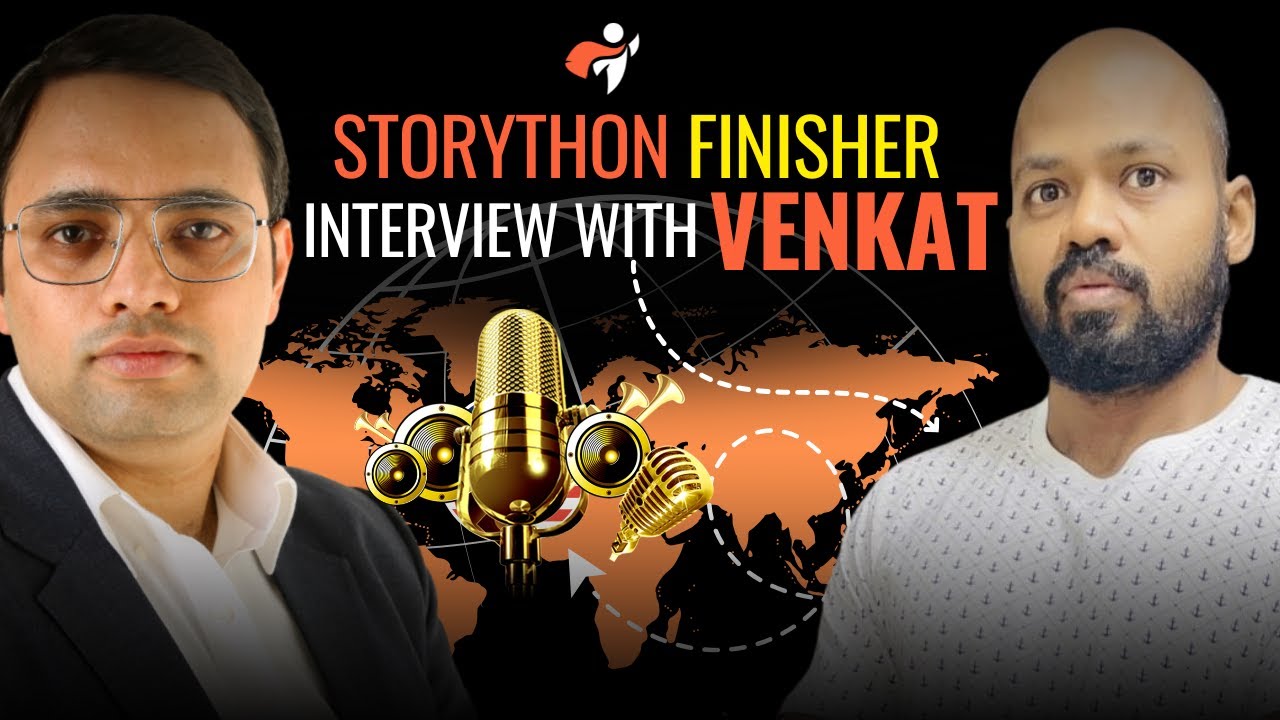
This content was created by Haritosh Srivastav. This content was uploaded by Haritosh Srivastav. This is a YouTube live-streamed mastermind/interview titled "What Makes Venkat a SUCCESSFUL Storython Finisher" (recorded 2025-02-09). Host Haritosh Srivastav interviews Venkat (Venkatraman), a member of the Confidence Storytelling Hub, about his experience completing the Storython Finisher Challenge. The transcript is an interactive conversation covering Venkat's background (design engineer/bodybuilder/entrepreneur), key learnings (mindset, condensing stories from 17 to 5 minutes, crafting from audience perspective, using conflict vs. excessive 'and'), time management and practice routines, and outcomes (becoming a more conscious/confident storyteller). Several community members (Prem, Sheryn Matthews, Anandraman and others) ask audience questions during a live Q&A. The session emphasizes mindset, craft, consistency, planning, and taking massive action for storytelling and public speaking improvement.
Chapters
Awesome, I guess we are live on YouTube. So welcome everyone who's joining this live stream on YouTube. First of all, apologies for not putting as many videos on YouTube as I intend to, but I've got something extra, something special for all of you here because this is our mastermind session, a portion of our mastermind session, and I am having a special interview today. So if you're joining us live on YouTube, you can type live in the, in the comments, and if you're watching replay, you can type replay whenever you're watching this. So let me introduce our interviewee. Venkatraman is the member of Confidence Storytelling Hub. For 4 months. He's been very, very active, and the reason I'm interviewing him is because Venkat completed the Storython Finisher Challenge, which was basically completing— making 5 video stories and sharing it with the group. So with that, let me start the interview. First of all, congratulations, Venkat! I am so, so Happy and so, so proud of you. How does it, how does it make you feel?
Thank you, thank you, Haritosh Srivastav. I am also so pleasure to share about Storython and about my story. Thank you.
Excellent, excellent. And, and for those who are watching, Venkat actually doesn't know what I'm gonna ask, so I'm gonna make him little tense. No, I'm just kidding. I'll keep it, I'll keep it simple. So first of all, Venkat, I want you to share your journey. Of who you are and what you do and why did you choose to be part of Confidence Storytelling Hub?
I am from Chennai. I am a design engineer. I am Mr. Chennai, Mr. Tamil Nadu bodybuilder. I'm an entrepreneur and I want to improve and I want to inspire others. I want to be a great influencer. That's the reason I joined storytelling course. Storytelling is more— most powerful weapon for the leaders and entrepreneurs. I want to be a great leader and entrepreneur and great storyteller. That's the reason I joined storytelling course.
Excellent. Thank you so much for keeping it short. I usually have to stop people in between, but thank you for on point. I want to know You have been part of this community for 4 years. Why did you choose to be part of something called Storython, and what was the journey like for you?
Before joining the storytelling conference, Storytelling Hub, I joined many courses. I had a lot of videos in my mobile, in the information we— I had, but The Storython session is a live session that creates impact than recorded videos. We all have recorded, recorded videos that won't create impact, but live session, whether it's online or offline, that create more impact. So that I attended the 9th session, and now I am in Japan. The time I attended the session was 11 PM. So because I know the value of the story time, it's like a— it's not a gold or silver, it's a diamond.
Absolutely. Thank you so much for sharing that. And for the audience, we actually used to do daily sessions at 6 AM Indian Standard Time. Venkat used to be in office in Japan time, but still used to plug in earphone, find a quiet place where he can join, and his consistent consistency has been truly, truly remarkable. Congratulations and thank you so much once again. Now let's talk about some of the learning. So I want you to list down your top 3 learning that you had during this challenge.
Yes, before Storython, my story was 17-minute story. And I changed to 5-minute story. The 4 most important is mindset. I learned great mindset from Storython. The mindset means, uh, we are all imperfection, that we acknowledge and go to the growth mindset. So in our community also, many have good storyteller but not sharing the stories to public. The reason is they are always thinking perfection. But the Storython, I learned mindset first. First and last, the greatest mindset. After that, only all other parts. And third is I crafted my story from end to reverse the start point, that is from audience point of view to my point. So that I crafted finally.
Excellent. I love that, your top 3 learnings, that yeah, first of all, you are able to take a lot of fluff out of your story to make it really succinct, from going from 17 minutes And yeah, we heard that part, that version of story as well to make it 5-minute, very crisp, powerful story. The other was the, yes, as we always say, skill set without mindset leads to upset. And then again, starting with the end in mind, knowing why are you telling the story, who are in the audience and how you can impact them. Excellent job. So everybody who is in the community, let's write SPTY, Story Power To You, for Venkat, and this is my terminology in the group that we have developed. So if you are watching it on YouTube, then you can still write SPTY Venkat, Story Power to You. Now let's move on. There were many tasks, many challenge, many challenges that were given during this Storython. What was your most favorite challenge and why?
Crafting stories. In my story, first I mention 'and, and, and, and.' That creates a messy, boring story. Then I revisited my story and mark where I have to mention 'but.' Conflict is very important in the story.
Yeah.
So when you craft the story, if you have more 'but,' then that would be a great story. If it's more 'and, and, and,' then it's a messy, boring telling story that you can find easily.
Wow, that's amazing. I mean, that's a different perspective I've not heard. And if you are seeing the flickering, I'm really sorry, it's my light who is trying to play, but I'm gonna go ahead with that. So of course, if you only have all the good things and there's nothing which is at stake, there's no challenge, then it becomes a boring story. So if you put the right conflict, right challenge, that's what makes your stories amazing. And thank you so much, Venkat, for sharing that. Now I want to ask you a very, very important question because we want to know why— we did learn about why did you join community, why did the Storython happen. I want to know what has happened after you completed the challenge. So what has been the major outcome or challenge of going through this Storython?
Now I am a conscious storyteller. Now I am moving in between conscious to confident storyteller.
Awesome. I want you to explain it a little further. I'm trying to set up the lighting, but I want you to explain what do you mean by conscious Confident storyteller. What is it that, and what does it mean for the audience?
The conscious storyteller, uh, how he share this story by emotion, by body language, through full conscious. That is the conscious storyteller.
Excellent. Awesome. So thank you so much for that, and I hope people can still bear with me. I'm still here. Okay, so we have a lot of audience members who may or may not understand the impact of storytelling, who may or may understand the impact, but they are not sure whether they should join a challenge, whether they should join a community. What is your tip and message for all such people who are curious but they don't know what to do next?
Yes. First, we all have to acknowledge that we all are imperfection. We are always thinking about perfection, perfection, and we first concentrate about who is our audience. So we are— we do not need to focus on pronunciation, accent. We focus on emotion part, content, craft, conflict, surprise. Suspense. In that part, we have to concentrate and craft the story. We do not focus on other part. So first, I concentrate of all, uh, lot of retake my video for perfection, but it won't work. One day I remember that 2 hours I took time to take 5 minutes video.
Wow.
Finally my phone was switched off, so then I think that it was worst. Now I take only 2 takes, then I complete the video.
Amazing, amazing. I love that, I love that. And this is for all of you. Nobody— I mean, I won't say nobody's born perfect, but only a very tiny minuscule portion of the world which might be less than 0.001% of the people, are born perfect. All of us have to work our way. Rest of us have to work our way. And it actually reminded me of my own journey when I started. Yeah, my videos were so cringy, even I couldn't watch for more than 1 or 2 minutes. So that's how we all go through. But I'm so happy to going from 2 hours to eventually getting your phone drained out. And, and I'm not sure if your phone had a battery, you would have probably continued for another 1 hour or so. Uh, to now taking— doing it in 2 takes only is truly remarkable, remarkable. And for that, I want all, all of us to again write story power to you. For Venkat, this is truly remarkable, and I'm so glad. And now we are going towards live Audience question segment. I'm gonna invite— we have the community members who have joined this for live session. So some of them have shown interest that they want to ask question live. So I'm gonna first invite Venkat. I was gonna say Venkat. I'm gonna first invite Prem who wants to ask a question to Venkat. So Prem, here you are. Would love to know what is your question. Venkat, you are an inspiration, and I really kudos to you for getting where you are and how you have made the 18, 17 minutes to 5 minutes. And I have watched time to time, your stories are quite not only influential, it is sometimes mesmerizing also, just for us to listen what's coming next. And you are well on your way to become a complete confident storyteller, if you not claim to be as yet, but I really hats off to you.
I just want to ask, so how has this journey helped you in your life? Yes, thanks Prem sir. For me, I wanted to improve my communication skill first part. Then after joining this, a lot of courses, I found that storytelling is first and foremost in the point for great public speaker, great influencer, for great leader. This is the first and foremost top place. So that's the reason I joined storytelling, because it connects all the human, because we are all the part— we are all full of emotions. We easily connect the humans by our storytelling, through our great storytelling, not messy boring telling, great storytelling. For that, this Storython is very much useful for me. That's the reason I attended all the sessions. All the 9 sessions at 11 PM in Japan time. Yeah, all in working days. So all the stories happened was happened in weekdays.
Yes, yes, awesome. So Prem, does that answer your question?
Wonderful.
Thank you, Venkat.
Thank you, thank you, Prem.
Thank you all the best asking the question. And we're gonna say SPTY to Prem as well because For all of us who feel that, no, I don't have what it takes to answer, I'm gonna recommend that you start asking questions first. That is the first step of becoming more confident. If you can raise your hand, if you can say, yes, I want to ask a question, even if you don't know what you're gonna ask, it's gonna— once you do that, it's gonna immensely boost your confidence again and again. So thank you so much for showing us. Story power to you, Prem. And let me also invite somebody who's very, very special, a member of the community for last 1.5 years if I'm not wrong. But more than that, she's a really dear friend of me, an excellent storyteller, and it's an honor and privilege to have her in the community. Let me invite Sheryn Matthews, who also wants to ask a question. So Sheryn, Thank you so much once again. And yeah, let's ask your question, Venkat.
So Venkat, congratulations, you've come a long way. You know, um, uh, I have seen you before and I see you now, and I see that your confidence level has really gone up as you speak. I mean, the way you are sitting, your eye movement, the way you are using your hands, not in storytelling but just in normal conversation. Your confidence level has really gone up. Don't you also feel so?
Yes, I feel I, I, I'm a lot of improvement in my personality, speaking skills. Yes, it's because of main storytelling course.
So it's amazing that you've been consistent for so many days, which is really tough. Um, you know, I also did something like this. I gave myself a challenge and I had done storytelling for 40 days. Okay. So, but you know, those 40 days I hardly ate, I hardly slept. I was doing only storytelling. Now you said you are a bodybuilder, you're a professional. How did you take out the time? That's most important. Most of the people I think would say, how will I take out time every single day to record and put a story? Because like you said, in the beginning, I'm sure you didn't take 2 takes. You might have taken many takes. You know, you might have felt, oh, here I went wrong, this I missed out. So number one is, how did you take that time out and when did you take that time out? And second is, did you draft it, practice it, and then tell, or you just thought and told? Like, how did it happen? How did these two things happen? First is, uh, how and when did you take out the time?
The first one is time management. That I learned a lot and I read many books and I got the information from 7 Habits book. No, no, so like the first half of the day, second half of the end of the day, evening, evening time only I can craft and share the videos. So after I come from office, I in the nighttime, 10 o'clock, 11 o'clock I craft the story, then I post the video because for my improvement, not for others. So it's my responsibility to improve my skills. That's the reason.
Initially, how much time did you take to record one story?
Uh, half an hour or 2, 1 hour, ma'am. In the— to be frank, in the first, uh, few months, I took 1 hour to complete this, share the stories. Yes.
And did you write and then tell, or did you just tell?
Uh, no, no, I, I, uh, take the hints and I craft the story. I don't write the full story. I, I hint the points and share the stories.
Good job.
Awesome. Thank you.
Awesome. Excellent. I just want to add something. I think commitment is very easy to make but very hard to follow through. And I do remember I saw a video of Venkat putting the video, I think it was probably around close to 1 AM in the morning, and I understood that this guy is not going to stop. And that is the reason, and that was very initial part of his journey, and And from there to here, and as you said, I see a completely transformed Venkat. I already call him Venkat 2.0. He's no longer the same Venkat who was before Confident Storytelling happened to him. Yeah, awesome. Thank you so much, and let's write Story Power to you, SPTY, to Sharon as well. Thank you for asking question, and I'm gonna also Ask Anandraman. I, I see you raised the hand. Do you also have a question for Venkat?
Ah, yes.
Okay, I'm gonna add Anandraman. Anandraman is little new to the community. I think he joined less than a month ago, uh, but he's been following us, what we do, and Confidence Story Telling Hub for some time. Uh, so yes, go ahead and ask your question to Venkat.
Yeah.
Ah, hello, Venkat.
First of all, congratulations. Thank you, thank you, Anandraman, sir. Yeah, yeah, just one thing.
There's an initial— how to overcome this initial barrier?
Every time when I try to do something, there is always one barrier is coming. So it's because of our commitment So we have to write in our notebook or in our journaling, set the goals. This week I have to complete, I have to come commit by writing. That creates impact. So I every week Monday morning I write this week I have what I have to do, every line by line, and I keep open in the table. So when I cross the place, I see the notebook.. And I think that I have to complete, I didn't complete this, I have to complete. So that's, I track all the my goals. It is very much helpful to me. It's our own development, this is.
So we have to do that, we have to do for ourselves, we have to commit, we have to do, and we fail, and again we have to do.
Correct, correct.
10 things we will plan and we'll do 2 things only. But again, we have to keep on planning, planning, planning only. Then only we will motivate us. Absolutely.
Awesome.
Thank you so much. I'm gonna add a little bit to what Venkat said. Yes, yes, you're saying something? Thanks for the tips.
Yeah, awesome.
I'm just gonna add to something which Venkat said, which is very, very profound, is that, no, all of you who are watching or who are part of the community or otherwise as well, doing planning is very, very important. Once you plan, you commit, and then do it. And that is where, and if you are having inhibition, which is first of all very, very normal, and I know you are little new to the community, once you start attending the session, you will understand, all of this is because we have been programmed to feel that way. And in the very first step that we do is working on our mindset, where we change the focus from ourselves to what our audience need. And one of the things that can really help you in this is being part of a community like us, where you are sharing your stories, where you are coming over and like we do our practice session, we have Story Gym session. So Storytellers Gym session, where people come and practice. When you go to gym, you're not competing, not competing with anyone else, you're competing with yourself, right? You're trying to make— if you want to plan to run 1 mile, you take 10 minutes, you want to make it 9:50 or you want to make it 9:30. Similarly, when you come to the session and plan, you get a lot of positive feedback and you get better so that when you go out there, when you don't know anyone, but still you have that confidence which you have earned by practicing. And that helps you in the journey. So the bottom line is keep attending the session, keep showing up, and whenever I ask anybody has a story to tell, raise your hand, you will see the results. The reason Venkat is here and we are acknowledging is that every time there is a Storytellers Gym session, I said anybody wants to share a story, Venkat always, even if he's not sure what I'm gonna say, he always raises the hand. And that is the testament of his progress. All right, so thank you so much, Anandraman, for asking the question. Everybody write SPTY to you. You want to say something? Thank you, thank you, thank you, thank you, sir. And now we are going to the last question for Venkat. So Venkat, for anyone who's watching this video live or who's gonna watch this interview, Later, I'm gonna remove my spotlight. I want to give you complete full spotlight, and you have up to 1 minute. I want you to share what is your message that you want to share with the world.
Yes, time is moving on, so we have to take responsibility for our development. Whatever we say excuse for our development, it's, it's not for our growing, stops our growing. So stop excuse and start act, do action, that is massive action. Because of the excuse, we are doing passive action. So from this I would like to conclude this, take massive action.
Thank you. Take massive action, that's the message that Venkat has given to you. Please take this seriously, your life truly depends on it. Even if you are the best thing in the world, but if you're not able to communicate, nobody is going to know that you are the best thing in the world. So please take this, please work on your communication, speaking, and storytelling skills. In the world where we are now surrounded by artificial intelligence, we're now surrounded by bots, what makes you connected is your emotion, your vulnerability, and that is reflected by the stories you tell to the world. So please work on your stories. Story powered to all of you who is watching this, and I'm going to see you in the next YouTube video. So stay









