Wolfgang Harbauer | Confident Storytelling Hub Mastermind
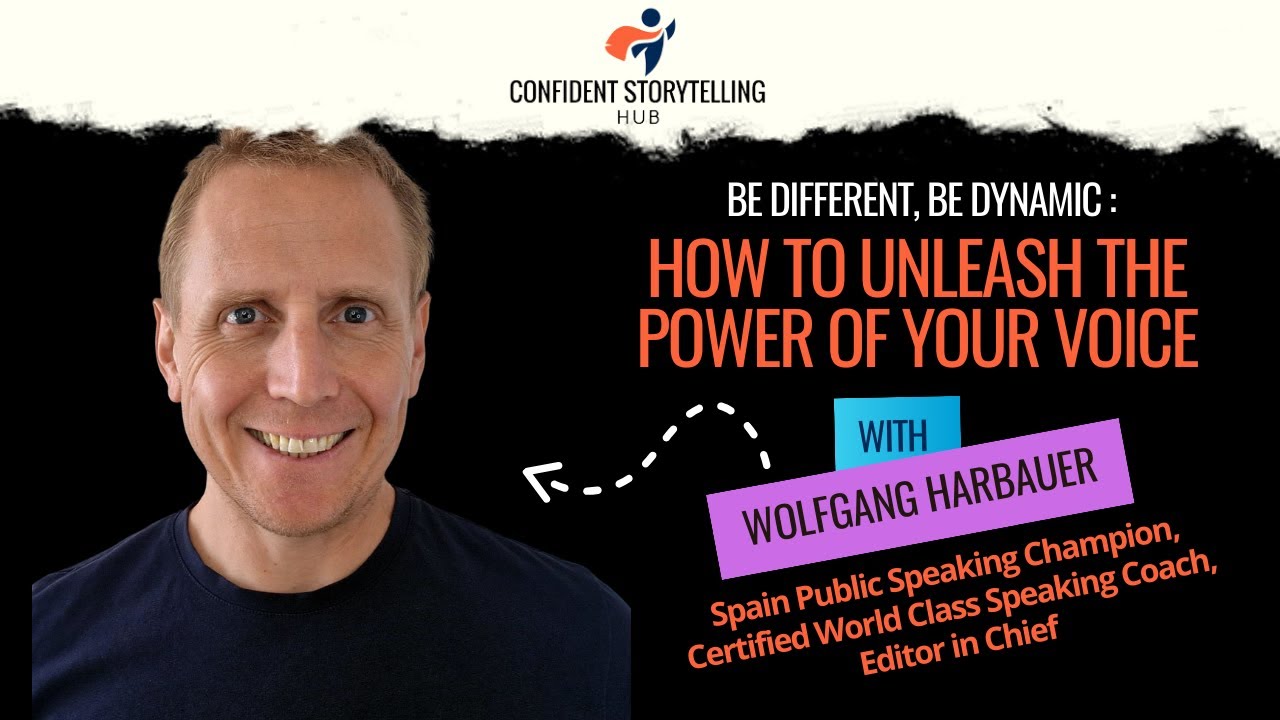
In this interactive workshop, speaking coach and journalist Wolfgang Harbauer leads participants through a comprehensive session on using the voice effectively for storytelling and public speaking. He begins by illustrating the power of a strong voice with the example of ring announcer Michael Buffer, then explains why warming up the voice is essential to avoid strain and to improve presence in everyday situations such as meetings. Harbauer guides the group through a series of physical warm‑up exercises (shoulder rolls, neck stretches, jaw massage, tongue‑8, yawning, stress‑test jaw pressure) and breathing techniques (belly breathing, controlled "F" exhalation) that build breath control and vocal cord readiness. He introduces the concept of vocal variety, breaking it down into tone, volume, speed, rhythm, and especially pace, and demonstrates how monotone delivery can make AI‑generated speech sound robotic. To practice variety, he uses an improvisational exercise where participants switch between animal‑based vocal personas (turtle, lion, duck, snake) and the iconic Michael Buffer style, encouraging them to stay in character and notice changes in body language. Throughout the session, Harbauer offers real‑time feedback, highlights the link between voice and storytelling, and shares practical advice for creating video content: proper microphone use, avoiding perfectionism, using scripts, teleprompter apps, manual cue cards, and recording in short takes. He emphasizes the importance of a strong opening hook, clear structure (why‑how‑what), and regular self‑review through audio/video playback. The workshop concludes with a Q&A, additional tips on managing nervous breathing, and encouragement to continue practicing vocal exercises and recording techniques.
Chapters
Do you hear me?
Absolutely clear.
Let's get ready to rumble! Do you know who said this famous sentence? If you're into sports, if you're into boxing, you certainly know him. Michael Buffer I guess he's the most famous ring announcer of all times. And with this sentence, Michael Buffer not only got super famous, he also got filthy rich. I looked it up the other day, and I think his net worth is about $400 million. So don't, um, think you are going to make $400 million today. That's not the purpose. But this example shows very well the importance of having a strong voice. And well, you are all storytellers, you are all speakers, and you are certainly aware of the importance of using your voice properly because your voice can make the difference if your audience is going to fall asleep or if they keep listening to you. As Haritosh Srivastav already said, I'm Wolfgang. I'm a world-class speaking coach. I work as a journalist. I use my voice in voiceover nearly every day. Everything what we are going to do today, which is warming up our voice, how to do that, and also learning how to use vocal variety and how to get into vocal variety. All those things are very practical. What I want to say with that is these are things I'm using on a daily basis, so we are not a basis, so we are not going to dive deep into theory today, but we, we're going to do some very interactive things and it's going to be funny because everything voice related is a little bit ridiculous. Yeah. Uh, but it's very funny and this is a safe place here, I guess. So I also want you when we are going to do all this stuff, if possible, turn on your video. So let's start with what I mentioned already: warming up your voice. You may ask, why should I warm up my voice? If I would have done what I did at the beginning, like impersonating Michael Buffer without warming up my voice, for sure I would have hurt my vocal cords because all we are going to do now, all the warm-up I did before that session. You may ask, yeah, but why do I need this? I'm not Michael Buffer. I'm not going to announce a boxing event. That's true. But may just think about this situation. It's in the morning, you come to the office or you're online with your boss in a meeting, and then you start the meeting like, okay, hello boss, good morning. Yeah, Have the results from yesterday. Yeah. Or you start like this: Good morning, boss. How are you doing? How are you feeling? You know, there's, there's so much difference if you have a warmed up voice. And I can tell you because I experience this every day. So what we are going to do, we are going to have my normal warm-up I'm usually doing in the morning. I'm going to explain you all the different things and what is the purpose of each of those exercises. If possible, if you can stand up, it's better. If you want to sit down, it's okay. But what is very important, that you have your feet on the ground if possible. You have to, to feel your feet on the ground. Okay, this is the very— you also notice this when you are on stage, of course, because then you are usually standing up, but this is very important because this everything here is our instrument. Our voice, not only our vocal cords or our mouth, our tongue, our jaw. No, it's everything. And we have to be connected. We have to be very well connected to use that instrument properly. So the first thing I do is really trying to relax. This part of my body up here. So the first thing we are going to do is a very easy thing. We are just going to rotate our shoulders. Yeah, okay. So we are going to rotate a little bit our shoulders to relax, like 30 seconds in one direction. And then we can change the direction.
Okay.
It's true, it's not 7 o'clock in the morning right now, so usually we have moved already, but especially in the morning, this is a, a quite good exercise. Okay. Now we have relaxed that part. Now what we are going to do, we stretch a little bit our neck. Okay. This is a typical Sports, exercise, be careful, don't do it too much. Is there a question? Okay, so what you can do, take the other arm and, um, move it a little bit in direction to the ground, so you will notice a little bit more stretching here. Okay, then carefully you change to the other side. Okay. And as I said, very important here, always trying to have a good posture to be connected to the ground, stand upright, keep your chin up in everything you do when you are speaking, because you don't want to make this small. You want to be open. This is the most important thing. Okay. Also in your mind, think about it. You want to be open. You want to project your voice. This is what we are going to do now. We are going to go to this part because usually we are all busy people. We are very stressed sometimes. And where does all the stress go? Someone knows that? Well, usually here. To the head. You know, often we have headaches when we are stressed. So this is the reason for that. And what we are going to do, we are going to relax a little bit our jaw here. Okay. And the first thing we are going to do, I'll think about, uh, dinner or lunch. We are going to eat a little bit virtually. Okay. Something like that.
Okay.
A big chewing gum.
Okay.
Mhm.
Mhm. This was a very good lunch. Mhm. Yeah. Okay, great. And, and now we are doing something very natural, and this is yawning, like And make some noise, make some noise. I guess you're alone at home, so nobody cares. So this opens up everything here. This is so important because this is where also the volume comes then from. Okay, now the next thing we are going to do, I call this the stress test. And as I already said, all the stress usually we have goes in that part, and especially here in our jaw. Okay, and what we are going to do, to have a look at what I'm doing, and then you can do it, because a little bit sensitive zone here. So you take two fingers, you put them here exactly, yeah, in between the, the jaw here. And then you push, and you will notice that your mouth automatically— that there's no other way—
opens up.
It should, at least. If not, you are pushing on the wrong spot. Okay, like something like this. Okay, and you may notice that this may hurt. Do, do you— does it, does it hurt, or is it okay for you? A little bit, maybe? No, a little bit. Yeah, this is why, because this muscle that there's— it's, it's very tense. And if you're going to push, then it, it hurts a little bit. So you can give that muscle a little massage. Okay, okay. And as I said, this is a very good indicator if you have too much stress in your life, if it hurts too much. Okay, good. The next thing that we are going to do, the part of the mouth, is warm up our tongue. This is an exercise which is very good. It's not only good for warming up before a speech or before doing a voiceover, whatever we are going to speak, but it's also a very good exercise you can do actually on a daily basis to strengthen your tongue muscle. Okay. And it's like drawing an 8 with your tongue. Something like this.
Okay.
And this helps you a lot if this tongue muscle gets more strength to improve your pronunciation. So do it. And you get tired very soon. That's the thing. It's—
it's—
we are not really— we are not really training our tongue muscle. So, uh, you can do that whenever you are alone.
Okay.
Um, or want to clean your teeth. That's another advantage of that exercise. Okay. So a very good exercise you can do actually on a daily basis, not only when you're going to speak. Okay. Well, now we have warmed up a little bit this part of our body. The next thing what we are going to do, and this is actually, I think for me at least, the most important thing, because this is key, and it's the breathing, the way how we breathe, because this determines the way how we can then use our voice in a speech, how we can be more flexible in using it. And one error we often do is we are breathing from up here. But when you are going to speak, you have to breathe through your belly. Okay? All the air has to come from down there. And what is the reason for that? The reason for that is that's the only way you can control your airflow and you don't run out of breath suddenly. And this happens if you are breathing from up here. How can we see that if we are breathing right or not? Well, there is one exercise, and I will show you how not to do it. In the moment, I breathe from here, and then I will show you how to do it, and then you are going to do that, okay? And you are going to do it a few times because, well, it's, it's, it's not so easy, okay? So I do it wrong right now. So I'm, I'm breathing up here. Well, You see, that didn't really work. So what I'm going to do now is going to breathe from down there. Mm-hmm. Haven't— hasn't worked so well. Doesn't work every time. But the thing is, this helps me to control my airflow. Okay, so try to take a breath through your nose or your mouth. Through your nose it's better because the, the air warms up, but you can do it through your mouth. Or just let the, the air fall in and then you do like this, right? Does it work? Just some comments. Open your mic. Yes. Is it hard?
Yes. Yes, it's not hard.
It's not hard for you.
That's great.
I made it easy.
Okay, well, I guess some of you are also into yoga, and it's true that a great part of that breathing process is— if you do yoga, it actually It's easier also for you because you are used to that kind of, of breathing exercises. But when you're going to speak, it is very important to remember this. Then there's another exercise which goes a little bit in the same direction. And it's, this is more about controlling the airflow and how you can control the airflow. Okay. And this is using an F. Okay. So what you do is you breathe. And then you let out a very controlled airstream with an F, and you try to hold it as long as possible. What does it mean? It does mean you can't just let the whole air go out at once, but you have to control with your belly the airflow. So I will just show you, okay? Maybe you haven't heard me because the mic maybe takes out that noise, but the thing is, all the time I was keeping that F, something like that. Okay, so try to hold it At least 15 seconds, ideally 20. Okay, try it. Okay, how, how did that, that work? Some feedback.
Oh, it was quite easy.
Oh, okay. Wow, you, you're all pros. That, that's, that's amazing. What I'm doing here? No, no, but it's, uh, that's great. That's, that's cool because that means that you actually control your breathing. And why are we doing this? This means, you know, the thing is, when you are speaking, you want to make a pause and a breathing pause when you think it makes sense and not when your breathing obliges you to do it, forces you to do it. So when you control your breathing, you can do the pause whenever you want to do it. And this is the reason why this training is so, so important from my point of view. So we are going to do a last exercise, which is also breathing, but more about our vocal cords, how to warm them up. And as a side effect, we have also our lips again. Warmed up. And this is just— well, we imagine being a bee, okay? So you're going to do is humming. What you're going to do is humming.
Okay.
Do it. That's actually one of my favorite ones, uh, because I think it's, uh, I really like to do it because you also notice that your voice gets, gets warmed up. Your vocal cords are starting to work. And, uh, yeah, I think for me it's a very pleasant exercise. Okay.
And last, but not least, would you mind repeating it once again, how to do that?
Okay, well, of course, no problem. Imagine being a bee, okay? Like, like if you are humming a melody or a song, like, you can change the tone. This is just for getting into a little bit into the, the flow, or you can just keep one tone, like, okay? Okay, good. Then I just as a last— well, not exercise, last tip. I'm going to show you my secret weapon. Okay, that's not so secret, but it's really my savior when I have a code. Okay, I live in Spain, but also the winters are cold here. People get cold and, uh, get a cold, and I— me too sometimes. And sometimes I need to speak and I have like this voice, you know. And, um, so what I have here, uh, actually it's just a bottle and like a silicone straw, okay. And it's like one-third or half of the bottle is filled with water, and it seems a very Yeah, like a, like a very stupid tool, okay? Not very elaborated, but it works. And what I do with that is just this, and I do this more or less for 2 to 3 minutes. And you have to try it. It's actually, it's amazing. The effect it has when, when you have a damaged voice because of a cold or you were shouting too loud maybe the day before because you were watching soccer or whatever, then this can save you actually. So just get a bottle and a silicone straw and you can build it yourself. Okay. All right, then let's just have some questions if there are any. Yeah, I think there is a question, right?
No, it's just an observation. The last one which you showed, in India, in southern India, there is a practice by very classical singers. They go into the pond, local pond, every morning, the classical singers go into the local pond, go into the water, and then they practice the vocal cords there, certain particular cords like what you just showed. So when you showed this example, it really brought me the memory of these people who, who does this for centuries and centuries. Even still now they are doing it. And so I just wanted to bring that forward, uh, just as a thought.
Thank you. Thank you. Yeah, actually all those stuff which I'm showing you today is nothing new. It's not, uh, you know, rocket science. No, I haven't invented that stuff. And also Take into account, this is just a very small selection of all the voice exercises you can do. This is just my warmup because I like those kinds of stuff, but you can take that. There are like thousands on also, if you go into YouTube, you will find a lot of those kinds of things where you can really dive deep into, into the magic of our voice. Right. Okay. So, okay. That was, uh, now we are warmed up. And now let's move to, uh, some— I'm going to share my screen, one second. So now we are going to— well, we have Michael Buffer here, and, uh, now we are going to see the aspects of the voice, because when I talk to my coaches, being it one-to-one or also in group Exercises. Often when we do the feedback session, that there's the feedback, hey, you have to add some vocal variety. You have to be a little bit different with your voice. And this actually is a good feedback because we don't want to be flat with our voice. We want to be dynamic with our voice. But what I see often is that people struggle with the feedback because they don't know what to change, right? So what is actually what makes our voice? Well, we have the tone, then we have the volume, then we have the speed, and then we have the rhythm and the pace, no? And, um, when we talk about public speaking, the most important thing is actually the pace. So if you have a very sustained pace, this may be pleasant, but it can be very boring. And I thought about that the other day when I was experimenting a little bit with artificial intelligence voiceovers, okay, which are going to take away my job. No, but, uh, actually they will, uh, so I have to do other things in life. No, but the reason why it doesn't work so well yet is actually that because if you try out AI voices, they work for some kind of, yeah, things. But what they do not have is they are not irregular, they are not really dynamic, they're very sustained. But this is when you notice after a few sentences, hey, this is not a human speaking, because actually these artificial intelligence voices are pretty good, but they are— it's always the same rhythm at the end of the day. And this is why, as a public speaker, and you know that not only from the voice, you know that from the story you are telling, you know that from the movement on stage and from the voice, you have to be irregular. You have to be dynamic. You have to change the pace. Sometimes you have to be fast. Sometimes you have to be a little bit slower. You have to go up with the volume. You have to go down. And this is what vocal variety is and what you need to— well, you have to get out of your comfort zone, out of your normal way you use your voice. So how to do that? Well, actually, for that, I brought you today, as Haritosh Srivastav already announced, some, some animals, because I like animals and I think animals work very well in coaching. So I brought you the turtle, I brought you the lion, I brought you the duck, and I brought you the snake. And I brought you also Michael Buffer, of course, which is— who is not an animal, but that will— we will meet him later. You will see how. So how or why did I bring 4 animals? Well, on the one hand, we have the turtle. The turtle has all the time in the world. Because it's going to get to 100 years and doesn't really have to hurry. So the turtle speaks very slowly, calmly. And then we have the lion. The lion wants to impress you with the voice. And where does the lion come from? From the belly. So when you are going to speak like a lion, take care, because here you can hurt your vocal cords. So try to get that voice out of your belly. And then we have the duck. The duck speaks very fast and no one can stop the duck from speaking. And I'm very sure in the real life, you know, persons who are a duck because they don't stop speaking and there's— yeah, okay, you know, you know what I'm referring to, right? This is the duck. And then we have the snake. The snake speaks very quietly, but although it speaks very quietly, you still can hear the snake at the other end of the room. So when you speak like a snake whispering, that's what I want to say, still think about how to project your voice. Okay, so, and then we have Michael Buffer, of course. I just forgot about him, but hey, he's the most important guy of this exercise. Okay, and this is like the typical sports reporter, American sports reporter I, I have in my mind when I think about Michael Buffer, Michael Buffer's voice. Okay, so what we are going to do, okay, let's, uh Get back here. So we are going to do some impro session. So this is for you, the opportunity to speak. I'm not going to speak anymore. I finished. So what, what we are going to do, uh, I brought you those animals here. All right. Uh, I have, um, here we go. I have, uh, all these animals, uh, on cards. Okay, and as you are going to volunteer, I heard Haritosh Srivastav told me that you are a very proactive group, so I guess everybody wants to be a volunteer today. Uh, we have time for, for everybody, I think. Um, so what do you—
yeah, Anushka is already raising the hand.
I—
yeah, that, that, that's super great. So let me explain, let me explain before, and then, then we can start. Okay, uh, right. So what we are going to do is you're going to speak for 1 minute. You can speak about whatever you want, your favorite recipe, your favorite sports, what you did this morning. I don't really care. Or, or I have a great story as we are here in the Storytelling Hub. I don't really care about the story. It's more about the voice you're going to use. Okay? So you will start to speak. After a few seconds, I will show you a card. Okay, and, um, then you are going to switch to the voice of that animal. Imagine how you would do that animal. Of course, you have your version of a turtle or of a lion or of a snake. Michael Buffer, do you version of that animal. And after 20 seconds, maybe I will show you another one, and then you switch to the other animal. In total, it will be around 1 minute. One important thing: the moment you switch to an animal or to Michael Buffer, try to stay in that role. I know this is the most hardest part because usually we start like to speak like a snake, and then after a few seconds, bam, we switch back to what we did before, like speaking with our normal voice. Try really to stay into, into that role. Okay, so who's going to be our first volunteer?
Yeah, Anushka, I already added her.
Okay, yeah, well, that, that's great.
Okay, yeah, so yes, let's do it.
Great, great. Okay, let's go. So Anushka, you can start just when you want to start speaking, and at some point I will show you an animal.
So You should have me speak about, uh, just give me like 10 seconds. Yeah, just, I, I'll speak about myself, I guess.
Okay, that's perfect.
So my name is Anushka Mishra and I am 19 years old. I am a second year student, uh, from Bangalore City University and I'm studying Commerce. And you should know how proud I am to study Commerce. You know how great it is to manage all the money in the world? One day, I'll be Elon Musk, and Elon Musk will come to me to manage his finances because that's the pride I have in my work. But let me tell you a story. With all the money people have in the world, there are few people who don't have even a single penny for the food they eat. We must do something for them because if we don't, then our lives are not that useful. That is what I think. We need to be giving, and the more we give, the more we get.
Great.
Wow.
So awesome. Thank you.
Wow.
Even with a, with a man, with a message. That's, that's awesome.
Thank you very much.
Very well done. I think she, she did really good switch. Stayed in that role the whole time. Amazing. You, you're a pro.
Thank you.
Great. Thank you so much.
Wow.
Okay, so, uh, next volunteer.
Okay, who wants to go next? Okay, Alka Ji, I'll add you to Spotlight.
I'm going to tell my, uh, okay, I'll say whatever I want to say. So it was one very hot April morning, and I was standing at the local railway station to drop my children to the crèche. So what I have to do now?
You're going to speak like if you were Michael Buffer.
I don't know how he speaks.
Well, like an American sports reporter. Imagine, like with a very lot of energy, a lot of wow, something like that.
But my story is without energy.
That's the exercise, right? You have to put power.
Power.
Come on.
Okay. So as I was standing on the railway station with my two children whom I had dragged out of the bed, and I was— I saw my train on the station. And when I saw my train on the station, I had to run and I was running to catch the train. And I was holding one child on my left arm. And I was holding the other child on my— with my right arm. And I was running. And as I was running and running and running, I fell down. When I fell down, all the people in the surroundings came to help me, and they helped me to pick myself up, and they pushed me into the train, and I got into the train. And as soon as I reached the train, there was a sign of train— Finished? Time is up?
It's okay, it's okay. I think that's great, and I really, I really, I really Do you know what happened? And that's the funny thing of these exercise, uh, apart often that our body language changes. In that case, it was a little bit hard to see, but what changed, I think, was a little bit also what you were telling, because suddenly you were like, we were running, running, running. I don't know if you, if you had that in your mind before, but the, the dramatic— it, it became much more dramatic because at the beginning you said, no, my story Well, it's not, uh, yeah, but it changed because you changed your voice, and that's very interesting, uh, in that kind of exercise. Okay, thank you very much.
Thank you.
Next one.
Next, who wants to go? All right, if nobody goes, I'm gonna pick someone. Okay, let's go with Prem. Yeah.
We had an invite for Christmas last afternoon. And guess where we arrived? We arrived at the same place where we met, I and my wife, my current wife. So this was a really beautiful place which I used to work 5 years ago. And when we went yesterday, I had a nostalgic feeling that I am back here, but this time with my wife whom I met in that place. So, but really speaking, I did happen to see a lot of people and recognize them, some of them who has been there for 5 years, 6 years. And then what did I do? I didn't— I kept myself away from watching them, meeting them, seeing them. For some reason, I didn't want to go and bump into them and talk to them and have a good time. But because I had other people, and the other friends kept on coming and chatting with us and so on. So, but I did wish some, some other time I must go to them and see them and have a chat with them in, in my leisure and not with her and things like this. So anyway, I, I, I plan to go another 2 weeks' time before the New Year, one more time to have this happen.
Well, I really, I really like your duck. And as I told you before, there are real life ducks in our lives. It really, uh, yeah, you're really great. I think with the snake, you could have, um, tried to go a little bit more with the whispering and something like mysterious. But yeah, some just things to try out. Just as a general thing, all those animals, I just made them up. You can take whatever character you want to. You can think about an old man or a young child or something like that. It's just this exercise to go out of your normal comfort zone because this is our voice, or this is the voice you are using, and this is our actual voice. And normally in our day-to-day, we, we just use that part, but we have that part. And this is an exercise, well, to, to find new aspects of our voice. Okay, so, uh, one more or two more maybe.
Yep. Okay, Minuji, you want to try?
Uh, I really like the idea of using all these different kind of voices, but I will try for a few seconds, but then I want to practice it first offline. Uh, but yeah, I can try. I want to try.
Yeah, try it here. This is all family, don't worry. Nobody is going to complain about anyone outside.
Okay, go ahead.
Sorry.
Hello, so good evening everyone. Uh, my name is Meenu. I have 27 years of IT and hardware technology industry experience, and, uh, I want to tell about my journey with the startup. Around 10 years ago, I wanted to join, uh, uh, my husband It's a snake or a crocodile?
It's a turtle.
Turtle. 10 years ago, I wanted to join my husband. We wanted to do something for like, boost the economy of India. So we decided to work on various sectors. So one of them was electronic system design and manufacturing. And with the Dream, Design, Deploy, this tagline, we decided to start our company in Bangalore. And we started manufacturing IoT devices. We started manufacturing for Reliance and other companies. And then we had a strong competition from China, and China manufacturing was much more stronger and cheaper than what we had in India that time. And many of our customers, though they designed the prototype with us, but then they went to China to get their products which were ready to use and didn't involve the development cycle. Uh, then, uh, perfect.
I think you did very well. I noticed the switch, and also you stayed very all the time within your role. You can even dare And I know it's super hard. I know this exercise is very hard because you have to think about what you are saying, and then you have to think about the role. If you think it's too hard, you can also just take some text and read it for you. If you just want to exercise for yourself, just take a text. It's not, it's not about, it's not about the speech itself. It's just, uh, imagine you are reading a book for a child. Often we do that and we go into the roles, no?, and, uh, this is what you can do for yourself. Just take a text and read it in different roles, like these animals, for example.
But well done.
Thank you.
Thank you.
That's a great—
actually, first time I heard about using this. So can we use any more animals, or these four?
As I said, you can think about whatever voice comes up to your— you can think about like a mouse, you know. I'm speaking like a mouse now. It doesn't matter, you know, it's the reason why we do that is, of course, we are not going to give a speech that way. That would be ridiculous. But you discover the voice you have, and maybe you can, you are a storyteller. So what do you do as a storyteller? Often you go into different roles because you're talking about this person, that person, and this person said, and you ideally, use different voices for that, because then the audience knows, okay, this voice is this guy and this voice is that woman. And you can really experiment a little bit with your variety. And this exercise is just to find out what kind of voices you are able to, to do, right? So you can imagine whatever animal you, you like to.
I have one more question. I speak even on phone and with somebody, they, they'll ask me whether I'm doing some exercise or running because of the heavy breathing. So what can I do to avoid that?
The heavy breathing when you're— well, actually, that's, that's, I think that's about try to relax, try to relax. And actually the belly breathing helps me a lot if I'm nervous. No, for example, when I'm going to speak on stage, people usually don't think I'm nervous, but I'm nervous at the beginning. And what I do to relax is I, I do a lot of belly breathing. It's like a small meditation I do before a speech, and it works a lot with the, with the breathing. So I get my breathing already into place and I could get relaxed. So this is what I'm trying to do with the breathing, that That works with me, of course.
Yeah.
So how many minutes we need to do?
Pardon?
How many seconds? How many minutes of belly breathing?
Well, 1 minute should be enough. If it's 5 minutes or, you know, well, it's not, you don't have to do it artificially. Just concentrate when you are breathing that you breathe from the belly. You have to breathe anyway. So, uh, try to do it from here and try to calm down. And, uh, when you speak, try to speak with belly breathing because that helps you, as I said before, to control your air stream. And it doesn't sound that you're out of breath because we are usually out of breath when we are, when we are speaking or when we are breathing from up here.
Okay.
But okay, sure, thank you. Okay, uh, last, last opportunity, last one. Mhm.
Okay, Sanjay, Sanjay, glad you to spotlight.
Okay, Sanjay, let's go, let's get ready to rumble.
I, I want to share my recent story. I which I shared last week. My name is Sanjay Sunil. I am from Pune, working one of the IT company from last couple of years. So today we share one story with the new animals. I don't know how it's work, uh, let's see. I was in the college When I was in the college, it was last day of the exam. I don't know, I was very serious about my career, but I don't know what I wanted to do right after the exam. And at that night, I couldn't sleep properly. And next day morning, I wake up and I talk with my parent. I want to find a job, but my— find a job, and that for that I need to go in the city. But my parents didn't allow me, didn't allow me actually. And then I don't know where to go. And the next day when I was talk with my parent, as I wanted to find a job, and I talked with my parent, they didn't allow me. And actually my town is very small, and for that I want to go to the city. City. Because of that, I was really nervous to go there, and I need to find, uh, find a job. So I couldn't talk to you more.
So, okay, thank you very much. Interesting. Again, as I said before, often the body language changes, and in your case, it was your face. I think, uh, you got more aggressive, your expression, the moment you became a lion. And that's normal. But that's also the cool thing of, of changing the voices. The effect it has is not just the sound, it's also the expression in, in general. So you can also try this, um, yeah, uh, in front of a mirror. Okay. So that was the exercise. Just one last tip I have for you is often when we are going to prepare a speech or yeah, going to be on stage, what we do is we re-record a video. And that's cool because it helps us really to see the gestures we are using. We can change, but often we don't focus then on the voice. Because we are watching the video, we are very focusing on the, on the video, not on the audio. What I can recommend you is, if you're going to give a speech or if you're going to tell a story, just record the audio and listen to it and try to find points where you can actually add some vocal variety, add some different voices. Another exercise you can do, which is very related to what we just did today, and I'm doing that when I'm going to give a speech often, As I mentioned before, I'm going, I'm usually doing the American sports reporter. That means that I give the whole speech like an American sports reporter, which is absurd, obviously. And usually I take care that nobody is at home when I'm doing that. Yeah. So, but the thing is, it actually helps me to see, okay, here the American sports reporter is absolutely not appropriate. And here it works very well.. But I only discovered this doing the sports reporter, you know what I mean? And then you can, of course, you can change. You don't have to use the American sports reporter. You can just say, okay, I'm going to use a little bit more volume here. I'm going to be faster here. And this is actually what helps me to improve my vocal variety in my speeches. So that was the workshop today. I'm going to drop you in the chat, feedback form if you want to give me some feedback on the workshop. I always try to improve my workshops, so I would be happy to hear your opinion about that. I'm also going to drop you my LinkedIn profile if you want to connect. Yeah, looking forward to that. And if you have some questions, I think you can shoot now.
Awesome, thank you so much, Wolfgang. Please put the links in the chat, and everybody please go ahead and connect with Wolfgang and you must connect on LinkedIn because he has started sharing some amazing videos. I really love and a lot of time I comment also. His videos are really insightful and interesting and fun as well. So please give him the feedback and let me add myself also into the spotlight. Thank you so much, Wolfgang. It was such an honor and pleasure to have you here. We really learned a lot. And yeah, team, this is your chance. You want to get your—
I have a question.
Yes, yes, Prem, go ahead.
Right. Um, Wolfgang, really, we appreciate— I'm grateful for this because it's just in time. It has come to me. I've started making YouTube videos to introduce my new course which is coming, but I'm struggling with the voice and, uh, you You know, she gets very impatient because my wife is the one who is recording me on this video, and I keep going over and over, and sometimes this 5 minutes takes about 3 hours, and it's not in our schedule. So no shopping, no food for us, and like these kind of things are happening. So would you please be kind to tell me how I can just get on and get this one at least in an hour to make this 5 minutes video?
Absolutely. Well, first, when we talk about videos, I would mention two aspects at first. The audio, make sure that it's recorded the proper way. So get a mic, don't use the microphone. I don't know if you use already or not.
Yeah, I have, I have the Rode mic.
Okay. Well, that's a really good one. Yeah, that's the first thing. So the the audio is recorded a proper way. And then secondly, don't aim for perfection. So edit the video, you know, if you— sometimes I do videos and I do some errors and I have to start again and again and again and again. Well, just make the cut and just go on with the next sentence. You know, you don't have to do the video like 5 minutes in a row. That's, um, something you can start with at least, because I guess that's one problem which happens, like, oh, there's an error, or there there was, there is a, a car driving by, uh, whatever, you know, there are thousand things which can happen when you're going to do a video. And actually, I also started doing videos and I thought, okay, now I have to do like 5 minutes in a row and it has to be perfect. It doesn't have to be perfect. Just start with the next sentence, make the cut, and then you will do it in less than half an hour. And also, you can try if you want to, if it's a very long speech and you don't want to— I don't know if you're going— if you're using a teleprompter app, that's something which helps. Uh, there are teleprompter apps which are free on the App Store. You can just put it on a tablet, on the, on the mobile. You can just read the text while the mobile is making the video, so you don't have to have everything in your head, and you can just read it as it is just appearing in your head. You know, it's like you can use a teleprompter. They're doing it on it on TV, like 60 years, so it's okay.
But expressions, when I read it out, can I connect with the ups and downs, the tones and the modulations? This is also a problem with my thing. Sometimes my reading is—
Okay, so you think it doesn't sound natural when you are reading it? That's what you want to say?
Yeah, sometimes, yeah.
Okay. Yeah, that, but that's the thing. The script has to be natural. What I want to say is just record an audio of yourself, what you want to say, convert it into a script, and then you read it, and then that's your natural way to talk. So don't write a script like a perfect script, and it has to be perfect expression, whatever, because this is when it starts to sound not natural. And I tell you, every influencer, all the, like, the big TikTokers, they're all using scripts. These videos seem to be very spontaneous, but they aren't. So don't hesitate to use a script. It will make your life, especially at the beginning, much easier. When you are going, when you are used to do videos and you have more experience, well, then maybe you can switch to another way of production. But especially at the beginning, because video is so hard, because there are so many aspects which can't, maybe don't work. Make your life easier using a script, using, if you want to, a teleprompter, or just learn the script, of course. And you don't have to stick like word by word to the script. You can be more spontaneous, but do a script before. Don't do it like spontaneous. That doesn't work. It just doesn't work.
Yeah.
Can I add something?
Yep.
Yes.
I think what he's saying that, Prem, your partner is doing the shooting. But if you can do that with the tripod and do the practice, at least with the tripod, that will save her time and you'll also be able to.
Absolutely. Yeah, that's also a good tip.
You're on mute, Prem.
Yeah, sometimes I find it easier while I'm on the road to talk than being here. And my videos, most of them which become really, which has become really known in the other thing, is mostly which I'm walking and talking, you know. So that way I have to have somebody to do it. But now we bought all these kind of static things, and all these things. But still, for lighting and for other things, she has better knowledge than I have. I'm not so good in all these things. She has better eyes for all these things. And, you know, she being Swiss, very, very perfectionist and all these things. That's another stressful situation for me, you know. So, but again, without her help, I can't move. I don't know anything. So, I am dependent, but to such a high standard is a another problem to keep up. So all these things is working, but we have to learn little by little by doing and experiencing and having bad days and fights and other things. We come to that place somewhere soon.
Absolutely.
One thing I want to add is like we both participated together in one video creation contest, and Prem, I used to wait for your videos, they used to be perfect.
Oh, this, um, video making. Video making, isn't it? Video making course.
So you, your video used to be perfect, so I used to wait for your video.
Yeah, yeah, that's because— not because of me, it's because of my Mrs.
Interesting.
I mean, I, I'm going to say that, yeah, uh, uh, Don't be, uh, like Paul King already said that it's a journey. You cannot become a rock star in one day, right? You have to practice, you have to. So I would say, yeah, if you can, try to record it yourself because that way you're not double stressing that, okay, somebody else is waiting for you to complete. Try to record. I mean, it is going to be stressful, still is going to be stressful, still you will have a lot of uncomfortable feeling, but at least you will have that luxury that, okay, you are only wasting your time. So see if you can do it alone, because once you master it yourself, then it doesn't matter how many cameras and lights and all of those. Those, I would say, are the secondary part when you're going to the next level. For the initial level, when you're trying to launch your course, just go for it, just, just complete it. And, and give yourself a deadline also. That's another thing that you can try, that you can say that, okay, I have got 30 minutes or maybe 1 hour for this 5-minute video I'm going to do my best and whatever the best version comes for this time, I'm going to take it. I'm not going to extend it beyond 1 hour. And in that, sometime when you put that deadline to yourself, it works out. So, okay, I have 1 hour to record this 1 video or 2 video or 3 video. Whatever comes out, it's going to be the final one. So I may take couple of 2 or 3 shots, but not beyond that. Yeah, yeah, awesome. Absolutely.
Thank you.
Thank you. Thank you for this.
Thank you everyone.
Thank you. Yes. Any other question? Anyone?
Yes, Minuji.
Uh, which teleprompter app do you use?
Pardon?
Which teleprompter app do you use?
Ah, oh, well, I have to, I have to look it up right now. Uh, I can tell you, uh, but there are just, just put teleprompter on the App Store and, uh, Uh, then, then there, there are various, uh, but, uh, I, if I look, there is an app called, it's called, it's called Elegant, Elegant Prompter, Elegant Teleprompter or something like that. But as I said, I'm not going, uh, to do any advertisement for any app. Uh, there are many, uh, you can, uh, if you use, for example, if you use CapCut, which is a very easy tool for doing videos and also to edit videos, There is an integrated teleprompter also. So it's in the app, in the video app.
You can use a manual teleprompter also. You know what manual teleprompter is? This one. I use pasted notes. I use 2, 3 points what I'm going to talk about in a short video.
Perfect.
And I put it right in front of my screen, just below my camera. So I'll just have a look. Okay, this is my point number 1. I go explain. This is my point number 2. I go explain. This is point number 3, and then I'm going to give you a summary and finish it. So, so that way I'm not even worried about, okay, is there a teleprompter? Is it running in the right, right place? I'm— am I missing a word? No, whatever it comes here, go for it. So use, use the manual teleprompter if you have to. I think this is, this is the best.
Yeah, great.
I, I am, I am in this, in this now, uh, what I'm doing is exactly this, but also as, uh Uh, rightly Wolfgang said the structure has to be there before prior.
Absolutely.
Yeah, absolutely.
And, and after practicing the structure, come back and put the points only. So it flows, uh, it comes, it— correct, correct. Yeah, yeah.
But you have to have, you have to have a structure. And what I learned also about video, if you want them to work, you have to get a really good start. You have to have the hook at the beginning to drag the people into your video, and then you can do whatever you want. Of of course. But think about the hook and the structure, and this is the most important thing. So true.
So true.
I think it's the model is called, uh, why, how, and what. Why you are there, how you are going to do, how you're going to help them, and what is the outcome of this, you know. So these three, uh, all the conversations, uh, template.
Yeah.
Yeah, very nice. Okay, awesome. One last question for Wolfgang. I know we are a little bit over time, but we love to chat. So any last question for Wolfgang? Saniji, you have a question? You haven't spoken much in the session today, so you have any question? No, I would like to only thank you. And yes, thank you. I'm very happy to learn a lot of things.
I'm just trying to get all the animal voices right. No pressure. Good to see Anushka leading, Premji, Minu ma'am, Sanjay, Alka ma'am.
I'm their fan now. So much to learn, and I've added you on LinkedIn.
Thank you so much.
Right.
Thank you. Thank you all. Thank you all again.
I had just one thing that I was thinking from the Indian context, because most of us from India. So you can think about that, how can you speak in the voice of Narendra Modi, then switch to the voice of Sachin Tendulkar, then switch to the voice of— no, Sevirat Kuruvilakanth. You might not know these people, I'm trying to put the right content. Then you might want to switch to Rajinikanth voice, and then you want to switch to Shah Rukh Khan voice. So that also is an exercise. So it can't be only animals, it can be characters, and then you can switch The purpose here is to really stretch your vocal cord and find the limits. I think what Wolfgang said was truly golden, that our vocal capacity is this much, but we only use this much, and there is a way for us to expand by trying all these exercises. So thank you so much, Wolfgang, for gracing us. Thank you so much for sharing those golden nuggets.
Thank you so much.
Thank you for participating. Really great.
Awesome.
Awesome. I will have to say goodbye. I will have to hop off now. So you're an amazing group and enjoy the rest of your meeting.
Thank you so much. Looking forward to have you again very soon.
Okay. Thank you.
Thank you.
Thank you.
Thank you.
Okay.
I'm going to leave you to it as well, but thank you so much. It's been a pleasure to meet all of you.
Yeah.
Thank you so much.
All right.
Thank you.
Thank you. Thank you for coming up.
Yeah, thank you.
Bye.
All right, so everyone, just a gentle reminder that next week we are going to have a small storytelling contest with two more communities. So I'm going to float a form by tomorrow in the group, and if you want to participate, please put your name. I think we'll probably have up to 5 people, so it's going to be first come first serve. 5 people and a story of up to 5 minutes. And we'll have some more other communities member who will come and participate and there is going to be audience polling and all those things. So it's gonna, we are going to end the year on a bang and we're also going to launch our annual member survey. So thank you so much once again.









