Back2Basics Podcast
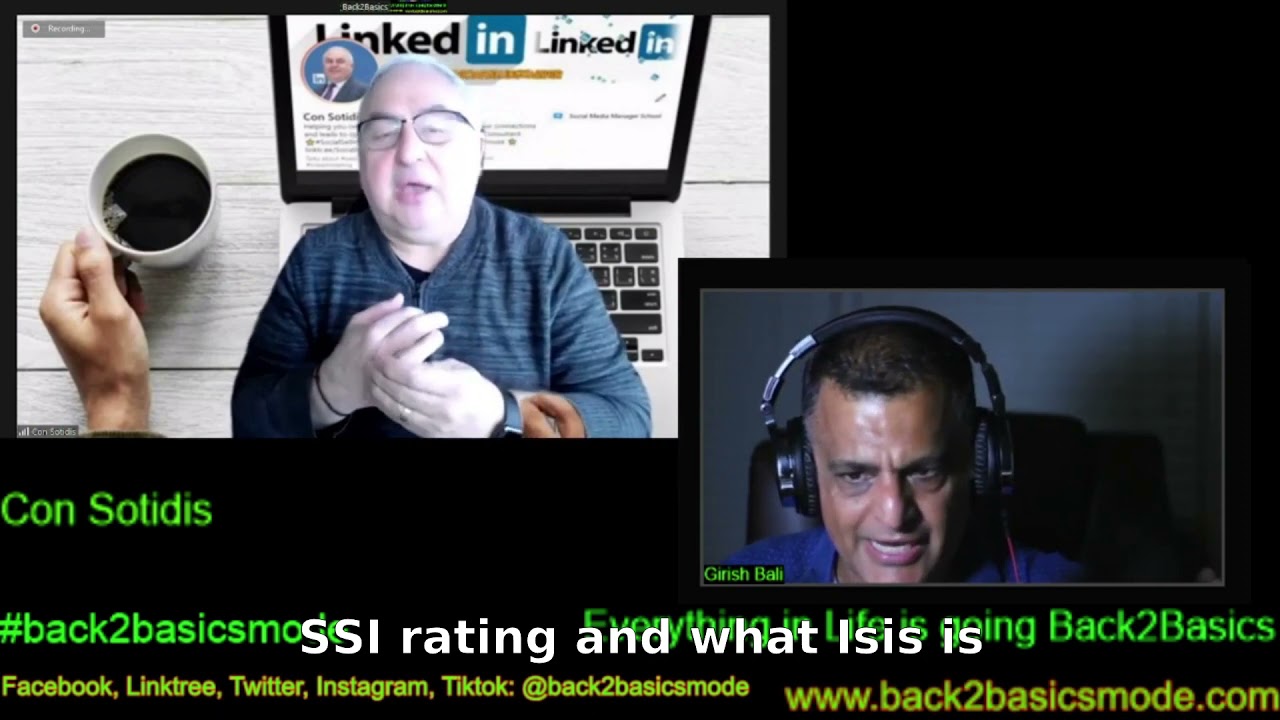
Girish Bali interviews Con Sotidis on using LinkedIn for personal branding and social selling. They cover the Social Selling Index, engagement strategies, and how to scrape data ethically without privacy violations. Sotidis offers a free 30-minute consultation for those wanting to get started.
Chapters
Hi guys, my name is Girish Bali, the host for Back to Basics. Another Back to Basics for another Back to Basics. Does that make sense? Well, anyway, so today we have a guest. We're going to talk about social media selling. You've heard of social media, you know, Facebook, Twitter, Instagram, TikTok. I'm pretty sure there's other ones, but those are the ones coming to my mind right now. But what does it mean by social media selling? We will figure that out today with my guest today, and I'm pretty sure he can give us some type of basic insight as to what that is. So let's invite, uh, Con to the show. Con, how are you? And thank you for coming back to Basics.
It's, uh, good morning, good evening, wherever you are in the world. Thank you very much for the invitation, which I really appreciate.
Thank you so much. So, Con, before we get into the basics of the social media Okay, what does it mean by back to basics to you?
You know what, it resonates a lot with me because I've always said to people, I'm a very simple person. And when I talk, even strategies, I talk very simple. I try to narrow it down to something that's easy for people to understand, digest, and implement. So back to basics for me is about taking some concepts we may talk about, whether it be some theory or some methodology, And then bring it down to some sort of practical little chunks that people can implement and adopt. That for me is back to basics.
Yeah, thank you so much for that, Con. So before we get into the other social media stuff, right, what does social media mean to you? Is it— is the social media stuff that I've mentioned, are those the only ones, or are there other ones too?
Look, social media is a very wide net.
Okay.
We have a number of platforms that are out there. For me, I believe that with social media, you've always got to sort of look at where your tribe is. And Seth Godin coined that term a while ago. It's about where your tribe lives.
Yeah.
I started off on Twitter about 10 years ago.
Yeah.
What I say to people is I was big on Twitter.
Yeah.
But somehow after that, I morphed into other platforms where my tribe was. So social media, you have your Instagrams, you have everything like your Snapchats and your Pinterest. You know, people look out there on social media. For me, the 2 platforms that I dwell on a lot is LinkedIn, and we'll talk about a bit that today, and a little bit of Insta. I'm trying to look at Facebook for, again, business purposes, but at the moment it's been more social outlet.
Okay, thank you so much for that, by the way. So what do you do, Con, before we get into the basics of the social media stuff?
I position myself, my branding in such Selling Warrior. And that is a bit of a brand that I've developed and put out there because what I'm trying to do is I'm trying to help people no matter who they are, business development managers, account managers, they could be coaches, consultants, to create a powerful brand mainly on LinkedIn. Well, we can talk about the other platforms because really at the end of the day, they all pretty much work the same.
Okay.
Mainly on LinkedIn to create a powerful brand That will catapult them and create one, awareness, 2, connections, and 3, opportunities for them to further either their career or the area that I focus on a lot is to get more connections, more conversations, and of course, more sales. Yeah.
So, I mean, guys, I just want to explain something here. The reason why I invited Con here is according to me, this is just me only and no one else. So no one has to sue anybody here. But I feel that Con is quite intelligent and quite educated on the social media side of things, especially LinkedIn. So, so that's my thought process on that, Con. I don't know about anyone else, but the, the, you know, the, the stuff that, you know, the knowledge that, you know, about LinkedIn is, is, is vast and it's just not networking with people and all that stuff. So can you tell me a little details about LinkedIn, uh, if you don't mind, what, what that is and who that is?
Yeah. Yeah, LinkedIn initially, when LinkedIn started, in fact celebrating its 18th birthday, I think it was this year.
Yeah.
It was seen as a job platform. So, it was about a way of someone putting themselves out there and a recruiter or a headhunter would go onto a platform and find the skills, their attributes, maybe look at their previous job experience. So, it was and probably still is a job-seeking platform. What we've noticed the last 5 years, but it's really maybe about 5 years, it's morphed a lot. And LinkedIn itself has made an intention to do this by adding some products to its suite, some paid products like Sales Navigator and Premium. What it's done is it's morphed into a B2B professional networking platform. And what I mean by that is more business to business. So the B2C, for example, may happen on Instagram, business to consumer, or Facebook. LinkedIn is positioning itself and really catering to that professional to professional in network. So what we see there is the ability to leverage your brand in order to create opportunities to then take those opportunities offline. Now, I just want to make an important point. When we talk about social media and selling, we never, ever, ever sell on social media. We use the word social selling and we'll talk a bit about it soon because LinkedIn has coined that term, but we never sell on social media. Social media is about creating a relationship and nurturing that relationship and taking that offline to a conversation where we may undertake some selling processes. So, you know, does that answer your question?
Yes, it does. But here's one thing that when we try to explain to people social media selling or whatever word you want to use, right, the first thing comes in my mind is data privacy. So can we explain to people that there is a difference between the two?
So you want to extrapolate that further? What do you mean by that?
So, so for example, like, you know, Khan's name is there and Girish's name is there, and, and we're gonna sell Girish's name and Khan's name as data, uh, to other, you know, companies or whatever.
LinkedIn has got a lot of security embedded in its systems where it doesn't allow for what they call scraping of the data.
Yeah.
So for you to be able to— we don't sell any data. What we try to do is we create connections and we create relationships. Now, there is automation tools out there. And first thing I need to put on the table here is I don't subscribe to any automation. People are amazed at things that I do, but I do everything myself, which is surprising because that takes a lot more time to do. But I believe in authenticity, I believe in integrity, and I don't do any automation. But there are tools out there and some are working successfully with some people. I'm not here to can the tools. I'm here to say that I don't use them and I don't think they're necessary to making authentic connections. But those tools are scraping data from LinkedIn. Now, there is a couple of court cases happening at the moment where we see LinkedIn is having a bit of a tussle with some organizations where they don't call it scraping, they call it just what Google does, going on to the meta crawlers and just crawl Analyze the data, but LinkedIn is now fine in those particular cases. So, um, your data is pretty much safe on LinkedIn. It depends what you want to put in, like any platform. What you put in there, what information you put in there, people will be able to access. So I just say to people, be careful about— if you don't want to put your phone number out there, don't put your phone number. But if you're in a business and you want to be contactable, at least put an email address somewhere where someone can contact you.
Yeah.
So it's about being, uh, like any platform, it's about being mindful of What data you got out there?
So thank you so much for that. So when I Googled, or when I searched, or investigated, or researched, whatever you want to call it, right, uh, when I said what is social selling, the answer that I got— and, and I'm gonna put my glasses if you don't mind when I read this— it says social selling is a strategy that uses social media platforms like Facebook, LinkedIn, Twitter to connect and engage directly with your large target sales, and and it goes on and on and on. So do you think that's the right definition or it should be something different?
Look, social selling was like I said, you know, we're trying to push their sales navigator product.
Yeah.
So they came up with a term that would be able to support that product. And for whatever the case may be, we're stuck with it now. Like I said, there's a lot of definitions. There's a lot of um. sometimes ambiguity, there's sometimes a bit of confusion around what it is. But I always go back to what LinkedIn set out for us as fundamental pillars. And I use those fundamental pillars when I'm talking to people. So just quickly, those pillars are creating a professional brand. That's about your profile. So if you see the back there, my screensaver there at the back, that's me. That's my profile. That's my professional brand.
Yeah.
So, having a professional brand is the first part of the social selling process. The second part is then connecting with the right people, finding, searching, and that's about developing your ideal customer profile and then start to use that criteria within the LinkedIn search filters to be able to hone in and identify the right people. The third part is engaging with insights. I call this the education phase. I call it education because it's about you positioning yourself as a thought leader. Having a profile alone, and I mean, some of the clients we talked to recently said, oh, I got my profile up, it should be right. I said, no, profile is the first step. You need to then engage. You need to show people your knowledge. What you found me, you need to show people your knowledge. You need to engage, create some content, curate some content, which is about sharing some other people's stuff with your perspective, but you need to also interact. And engage on other people's posts, make some intelligent commentary, make some observations. And the last part about social selling that LinkedIn has defined for us is about building the trust of relationships. So by engaging, by creating that thought leadership, you start to nurture, you start to direct message, you start to take those conversations from the online to the offline. So in a nutshell, it's about profile, Which is your brand. 2, connecting with the right people. 3, knowledge, thought leadership. And 4, building a relationship and nurturing that relationship.
Yeah, thank you so much for that. So, Con, I have a question now. For LinkedIn, there is an option to find out what your rating is, okay? Which is your sales rating or SSI rating or whatever.
Social selling.
Okay, so is there social selling for the other platforms also?
From what I understand, every platform has got its analytics, so you can get your analytics in there. Like I said to you in the beginning, I don't do much analytics with the other platforms, Girish. I mainly focus on LinkedIn. I know via Google Analytics you can do on Facebook, and there's also some Instagram analytics programs. But social selling is one particular index that exists in LinkedIn. Again, you don't want to get too caught up with social selling. It's because it focuses on those 4 pillars I've mentioned, and it rates you out of— Out of 25, so you just score out of 100. Yeah, and it's updated every week. There is some other tools available. There is, uh, yeah, and there'll be some other— there's one called shield.app and there's one called analytics.io, which both offer some free plans. And just people, if they want to get deeper into the analytics on LinkedIn, look at those particular tools. But every platform will have some analytics available to it, whether it be some from Google Analytics or from the the native analytics of its own. Social Selling Index is a good— I've been talking to a customer yesterday. It's a good starting point. If you just start on LinkedIn, take a snapshot of your Social Selling Index, come back in a month's time once you've adopted some of the strategies that I've put in place for you and then see what it is. You should start seeing some movement.
But is that— does that mean that I'm actually less than you or more than you depending on the rating? That doesn't mean anything, right? So, so why is it so, why is it so important then?
It always goes back to your intent and purpose on LinkedIn. Like, we should all have a strategy of why we use a particular platform. Yeah. So, you know, you use a podcast platform. I know talking to you, you've got a strategy in relation to that.
Yeah.
Everything we do on the social platforms or whether it be on the internet, we should always have a broader strategy. What's the purpose? For me, my purpose and intent is to create some brand awareness. Yeah. to educate my followers. What I mean by educating is to share some thought leadership. And 3, to try to nurture relationships, to have conversations offline. But the first 2 are priority for me. So there's no one better than someone else with a Social Selling Index. It really comes down to what your intent and purpose of being on a platform is about. You might have a 50 or 60 as a rating. That's okay. But if your purpose is to create some brand awareness, as long as your brand is out there, that's okay.
Yeah.
Always keep in mind what you want to achieve What your goal is. And like I said earlier on, Girish, it's about using the Social Selling Index as a benchmark, I suppose, as some sort of analytic tool that's available to you for free. But don't get too hung up about it. If you're seeing some trends, if you're seeing some achievements, it doesn't always have to reflect on the Social Selling Index. It just sits there as an ability for us to get some idea of how we perform.
So thank you so much. Does that mean that it's it's more of the business or marketing tool? Which way would you look at it?
Look, like I said, it was initially only available to people who had Sales Navigator. Yeah. So when LinkedIn launched Sales Navigator, even the last couple of years for everyone, and if people want to get into it, all they've got to do is go to LinkedIn, just click on the LinkedIn logo, then at the end of it, just put sales and they start. So you got to go to, just so people know, because it's, I think it's a, Since we mentioned it, it's really good to know how to use it. So it's linkedin.com, and then at the end, at the end, they just put /sales/ssi. So linkedin.com/sales/ssi. Everyone has one and it's free. When you do get into it, it comes up with a branding of Sales Navigator because it was originally a Sales Navigator tool. Not everyone should rely on it depending on their strategy.
That's my advice to people.
Yeah. Just have a look at it. It's good to have as an analytical tool.
So let me, let me just explain to my, my viewers, if you don't mind. So guys, what I did a couple of months back when I actually met Con for the first time, a couple of months, more than that actually. So he told me that you can go to linkedin.com/sales/ssi. What would that do? That would actually tell you what your rating is. It could be 30, could be 20, could be 76, depending whatever the number is. Okay, and it'll tell you step by step what you need to do to increase it or decrease it. Why would you decrease it? You want to increase it according to the Sales SSI. But what Khan is saying is rating is just rating. That does not mean that's you. Now, my purpose for my podcast is back to basics. Now, does that mean that my rating is bad and I'm a bad person? No, it just means that maybe I'm not getting engaged properly. So what do I need to do to engage? And that's what Khan is saying. So Khan, is that correct?
What it does, that's exactly right. You sum it up, and that's what I love about you. You're really bringing back the basics. It gives you an idea of what are some of the areas you need to focus on. What you said, if your engagement with insights is low, well, that means you must need to write a blog, do some more posting, engage on some posts. If your Uh, not fine. If you're finding the right people, score is low, you need to connect with more, do some more searching. Yeah, LinkedIn rewards people that do searching on this platform. It's amazing what LinkedIn is able to monitor. So the more you search and the more you start identifying your— the right people you want to connect with, LinkedIn will start rewarding you for that.
Yeah.
The more you start posting content and the more people start engaging on that content, LinkedIn will reward you for that. So it's what you said exactly. Find out where some of the areas you may need to improve. Don't get hung up on the total score, but it's good to find those areas and improve on those as you go along.
Yeah. So, Khan, I just want to tell you too, when I actually first time met you, mine was 60-something and then it came out to 76. So I must be doing something right. But today it went down to 56 because I was not really concentrating on what you were explaining. But that does not mean that I'm a bad person. That just means that I'm just not engaging a lot. That's what it is.
And, and, Givish, mine was also— mine went up to— I managed to get one stage when I was very active. We managed to get up to 90s.
Yes.
I think something happened that LinkedIn managed to change the algorithm. Yes. And I say to people, I say LinkedIn and KFC are the same.
Yes, yes, yes, yes, yes, yes.
Putting in a lot more work. So even you'll find with a lot of LinkedIn coaches and trainers, they're not going to be in the 90s. Even those people still have to work hard to establish a rating. That's why we say to people, don't get hung up too much about it, because even the top gurus of LinkedIn never, never achieve the perfect score. We're all always learning more about LinkedIn.
So thank you so much, Con, for that. So tell me more about you. What do you do in detail, if you don't mind?
My original background has been in learning development. In fact, I was a public servant and worked in the revenue office. And then moved into a strategic role in development. So I've always got— I've always been a people person, as it shows. I'm a networker, I'm a communicator, and that's why LinkedIn resonated with me, and I moved into that platform wholeheartedly. So my aim is to support people, could be coaches, it could be business development managers, to one, start off with having, I suppose, a high profile on LinkedIn, a strong profile. Sure. And then from there, teach them and educate them how to then create some content that resonates with their following, that is aligned to their branding. And from there, coach them and support them to be able to have those conversations offline where they can get the individual in a conversation, listening, unpacking, understanding what the problem is, and then positioning their offer. as a way of a solution to the individual. That's in a nutshell what I do.
Of course. Of course. Thank you so much for that. So, Con, you've done so much. I've read your profile, I've met you personally, and now you're on my show. So what's next for the next 5 to 10 years at least? Because you know what? It seems like you're not going to end.
Well, let's just— that's it. Take a bit some time to reflect here. I think this is a classic case of how social media and networking can deliver some results. You and I met in a clubhouse. Yeah, we connected. We had a conversation. This is the beauty of where we live in this world, Girish. It's a network world. It's a it's a it's a people's world. It's about let's not forget one thing: no matter whether it's LinkedIn or Facebook or Instagram, right? People connect with people. And in my business, people buy from me. That's why I'm very much into personal branding. What's next for me? My aim is to be able to develop a coaching business around social selling that people can refer to me and say, well, you know, this person, he knows what he's talking about. He's helped me achieve X, Y, and Z because at the end of the day, it's a results-based business. But more importantly, What I hope is to be able to travel the world one day, COVID permits, to be able to speak to many more people and to share my knowledge. I have one mantra in life, Girish, and it's a space, but you know what you talk about? It's give, give, and give again. I've been very fortunate to have mentors and supporters in my life over the years who've given freely. I want to do the same and educate and pass on my knowledge. Because we only have a short time on this world and we've all got to make a difference.
Yeah, absolutely. Thank you so much, Con, for making this show brighter for me and, and giving a little insight about the social selling and, and what it is and what it does not do. And, uh, and it's— there's a difference between data privacy versus, uh, selling also. So thank you for that. So do you have any last words before we let you go? It seems like I can put you on the show for hours and hours. But obviously, unfortunately, we do have short time. So any last words before I let you go?
Thank you. I really appreciate the invitation again today. Thank you very much for taking the time to have me on. My advice to people would be, and one of the words I use is when I do social selling, it's about embrace. Give it a go. Have some courage. Get on the platform and give it a go. You can't break this thing. You can't break it. So give it a go. Create a profile. and start engaging on things like LinkedIn or Instagram, whatever platform you, you feel appropriate for your particular tribe, your particular purpose of being on that particular platform. So give it a go, have some courage, find me on LinkedIn, connect with me. If you're going to connect with me, say you heard me on this podcast. So, you know, say to me, you know, my friend Girish, you think he's a great guy and you want to connect with me as well. And let's connect. Happy to help people. I offer free consultation for first 30 minutes. So take up the opportunity. Let's have a chat. Let's see what we can do for you. But most importantly, give it a go.
Yeah. Thank you so much, Khan, for all that. I think I've used up so many 30 minutes out of you. So, but, but I think you're more of a friend now than anything else. So thank you so much, Khan, for coming on the show again.
Thank you very much. I really appreciate it.
Thank you. So today we spoke with Con. We talked about social selling, didn't we? We talked about should we sell data, should we not sell data? No, that's not what we talked about. We talked about the social media, how to use it. Use that damn tool in a good way, in a nice way, not in a dirty way that we, we all know, you know, getting data and all that stuff. So let's not do that. Let's listen to this episode and think about what you want to do And just enjoy life because life is too short, you know. And that's what we're trying to do here in Back to Basics. So guys, as usual, as always, there is a quote of the day. There is a quote of the day, and here's a quote of the day: Selling through social selling is the closest thing to being a fly on the wall in your customers', prospects', and competitors' world. So guys, as usual, as always, there is A last line that we always say, everything in life goes back to basics, and that's what we did today, guys. Guys, take care, God bless, and keep on commenting— good, bad, ugly— either way, it'll make my show stronger. I'll keep on improving each and every time that you give me comments. So guys, just support me in this small podcast that I have so far, and God bless, and I'll see you next week. Next week's episode on Back to basics.
To a school that was predominantly male-dominated because it was an engineering-focused school, engineering and math. And so I've always kind of been in an environment where I've been underrepresented as a woman. But because of that, I bring a different perspective. It's really a superpower to be a minority of any kind in the technology field because it's a whole different perspective. That's the Amazing thing about diversity is that when you can get an amazing diverse workforce and customers and partners and all of those, that's when you're going to see the biggest return on your