CRNA Conferences Explained: How Immersion Helps You Stand Out
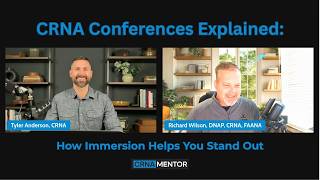
Dr. Richard Wilson shares how attending anesthesia conferences transformed his career from first-time attendee in 2005 to frequent speaker and leader. The episode covers AANA's three main conferences, networking strategies for first-timers, and why immersion in these events builds knowledge, connections, and leadership opportunities that reshape a CRNA's trajectory.
Chapters
Once you start going to these anesthesia conferences, you'll catch the bug. I didn't fully understand what he meant at the time, but after being in a room surrounded by CRNAs from across the country, listening to conversations, watching leadership, and absorbing the language of our profession, I understood. Because something shifts when you immerse yourself. Immersion leads to this identity, and identity leads to advocacy. And today we're going to talk about how simply showing up can change the trajectory of your CRNA journey. Welcome back to the CRNA Mentor Podcast. Today's episode is part of our advocacy miniseries leading up to mid-year assembly, but this conversation is something more foundational than policy. It's about immersion. Attending conferences are more than just a resume builder. They accelerate your professional development. You start understanding the language of anesthesia. You gain awareness of the forces shaping this profession. You build confidence and develop perspective. And over time, you stop feeling like someone trying to get in and start thinking like someone who belongs. That's identity formation. And identity is what produces advocacy. Today I'm joined with Dr. Richard Wilson, the Assistant Program Director of Ursuline College's Somnia of Anesthesia Nurse Anesthesia Program. He's a fellow of the ANA. He's an ANA social media ambassador and a member of the Leadership Identification Committee. Hello. Richard is a national speaker, educator, clinician, and someone who's spent years immersed in the field of anesthesia. Today, we're going to demystify anesthesia conferences for RNs and APRNs. If you've ever wondered, is this space really for me? What would I even do there? And would I feel out of place? This episode is for you. Welcome to the podcast here, Richard.
Tyler, thanks for having me. I'm excited about this topic and really excited about just talking about advocacy, talking about getting involved and just being a part of this.
Certainly. And Richard, you know, aside from us, you know, connecting at these conferences this last year, you're someone who is all around these conferences all the time. Tell me a little bit about your background. And I guess my first question for you here, Richard, as we, you know, talk about conferences, Can you remember back to a time where you weren't a speaker at one of these conferences and just an attendee?
Oh, absolutely. I mean, my very first conference was back in probably around 2005 when I was in anesthesia school. I remember that one vividly being in Washington, DC at the time. It was the national conference, the annual congress is what it's called now. And just really enjoying that environment and getting engaged and involved with all of the nurse anesthetists the nurse anesthesia students, residents, they were all around. And then for a number of years after I graduated and as I became an educator, just going to more of these conferences and just sitting there and soaking all of that in, that we were learning, you know, from the lectures, but also that I was just learning in the hallway conversations and networking with all of those people that were there for the same exact reason.
Mm-hmm. That little detail there, the hallway conversations, as you talk to more people within the ANA, so many of them will tell you that is oftentimes where you get the most value from these conferences is interacting with all these people throughout the field. And one of the things, Richard, and actually the whole idea for this podcast episode was something that you said to me back at Mid-Year Assembly. You told me, once you start going to these conferences, you'll catch the bug. What exactly did you mean by that?
Oh man, it is just so addictive. I mean, really, as you go to these conferences and really, if you're looking at advancing your knowledge base, your clinical expertise, your professionalism, your scholarly work, you're just advancing maybe in some leadership opportunities, You get all of that there at these conferences, right? As we look at all of the conferences we have for the AANA and even our state association conferences, you gain all of that from that. And it becomes really that bug that I was talking about. You just keep wanting more and more and more. And then there's a number of these individuals like you, Tyler. I mean, we live obviously in totally different states.
Right.
But we get to see each other at these conferences and get to catch up and see how things are going and really build off of each other. So, That's the bug I'm talking about, is that it really becomes where you meet great people. You get great education, whether it's in knowledge base, just to have some information there, whether it's in things you take back to your clinical practice, or whether it's in leadership development. And if you're wanting to grow and you're wanting to really excel, you get that there, and it just continues and it continues. And it honestly carries over after the meeting, and then you get excited about coming to the next one to do it again.
Yep, and I love that, and I, I wholeheartedly agree. You know, Richard, at what point did, did going to these conferences move from, in your opinion, this kind of optional thing to something that now is essential to who you are as a CRNA?
So if I really go back and think about it, and, and, you know, if I were to say that I went to every conference every year since the day I started anesthesia school, I would obviously be I'm not lying to you, Tyler, here, right? But when I look at it and I started thinking about this, so from about 2006 when I graduated to about 2009, I would go to some conferences here and there, state conference, maybe a national conference, but I wasn't consistent with it, right? Then I became an educator in 2010 and I was a new educator. I was a new CRNA. I was hired as an assistant program director about 3 and a half years out of school. And I went to the ADCE at the time It was called the Assembly of School Faculty. Now it's called EDGE. So, for all of you listening that don't know what that is, that's our educators, our National Educator Conference for CRNAs. And it was probably about my second year going to it. So, the first year was a lot of fun. I enjoyed it. I met a lot of great people. The second year, I was more comfortable in what I was doing. And I really connected with people that honestly, I started texting and I started calling. And they were helping me with policies that we were writing for our program. They were helping me with lectures and content and we were just bouncing stuff off of each other. And I realized this is what it's about. It's about connecting with those individuals. It's about learning things while we were there. And we learned a lot of great information in the lectures and the presentations. But it's also about connecting with those people that year in and year out, I could connect with again and that I knew I could reach out to and that I could say, "Hey, can you help me with this?" Or, "What are you doing in these situations?" Right? Right. Comes on the leadership end. And that was 2011, 2012 when I was doing that. And I still actually have individuals that I still keep in touch with just because of that. And then I was an item writer on the, uh, SE for the self-evaluation exam.
Okay.
I did that for about 5 years. Well, that came because I attended a workshop right before one of these meetings. And I got engaged with how to write exam questions. I was like, "Ooh, I like this." So, I actually, you know, contacted and applied for a position on the NBCRN-AC Committee and got accepted in that because, again, that bug caught me. And I was like, "I like this. I want to get engaged. I want to get involved." Mm-hmm. So, really, as you look over those several years, it became very, very clear to me that, yes, it is optional. However, it's more than that. It's all the things that you get. It's all the interactions you get, and it helps you grow so much.
Yeah, and that's one of the things I love about it because there's so many different avenues to explore. You know, just as you mentioned, you know, being— helping to develop your test questions. That's something, you know, as a professor, I'm like, oh, I should really do something where I can improve that aspect of, you know, my teaching. But there's so many different doors that open. As you just go to these conferences and many of them, you know, you oftentimes don't expect. And it's just really forming those connections. And, you know, even, you know, yourself, you've been a mentor to me and I know we're texting back and forth quite a bit here. And this all stemmed from, you know, just attending Mid-Year Assembly and being A&A social media ambassadors together and that R&A meet and greet. But Richard, let's discuss a little bit about, you know, all the different types of anesthesia conferences that are out there, you know, within the A&A. I know, You're coming off the EDGE conference, that educator conference. I'm sad I missed you guys there. I was texting back and forth with you and Daniel King, and I'm like, oh man, I've heard amazing things about EDGE, and hopefully next year I can make it out. But let's break down a little bit of, let's start, I guess, with some of the ANA conferences. What are all the opportunities, especially for our aspiring CRNAs?
Yeah, so you've got 3 primary ANA conferences. That are held throughout the year. The one that we're talking about right now, obviously EDGE, which used to obviously be the, like I said, the Assembly School Faculty and then ADCE. But the key behind that one is that's all of our educators. So that's educators from all across the country gathering together to really look and say, okay, how do we do a better job educating? How do we reach people and what are the new tactics and techniques out of there? How do we teach teachers, right? How do we educate the educators? Educators so that they can go and even improve what they're already doing, the great work they're already doing. How can they build on that so that the people we graduate are great? So we just want to keep growing the profession, you know, and that's one that we don't see a lot of APRNs, RNs. That's what I was gonna ask. We don't even see a lot of residents there.
Right.
Um, at that one, because it really is about educators and really about what they're doing within the profession and how they can build on what they're Now, you know, that one usually takes place in around February timeframe. Then we've got the Mid-Year Assembly. We all know what that one is, right? That's a great one overall, and that's very, very important for our profession. And the Mid-Year Assembly is held in Washington, D.C. every year, and this is our advocacy meeting. This is where we get up there into D.C., we get up into the legislators' offices, and we have conversations with them. So there's always great things there. There's always these events and these lessons and these connections that you make there. And we learn about what's important in advocacy. And then we also take that and apply it. We take that and go meet with our senators and our representatives. We talk with them in the offices about why CRNAs are important, and it's important to have full scope of practice and to look at full reimbursement and to go through all of these things that are important to help grow the profession so that we can reach the communities we need to to do with high-quality, cost-effective care. And that's a great one to go to for residents. That's a great one to go to for RNs and APRNs because you get to have a lot of connection there. But you also to see how do we grow what we're doing? How do we advocate for what we're doing? And how do we protect what we're doing within the nurse anesthesia profession? So that's a great opportunity to really learn, to really connect and get engaged.
Mm-hmm.
And it's also one of those things that, you know, let's demystify as you were talking about a little bit of this is some people go, well, I don't like advocacy. I don't like to talk to legislators. I don't like talking to representatives.
Right.
They're people, they're individuals. And a lot of the times, you know, we are the content experts in this information and they're seeking more from us to help them out. So it shouldn't be an overly difficult conversation. But as an RN and APRN, you're usually not going to be engaged in having the conversation. You're coming along for the experiences. To really see what we do, right? Yeah.
And that, you know, last year, I know incorporated into that RN meet and greet, and just a quick plug for that, I am doing the RN meet and greet again this year. You know, this is specifically geared towards our RNs to make them, and APRNs, to make them feel more comfortable attending Mid-Year Assembly. And one of the things that I talk about in that presentation is that there's a wide spectrum of anesthesia topics at Mid-Year Assembly. Some of them, at this point are still over my head, you know, talking about reimbursement and things of that sort. But this is all about getting exposure and you don't have to completely understand it, but you know, as long as you start to put yourself in these opportunities to learn, things will start to click a little bit more. And even just understanding that advocacy piece a little bit more, you know, I know that some of my mentees actually stuck around and went to lobby And I know that some of the faculty, program faculty that were lobbying right next to them, they were blown away. They're like, wait, you're an RN that's came to lobby with us? And that's something, if you are interested in advocacy, that option is available at Mid-Year Assembly to actually go and lobby alongside of CRNAs lobbying for your future profession here.
Yeah, it was really fun doing that session with you last year. And I hate that I'm going to actually have to miss it this year for my niece's wedding, but I'm excited about her getting married. But really, you know, you're right, you've got to be in the room. And if you're not in the room, then you're not going to understand this, right? And it's as simple as, you know, starting an IV in nursing school. You didn't just walk in and the first time that you walked into a room, you read it one time and then you popped an IV straight in the patient and you were successful every time after that. Yeah. You had to learn it. And the way you learn it is by getting immersed in it, by getting engaged in it, by seeing it over and over and over again. And then it becomes habit for me. It becomes where that is now in your mindset and you start to understand it more as you're talking about. I didn't really understand all of these terminologies and I've been doing this now for around 20 years. You know, it wasn't until probably last 5 or 6 or 7 years that I really started understanding this as I was going through. Our professional practice courses. And as I was learning more about the advocacy and getting engaged, that grew my attention towards it and grew my knowledge in it, because then I started repeating it over and over again. That's what has to happen.
Yeah, that, and that, right, that piece right there is super valuable insight, because myself included, like, I'm, I'm actively learning, you know, and a lot of how I frame this is I'm trying to best serve my mentees. And in order to do that, I have to be engaged on all fronts at all times. And I appreciate you saying that because that's, you know, helping me personally as I'm navigating this. It's like, I'm still familiarizing myself with the terminology, with the lingo. And the more that I can be in the room, the better I can kind of serve all the mentees and advocate for this profession. Now, Richard, we— well, I think I'll eventually have a kind of a whole thing focused on midyear assembly. So let's move on a little bit to annual congress.
Yeah.
I know we met up there. Tell us a little bit about about Annual Congress?
So Annual Congress is about 5,000 people, I think it is, around Annual Congress. It's a large number of nurse anesthetists. There's a large number of nurse anesthesia residents and it's always a great time. There's always a lot going on around it. There are events that are thrown by many of these recruitment companies and the staffing agencies. There's events thrown by the AANA that are fun and engaging and we really enjoy going to those. But that's not all that's there, right? It's usually in a great city. I'll give a plug this year, it's Boston, which I'm looking forward to. I love Boston. But what is it really looking at? And it's looking at a lot of education. So, you know, we've got clinical practice, we've got billing, we've got education for the educators there. We've got, you know, just research that is being presented there. So, it's so much in the educational aspect of you can pick pick, right? Because there are so many presentations at annual congress. You can literally pick the track you want to go or look and say, okay, I really want to understand hemodynamics, and you can find a lecture on hemodynamics.
Yeah.
Really want to understand respiratory event management, you can find one on that. A plug for that for this year, by the way. But anyways, really what you can look at is whatever avenue you want to look that. You can go to that. I'm gonna be honest with you, sometimes it's overwhelming because of the fact that there's so many presentations. You're like, I can't be in these 3 all at once. They're very, very good and they're interesting for me.
Yeah.
So, you know, that's a great one that you get to. And then you get to network because we see a lot more residents there than we see in some of the other ones, right? Our nurse anesthesia residents, we see a lot more RNs and APRNs now showing up to that meeting than we have in the others. So it's a great opportunity to network, not just with a few people, but with a lot of people to actually get a lot of opinions and a lot of feedback on our profession.
Absolutely. Yeah, yeah. Annual Congress was so much fun this past year in Nashville. I mean, the setting, I love the city of Nashville. And then when, especially in combination, you mentioned some of these parties, these after-events, renting out Jason Aldean and Luke Bryan's bar. I was like, "Wow, this is like, this is my, one of my top vacations last year was going, you know, to Nashville." with the annual Congress. And as you said, you know, last year was record numbers of attendees. And largely, I feel like that was attributed to our RNs and APRNs in attendance, which I, you know, foresee that just continuing to build, especially as more and more resources kind of get built out and more focus gets put on our RN and APRN attendees. Richard, let's talk a little bit about— I know you're active not just at a national level, but at a state level as well. Could you talk a little bit about some of, you know, the state associations and the meetings that are out there?
Oh yeah, I mean, pretty much right now every state has a meeting, an annual congress or an annual meeting every year. Some of that is virtual here and there. Most of the time they're in person. We're now starting to see regions. So as you know, we've got, what is it, 7 regions now within the AANA. We're now starting to see regions every 3 or 5 years have a meeting that brings all of the states within their region together and have, which is great. I believe Region 3 did it. I believe Region 5 has done it. So they've been really good in those aspects, um, and those are really fun to attend also. So I speak at a number of them all across the nation, and I enjoy getting there and seeing our nurse anesthesia residents there, meeting new CRNAs, and also seeing some of the RN APRNs that are now attending these meetings to get engaged and really figure out, okay, what is this state and the nurse anesthetists within this state about, and how do I connect with them and start seeing, okay, is this really what I want to do? Now, I'm going to just be honest with you, and I'm just— give me just a minute here. I want to kind of go on a little history with some of this. It's really when you looked at what we told people to do for nurse anesthesia. Now, this may be a little out-of-the-box thinking for some people, but when we told people what to do to figure out, hey, do you want to be a nurse anesthetist? What did we tell them? Go shadow. Go shadow for 16, 24, 48 hours, whatever, right? Go do some shadowing, make sure that you see what they're doing in the operating rooms, and then that is what you want to make sure that you're, you know, want to spend the next 40 years doing. The next, you know, at that point, you know, 2.5 to 3 years of education and 30, you know, years of practice. Make sure that's what you want to do because you don't want to invest all of and then figure out halfway through this is not what you like.
Right.
But that's when we were the best-kept secret. We're no longer the best-kept secret in healthcare, right? And when you're not the best-kept secret in healthcare, which we don't need to be, we really need to be talking about who we are, what we do, and promoting what we do. You have to also protect it. So that's why I think it's important also for all of these individuals to go to state meetings so that they can get engaged and see, is that that's the side I also want to be in because we're really going to be getting away from everybody being able to just go work 40, 50, 60 hours in an operating room, put somebody to sleep and wake them up, right? And provide safe, cost-effective, quality care but not advocate for it. We're going to have to see more and more and more advocacy as we continue to advance the profession. So it's important that these individuals get there and they see, okay, I like the clinical this, but I also am okay with doing the advocacy practice here too and wanting to be engaged.
Yep. And, and I love that. And I would say that's been a transition in, in my CRNA journey personally, is that I absolutely love the clinical aspect of things. Like, I, I, I love so many different sides of this profession, from, you know, teaching to the clinical side, but advocacy for me is, is newer, and it's something that it, it is— it's like, again, going back to this idea of catching the bug. It is something that you just get so passionate about and you almost obsess about because you, you look at how it impacts literally all aspects of this career. And, and, you know, so many, uh, so many CRNAs, you know, they go to— they go to work, do their cases, go home, and, and, and that's all well and good. But, but part of what I want to do with CRNA Mentor is really pull back the curtain on all these things concerning advocacy and then seeing, really just being in the room and seeing what connects with you at these various parts of the conference. And, uh, yeah, I think, I think that's, that's so important. And, and it's great that this is no longer the best-kept secret. I know many of our aspiring CRNAs might not agree with me as I, you know, do my daily phone calls and they're like, wait, so how many people are applying? Do you think this is just kind of a thing now? I'm like, no, no, it's— this is, uh, you know, social media mixed with, you know, people just being more aware of this profession. We're out in the open now. And, but again, this allows for more opportunity. It just, it goes beyond shadowing, like you said. Now, Richard, your state association, are you active in your current state association?
Yes. So I'm active. I've stayed active for a while. Previously, I was the PR chair for our state association. I currently still am the PR chair of it, but I also sit on the board of directors as a trustee for our state association. And I've spoken at it several times before.
I know you were up at, I'm in Pennsylvania, you were at PANA in the spring after mid-year assembly. I'm like, wow, Richard, you're coming up to my, I was unable to make it. I'm like, you're coming up to my conference. I said, I wish I could go out there. 'Cause we're a little bit spoiled in Pennsylvania with how many anesthesia schools that we have. And then I often tell, you know, my local people people, like if you're looking to go to school in Pennsylvania, those state associations are often your best option because you get exposure to virtually all the anesthesia programs, the faculty, the nurse anesthesia residents that are out there. So those, you know, these state associations can be excellent, excellent learning opportunities, especially locally.
Absolutely. And one thing I want people to truly, the listeners on here to recognize is yes, you'll see faculty. There. You know, and I'm gonna speak from a faculty perspective. I've been in it for over 15 years now. And we enjoy meeting you. Don't get offended now when I don't remember your name in a week. Because we have so many people that do come up to us and do want to talk. But don't hesitate, especially if I'm ever at any of these meetings, guys, at state meetings, because I'm speaking at a number of them, to come speak to me and talk to me. And I'll be glad to answer any questions. But the one thing that I also think that you cannot forget out is the students that attend these meetings. So a large amount of people that attend these state meetings are students, right?
Mm-hmm.
From the programs, and they're from the various programs. This is your opportunity as an RN-APRN to ask them questions. What do you like about the program? What do you not like about the program? What is the structure? What is there that I'm not seeing online or that I haven't heard about that I need to know about if I'm considering this program? Because it used to be, as you mentioned, Acceptance rates used to be as high as 25% and 30% in some of our programs, to now we're seeing acceptance rates are down less than 12% within the programs. So it's no longer that, hey, I can just apply to this one program and I, you know, try to get into this one program, these two programs. We're seeing people having to cast nets around 10 or 12 programs to try to guarantee admissions into some program that, you know, that they'll be a fit with. And so that's why it's important while you're at these to ask the students and the learners, there. What do you like? What do you don't like? What is cool about this? What is your structure? Because it has to be a good fit.
Richard, just, I want to give just a little, uh, pull back the curtain a little bit on some of these other opportunities that are out there. Uh, you know, we talked about the ANA, we talked about state associations, but there are various different workshops and, and, and kind of subsets and, and other organizations, some within the ANA. I, you know, I was teaching on Thursday and I was talking with one of my students, and, and she was talking about attending the Multicultural Conference. She's part of the Filipino Association within the ANA. Um, have you ever attended, you know, any of these other, uh, say, Diversity CRNA, or any of these other, uh, some workshops that are put on, uh, anything like that outside of, you know, our state associations and stuff, stuff with the ANA?
So I've done a little bit of the workshop stuff. But to be honest, I haven't gotten hugely outside of that other than maybe some private companies. You know, obviously, there's a number of private companies out there that also offer experiences and conferences at different locations. And I've done a number of those. With workshops and all, I'll be honest, it's been, the meetings are so busy for us as educators. And they get so, we get so caught up in a lot of different things that it's been difficult to get to some of these outside conferences overall.
Gotcha.
They're great opportunities. And they're very specific. So you look at things like some of our OB epidural workshops, the multicultural diversity workshop. You know, when you look at some of these, they're very specific, and they meet the needs of those individuals. And when you go to these, they're encouraging. You get to see people that are going through the same experiences as you or want to have the same, you know, goal as you. And it becomes a very encouraging event when you go to to them.
And, and one of the things, you know, in talking to many, many mentees that are involved with, say, Diversity CRNA, or, you know, some of these other associations like the Filipino Association, like, I, I love the connection that these individuals get and the community there. That's probably the biggest takeaway. I, you know, I'd love to attend, you know, a Diversity CRNA event just to experience it, but people walk away from that and feel so welcome, so included, so much part of that community. And, and that, in my opinion, is, is one the most important things, especially for our aspiring CRNAs, you know, trying to, to navigate this and see if, if this feels right. And if it does, you know, this can be a great path for you. Uh, you know, Richard, for our— all of our aspiring CRNAs who aren't yet in anesthesia, I know we talked about a lot of this, but why should they care about attending these anesthesia conferences?
Well, one of it's what we talked about earlier, right? You want to know what you're getting into. You're getting into. And when you look at what you're getting into and you look at going— for me personally, looking at going into clinical practice and shadowing in the clinical practice setting, you know, that's only one aspect of what we do. We do a lot in the leadership side. We do a lot in the education side. We do a lot in the community engagement side. And so, when you go to these conferences, you get to see that, right? You get to see that. What all we do outside of just providing safe care within the operating rooms. So that's why it's important for these RNs and APRNs to really see these events, and they get to talk to people. Also, when I'm in the operating rooms, I'm focused on the patient. I'm focused on the care I'm providing for that patient. I'm focused on the, you know, the other individuals, the surgeons, the tech, the nurses that are all in the operating rooms with me. And we're really focused on the hemodynamics dynamics, respiratory status, and all this going on within the patient care. So, it's difficult for me to have conversations about the profession overall within that setting. So, it's also a great opportunity when there are these things to have an overall professional discussion of advocacy, what's going on within the state, you know, what is the practice like within the state or practice like within the facilities.
Mm-hmm.
You get to learn a lot more when you these events because really in the operating rooms you learn a lot about, hey, propofol, rocuronium, Dilaudid, ketamine, you know, you learn a lot and you can get a lot about that, what isoflurane does, right? But then when you get to these conferences, you get to learn more outside of just that practice.
And that's a great point. And it's interesting you say that because that's exactly right. You know, and I've had I've had people come to shadow me and they're like, "Oh, I really want to shadow you because you're really passionate about the field and I want to have a good shadowing experience." But again, this is just a snapshot of this collective profession and it's just the clinical side of things. And that's obviously what so many people are focused on, but hinting at all this other stuff is great. And this is a great opportunity to explore that as well. Richard, I want to talk a little bit about, you know, you are part of this leadership development committee. How does exposure to leadership change someone's trajectory in their CRNA journey?
Well, let's just say this. 2009, I applied for my assistant program director position that I got hired for. I will remember this conversation vividly with my wife because she was like, are you ready for that? And I'm like, yeah. And she asked me, well, 'What if you get the position?' I was like, 'No way. I don't have enough experience in this. I've never done education. I know the other person that is applying for this who is a lot more qualified than I am and has contacts.' And then, I got a call a week later to say, 'Congratulations. We're going to offer you the position.' And I thought, 'Oh, what have I gotten into?' Right?
Yeah.
But that led into leadership. And I had not really had true leadership opportunities at that time. And then I was, I was tasked with actually opening a second campus for the program that I was hired for immediately. Now, that had— to do that, I had to get engaged with hospital leadership. So I got another vice president of academics, right? So we think about CRNA leadership, but we all need to think about leadership leadership as a whole. So we need to think about leadership within hospital systems, leadership within our legislatures, leadership within the CRNA profession. And as I started going to more of these meetings, I started getting engaged with a lot of these leaders. I'll just throw it back to Sharon Pierce, all the way back to that time frame. For those of you that know Sharon, you know, Sharon, before she ran for president-elect or president of the AANH, A. She was a trustee. She was in, you know, the North Carolina area. I don't live too far from the North Carolina area. So I had her come speak at one of our meetings and just stayed engaged with her and used her as a mentor in that leadership opportunities. Lynn Reed, who was the Director of Professional Practice for the AANA for a long time, she was a mentor to me. I met her at a meeting, got her phone number, bugged her and bugged her and bugged her just to really stay engaged. And Then, as that happened, I started really again catching that bug. I want to know more leaders. I want to get engaged with them to where I got to know people on these committees. I got to know people in these leadership positions, even within the AANA. And it really encouraged me to want to serve more. So a couple of years ago, I ran for a position for the Leadership Identification Committee. Where we actually oversee the election process for the AANA. So we're recruiting leaders to come in and run for these positions. We're vetting them and we're running the process of the election. And again, I got to know more leaders through that. And they have had an impact on the way I actually do some things. Yeah, there have been things I've looked at and I'm like, "Hmm, yep, probably not the best idea." And it's because I've seen what they're doing. I'm like, I love what they're doing. I want to start incorporating that maybe into my practice or incorporating that into my leadership styles.
Absolutely. And, you know, when I went to Midyear Assembly, you know, this was my, actually, it was my first attendance of Midyear Assembly. It was last year. And I had an idea of all these people that I wanted to network with that, you know, I've seen online and, and I wanted to know more about. And And really for me, it was about identifying role models. You know, who do I want to be like? Who do I want to learn from? And it was funny because in talking to my mentees that were in attendance, they went to the mid-year assembly and they're talking about all these people that are on social media and like, oh, there's so-and-so, there's so-and-so. I'm like, oh, there's Drew Riddle. Oh, there's Tracy Young and our friend Nijmaa. Like we were kind of going back and forth. It was like, oh, that's the person. Yeah. And, you know, as I went to these, these conferences and start to talk to these people more, and really identifying these different things. But one of the things, Richard, you know, when you look at all these leaders in our profession, what do almost all of them have in common?
I mean, when you start looking at all the leaders, and you can go back for years and years and years. But really, when you look at all these leaders, and one thing I want to talk about with leadership is leadership It's not what you determine. It's what others determine, right? You can think you're a leader and do absolutely nothing. True leadership is when you are building others up, when you are bringing others along with you, and you're training that next generation. Now, when you look at what they have, the first thing they have is a love for the profession. You cannot lead something you don't love. So, if you are just ambivalent about it, you're just you know, wanting to get a nice paycheck from clinical practice, you're not going to be a true leader moving down the road because you've got to have a love for the profession overall and seeing it grow. They have a resolve. They're determined. They're determined to make sure that they're winning battles for the people they're representing, for the CRNAs that they're representing. And they have a vision. They're looking towards the future. They're not just saying, hey, I I need to protect what's 6 inches in front of me. They're looking 60 miles in front of them. And they're saying, "Hey, when I see what we're going to be doing in 5 or 10 or 20 years, what do I see? What are the steps I see for us getting to that in itself?" So really, when you look at that, that resolve in staying determined, that vision of moving forward, this really drives drives these individuals. And a lot of times, we think that leadership comes from just being within the profession for 20, 30, 40, 50 years. But it doesn't. That leadership can happen very soon. I mean, let's take, you were talking just now about Nishma, who is a wonderful individual. She's doing a lot with you talking about the 1099 community and what she's doing within that. She's doing a lot within the Illinois Association Association of Nurse Anesthetists. And she's not been practicing that long, you know, in a real, in a sense of what a lot of people would think is a long time. But she started making an impact early, becoming a leader early, and getting engaged early. And actually, it's had an impact on me. And again, I didn't meet her till last year at Mid-Year Assembly. And we've kept in touch and love seeing what she's doing there. So, you know, that's just one example of watching people become leaders that actually have impact on you also as a leader.
Absolutely. And, and I just want to highlight, you know, your response here. This is really the blueprint, in my opinion, to being a leader. All those things that you mentioned, that was a, a true gem there, Richard. Uh, you know, one of the things that I talked to, to aspiring CRNAs about, you know, this leadership component of your resume building is so, so important. And so often it's framed as just the formal titles. But as you mentioned, a love for this profession, and that includes in the ICU, trying to be the person that, hey, I can do this. Hey, I'm gonna raise my hand and offer help. And like you said, it's about lifting other people up. And that includes people on your unit. And when you start to do that, you get identified as a leader on your unit that they come to with questions, that they, you know, you're their soundboard. And that's how you kind of— you rise to the top in the ICU. And then this carries through into anesthesia as well. Let's talk a little bit, you know, I want to, I want to make this fun here and do some kind of rapid-fire questions. All right, so we're going to change it up a little bit. I give some, some substance to these aspiring CRNAs in attending these conferences. So let's say for a moment that I'm a bedside ICU nurse listening right now, and I've never been to a conference What, in a couple sentences, let's say, for example, at Midyear Assembly, what would my first day look if I'm arriving with opening ceremony? What are all the things I walk into the JW Marriott? What am I going to see?
Well, you're going to have a rush of emotions, which are going to be excitement, overwhelming. You're going to be in awe because, again, people you've been watching on social media that that you have maybe been looking up to as mentors are going to be there. You know, so that's going to be what you have to balance and think about as you walk into that setting is just really taking a deep breath, centering yourself, and just being in the moment. Because there's going to be so many emotions going on during that time. So really, when you talk about what do you want to be, right?
Uh-huh.
What do you want to have while you're you're there. Just be in the moment and enjoy being there with all those individuals.
What should I wear? You know, I've never been to one of these conferences before. What should I wear for men and women?
Always, always go business at these conferences. You'll never go wrong with going business at these conferences. Now, if you ever see me at these, forgive me because I may not be in that. But I've also been doing this for 20 years. So there's a little bit bit of a difference. But as an RN, APRN, I have that business wear. So, you know, it really— as you are kind of walking around the hotel and all, just, you can be casual. But as you're thinking about attending these meetings, as you're thinking about these events and all, um, just make sure that you are— you're really dressed for success. Uh, what you attend in the meetings is usually business. Going to some of these events, usually it's more of a business casual type thing.
Great. Um, how should I introduce myself, uh, and kind of start to try to network?
Always approach them. Never be scared of the CRNAs or their students. And introduce yourself as an aspiring CRNA. Tell them you want to be in the profession. Tell them you're wanting to do this and that's why you're here. You're wanting to be engaged and meet people and that's why you're here. I promise you, if you do that, you're going to get drug around every corner of that place to meet somebody.
What's one mistake some first-time attendees make?
Not getting involved. They come there to just watch, to be passive, to put it on a resume and a CV that they attended an AA/NA meeting, but you'll get nothing out of that. Really, once you start getting getting introduced to these individuals, having conversations with them, and learning more, then you'll get something out of this. Otherwise, you're just spending a lot of money to put some words on a resume.
100%. You know, I, I say this time and time again, and this includes, you know, your experience in the ICU, uh, you know, going back to just being there. Say you're in the ICU for 10 years. If you are not an active participant and actively learning you know, the, the 10 years is just a number, right? And same thing with these conferences. You really need to make the most of them. And I get it, like, it's, it's uncomfortable to, to put yourself out there and, and, and kind of feel vulnerable and feel like, well, this is not quite for me. But as soon as you do that, as, as Richard said, you know, there are many CRNAs are going to take you under their wing. Maybe you'll have something in common. Maybe you'll be from the same area or, you know, went to the same undergrad near I went to nursing school, something like that. And you'll connect. And then all of a sudden, you're going to have somebody to pal up with and go around. But you have to put yourself out there first. What's one thing I should absolutely do at my first conference?
You have to introduce yourself to people. That's what you must do. You're going to have a lot of people that walk around. And just as we talked about earlier, Tyler, there's a lot of us that go to these conferences over and over again and we don't see each other for a year, right? You got to introduce yourself to people. And one thing do not turn down is if a CRNA says, come to dinner with us, if a CRNA meets you and says, hey, come and hang out with us in the lobby or wherever we're at for a little while, do it. Because those are connections that you're going to be making that are going to last you a lifetime. Mhm. Time.
Uh, you know, here's, here's a topic. I've talked to other educators and I've got their opinion, and I have my own personal opinion on this. You know, should these aspiring CRNAs be carrying around a copy of their CV at, at these conferences?
You know, personally, I'm not a big fan of that, and the reason I say that is because I am not a big paper person. And usually at these conferences, I'm going from one place to another to another. I may not be going back to my hotel room to put the resume in to look at later on. You know, I really love digital stuff. We've got so many things that we can do digitally with sharing contact information to send it to them later. You know, or asking them for their email address and then just even writing that down. You know, I think it's more impactful, to be honest with you, is saying, "Can I send it to you later?" Because we're so busy at these conferences. We're not really taking a good look at it, to be honest with you. I think as an educator, I would love for somebody to say, "Hey, can I have your contact information?" or "Hey, here's a way to scan my— here's a QR code to have my CV." Those kind of things really stand out. And again, I can do it later when it gives me a little bit more time to actually look at it versus quickly going through it because I'm headed to the next I'm headed to meet somebody real quick.
I completely agree with you, and I'm glad you said that. And that's kind of the feedback that I've got from other educators is, you know, you don't want to be lugging around this piece of paper. This is about making a connection. And I feel like oftentimes it's, it's thought of in the wrong way from some of these aspiring CRNAs. It's like, okay, I just, I just got to hand off this piece of paper and then I can go away. And it's, it's about connecting, making eye contact, finding some common ground, talking about, you know, where you're from. You know, it's, it's these, these simple things that I think make make a bigger impact than, you know, this perceived, oh, here's my CV and then here we go. But, but, uh, yes, to your point too, you know, the digital side of things is much cleaner and you can always send it later, but it's about here and now making these connections. You know, if someone's introverted, and, and my, myself included, I, I'm thinking about this, you know, I did not go to anesthesia conferences years ago when I was, you know, an aspiring CRNA, uh, and I, I consider myself introverted? You know, how do you still maximize this experience? Do you have any, any tips for overcoming that?
Find you a good extrovert, hang out with them. And that really, you know, joke around by that, but that's, that's true, right? Find others, because when you find others that can complement you, you'll be able to complement them in other areas. So you find somebody that you see, and they're going around and meeting a lot of people, or they know a lot of people, or, you know, you can tell they've got a great personality and they're outgoing. Going, and don't hesitate to hang around with them. Don't hesitate to join in with them. And I'll be honest with you, in these ARN APRNs, even if you're going there by yourself, you should be joining in with groups. So groups of you should be getting together and going around, because that's really going to help you meet more people, because obviously that widens the circle of people you're going to be meeting, and it gives you more opportunities of talking in engaging with people. And I want to make sure that, as you know, that I say this. And as we talk about the RNs and APRNs going, and you brought up something a little while ago that was very nice. You know, this is not all about, hey, I just want to sell myself to you as a potential candidate for your program. You know, that's really not where this should be occurring. This should be just, hey, I'm getting to meet you. You know, if it does come across as, yes, I'm interested in your program. And they say, okay, what questions do you have about my program? Program, then that's wonderful. You know, start asking some of your questions. And just a little bit of advice: don't ask them stuff you can easily find on the internet or easily find on their websites, right? You want to make it engaging, and you want to find out stuff that you, that you really want to know. So get in these groups, go around and engage with individuals to really just talk about the profession, talk about advocacy, talk about what the future of the profession looks like overall. And when you get engaged with those people, if you're introvert and you get engaged with those people, it brings a little bit out of you, but it also gives you an opportunity to go around and meet more people again, learning more about what's going on within the profession.
Yeah, no, absolutely. And that's something that I, you know, want to kind of put more, more and more focus on within the CRNA Mentor community, our Facebook group, um, as well as within the CRNA Mentor platform, is that, you know, trying to form these connections. I know within our community last year, we had like a meeting before the meeting with annual Congress. And we're gonna do the same thing here with mid-year assembly. So maybe you can find people and connect, you know, that RN meet and greet, I plan on kind of setting that up in such a way that you can find individuals to kind of pal around with throughout the conference. One of the real special memories for me with mid-year assembly last year was, it was after the PAC event and we were going to another bar afterwards and a group of aspiring CRNAs came up to me and they're like, Tyler, we want to thank you so much for that RN meet and greet. They're like, we all met there and they were from all parts of the country and we've been around this entire conference together and had this group of people that we wouldn't otherwise have. And there's going to be more and more focuses on this, I think, within the ANA, but you know, this idea of of finding your group of people. Even myself personally, like when I went to that conference, I went there all by myself. You know, I had this safety net of faculty at Bloomsburg's anesthesia program, which I, Debbie Manzola, I pal up with them. They're kind of my safe spot, but I'm like, I need to practice what I preach here. I need to go out here. I need to make connections. Certainly, you know, meeting you, Richard, at being an ANA, social media ambassador, I kind of had that a little bit of a safety net and a common ground that we could talk about and obviously incorporating you into the RN meet and greet. But myself included, there was a moment where I knew I got at last minute got tickets for that PAC event. And I'm in the lobby, I'm like, I'm gonna head over there. I'm like, well, I don't know if, you know, Debbie, I don't actually, they're not going over there. There. I had, you know, my Pana people, Sarah Trau and stuff, they were all kind of in a group. And I'm like, all right, I'm just gonna walk over here. I just start walking over and right next to me was Tracy Young. And so then I got to talk to Tracy Young. He was one of the people that I'm like, I gotta talk to Tracy Young this conference. And as it worked out, we walked over to the conference together, we're talking, I was talking about, you know, being a social media ambassador. Ambassador. And for me, that was really special for him. He's just walking over the conference or to the PAC event, but you just need to push through. You just need to put yourself out there. Like I said, I myself am an introvert, but trying to find these pockets of people that have, you know, you can find some common ground. And I think it'll be easier and easier as things progress with this RN APRN membership. Richard, you know, for our aspiring CRNAs who are listening right now, right now, and they're on the fence about attending Midyear Assembly. This is our next conference coming up here. What would you say directly to them?
You know, it's well worth it. I think the connections you get there, I think what you learn about the profession there, I think the excitement that is centered around that meeting in itself, because it has a different feel than the Annual Congress, because it does have a different focus overall. So I'd say do it. Go there, get engaged, enjoy the people that are there, learn more about the profession, and make your contacts that are either going to be lifelong friends, as we will, you know, see, or, you know, they're at least going to be people that help mentor you and help you get to your next stage, which may be CRNA school.
Yep, absolutely. Yeah, Richard, one of the things that I talk about quite a bit in my phone calls on a daily basis is all these different things that you're gonna do. And many people, as you hinted on before, look at these conferences purely as a resume builder. And my opinion is, as we said, you have to put yourself in the room. You know, the virtual option is great to put it on your resume, but putting yourself in the room affords you this opportunity, like all these things we said, you know, to learn about this profession, to learn how to advocate for this profession. You know, I've had mentees that attended these conferences and, you know, they were coming off of going maybe to NTI or acute care conferences and they're like, I felt more welcomed. I felt more included. I felt like I was part of this community. And they came away from these conferences conferences so energized. And the thing about it, and this is something that I teach, is that you can't fake passion, whether it's, you know, resound around the anesthesia profession itself, whether it's about things that are going on in your unit, things that you're working on in your unit. When you care about something and really connect and feel that, you know, it lights this fire in you and you want to pursue to it. You can't fake that in an interview. And I think that our interview panels can feel that when you're not just talking on a surface level, but the inflection in your voice changes when you talk about Mid-Year Assembly, about Annual Congress, because the impact that it made on you. And I think that's something I really want to drive home with all of our listeners today is, you know, when you put yourself in these positions, it allows that passion to start and it allows it to Really important you talked about there, Tyler, and I want to mention that is, you know, there are virtual options, there are in-person, but you do not get the same virtually as you get in person.
You don't get those connections. And yes, as an educator and someone who sat on an admissions committee and who is highly engaged with faculty in many different forms, I will tell you, we can tell that. You know, faculty across the nation can tell that passion, and that's what we're looking for. So we're able to tell whether you put, you know, the shadowing hours on there just so you could say you met that requirement or that you shadowed, or that you put the attendance to the state or the national meeting on there so that you could just say you attended the state or national meeting because more people are doing that now and that makes you a more competitive applicant. What we're going to ask you about is what did you learn while you were there? What hit you? What do you think about the profession now from being there? What did you learn about the profession while you there that you did not know before you went there. We want to make sure you get something out of it and get engaged with the people that are there versus just putting it down as an expensive checkbox on that resume.
Those—
that is a very, very important mentorship pearl right there.
Well, thank you for that, Richard. And, and I want to thank you for joining us on the CRNA Mentor Podcast today. For being a leader and a leading voice in the field of nurse anesthesia. You know, I always love listening to all these different podcasts that you're featured on, listening to you speak at these various different conferences, and just connecting because in my opinion, you are one of my true mentors in this field. And I appreciate everything that you do for the field of nurse anesthesia.
Well, thank you, man. Thank you for all that you do. And I know that, you know, moving forward, all of us moving forward together, we're going to do great things for CRNAs. And I wish to your community, I wish all of them the best of luck as they are moving towards their journey of becoming a CRNA.
Thank you, Richard. I appreciate it. Take care.
You too.
More from Tyler


How to Make the Most of AANA Annual Congress as an RN | Advice for Aspiring CRNAs

Professionalism Starts Before CRNA School - The Kind of Applicant You're Becoming


Locums, 1099, and W-2 CRNA Practice Explained: What Every Future CRNA Should Know

From Penn to Solo CRNA Practice - The Unexpected Growth of Independent Practice





The Most Unique CRNA Role in America? Shock Trauma Go Team & Austere Medicine