Dual CRNA + AGACNP Programs Explained: The Future of Nurse Anesthesia Education?
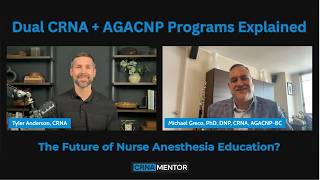
Dr. Michael Greco, a CRNA and educator at Hofstra University, designed one of the nation's first combined CRNA and Adult-Gerontology Acute Care Nurse Practitioner programs. The dual degree requires about 750 NP hours plus the standard 2,500 CRNA hours and opens scope to PACU sign-out, prescribing, and ICU management. Greco sees it as preparing clinicians for complex healthcare systems, not just stacking credentials.
Chapters
Healthcare is becoming more complex, not just in the patients that we take care of, but in the systems that we work in. And as that complexity increases, it raises an important question. Are we training clinicians to fill roles or shaping providers who actually create value in a complex healthcare system? Over the last two decades, we've seen transition of doctoral education in nurse anesthesia, but now some programs are pushing even further. Combining acute care nurse practitioner training with CRNA education into a single doctoral pathway. Today I'm joined by Dr. Michael Greco, one of the key architects behind this model, who played an important role in designing one of the earliest dual degree programs at Hofstra University in partnership with Northwell Health. And this conversation goes far beyond a dual degree. It's about how we think about the future of advanced practice.
Yeah.
Welcome back to the CRNA Mentor Podcast. Joining us today is Dr. Michael Greco. Dr. Greco is an accomplished CRNA with over 25 years of experience, known for his leadership in nurse anesthesia education and program development, including roles at Columbia University, Barry University, and the founding program director at Hofstra University. He currently practices at Memorial Sloan Kettering Cancer Center and serves as an adjunct professor while consulting with universities nationwide on innovative CRNA program design. Dr. Greco is a recipient of the AANA Helen Lamb Outstanding Educator Award, and he has also contributed nationally throughout leadership roles, accreditation work, and service on key committees and organizations from the AANA to the AANA Foundation and the Council on Accreditation. He holds a PhD a DNP, and an MBA. Dr. Greco is a fellow of the ANA and a fellow of the National Academies of Practice. He continues to shape the future of nurse anesthesia education through mentorship and professional advocacy. Welcome to the podcast, Dr. Greco.
Thank you, Tyler. Thank you for having me. This is, this is great.
Oh, you know, this is, this is a conversation I've been looking forward to. Uh, we've been talking about back and forth about this dual certification and dual programs. And you are one of the architects of this entire model. And so I'm super excited to have you here today and kind of hear it straight from somebody who pioneered this whole thing. So this is gonna be a very interesting discussion because, you know, as we talked leading up to this, there's a lot of misinformation out there, especially concerning these dual degrees.
There is, yeah, absolutely. And you know, it's funny how, this whole innovation actually developed by combining the two certifications. I've always wanted to do this. This is something that really, I always thought about. I would love to have a CRNA program combined with the NP certification. And this one goes back to my days at Columbia University, where I served as the program director, where we really collaborated closely with the NP programs there. Doing a lot of our skills together. For example, I would teach the airway management to the acute care MPs, or maybe I would teach the A-line placements to the acute care MPs, or the central line placements. And I was like, you know, there's such a great overlap. I would love to have some of their knowledge as well as some of the skills that they do that maybe we don't do as CRNAs.
Yeah.
And after I had gotten recruited by Northwell and Hofstra, I was recruited away from Columbia University for a different role, which unfortunately had a great financial—
Different delta.
Delta, where I was gonna make a little bit more money is actually why I had left Columbia. And I was a firm believer of, you know what? Everything comes with risk-taking. You gotta take the risk. So I left Columbia University and I went over to Hofstra University, Northwell Health. Um, actually, I went to Northwell first, and that's where I realized it was difficult to recruit CRNAs. So I was like, you know what, let me grow my own. Let me grow my own since the close collaboration with Hofstra. And yeah, initially we toyed with the idea of maybe having a combined program, um, and we were like, you know what, let's just get this program, the CRNA program, off the ground until, uh, we get it going, and then we can always talk about combining it. So I was like, all right. So we submitted the application to New York State, and this is where like a lot of the minutia work is done. It's not just writing the program, writing the curriculum and executing it, it's getting it past your state boards of nursing. So we sent the program to the state board of nursing and everything looked great except one thing. So my phone rang and it was the dean that called me and she said, "Mike, listen, you want that acute care program?" I said, "I would love to have that combined program." She said, "You got it." She said, because New York State views the DNP as a nurse practitioner degree, and it's tied to licensure. So we cannot develop any nurse anesthesia program in New York State without providing an acute care component to the class. Now that goes back to the history of the development of the DNP. Now people say, well, then why does Columbia University not have the combined program? And they give a DNP. Because they're grandfathered into that, as well as University of Buffalo. Every other school or program or new program opening up in New York State is required to have that dual program because we confer a DNP, and the DNP is viewed as a nurse practitioner degree.
And that's something that, you know, as people are looking at these various programs, they see many of these programs are located in New York State, That's exactly why, right?
That's exactly why, right? That goes back to the history of how did it all start?
Yeah, that's great. So, Michael, so in terms of like when you set out with Hofstra to build this program out, you know, you talked about some of the history associated with it, but looking at, you know, the future of healthcare, were you considering, you know, potentially the value that this could provide to, you know, CRNAs as well as nurse practitioners in the future?
And also, and the value to our patients and our communities at large. Oh yeah, I got, I really started to innovate in my head and said, what can I do with these dual degrees? And it really, so many eyes were on me, not only within our, the Northwell Health System, but nationally as well. Like, what are they going to do with that degree? So in New York State, you know, we work on our RN license. There's a lot of restrictions to our practice. So we don't even have prescriptive authority. We're not even APRNs in New York State. We're RNs, which is with the DNP degree, that, that is an APRN degree. So you are now with the NP part considered an APRN as a CRNA in New York State with that, with the DNP degree in New York State.
Right.
So anyway, I thought about what can I do? Because now I was also, I was in education in the university, but I was also on the health care side, the daily operational side within Northwell Health. And I was like, how can I expand the CRNA scope of practice within the health system? What could we do that we're not allowed to do now? And I thought, well, what— how are we utilizing the NPs right now? We have a lot of NPs in anesthesia. Why can't a CRNA simply fill that void since we have that certification? Why can't I sign patients out of PACU? Why can't I write orders? Mm-hmm. Eventually what I really wanted to do at Northwell was to expand into big fellowship programs, including a critical care fellowship, like we see a lot of our attending anesthesiologists do, critical care medicine. We have the background of critical care. We have that knowledge, we have that skillset, and we demonstrated that skillset during COVID when we were able to jump right in.
Yeah.
But I can tell you this, and I'm gonna only say to the nurse anesthesia community, we had that skillset during COVID but there's more skills that we lacked that were identified for us to practice in the critical care setting. And really it had to do with really the form, the formal write-up of a history and physical, and really prescribing and managing a lot of the advanced coexisting diseases long-term. Yes, we manage them in the operating room short-term, get them out, get them to recovery. But I'm talking about maybe you have a thyroid storm going on. Well, what's the proper way to manage a thyroid storm? Or, or tumulysis going on. Just different other medical comorbidities that we see that an acute care provider is responsible for that we may not have that knowledge because it's not in our curriculum, it's not in our scope of practice.
Right.
So things in the ICU that weren't just ventilator-focused or fluid volume or vasoactive medications, there was other things outside that without medical knowledge. So I figured by combining this program, that would really give a lot of, give all these nurses that are graduating, these nurse anesthetists that are graduating, that knowledge. Where they're really, really, really a comprehensive care provider and can take care of all these complex diseases.
I love that. Now, Michael, I wanna zoom out a little bit. I wanna kind of talk about, you know, as you alluded to, this didn't kind of happen randomly, this dual certification and dual degree. Let's talk a little bit, and I know you've taught this before, you know, in the setting of nurse anesthesia school about the history of the DNP. Walk us through a little bit about kind of the timeline as things have evolved here with the DNP moving up to where we're at now.
So Tyler, when do you think the first doctorate degree was given? Or conferred, I should say.
The first doctorate degree, I, you know, when I was initially researching this, I thought it was kind of, you know, early 2000s, that that's kind of how things kind of shook out.
That's when it took a spin-off of the IOM report, but really the first doctorate, practice doctorate, was given by Case Western Reserve in 1979. So we're going way back. You know, Columbia University did give an education degree, an Ed.D., out of Teachers College, which was given to nurses. So if you really look at the history of doctoral degrees given to nurses, it was kind of Columbia, but we're talking more about the practice doctorate degree.
Mm-hmm.
But that first practice degree that's documented in the literature is 1979 Case Western Reserve. It did not prepare for advanced nursing practice. So was it really a true doctorate degree, clinical practice doctorate degree?
Hmm.
So then you have in 2001, the University of Kentucky developed a program and they conferred their first degree in 2005. It was their first DNP class in the country, but it was focused on leadership and executive management. So here we go again, let's think about what the DNP degree is now. We're not focusing on leadership and executive management.
Right.
We're focusing on translational research, applying that research research into the clinical practice. That's what we want from the DNP degree. This degree was not really granted to advanced practice nurses. It was for your administrators and for others wanting to return to school but wanted a clinical practice degree. But unfortunately, the University of Kentucky really never published this degree, really never put it out there. So they're not getting a lot of credit for that, for being the real, uh, pioneers, when in essence they were.
Mm-hmm. Right.
So, you know, then we filter back to the mid-1990s. We focus on Columbia University, where we had the Dean Emeritus there. Her name was Dean Mary Mundinger. And Dr. Mundinger designed and conducted a study. She was a big advocate of nurse practitioners, huge. She did a study, and her study was to look at master's-prepared primary care NPs to doctoral-prepared physicians and patient outcomes. And she did this over a 3-year period, and she had a huge cohort of like maybe, uh, 3,500 to 4,000 participants where patients were, were, uh, cared for by physician cohort and an NP cohort. And Columbia used to use, um, the model where they really trained their nurses. It was a full-time NP program. They were out and about in the hospital really training, kind of like an apprenticeship model, where they really were training these nurses to really step up to the advanced practice role. And this was just a— this was really the landmark study. A lot of doctors hated this, but they still allowed her to go on with her research. And basically, her study results that came out showed that there was no significant difference um, in patients, regardless whether they were cared for by an NP or a physician, and this was in 6-month time, all their physiological test results with diabetes, asthma, there was no difference in the outcomes.
Hmm.
This really, really, really put the NPs in New York State on the map whereby they were granted full practice authority. It really set the stage for, uh, an innovative comprehensive care practice by Columbia University Nurse practitioners, they actually have their own freestanding clinic here where the NPs are just the primary care providers.
Nice.
And this is where Mary Mundinger, now they used to have started a Doctor of Nursing Practice degree at Columbia called the DRNP. And this was where it all started. The degree model was the Doctor of Nursing Practice. And the NP gained admitting privileges. They developed this really robust comprehensive care model where the NPs were seeing the patients, following through. They even had admitting privileges. At the hospitals from their clinics. So they really changed the first, the face of the true clinical doctorate, which is their DRNP.
Mm-hmm.
And this degree that was developed at Columbia really prepared students to manage complex patients, prepared them to manage patients in an outpatient setting with advanced clinical science, informatics, and research, 'cause they were translating their research to practice. And this degree, we have the 8 essentials that are put forth by AACN. And this really focused on that 8th essential, which is really clinical practice, focused on clinical practice, where it focused on evaluation and outcomes. And that's really what all accreditation organizations do. They focus on evaluation and outcomes.
Mm-hmm.
So since she's not given credit though for having the first DNP because it was a DRNP. It truly was the first true clinical doctorate. Later on, they changed the name from DRNP to DNP at Columbia only because CCNE, which is the organization under AACN that accredits nursing programs, they did not have an identifier to accredit a DRNP. They only accredited DNP. So they grandfathered in the Columbia University way of viewing the DRNP as a DNP. Mm-hmm. And that's where it came from. But let me tell you, this Dean Mundinger from Columbia proposed to New York State about this doctorate degree. This is the entry degree to clinical, advanced clinical practice. So this is why New York State tied onto this and said all advanced clinical providers must have a DNP degree to practice, 'cause it's also tied to their licensure. Tyler, New York State nurse anesthetists are not ARNPs.
No.
We work on a nursing license. So how could we have a DNP degree if it's tied to licensure, if we don't have that degree.
Great question.
If we don't have that license. So that's when this whole acute care component came in that we had to develop it.
Gotcha.
But really, wanna hear something really cool about this though? So the DNP, as we all know it, Mary Mundinger created an exam because she felt her NPs had the same knowledge as physicians had. She created an exam, and you could Google this, it's called The Diplomat of Comprehensive Care, DCC. Now, when physicians go through training, they do different steps. Step 1, step 2, step 3. Step 3 is their culminating exam of all their years in medical school and training that gives them a license, which is tied to their MD or their DO. It's their medical license.
Mm-hmm.
So Mary Munninger took that same exam and created an exam for the DCC. So when you graduated from a DNP program, you were able to take this comprehensive exam. Unfortunately, DNPs were not going for that. You want to know why? Because every school views the DNP separately. They retired it because it took $50,000 to run the exam every year, and maybe only 20 people were taking it. So they retired that credential, but it's very interesting to look at. It's called the Diplomate of Comprehensive Care. Certainly.
Yeah. Michael, in terms of some of the timeline for the DNP, the American Association of Colleges of Nursing endorsed this back in, it was like 2004, I wanna say.
Right.
As things evolved and anesthesia, you know, we were kind of quick to adopt some of these things in terms of the standardization with the APRNs, but the Council on Accreditation kind of got hold of this back in 2009 and wanted to kind of position the nurse anesthesia programs to move towards this doctoral preparation. Programs. You know, these are some of the big things that, that kind of led us down this road. Where does, where does Hofstra, as you kind of pioneered that program, where does Hofstra kind of fit into the timeline of when that program came out, as that was, you know, the first dual acute care nurse practitioner and CRNA degree in the country?
Yes, so the program opened 5 years ago. That's it. It literally took me a year to write and get approved, and we were ready to go. I did it full-time. I just sat there, I wrote the program, uh, we put it through the state, we made the little revamp to the hours. But you said something— the recommendation came forth from AACN about the doctorate degree. Um, we jumped on it. The CRNAs, uh, COA, we ran with that recommendation. It was just a recommendation. We are the only advanced nursing discipline that said we're making that our terminal degree in clinical practice. There are still NP programs out there that are master's based, that are not DNP based. Many of them. It is a recommendation, just like right now too, just to come off target a little bit of what we're saying, but clinical hours, um, clinical hours, they just increased the clinical hours. I wanna say to 750. It's a recommendation that NOF, the National Organization for Professional, uh, Nursing Educators in, in the NP, uh, domain, they made a recommendation to increase their clinical training hours. It's just a recommendation. CCNE is the one that makes the standards, but all these other organizations make recommendations. And that's what it was, and we ran with it. But while I was developing this program at Hofstra, we had already started the COA, kind of made it mandatory that any new programs that were opening were required to have and grant and confer a Doctor of Nursing Practice degree as their terminal degree.
Okay.
In New York State, remember that's an NP degree because the degree is tied to licensure. So on a DNP degree, it says Doctor of Nursing Practice in Adult Acute Nurse Practitioner. That is the degree that we give in New York State with the concentration of adult and acute nurse practitioner. So we have that on our degree. So here's the thing about it, it's bad. Because Tyler, saying you wanted to come from Pennsylvania and get your DNP here in New York.
Right.
You can't. You gotta come and take our post-master's NP courses and training and clinical hours in order to get a DNP in New York. So what happens to our CRNAs that have a master's and want a DNP in New York State that don't wanna get in acute care? They just wanna get their DNP and be done. They gotta leave the state. Case Western came years ago and they were like, we're gonna start a program for nurses that wanna be DNPs in New York. New York State would not allow them to hold classes here. So they held their classes in New Jersey over the George Washington Bridge. I'm pointing 'cause that's where the George Washington Bridge is. They hold classes right over and all the New York nurses would go over the bridge to get the degree. We are losing a lot of revenue here in this state because of their outdated laws up in Albany.
Yeah.
So I tried to get Dr. Mundinger to come on board. I was working with some of the faculty that's at Columbia that were pioneers in this. I was like, guys, we gotta change this for CRNAs. They're like, Mary worked so hard on this. It is so hard, only she could reverse it. But this is something that really needs to be changed.
And I think you key in on something very important here. Looking at this is very much a state-by-state thing to navigate as well. Looking at New York, like you said, I'm in Pennsylvania. We have similar, these acknowledged as APRNs, That's a similar issue here. Now, Michael, one of the things that, that I know a lot of people were asking leading up to this timeline when the DNP rolled out for nurse anesthetists, there was this timeline of 2022. And this is when, 2022 was when students who were entering a DNP program, they had to graduate with a doctorate degree essentially. And then by 2025, all nurse anesthetists going into school, SRNAs, nurse anesthesia residents, it's normalized that in 2025 now they all have their doctorate degree. That was a timeline that I think a lot of people were not quite sure of as related to the DNP.
Yeah, well, you know, the COA was really closely monitoring that and they were really disseminating— they did a great job with the rollout of it and they were disseminating what schools were still conferring a master's versus a DNP. And they really worked with each program to make sure that that timeline was met. Appropriately. But some students coming in, you know, were maybe about 2 years ago, we graduated our last master's degree class from the universities. And now everyone, like you said, is in the DNP. They'd have to come back and they would have to take that work to get the DNP degree. Now I remember this from years ago when I first was in CRNA school, the change that we had from baccalaureate to master's. And I was always thinking, you know, I know those clinical preceptors, They all had their bachelor's degrees. And I'm like, I wonder how they feel precepting us knowing that we're gonna have a higher degree when we graduate from what they have.
Right.
And now I see it just repeating itself again where a lot of master's prepared CRNAs are precepting DNP prepared students. And you always hear this, and I know maybe it was Richard Wilson or Mike McKinnon put out something recently, like we always thought we had it harder when we were in school compared to the way students have it today. But we also didn't have doctoral work, that extra workload with all these— we had a master's thesis, which some schools may, may have been a little more rigorous than some of the DNP projects, but every school was different. But we didn't have all these excess courses that we had to take to meet. Then we had 8 essentials. Now we have 10 essentials and require all these excess classes to meet those 10 essentials.
Michael, one of the things I want to kind of pivot and discuss here is there's a lot of discussion about Hofstra being one of the first programs in the country to fully integrate this dual. And I guess we keep saying acute care nurse practitioner, but, you know, as, as, as it stated, the adult gerontology acute care nurse practitioner, um, and the CRNA doctoral program, you know, from, from your perspective, how do you define that? You know, that, that Hofstra was the first program.
So we were the first program to actually offer the combined curriculum where our students that graduate are also— they take two boards. They take the MBCRNA to be board certified as a CRNA. They also take— there's two different, um, there's two different types of certifications you could take because there's two organizations that offer you certification as an MP. There's like AACN and, um, ANCC. So they— you could take either or to be certified. Now There are a lot of schools, for example, now, just going back to Columbia University, in 2029, Columbia proposed to New York State that all students in clinical programs will take the 3 Ps, advanced patho, advanced pharm, and advanced physical assessment. Those are the 3 classes that allow you to get the credential of acute care NP in New York State. However, They were not able, they're not able, if they did not take their clinical hours as an NP and have formal classes in diagnosis and management, they are not qualified to be certified as an AGACNP. They have the letters after their name, but they don't have the BC because they'll never be board certified. Now listen to this.
Huh.
New York, as hard as it is to get your DNP, 'cause it's an NP degree, New York is the only state in the country that does not require certification to practice as an acute care NP. Every other state requires you to have that board certification. Maybe California doesn't require it. I'm not 100% sure.
Maybe.
Mm-hmm. But New York 100% is the only state that requires you— you do not have to have it. However, most hospitals, and I don't know any hospitals that don't, do require you to be board certified. So there are CRNAs that put, um, ACNP, acute care nurse practitioner, after their name, meaning that they have a license, which they get a license from New York State saying they are an acute care nurse practitioner, but they're not able to practice. They could write prescriptions, but they can't practice as an NP. Where me, with that program, since I did the clinical hours and I did the dual program and I did it at Hofstra, I did the post-master's, I'm able to also practice as an NP.
That's interesting. Now, Michael, in terms of these dual degrees, there was a time where, you know, some CRNAs would— they'd be a CRNA, they'd go back and become an NP. The curriculum that you had developed at Hofstra, what kind of made this model distinctly different than anything that had existed before with this dual program?
So what I did is I really cross-mapped the program Let's put it this way. As a CRNA, we really learn about A-lines and we learn how to put A-lines in. We learn about A-line tracings. That's the same thing. There is so much overlap in the curriculums. So you're kind of killing two birds with one stone. If I have a CRNA that's doing their acute care hours, a CRNA student doing their acute care hours, and they're getting an A-line, they can count that A-line. They could count the A-line for both programs. It's still an A-line they're putting in. They're not like double dipping hours. It's either NP hours or CRNA hours. We're not double dipping hours. But procedures you could double dip. I had them doing clinicals in the ICU. They were putting central lines in. Those essential lines are not gonna change whether they're in an operating room in OR, if they're doing it under, it's still a central line with ultrasound.
Mm-hmm.
So there was a big overlap in the curriculum. So what I did is, the way we designed it was if I'm teaching primary hypertension with anesthesia related to anesthetic management, we're gonna keep the pressure 20% within the baseline, as we teach in nurse anesthesia. I'm gonna— we were expanding that on the acute care side as how would we manage this in an acute care setting on the floor going on? What is the titrate of drugs that we would prescribe for these patients? How would we prescribe it? What would we do? So we would look at acute care stuff like right in the operating room, and then we'd look at long-term on the floor. Let's look at other coexisting diseases that can come after that and alter that. What maybe diagnostic tests would we want to do on that, things that maybe we don't do as a CRNA. We would expand it a little further, like the actual diagnosis and management. We're not really diagnosing as CRNAs, we're treating, but we're not really formulating a true diagnosis, where on the NP side we are. You are coming up with a diagnosis, and there is a process that you, that you put into play when you're coming up with a diagnosis, and I learned that on the NP side. So I definitely had a lot of value within my skill set and it really increased my skill set by doing that.
Yeah, as you said, there's a lot of value to that. And I was just gonna say that, you know, kind of crossing how we operate in the operating room to, you know, we look at patients differently in terms of diagnoses in the ICU. Now, what was the problem that you were trying to solve by combining these two degrees?
Well, initially, really, the problem I was trying to solve was to get these students a DNP degree. But really, then, but really, when I put on my thinking cap, I said, you know what, how can I, one, I could really increase access to care. Imagine in these rural areas where there's a CRNA providing anesthesia that could really provide some aftercare and really medical management of these patients, pre- and post-op care, really manage them. After, you know, until they— until discharge. So we were really giving them a— we were fully equipping these providers with a comprehensive base of knowledge. What I was looking at in our healthcare system was I was looking at maybe to expand the role, like I said, in the ICUs, but even get— we're limited in New York State without practice, but I was looking to expand the role of the CRNA where they could cover PACU where NPs are managing patients. We can do that. We can sign patients out. We could prescribe. And we could do that with the acute care license and certification. So when I was on the Northwell side, I started to write a job description and do this where the CRNA was transient and could work in all these different areas, utilizing both of our skills. And it required a dual set of privileges. We had to have NP versus CRNA privileges signed off. And we were really running forward with this. But on the Northwell side, I had a very, very strong— we had a change in our leadership and a new leader came in who was very, very, very ASA-versed and very active there. And of course, trying to suppress us and did whatever he could not to move our practice forward. And he suppressed that and pulled that out immediately. And we just put a kibosh on that. But we already had the wheels in motion. My NP partners on the Northwell side were all on board and they were loving this. They were loving this, and NPs were looking maybe to come into the program. Um, it, it was just really, it was really a dynamic setup. Um, but unfortunately it didn't work in that health system just because my senior leadership was not really buying in after it already took off from the grounds. But I could tell you something, Tyler, doing this too, as I talk about access to care and everything, New York State requires us to be acute care NPs. But is that really the right, right certification for us if I want to really practice in rural America? Probably the FNP would have been the best because they are across the lifespan. The acute care nurse practitioner starts at 18. So as CRNAs, we are full-service providers across the lifespan, from neonate to geriatric population. We've got all that knowledge where the NPs hone in on a specific population. Mm-hmm. And truly doesn't make us an across-the-lifespan provider on the NP side. And that is one thing I would have done different, but a lot of the hospitals for inpatient care want acute care nurse practitioners.
Got it.
And if they have a pediatric population, they usually bring in PNPs.
Mm-hmm.
Family is more like primary care.
Yeah, that, that's an interesting perspective, kind of talking about the lifespan, but you know, as you look at our, our patient populations in the operating room, That's exactly what it is.
Yeah.
Now, Michael, one of the things that comes up from time to time when we discuss dual degrees, you know, there are some CRNAs and maybe even some programs out there that push back a little bit on a dual degree, you know, thinking that it's just more education. What is your response to that? I know you said there's some overlap certainly, but what would you say from when people offer that perspective?
You know, I wanna support this program because I did develop this program, but let's look at things on a microeconomic level. The first thing I would do is compare credits. I don't think that my Hofstra program, I wanna say it was 98 credits. I don't think that is off from any other program, but you're getting a dual degree, a dual certification. The other thing though that you wanna look at too is when you're getting a dual certification, you are required to do 750 clinical hours on top of your 2,500 clinical hours required for your CRNA. So now you're doing 3,000-something clinical hours, which is— it makes it a little bit more robust. The training is, is probably harder, uh, and more time-consuming. And in some programs, it may even be more money. Um, like I said, I know Hofstra's program was pretty much— I did look at the market And I looked at the compare— I did a comparison to the different programs because I didn't want to overload the students with credits. But that's something that prospective students should look at is the credit load. But just know there is absolutely never a loss for you to have more knowledge. You could never take the knowledge that you gain and say, oh, that was a waste. No knowledge is ever wasted. So even if you learn one thing in the program, and trust me, you would learn a lot more, you definitely should. You definitely should. Now I'm writing the program right now for Malloy University on Long Island, and any mistakes that maybe I made at Hofstra, I'm not making them at Malloy. So I think that they're gonna be a stellar program. They have stellar NP buy-in. They're loving this. And the support is definitely there, and the credits, the program will be 100 credits once we get it approved and rolled out. And it's definitely doable as well.
Great. Michael, one of the things that, that you touched on briefly is this kind of looking at these dual degrees in a regulatory and kind of state-by-state basis. And I think that's oftentimes one thing that gets overlooked in this conversation, that while our education is evolving, the practice is still regulated at a state level. Um, can you talk about that a little bit? I know we've been talking about New York State, but other places in the country?
So absolutely. And that's when you develop a program, when you're writing a new nurse anesthesia program, that's like the first thing you have to do is look at the specificities of that state that you're going into. Also, you also have to look at accrediting bodies too, Tyler. All of these different regions have different accrediting bodies. So you want to see really what their requirements are, where that university is located, what accreditation standards they have. This is even before we get into ANCC, CNE's accrediting bodies, or the COA. We wanna know the state and the regional accreditation requirements. And that's why it's good when you open a program in another state to get, to have somebody who's versed in the State Board of Nursing or the state ed department or whatever that state is following.
Right, right.
You know, because there are a lot of nuances and specificities to each individual state. And I may not be in the know of that if I'm new to that state.
And I guess my question with that is, how do you factor that in when you just kind of find a, you know, a local regional expert that's going to help walk you through that as you're developing these dual programs?
Yes, or a lot of times, like maybe your associate dean or your dean who's running that school in that region, they're in the knowing of it. They're a good resource. And then you just expand out. Each university has like a liaison in their state boards of nursing, and it's a person that you could reach out to and throw some questions off of.
Gotcha.
Look at the blueprint of their applications, see what they want as you're developing the program, and just make sure that you're able to fulfill that.
Mm-hmm.
And you know, the hardest accreditation to get through out of all of them is the COA. They're so specific and I love it because that really safeguards our profession and really safeguards the great care that we, the RNAs, do. It really makes sure that our programs are preparing adequately trained nurse anesthetists to be out there. We're the gatekeepers and the COA does a great job keep making sure that that gate is kept the way it needs to be kept so that good full-service providers are let out under the title Certified Registered Nurse Anesthetist. Thank you.
100%. Yeah. Yeah. So, so as you, as we're talking about, you know, at a state level, you're really, as you're building out the program, are you kind of looking at how, you know, graduates will be licensed or even how they'd be credentialed at the hospital?
Oh yeah. We absolutely look at that as well. Oh yeah. That's, that's a big— and you look at that as you're developing the program, you learn all of that when you start getting into your clinical training and the clinical requirements for each individual site. You know, there are many programs that students leave states. Like, for example, here in New York State, I know we got a program from Connecticut here. We've got programs in New Jersey here. You know, so those are out-of-state states that are coming into our state as well. It's the same thing if you're in New York State and you're— when I was at Columbia, my students were in Maryland, Baltimore Shock Trauma, doing trauma training. And, you know, there was definitely— I was crossing a state line. I had to be in the knowing of Maryland State Board licensure for my students that were practicing there. And they were also going to New Jersey as well. I had to be in the knowing of that. And that the state of New Jersey was a little harder to get a license based on some of their requirements. And even for CRNA graduates too, you know, they require like a DEA course more than any other state.
Gotcha. Now, looking at, you know, some of these programs, like we said, New York State is kind of a cluster of these programs. Hofstra was kind of innovative. Now, Were you able to kind of navigate this from, you know, your partnership with Northwell Health and how did they kind of support you in that?
Yeah, so when I first went into Northwell, that's who recruited me out of Hofstra. I was a director, I oversaw 4 hospitals. Within a year I was promoted to over like 22 hospitals. So I was over the CRNA practice for the entire system at Northwell Health. I was an assistant vice president. And that's when I got the innovation of where am I gonna recruit CRNAs for? 'Cause we just had a big takeover of a private anesthesia group that was no longer there. We kind of took them over and took anesthesia services internally. And I needed to recruit CRNAs and where was I getting them from? You know?
Mm-hmm.
So that's when the innovation came that we already had this university collaboration, very, very tight collaboration that I was able to do this. And I was released of a lot of my duties from Northwell Health to go over to Hofstra to fulfill the program director role where, where I was able to oversee the program because most of my responsibilities were on the school side. But the nice thing is I was funded and paid for by Northwell Health. They're the ones that pay. I wasn't paid by the university. I was an employee of Northwell Health in the university. But listen, that academic partnership that you see there, that's future. That is key. That is how these schools of nursing, if you don't have an academic partnership, The days are over for a lot of these small schools that aren't truly giving back to these hospitals because they wanna hire your workforce. You wanna train them. You've gotta train your students this day and age how they're gonna work. We need to train them to be in collaboration. We need to train them in teams because that is how we are going to practice when they graduate, in teams, in collaboration.
Yeah.
And I'm not just saying in collaboration with an anesthesia team, anesthesiologist, I mean a collaboration with other disciplines because that is key. You can't move anything alone. So having that partnership with Hofstra and Northwell and having the access to all the clinical sites was key.
Yeah.
And I tell a lot of these universities that we've gotta partner with some, we have to partner. Maybe we could, we as faculty need to give back to these hospitals as well. And you're seeing a lot of partnerships going on out there with different anesthesia groups, different universities and hospitals. Because that is key, that is future. You cannot move a mountain alone. You need to be in collaborative partnership agreement.
100%. And I want to key in on that, that little gem there. You know, as you all are looking at programs out there and trying to figure out, you know, what program is a good fit for you, look at these partnerships because they can be, you know, as you mentioned, this collaboration and access to all of these resources. And, you know, I know on the side we've spoke, Michael, about, building out, we call it like a pipeline. I'm currently doing that within my healthcare system.
Yes.
Nurses, to retain them, to recruit them, to train them, to make them part of your greater healthcare system. And there are many, many programs that are going to prioritize those nurses because they want to retain them, right?
Yeah, yeah. I mean, academic and practice, academic partnerships and practice really have come together to really listen and understand each other. And you're absolutely right. So this is when, you know, I see on the mentorship page, a lot of people, I don't care what school I get into, I just wanna get in. Well, you really should care about the school you're getting in because if you're not being trained properly because they don't have that good clinical training for you, you know, a lot of these hospitals with the partnerships have great facilities that wanna train because they wanna hopefully recruit you. But there are some universities that are out there that are just charging. They're charging, they're taking your money, they're not giving it back to the clinical sites. For clinical training, and you're getting less than par clinical training. I don't care, I just want to pass my boards and work. But you'll care when you start your first job and you don't have the skills, you don't have that training, and then you get terminated. And you know what, a termination goes on your license. You want to be able to speak your game and make sure you go to a school that's adequately going to prepare you. Honestly, we don't have very many of those programs out there because the COA would not tolerate that, but there are a few schools that, that can have better training for their CRNAs. Um, for their CRNA students that, that are going through. And a lot of that tends to happen through the partnerships because there is something that, that we're going to give back to these hospitals, right?
One of the, the questions that, that, uh, you know, I kind of keep coming back to is, with this dual certification, are you creating a better CRNA, or is it fundamentally like a different type of clinician?
I don't want to say a better CRNA because um, because I think that all of our CRNAs are great, but maybe, maybe a more comprehensive CRNA, um, that really can expand their scope and their role. For example, you know, you'll have CRNAs say to me, I can go and work in the ICU, uh, with no problem at all. You, you probably can go and work— you, you most certainly can go work in the ICU with no problem at all, and you most certainly can be to see an NP, but it's just giving you that extra education. Everything starts from education. You could do anything you want. You absolutely can do it. There's no doubt in my mind that a CRNA cannot conform to an NP role, but there is excess knowledge that you gain. I can give a TPN sheet to a CRNA and say, okay, fill this out for your patient that's going back to the unit. Well, that's something that acute care NP will do in the ICU. I could teach you how to do it and you can do it, right? Mm-hmm.. But do you know how to do it offhand, where someone could throw a TPN sheet at me right now and I can write those orders? You know, I can easily pull up my calculator and calculate an anion gap by just looking at my gas. I could do that just because I had that mindset and that acute care training, where as a CRNA I'd probably have to Google how to do it, and because I wasn't doing it all the time. But there it is, it's just added knowledge that you can add extra tools in the chest. Every CRNA is capable and competent to be an acute care NP. It's just having that excess knowledge and, and tools to really expand your knowledge base. I could tell you the DCC exam was, was a perfect mirror of that. It was very hard for CRNA to pass, um, because we don't have that medical knowledge. I, I didn't know the first thing about looking in an eye. I learned it in physical assessment class, and I threw it in, in the back seat of my car after I learned that.
Right.
But to take an ophthalmoscope and go in and do a fundal exam, I can actually do that now and really look at your vessels and understand it because I had a lot of time doing that in clinical practice with my physical assessment. You know that everyone gets a physical assessment when you assess a patient in the unit or on the floor or in the acute care realm. That's not something we do in anesthesia. We'll do a quick and dirty physical assessment, airway, lungs, heart, take a great history and move on. We're not really adequately doing a full physical assessment, a physical exam that we normally do.
You know, most of our— the audience that's listening today, they're, they're just thinking about getting accepted to CRNA school. They're, they're focused on their ICU experience, maybe improving their GPA, GPA, getting their CCRN. You know, should they even be thinking about, you know, these dual certifications out there, uh, as they position themselves as an applicant?
You know something, Tyler, you never know what the future brings. So why not, if you have the opportunity, why not take advantage of it? You never know, you can start, think of going on a camping trip. You start on one path and who knows where you're gonna end up.
Yep.
And your life and your academic career is just like that. You may intend to end up at point B on the other side of the park, but you may end up in a golf field, a golf course. You don't know. So just prepare yourself and bring on any opportunity that's potentially there because where you plan to go, you may not end up there. You may end up somewhere else and you may end up in a great place. You know, just think about how marketable you could be to be an APP director somewhere over both CRNAs and acute care NPs because you have both degrees.
And, and it kind of in line with that, you know, as these applicants, everybody's asking me like, how do you stand out? How do you, you know, how do you look different? You know, somebody who is focused on maybe this dual degree from the start, How can you show that you're focused on it? How can you show that this is something that you've intentionally done to position yourself for this program? You know, as a, you know, somebody who's pioneered this type of program, is that something that you'd be looking for in applicants?
You know, I hear like when I would interview a lot of candidates out here, you know, I was so torn between do I wanna be a nurse practitioner or do I wanna be a CRNA? You'll always have those candidates to say, I wanna do nurse practitioner and I wanna do CRNA. You don't do, you be, come. But I, I would have a lot of them. I, I was torn between the two of them, but having this, having this, this is both what I wanted in a career. And that's why people are applying to the program because they wanted both. And, and that's exactly the type of caliber of a student I want, someone that wants to be there.
Yep.
Once you start this program, if you just wanna be a CRNA and you're pushed into these dual programs because you got a seat, That may not be the right fit for you because I can tell you how many times I would hear, "Ugh, I gotta do my NP clinical hours." And I'm like, embrace it. You signed up for this program, you knew you had to do those hours, get something out of it. Round with the docs. This time you're rounding, you're on that team. They're gonna ask you physiology questions. Bring that knowledge back into your advanced physiology course because you're gonna get it. Embrace it.
I love that.
Yeah, don't look at the glass as half empty, look at it as half full. It's a great opportunity and it's built in the program. Oh, I just wanted to concentrate on anesthesia. I don't wanna do this acute care stuff. Well, this wasn't the right program for you then.
Looking towards the future here, Michael, do you see more programs moving towards this type of dual preparation?
Yeah, you know, I first created this at Hofstra and then multiple schools were calling me asking me, how did you do this? And I would sit down, it happened at a lot of the congresses. I'd meet with different programs program directors, I'd show them my curriculum map, my matriculation plan, and I would say, this is how I did it. These courses overlapped. This is where I put the additional clinical hours. This is where I put the diagnosis and management courses as it overlaps some of the content in coexisting disease. That's what I kind of did is a lot of the stuff was coexisting disease type courses that overlapped with the NP courses. And I did it over 3 semester time so they could get all their clinical hours.
Mm-hmm.
But since then, there have been numerous programs that have followed this lead and have opened programs throughout the US. I could tell you there's one in New Orleans. I know that there's Rosalind Franklin that has one. I know there's a program in Boston that is considering one right now. We've got Malloy opening. We've got Hofstra. I know that Albany has a component of it. I don't know if their students are board eligible, but I know that they do have that component in order for them to grant the DNP. There's a school opening in Rochester, there's St. John Fisher. So there definitely are programs that are following the lead and doing what we did at Hofstra, and they're looking at how we did it at Hofstra and implementing that in their program. Some of the schools are not even changing the course name, keeping them the same as we had at Hofstra. Whatever.
Yeah, no, no, that's great. So, so more, certainly more adoption, you know, of these, these dual programs that are out there. You know, as, as we look to kind of wrap this up, Michael, one of the things that, that I think needs to be part of this conversation is our applicants, you know, positioning themselves to provide the most value to our patients, the most value to the nurse anesthesia community, uh, you know, try and impact everything that we can in moving this profession forward. And, and I think there, there needs to be a part of this discussion about how much value this brings to you as a clinician. Similar to the, you know, the programs that really prioritize, you know, independent practice and independent, you know, experiences while you're going through this training. I wanna frame this in terms of value. Would you say that, you know, this nurse practitioner dual degree here offers more value and makes you more marketable in the future?
I, 100%. I think that it definitely opens, as a nurse anesthetist, We're equal. But there are more opportunities outside of nurse anesthesia. Maybe, you know, right now when you graduate as a new grad, you wanna give anesthesia. That's what you work so hard for.
Right.
But maybe 5, 10, 15 years, you wanna be in a leadership position. And like I said, you may be a leader of APPs. When you're sitting at that table, you can also talk not only nurse anesthesia where, you know, we're always the black sheep. People don't understand us. Nursing doesn't understand us. Physicians don't understand us. But when you throw in that NP credential, you're also one of them. You're nursing, they understand you. So when you're at that table and they know that you're also an NP and you're a CRNA, your voice may be a little bit more clearer that they understand because they know that you are one of them. So there may be more opportunities that will open up for you. You know, even like maybe, of course, CRNAs, because of the procedures that we do, we tend to make a little bit more money if that is your motivation. But there's a lot of flexibility on the NP side. Maybe you want to go work in an urgent care center. Oh, wow., and you certainly could do that as an acute care NP. Um, there is a lot of flexibility. You wanna do telehealth, you wanna work from home, you could certainly do, um, you could be the IV therapy nurse from home, you know, doing the consults. There's so many different things that you could do as an acute care NP. Of course, it is limited to the state licensure, what their scope of practice allows you to do outside.
Mm-hmm.
Um, but there's a lot of different, um, opportunities for you as an acute care NP and CRNA. So I think it— there is a value to it because like I said, you never know where the future is going to land you, but you got skills behind you. Even, even like, even one other quick thing, even as an educator, guess what? I teach right now. I help Columbia University out. I'm not in the nurse anesthesia program. I'm helping out the acute care program. I'm giving them lectures. So even like in schools, when I, you know, if I'm looking for an academic job, I could market myself as I could teach across all programs. I could teach in your CRNA program, your nursing program, and your acute care, AGACNP program, because I got all the skills. You never know where you're gonna end up.
That's dynamic. I didn't even think of it from that angle, but that can open so many more doors.
Yes, yes.
Michael, in terms of, you know, last thing to kind of leave our listeners with here, you know, any of our listeners today who are considering one of these dual programs, what would you say to them as they get ready to apply, as they try and think to the future as to what this could bring for them?
This is what I always tell my students. Nothing good comes easy. If it's easy, it's probably not gonna be good. And I don't wanna knock the NPs, but NP education is done on a part-time basis. You're able to work, your life isn't really interrupted. You're taking your classes. I'm not knocking the programs at all, but it's different. And a lot of NP, you never find a CRNA that comes out and says, I'm not happy with my job. We love our job. You may hear MPs come out that are solely on the MP track that they want to come over to the CRNA side because they want to come over to us. But we work hard because nothing that requires hard work is going to come easy, but it's going to be good. So I embrace all the MPs because there are a lot of MPs too on the mentor side that want to come over to the CRNA side. I welcome you. You know, years ago I may have said, you know, you had your opportunity and you chose to be an NP. Now what is your motivation for coming to our side? But I see the value in both. So I welcome them now. I welcome them to any of our programs. I think you're an asset to our program.
That's great. Well, Michael, thank you for joining us today. And one big takeaway I want for everyone who listened to this episode is that, you know, this really isn't about just a dual degree. It's about perspective. Because it's really easy to kind of focus on the steps in front of you, you know, getting into school, passing boards, landing your first job. But the people who truly stand out in this profession are the ones that understand the bigger picture, you know, how healthcare is evolving, how these roles are changing, and how does that fit into the larger landscape of healthcare. And these dual degrees can certainly help with that. And I think, you know, it's important to look at, as we discussed before, the value that is created from these systems when you have two different perspectives and really can look at it from a nurse practitioner and look at it from a CRNA. And that's really the shift. It's not just about filling a role, but it's starting to think like a provider. So, you know, as if you're going through this and really considering this option, look into it and look to see, you know, how does this align with your future goals? I really want you to think about the kind of clinician that you're becoming along the way and the value that you're gonna bring when you get there, because ultimately that really defines the impact that you're gonna make in this profession. So, Michael, I, I can't thank you enough for joining us today and, uh, for your contributions to the CRNA Mentor community, and, and especially everything that you're doing from administrative, from, you know, academic side of things, building out these programs and being a true voice in nurse anesthesia.
Thank you, Tyler. I appreciate it.
Absolutely. Thank you. Take care.
Thank you.
More from Tyler


How to Make the Most of AANA Annual Congress as an RN | Advice for Aspiring CRNAs

Professionalism Starts Before CRNA School - The Kind of Applicant You're Becoming


Locums, 1099, and W-2 CRNA Practice Explained: What Every Future CRNA Should Know

From Penn to Solo CRNA Practice - The Unexpected Growth of Independent Practice





The Most Unique CRNA Role in America? Shock Trauma Go Team & Austere Medicine