How to Choose the Right CRNA Program: Information Sessions Explained
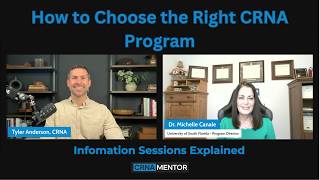
In this episode of the CRNA Mentor Podcast, host Tyler interviews Dr. Michelle Canale, Assistant Dean and Nurse Anesthesiology Program Director at the University of South Florida (USF). The conversation centers on the pivotal role of CRNA program information sessions and open houses in helping applicants make informed decisions. Dr. Canale emphasizes that applicants must treat these sessions as two‑way evaluations—assessing both program fit and personal readiness. She outlines the granular details prospective students should scrutinize, including curriculum structure, clinical site diversity, simulation resources, OSCE boot camps, financial‑aid options, and life‑logistics planning. The discussion covers the importance of transparent program statistics (GPA, GRE, attrition rates), the value of faculty and current‑student interaction, common applicant missteps, and the stark reality that re‑admission after withdrawal or dismissal is less than 1%. Rapid‑fire questions highlight emotional intelligence, weekly time commitment, and self‑assessment as key predictors of success. The episode concludes with details about USF’s upcoming hybrid open house on May 15, 2026, and a call for applicants to engage early with the AANA and professional networks.
Questions this video answers
Attend information sessions, ask questions, meet prospective students, and understand the profession.
Emotional intelligence.
The weekly time commitment.
The rigor, time commitment, and their own ability to handle it.
Is this profession for me? Am I invested in the profession for the long term?
Chapters
One of the biggest mistakes I see aspiring CRNAs make is applying to programs they don't truly understand. They spend months perfecting their resume, studying for the GRE, and preparing their applications, but they've never actually taken the time to deeply learn about the programs they're applying to. That's where CRNA information sessions and open houses come in. These sessions are one of the most valuable and most underutilized resource available to applicants, because when you attend them, you begin to understand something that many applicants overlook. CRNA programs aren't just evaluating whether you're a good fit for them. You should also be evaluating whether the program is the right fit for you. And in this episode, we're going to talk about why attending these sessions actually matter and how they can completely change the way that you approach applying to CRNA school. Welcome back to the CRNA Mentor Podcast. In today's episode, we're going to discuss the importance of the CRNA open house house and information sessions and how they can be an asset to your development as a CRNA. Today joining me is Dr. Michelle Canale. Dr. Canale is the ANA Director of Region 9 and the board liaison of the membership committee. She is the assistant dean and nurse anesthesiology program director at the University of South Florida in Tampa, Florida. Dr. Canale leads, uh, one of the largest programs in the country and was recognized as the ANA's Program Director of the Year in 2025. Dr. Canale is a fellow of the ANA. She serves on the ANA Education Committee as well as a board director, vice president, and the president of the Florida Association of Nurse Anesthesiology. Her passions are professional leadership, advocacy, service, and educating full-scope future professional CRNA leaders. Welcome, Dr. Canale. Thank you for joining us today on the CRNA Mentor Podcast.
Thank you so much for having me, Tyler.
Yeah, this is something, information sessions, virtual open houses, it can be such an asset to development and really honing in on the specifics of these programs. And that's exactly what we're gonna talk about here today. And, you know, one of the reasons I really wanted to talk to you, I think we could probably have a million different episodes in terms of all the different things that you're involved with and all the, you know, things that you bring to not just the ANA, but, you know, your Florida Association as well. But, you know, your program and the virtual open houses and open houses that you do are so robust. You know, I often talk to mentees and we talk about how, you know, it's great to attend these, but there's very much a spectrum of what you'll see out there is that sometimes it's a surface level and sometimes it's, you know, completely inclusive and people leave these things saying, "I have no further questions." And I feel like yours is more of the latter. So let's get into it a little bit today. You know, Michelle, many applicants see information sessions as optional. From a program director's perspective, why are these sessions so important?
Yes, I can't stress the importance of attending any information sessions that are offered by the programs that, um, you're applying to. Um, this is one of the biggest, uh, decisions somebody can make, um, across their lifetime. It is a huge commitment Uh, so it's important to have as much information about the journey as possible. Um, we understand that, uh, our applicants are ICU nurses who are at the pinnacle of their ICU careers at this moment in time when they're thinking about applying to nurse anesthesia— nurse anesthesiology, uh, programs. And so they, um, have a full career. Uh, they are usually the resource person in their ICU.
Mm-hmm.
Um, they are somebody that is mentoring others already and who people look to as a resource. Um, they are about to make a decision to put that behind them and put that aside and, and leave that behind as they move on to the next step in their journey in life. Um, that's a big deal. Uh, so I think it's really important that prospective applicants really know what this is. Mm-hmm. Before they make that decision.
Absolutely. Yeah, I, you know, talking about how comprehensive your open house was last year, and you have one coming up, which we'll talk about here shortly, but, you know, the one from 2025 lasted over 3 hours. You talk about a wide variety of things, and, you know, what are you hoping applicants walk away from in understanding about your program after attending?
Well, you know, there is lots of information that you can find out about our program on our website. But not everything can possibly be displayed there. There's lots of other granular details that are really important for people to know, and one of the things I mentioned quite a few times in the open house is that we don't want any of this to be a secret. We want all of the information, you know, as much as possible to be out there so that prospective applicants can make the right decision for them, not only about about which program they want to apply to or which program they could see themselves in for the next 3 years, but also whether this is the right time for them. Because I mentioned several times, you only get one shot at this. And I explain a little bit why that is during the open house. And so it's critical for prospective applicants to have as much information as possible. [FOREIGN LANGUAGE] So we— I love doing the open houses and then posting them on our website so people can watch it at any time. If they weren't around at that time or didn't know about it, they can just click in and watch it from the previous year and get the most recent and up-to-date information about the program as they're going through that journey of considering applying to the program.
Yeah, that's great. And I love how you frame it. It's not a secret, you know? It's not like these programs are trying to hide something and it's like, oh, it's expensive exclusive, you know, to this information session. It's like, let's get this information out here. Let's make it accessible. And I think, you know, the more and more programs that can do that are just going to, you know, ensure that people are aligning appropriately with the programs. And as you said, making sure it's a good fit for them and making sure that they know what they sign up for. You know, I think that that's really my takeaway, especially from your open houses, is ensuring, as you said, that this is the right time and the right fit.
Mm-hmm.
You know, when applications attend these sessions, what aspects of the program should they be paying kind of the closest attention to when attending these open houses?
Well, I think open houses in general will give a lot more information that they may not have gleaned through the other methods like perusing websites or even shadowing or even meeting people at conferences. Program faculty and program directors or other students at conferences. There's a lot more granular detail in these open houses. We like to cover everything from our curriculum to our clinical training and where those sites are. We, as you mentioned, our open house was pretty long at 3 hours. I've brought in people from financial aid so they can talk about what that looks like.
Mm-hmm.
We have our DNP project course director present on the DNP project, because that is a big component of the doctoral program to become a nurse anesthetist. So all of these things are so important so that prospective applicants can get that more granular level of information.
Mm-hmm, absolutely. And I think, you know, even bringing in, as you mentioned, financial aid, there's many things that, you know, especially as people going to this process, if they don't have anybody else in their family that has maybe even been to higher education and now they're trying to navigate this themselves, I think there's a lot of pieces that may not be on their radar. You know, certainly the financial aid piece, I think, is at the forefront, especially, you know, I know you were featured in that one podcast with the One Big Beautiful Bill Act, and I had something with Dr. Daniel King, we spoke about that as well. So I think that's kind of on people's radar, but to have somebody actually come and talk about that, it really puts things in perspective, how to best approach this and ensure that you have all the information available to make the best decision. Yeah. Um, in the past, you know, you've shared the average statistics of the cohorts that have came through your program. Why is this important for applicants to understand these numbers and these statistics?
We see a lot of, um, dialogue out there on different Facebook groups, um, where people are discussing GPAs and can they get into a program with a specific GPA or not. Um, I see people talking to each other about that, and, and sometimes the information that's out there is not always accurate. So I think it's important to be present. I like to be present in those groups when I have the time. I like to weigh in and try to give very accurate and realistic information from the source, which I think everyone—
Yep.
Everyone can benefit from that. I think it's good for prospective applicants to see what the data is on who has recently been selected in aggregate, you know, those aggregate average GPAs that we look at and who has been admitted in the previous admission cycles. It gives people a more sense of reality of the situation. And more perspective. If their GPA is a little bit lower, maybe where do they need to try to get it to, or whether or not this is a realistic path for them, because we definitely don't want somebody wasting time and resources and energy if this just isn't in the cards, and it's not for everybody. So I, you know, again— Yeah. I really don't have any— we don't have any secrets. I want this information out there. We may not have the highest average GPAs of all the programs across the country, but that's not important to me. What's important to me is that prospective applicants can, can see who it is that we're admitting on average.
That's— I, I love that. And, and first off, thank you for, you know, you've been a, a big important member of the CRNA Mentor community, our Facebook group. And, and when you share information. You talk about, you know, it coming right from the source. And, and that's exactly, you know, how I like to frame this as we have more and more, you know, program directors joining, faculty joining, and kind of adding their two cents. But when you chime in, I always pay attention to the posts that you have because I'm like, I'm gonna learn something here as well. So I really appreciate that. And I think there is a lot of value. Many applicants are so focused on stats, and at times I feel like they almost reduce themselves to what their stats are. And, and you kind of have to look at beyond that. But at the same time, I think I think it's important for you to acknowledge, you know, ensure people aren't wasting their time and that this isn't, you know, the right path for everyone. But nonetheless, you know, the stats are something that people are very, very, very interested in. So I appreciate you, you know, sharing those details. During your previous open house, you highlighted a wide range of clinical sites that students train at within your program. Why does your program place such a strong emphasis on exposing students to different clinical practice environments?
Yeah, so every nurse anesthesia program is accredited by the Council on Accreditation, the COA. And in that respect, there is a minimum bar that every program is trying to meet with regard to having a portfolio of clinical sites that offer the minimum number of pediatric cases and open heart cases, you know, craniotomies, obstetrical cases, labor and delivery type cases, and, and many, many other categories. We certainly are not a program of minimums, and if you look at history over time, the goal of the COA and the AANA is to advance the profession, so they're constantly monitoring not only are programs getting the cases for their students that they need to, to meet accreditation and so that the students can qualify to sit for the National Certification Board exam at the end of their program, but they're also monitoring, are programs doing more than that? What are they doing? Um, could we raise the bar without eliminating any programs from being able to have their students complete their, their minimum requirements. You've seen over time that the case requirements have changed. So particularly for our program, we're striving for more than minimum training requirements.
Yeah.
Um, and we want to make sure that our students are able to graduate and practice to the full scope of anesthesiology services. When I say anesthesiology services, I mean by any given provider, even, you know, physicians. We're all practicing, we're all learning from the same textbooks, we're all using the same medications, we're all using the same techniques. Um, CRNAs are the only anesthesia provider that is interchangeable with their physician counterparts. And so our goal is to train the future of the profession to practice to the full scope of any anesthesiology service provider. Um, So if you look at our clinical site portfolio, we have 48 or 49 clinical sites now. It's constantly changing because we're seeking out, um, new sites that offer something new and different and more than what we have. Um, for example, we now have a critical access CRNA-only clinical site. And that site is training our students to be independent, independently practicing, critically thinking, independently thinking providers. We've had many students who were able to graduate and work in a CRNA-only practice setting on day one. We've had several graduates who work in the Indian Health Service, rural Alaska, the Dakotas. And so that is our goal, is to not just meet minimums but to surpass that, be ready for the next change in minimums and case types that the COA may implement, and be on that leading edge. So we have several Level 1 trauma centers, Level 2 trauma centers, burn centers. We have several pediatric hospital settings. We have robust obstetrical experiences, and we've added in recent years CRNA-only practice sites, which we think is really important for our students to get that.
Yeah, no, and I really want to highlight that for all of our listeners, is that, you know, when you're going through this process to, to identify schools, this is something, you know, people often ask me, if you could do this all over again What would you do differently? And if, you know, I— my, my opportunity to go anywhere in the country and, and find schools that really value independent practice and have, you know, these autonomous sites baked in that they prioritize CRNA-only practices, you know, that is going to prepare you the most for what's to come. And, and the— I think the subtle thing that, that many applicants don't realize is that it is going to make you more valuable as a CRNA if you have that under your belt. And there are some CRNA practice groups that focus on individuals that come from these programs that already have independent practice. Or, you know, I know you mentioned in your open house about having a 2-to-1 ratio, you know, of nurse anesthesia residents having a CRNA oversee 2 different rooms, you know, when they get into their latter parts of their practice. So like, I think as if I could do this all over again, I would really prioritize those sites because they're going to give you the most bang for your buck and frame it in a way that it's important important to them, so then it can be important to you and you can achieve some of those goals. So I absolutely love that about, about your program and how you, uh, everybody in your group and at your program values that as well.
Um, thank you. Thank you. We really do try to, um, be on the leading edge there.
Yep. That's excellent. Uh, Michelle, when applicants are comparing programs, how important are educational resources like simulation labs?
Well, simulation is a huge part of nursing anesthesiology education. It's important for applicants to look at what the resources are of the program to see how they're, you know, implementing simulation into the curriculum. In our program, we have worked really hard to align what our students are covering in simulation during any given week in the program and align that with what they're also learning in the classroom. It wasn't It wasn't always like that, but we've worked hard to realign our curriculum so that they're not studying OB in simulation, but they're studying open heart in the program at the time in the classroom. That doesn't make as much sense to do it that way. I believe in a sort of a layering technique where some people are visual and tactile learners and some people are auditory learners. People learn in different ways, but everyone can benefit from a layering effect of being assigned a reading assignment in obstetrics, hearing a lecture in obstetrics, and then going into the sim lab and actually putting hands on and practicing obstetrics techniques and skills and high-fidelity scenarios in the operating room.
Mm-hmm.
So that's how we approach simulation. We, we have a state-of-the-art simulation center at the Center for Advanced Medical Learning and Simulation in downtown Tampa. It's all— the acronym is CAMELS. That is a world-renowned simulation center with real certified operating rooms. That's where students learn. And so we're very fortunate to have that resource. Not every program has that. And in honesty, You don't necessarily have to have a CAMELS, uh, in your portfolio to offer simulation, uh, curriculum in your program. But I do think it's an important aspect, especially if you're a learner who likes to, um, to actually have hands-on to practice before you're actually going in to give real anesthetics to real patients. It's very beneficial.
I love that layered idea of teaching. It's something that, you know, I know when all these programs made this transition to the DNP or DNAP, it was something that a lot of programs then kind of turned into front-loaded programs because it kind of made sense with the flow of stuff. But, you know, people often ask, you know, would you do an integrated program or a front-loaded program? And my program, we had one semester of didactic and then got right into clinical. And I really appreciated seeing in clinical what I was learning in the classroom and, and that layered technique. Um, even though your program is, uh, front-loaded, correct?
Well, it, it is sort of front-loaded and then, um, integrated quickly. Uh, so the first semester is all didactic. The second semester is all didactic. The third semester we start, uh, simulation and we do a 6-week simulation boot camp where we Um, have students come into the sim lab and learn all the basic things they should know before they step foot in the operating room. They learn, um, basic, uh, emergency airway setup. They learn an induction sequence to induce the patient under anesthesia, masking techniques, intubation techniques. They learn a full top drawer drug, um, cadre of anesthetics. They have to pass an exam on that. Um, They, they learn an FDA machine checkout. And they have to pass an OSCE, or an observed structured clinical evaluation, on all of those things at the end of the 6 weeks in order to qualify to start clinical in week 7. Then they start going to clinical. In the beginning, when the program was a master's program, it was truly front-loaded. And clinical started later. Through feedback and evaluation of the program over time, the clinical was moved up in the program and added in based— we do a lot of evaluation techniques. Students evaluate the program, faculty evaluate the program, our clinical partner sites evaluate us, and we listen to every word of that and we make deliberate changes. That's how we've improved over the years. And so we do have 2 semesters of front loading, but then we go right into clinical. And our students pass that OSCE, go into clinical, and I can tell you that I think that makes a real difference in setting them up for success. And it's something that our clinical partner sites have given us feedback that they truly note the difference in our students.
That's, that's amazing. I haven't heard of the OSCE before, but I would hope more programs employ that approach. Do you know, are there other programs out there that have something similar?
Oh, I'm sure they do. OSCE is just an acronym for an observed structured clinical evaluation. And so other programs I'm sure are using OSCEs in their simulation curriculum, but it was one of the greatest improvements we implemented in our program many years ago. Is to have that boot camp that prepares students and tests them before they qualify to go into clinical. And if they don't quite pass one part of the OSCEs, we'll remediate. They'll come back and retest and probably go into clinical the following week. But we want to make sure that they're set up for success.
Yeah, no, that's excellent. You know, your program, we talked about it briefly earlier, but your program discusses financial aid and you speak very openly about life planning, before starting the program, everything from childcare to managing responsibilities outside of school. Why is it so important for applicants to think through these life logistics before starting their program?
There is so much more to being successful than just having the right GPA or perhaps a GRE score, um, whether you have all the right prerequisites or the right ICU experience to support your knowledge and success in the nurse anesthesia program, there are so many other things that, that contribute to success or can detract from success once you're in the program. And these are things that you really should be looking at before you embark on this journey. Um, This is a full-time program. You cannot work when you're in the nurse anesthesia program. We've had students that have tried it and doesn't turn out well. So it's important to be set up for success, understanding how you're going to pay for this, what that looks like if you haven't saved up money ahead of time, or if you have saved up money ahead of time, what that would look like for you. Whether or not you have adequate childcare, whether you have a good backup plan if your child gets sick or if your spouse gets gets sick or your partner and they are not able to help you, you have to have a backup plan. And this is sort of the nature of what we do as anesthesia providers anyways, right? We have a plan, we have a backup plan, and we have a backup plan for our backup plan.
Mm-hmm.
And that really starts when you start your program. So again, there are no secrets here. We want to make sure that everybody understands what this is before they embark on it so that they can mitigate some of those possible things that can derail them. And We want everyone to be successful. We are not selecting students that we don't believe can be successful. But even having said that, um, things fall out of the sky. So what's your backup plan for that?
Right.
And then you only get one shot at this, right?
Yep. Yep. And you know, the, the teaching that life doesn't stop even though you're in your CRNA program. So, you know, being adaptable, but setting yourself up for success as well. You know, Michelle, one of the most valuable parts of information sessions is the opportunity to meet faculty. Why is it important for applicants to interact with faculty or even current students during these open houses and information sessions?
I think it brings transparency. It allows prospective applicants to determine whether it's a good fit Um, certainly all programs are trying to meet the same accreditation requirements, but they have different ways of doing that. Um, being able to assess whether there's a robust faculty team available, um, and that, that is in, um, a good ratio to the number of students that they're admitting is important. Um, certainly accreditors are looking at that too and trying to ensure that programs have resources, but it also gives prospective applicants a chance to see how they relate to the faculty, whether they feel a connection or whether they feel faculty are readily available and supportive and, and who they are. They may make a connection with a faculty member. Um, you know, I get questions sometimes about, you know, your program is very large. So how will that possibly be different than if I go to a smaller program? Well, the short answer to that is, it won't be different if you— a program has a robust faculty team in a similar ratio of faculty to students as a small program. And we do, we have a very robust faculty team, we have 8 full-time faculty, 2 regular part-time faculty, and a whole cadre of adjuncts. Many of them have been with us for many, many years. We're very lucky. We have such a great team. We all work very well together. We enjoy what we do. We enjoy each other. And so it really helps students through the process to, to get to know those faculty and see what that connection is.
Certainly. And I've had, you know, more than a handful of mentees that, you know, they're going through this process and like, this is my top school, this is my top school. And then I talk to them and, oh, how was the information session? How was, you know, the open house? It's not my top school anymore. It felt off. It felt like, you know, I didn't have the connection that I thought I would. And I think that's why these are so important to, you know, again, not just, are you a good fit for the program, but is the program a good fit for you? And, and I think you can really gather that, especially talking to faculty, especially talking to some of their current students. Your open house, are there any student involvement? Do they have any availability to talk?
Yes, our students are there as well. Usually we're inviting our student government officers, our students have an election close to the beginning of the start of their program after they've had a chance to get to know each other. They elect student leaders that— president, vice president, secretary, treasurer, uh, and there are several other positions as well. Um, those students are usually the ones that are coming to these events and meeting with prospective applicants. Um, prospective applicants love meeting our current students They do that both at the open house as well as in some of these conferences. Our, our students are going to lots of these conferences. We highly encourage and support that. We believe it's part of the professional mentorship and enculturation of supporting the future of the profession. And so prospective applicants will connect with our students quite frequently at some of these conferences, and they love picking their brains, really getting down to the details of what it's really like to be in a program, maybe even without the faculty there so they can speak openly and honestly.
Yeah, absolutely.
I think that's great. I want prospective applicants to have as much information as possible about what this really is and what it really feels like from a student Yeah, no, I love that.
And I've realized that as well. It's like, you know, people enjoy talking to me at some of these conferences, but then if there's a nurse anesthesia resident, I'm like, here, go talk to them because I know you're going to ask them all the deeper questions. You know, maybe the questions that they don't feel comfortable asking faculty or staff. And, and, uh, no, that's great. Making that connection. Michelle, what mistakes do applicants sometimes make when engaging with faculty during these open houses or information sessions?
So it's important to have good situational awareness and self-awareness when you're interacting with prospective programs that you're going to be applying to and even their students. In our interview process, there's a faculty interview of the applicant, but then there's also a peer-to-peer where the student— our student is interviewing, or a group of our students are interviewing a prospective applicant, and they're also filling filling out some forms and answering questions. And we collect those and we look at what our students are saying with the applicant. Sometimes it's interesting because the applicant may say things very different to the students when the faculty aren't there than when— what they say to the faculty in the faculty part of the interview. I see applicants trying to give their elevator speech you know, about themselves and, and try to, to advance their standing in the application process maybe by, by doing that. The way to be great in the application process is to be great, not to try to portray something. It's all there in the application.
Right.
It's all there. So just keep that in mind. Don't try to oversell yourself or be too pushy or, you know, in-your-face type thing.
Yeah. So would you say, should prospective applicants, should they be bringing their CV to an open house if they're attending in person, or is that something that it's already going to be part of the process? It's not going to really help at all.
The CV is already part of the process. It's part of the application and you will have to upload a CV as part of your application. Handing it to a prospective faculty or program director is really not going to advance your application at all. So I, I don't advise doing that.
Yeah, and that's— and you kind of touched on that about conferences as well. I've heard from a number of other faculty, it's just like, I really— what am I going to do with that piece of paper? You know, It kind of gets lost in the shuffle. And it's— I feel like at times, you know, maybe these individuals are being coached to, oh, bring your CV, give it, pass it off. And it's like, OK, I passed off my CV. Now I can kind of go run away. And— But at the end of the day, I think, you know, you talk about situational awareness. And I think that's really paramount here in terms of trying to navigate this is just realize what's going on and trying to, you know, just introduce yourself and make a good first impression without being kind of like a, a car salesman. I think that's the main takeaway here.
Just be genuine. Be real. Be genuine. That's really important.
Yeah. Michelle, during your, your last open house, one of the things that really stood out to me was how you talked about how rigorous the program is clinically, academically, personally. Why do you feel it's important for applicants to hear this level of honesty before they apply?
I think that, um, in some respects this can still be somewhat of a mystery, um, and I've talked to many, many students and applicants over the years and there's been a consistent theme. No matter how hard we try to describe how hard and rigorous the program will be, students that are now in the program always come back and say As hard as you tried to describe for me how hard it was going to be, it was so much harder than I could even imagine.
Sure.
So, you know, that's— it's unfortunate that it is— it just is that hard. Nevertheless, the right applicants that we select can do it. We believe in them. If we've selected them, they can do it. But I think it's important to make sure that they understand that from the beginning so they can mitigate some of those ways that may try to derail them or maybe become a distraction. Again, I would never want somebody to apply and enter a program who did not have a good understanding of how rigorous the program is clinically, academically, and just with other life events that may pop in and try to derail them.
Mm-hmm, and I love that, and I think that, I agree, I think that is so, so important., to ensure that they know what they're signing up for. And, you know, as I was listening to your, your last, uh, open house, I, I really try and my best to empathize with, with all these aspiring CRNAs. And, and I, I'll be honest, like, I did get a little bit of a pit in my stomach as if I was feeling nervous, like I was applying to the program, because it's like, wow, this is, this is a lot that I'm signing up for here. And I think it's completely normal to feel that way. You know, you attend these information sessions, these, uh, open houses, and, and for you to be kind of questioning, you know, Wow, this is a lot. But I think it's also a mindset piece here as well. You know, this, as you said, you're selecting these students because you believe that they will be successful. And I think for the applicants that, you know, get those letters of acceptance, that should be, you know, reaffirming their, their beliefs that, hey, there's somebody else that believes in you, that you can do this. So I just want to point out that it, it is normal to kind of feel this a little bit of a pit in your stomach as it's like, all right, this is, this is going to be intense. But it's going to be so worth it. And to have a program, you know, that's really willing to support you throughout this, I think, in my opinion, is one of the top reasons to attend these information sessions and these open houses to really connect the dots throughout this process. Now, Michelle, one of the things that you've stated a couple times here is that you only get one shot at this. Can you elaborate on this statement and why it's important? To discuss this in an open house.
Yeah, this is really important for applicants to understand, and I don't say that, um, to scare anybody. Again, I really want people to understand what this is and be ready for the journey on their first attempt. The reality of the situation is that if you matriculate into a nurse anesthesia program anywhere in the United States and Puerto Rico, and you are not successful on your first attempt, you end up withdrawing or becoming dismissed for some reason, the chances of getting admitted again to a nurse anesthesia program is less than 1%. It's very low. Um, the, the, the reality is that there are so many qualified applicants that programs really don't need to admit somebody who already demonstrated that they were not able to be successful. It's a risk. And it's not just because, um, we don't want to give them another chance, but our accreditation is hinging upon our first-time pass rates on the National Certification Exam.
Mm-hmm.
Our attrition rate, or the number of students that we admit who don't make it all the way through to completion of the program. So the COA is looking at that. And the other nursing organizations are looking at those numbers as well. And so it's not just that we don't want to, but we have to also maintain our accreditation. So it's important for for people to be ready for the journey, to really know what this journey entails, to understand the rigor and how hard it will be, and to set their lives up for the journey. And if it's not the right time, it's better to wait until it is the right time, until you can get everything situated the way it needs to be. Have we had, you know, applicants that have young children at home? Who've come into the program and been successful? Absolutely, lots of them. But they had really good support systems, and they had backup plans and backup plans for their backup plans, right?
Yeah, yeah, that's, that's a really valuable insight here, Michelle. I want to, I want to get into some rapid-fire questions and make this fun as we start to wrap this up.
All right, so, um, first question: one thing every aspiring CRNA should do before applying to CRNA They should get as much information about the curriculum, the clinical commitments, um, and all the requirements of this degree. Uh, they should attend information sessions. They should ask questions, meet with prospective students, um, and really understand what this profession is all about.
That's great. Next question: one quality that separates good applicants from great ones?
In one word or phrase, emotional intelligence. We can look— we can look at statistics and numbers on a page, GPAs, GRE scores, ICU experience, and numbers of years and reference letters scores, but emotional intelligence is a a huge part of their success.
Great. Um, one topic every applicant should ask about when attending an open house?
They should ask, uh, what the weekly time commitment is, if they don't already know that. I mean, hopefully they do kind of already know that, but if they don't, they should really be asking, uh, ask other students what that looks like.
Great. Um, one thing that applicants underestimate about CRNA school?
They underestimate the rigor. They underestimate the time commitment. They underestimate their own ability to do something this hard. Sometimes we believe in them more than they even believe in themselves. And that's where emotional maturity comes in. Um, so they need to really look inside themselves too.
Great. Yep, I, I completely agree with that. And finally, one question applicants should be asking themselves before applying to CRNA school: is this career for me?
Is this profession for me? Um, am I invested in the profession for the long term? And because if they cannot answer yes to the question, it's going to be really hard for them to sustain themselves through 3 years of this program.
I 100% agree with that. Michelle, I— there's— you shared a lot of gems here, and I think that, that, you know, just setting the stage for talking about information sessions and open houses and why they are so important. You know, I want to talk a little bit— I know we've been talking about your program a bit, but you have an an upcoming open house. Can we talk about that a little bit with USF?
Yes, we do have an upcoming open house. It's coming up in May. It's going to be on Friday, May 15th, 2026, from 2 to 5 PM. It is hybrid. We are going to allow prospective applicants to attend either online in a webinar type format, but it'll be live or in, in person. You can go to our program's website and click on the registration link there. You, you really do need to register ahead of time to attend, but we really don't limit the numbers. We just need to know who's coming, make sure we have a big enough classroom on site. So you'll let us know whether you're in person or hybrid. And We will have information on the curriculum, the clinical, financial aid, the doctoral project. There will be students there that you can meet with and faculty there as well.
That's great. Michelle, just out of curiosity, do programs keep track of who attends these sessions? Like, does it give you a slight bump on your application to show that you kind of are committed to this program by attending these?
Um, I have looked back to see if somebody actually attended one of our open houses just to see if they had information about the program if I have a question, but where it really comes through is in their personal statement. I tend to see applicants writing their personal statement and working this in there that they attended the open house and you know, maybe something that they learned about the program at the open house. That's where it really comes through, that they're able to speak to it and the value of it and what they truly understand about the program.
That's perfect. And I couldn't agree more. And I think that's why these open houses are so important. I do really feel, and this is, you know, what I teach my mentees, if this is your top program, this should be a top priority for you. And not, not only just learning about the program, but, you know, as we discussed throughout this entire episode, really about setting you up for success. So that, that's one thing I, you know, I, I can't, um, emphasize enough. You know, attending these sessions are so important. Um, Michelle, in closing, uh, if you could give one piece of advice to the aspiring CRNAs listening right now about how to approach the process of choosing and applying to a program what would that be?
Do your homework, uh, do your research, look for information on the websites that they have, uh, for all the individual programs, attend conferences, enculturate yourself into the profession, um, get involved, uh, become a member of the AANA as an RN or APRN, and really tap into all the resources that are being provided through that membership. We want you to join us. We want to see you join early and see you kind of growing through that process and preparing yourself over a long period of time. That really speaks to your determination and fortitude. And so I would encourage prospective applicants to, to join the AANA as an RN or APRN member inculturate yourself into that experience, tap into those resources, and really, you know, invest yourself into the process.
That's perfect. Well, Michelle, I, I can't thank you enough for joining us today. I, I can't thank you enough for being part of the CRNA Mentor community, and more importantly, all the work that you do within the ANA and, and really moving this profession forward and being one of the leading voices and, and one of my big role models in this space. So I, I can't thank you enough.
Thank you, Tyler. It's been a pleasure speaking with you today, and I want to wish all the prospective applicants out there the best on their journey.
And real quick, Michelle, will you be attending Mid-Year Assembly? I would imagine, right?
Absolutely, I will be there.
All right.
So at the Region 9 breakout session and in many of the other sessions.
Perfect. I'll be there as well. So if you guys are listening today and wanna attend Mid-Year Assembly, you can meet both me and Michelle there. So, all right, take care.
More from Tyler


How to Make the Most of AANA Annual Congress as an RN | Advice for Aspiring CRNAs

Professionalism Starts Before CRNA School - The Kind of Applicant You're Becoming


Locums, 1099, and W-2 CRNA Practice Explained: What Every Future CRNA Should Know

From Penn to Solo CRNA Practice - The Unexpected Growth of Independent Practice





The Most Unique CRNA Role in America? Shock Trauma Go Team & Austere Medicine