Success in CRNA School as an Immigrant: Juliana Washington on Rejection, Resilience, & Belonging
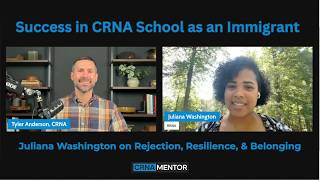
In this CRNA Mentor Podcast episode, host Tyler interviews Juliana Washington, a second‑year nurse‑anesthesia resident and class president who immigrated from Brazil. Juliana recounts her upbringing in poverty, childhood trauma, and the challenges of moving to the United States at 18, including eviction, low‑wage work, and learning English through babysitting. She describes her unconventional entry into nursing via dental assisting, her discovery of ICU work, and the pivotal moment that sparked her interest in anesthesia. After three consecutive rejections from CRNA programs, Juliana strategically improved her candidacy by seeking feedback from schools, taking advanced coursework, engaging with the AANA community, and developing a “pizza‑pie” application model that breaks the process into manageable slices (financials, volunteering, politics, grades, testing). She highlights the importance of mentorship—citing mentors such as Caroline Killman, Dr. Ian Heuer, and AANA President Jeff Molter—and the role of networking at conferences. Juliana also discusses her leadership as class president, speaking engagements, and the creation of a book and planner to guide other applicants. Throughout, she emphasizes resilience, the power of a strong personal “why,” balancing motherhood with CRNA school, and the need for representation of immigrants and non‑traditional students in anesthesia. The conversation ends with practical advice for discouraged applicants and resources for survivors of childhood abuse.
Chapters
What happens when you leave behind everything familiar—your country, your culture, your support system—to pursue a profession where you're not sure you even belong? For many immigrant nurses, the journey to becoming a CRNA can feel isolating and overwhelming. You're not just building an application; you're adapting to a new culture, overcoming self-doubt, and trying to succeed in spaces where you rarely see stories like your own. Juliana Washington knows that feeling personally. Her path from Brazil to CRNA school was anything but linear. It included uncertainty, rejection, and hearing no multiple times before finally gaining acceptance to a CRNA program. But her story is proof that success in nurse anesthesia isn't reserved for applicants with perfect journeys. It's often built through resilience, persistence, and simply refusing to quit. Welcome back to the CRNA Mentor Podcast. I'm joined today by Juliana Washington, a second-year nurse anesthesia resident from North Carolina. She is currently the class president, and she was actually invited as a speaker at the annual North Carolina State Anesthesia Conference. Before stepping into leadership roles in nurse anesthesia, Juliana was an immigrant from Brazil trying to find her place in a new country while pursuing a dream that often felt out of reach. In this episode, we talk about resilience, rejection, identity, and what it takes to keep moving forward after hearing no. Juliana shares her experience overcoming CRNA school rejections, adapting to life in the United States, and ultimately transforming those setbacks into growth, confidence, and leadership within nurse anesthesia. Welcome to the podcast, Juliana.
Thank you for having me. It's really an honor to be here.
Oh, we're happy to have you. And, and I love talking to individuals with different backgrounds and how they've navigated to anesthesia school. And you have a very, very interesting background. And, and I, you know, this, this idea that, that everything has to be linear, linear in anesthesia and applying to school is not the case. And you are a perfect example of that. And, you know, before we talk about CRNA school and where you're at today I want people to understand the story behind your success because, you know, your story, it started long before anesthesia school even entered the picture. So let's kind of dial it back to, you know, growing up in Brazil. Can you tell me a little bit about that?
Yes. And I would say if you had asked me that when I was little, and you know, when you ask children, "What do you want to be when you grow up?" My honest answer, would probably have nothing to do with anesthesia. And the reason why that is, is, um, unfortunately, uh, in Brazil that career is— doesn't really exist. It's, uh, held at a different, um, level. So I wouldn't even know what a CRNA was. Um, and I was born and raised in Rio de Janeiro, Brazil. I lived with my mother and my younger brother. She, my mother and my dad separated when I was very young. I was probably about 4 years old. And to be completely honest, Tyler, my biggest aspiration growing up, as silly as it may sound, is that I would like to have a phone at the house and not even a cell phone, just a cord phone.
Mm-hmm.
Because we were, we lived in poverty, to be honest with you. And things were hard to the point where we did not have running water at times. I know all about carrying buckets of water and honestly waiting on rain sometimes to have some water at the home. Although, you know, I know that sounds very difficult. When you live in it, it's your normal, right? You don't have anything else to compare to. So we, the idea of living in a community came from a very young age to me. My grandmother is the biggest role model that I have in my life. She was the herbal remedy lady. She was the, I am going to see Dona Nea, which is her name. Mm-hmm. Everybody would come and ask her, "Hey, do you have some herbs for my cough and for this pain and for this infection?" Which now I know it was probably not the best thing, but you know, she made do. And just seeing the love that she had for people, just seeing that even when we didn't have a lot, the little that we had was shared. Mm-hmm. And I am very, very thankful for that experience. Up to this day, you know, having a 10-year-old daughter, I make a point in teaching her how important gratitude is. And I tell her, you know, we don't know what people are going through. So even if we're walking through and someone is taking the trash out, a smile goes a long way. Mm-hmm. So I think that's, that is my pride and joy is to know that my daughter is being raised, being aware that we live in a community and our jobs is to lift each other up.
That's great. I love that. And, and this is our Mother's Day special episode. So happy Mother's Day.
Thank you. Thank you.
You're welcome. Now, now, Juliana, when, when did you come to the United States? And what was that transition like for you?
I was 18 years old. I had just finished high school in Brazil. And I know my parents weren't married. My father was very present in my life. And at that time, he moved to the States when I was probably about 4 years old when he left. And because of him, I was able to attend a good school. And once I finished high school, he wanted me to come to learn how to speak English. So this was 2005, the end of 2005. I was supposed to come here to stay for a couple months and, you know, just learn how to speak English. And that turned out to be a once in a lifetime opportunity. His— he worked for a company for several years and his boss said, well, if your daughter would like to stay I would be glad to sponsor her. And we took that opportunity and with some arrangements, of course. And that turned into a year. And then unfortunately, my dad had some health problems and had to go back to Brazil. But before I did, I asked him if he would allow me to move out on my own. Mm-hmm. Find a roommate, and I wanted to see if I was able to, um, uh, put myself through school and take care of my bills. And I wanted to do that as a trial while he was still here. And I told him, I said, hey Dad, if I can't do it in, in that year, I would just go back home and it's fine, but I don't want to give up before trying.
Mm-hmm.
And, you know, I was able to do that. I started in the US cleaning homes and babysitting. And I loved working with children. I loved to be a babysitter. And that was my blessing too, because when I— as I was learning English, a lot of the children that I used to take care of, they were in second, third grade. So they would come home with spelling lists and words, and we would practice together. So they were teaching me, they were helping me with spelling, pronunciation. So that was wonderful. However, I think this was around 2008 when the recession happened. And the first thing that you were gonna cut off on expenses is going to be somebody coming to your house, right?
Yeah.
So if you have someone cleaning, you can probably do that yourself. So that's when things got exceptionally hard for me because I didn't have any work. And it was a point where my dad was no longer here. I was by myself. But I think the most difficult moment is when I actually got evicted from my apartment.
Yeah.
At first, I had a 2-bedroom apartment and then I had to cut down and get a 1-bedroom apartment, all the way down to a studio. So that was, You know, I was at the bridge of giving up, really. I was at a crossroads. And thankfully, because of the people that were around me and these children that I was helping raise, they opened their homes for me and say, "Hey, you can stay with us until you get up on your feet." Wow. So being from a different country, we hear that Just these ideas that are not true about how a country is or how we— I think we stare at— we tend to be stereotypical. But I can honestly say that I have experienced nothing but support and acceptance while I've been here in the States.
That's great. Wow, those are some major obstacles to overcome here in this journey. And, you know, I— like I said, I love talking to people who have immigrated to this country because very often the story, you know, goes that you've had to overcome overcome so many different obstacles, even learning English. And you're talking about these 3rd graders that are teaching you English. I've had other mentees that they worked at a Dollar General because that was a great opportunity to interact with customers and learn English. And I think there's so many things that people like myself take for granted who were born and raised, went to, born in Pennsylvania, went to school in Pennsylvania. As I said, before we went online, I'm kind of one-dimensional. And I feel like this is so eye-opening to me to hear these stories. Yeah. But certainly, you know, a lot of resilience, a lot of grit, you know, that goes into your journey, just kind of even getting started. Now, tell me a little bit about nursing school. Now, you weren't in nursing school in Brazil. You were— you came here, and when did you go to nursing school?
So I honestly had no idea that nursing is what I would choose. My first— My first diploma was in dental assisting. So I was able to meet a nurse that worked in our oral surgery office forever ago, but I just fell in love with everything that she was doing. And a lot of the nursing flourished while I was at the dentist's office because, you know, we are taking care of all different ages and I have always been very empathetic quick with, you know, knowing when somebody is afraid, learning how to look at those nonverbal signs. And that just came very natural to me. And after I, I was probably there for maybe 2 years, my, my boss came to me and, you know, he said, what is your 5-year goal. And, you know, I'm 20, so I'm like, uh, 5 years? I'm just trying to make it till next month. Um, so, you know, I was like, huh, I, I think I really would like to be a nurse. But I think that's the thing when you're an immigrant, Tyler, you— your aspirations are— your dreams are, are not big. You know, you're, you're literally— unfortunately, the concept is is just to make it, is just to get by. So for me, you know, I always heard my mother talking about all these dreams that she had, but it was sad to me in a way because, you know, I would think that's never going to happen. You know, my outlook was so negative then, but—
Yeah.
I can say that now, but at the time it was my reality. And I think the most defining moment in my life, this was before I had, you know, the job at the dentist office after my dad had gone back. I had, I picked up a job at a grocery store, you know, not the regular kind, like the big fancy ones. And I was 20 years old and it was my first day on the job. Wow. And I was taking the trash out, walking around the store, and the look that I would get, it's what really upset me and made me feel really bad. So I took the next logical step that I could. I went and cleaned the bathrooms because nobody's going to see me in there. But that was again, you know, that wall. And I'm like, I have to protect myself. So I'm going to go in here and do the best job that I can. Okay. And as I was, you know, cleaning the mirrors and looking at me, I had a flashback. And this is a sensitive topic, but I feel like it needs to be discussed. It needs to be talked about. It needs to be talked about. And is the fact that at a very young age, unfortunately, I was, I was molested as a child.
Mm-hmm.
And unfortunately, the majority of cases is this happens with people that we know. So 90 to 93% of the cases is someone that the family knows and trusts. And it, I believe it was from the ages of 7 to 10 years old. And at 10 years old is when I finally, I think it finally clicks and you learn to think, hey, this is not okay and I'm going to have to speak up for myself. I wish it would have happened sooner, but it didn't. And the hardest thing for me was to learn how to forgive, but most importantly, most importantly, how to forgive myself. Because I've carried that for a long, long time trying to think back, hey, I should have, I could have, but I was a child. So my job as a woman now is to realize that— Mm-hmm. I was a child. It was not my fault. It was not fair, but it happens. However, I would not allow someone else to have power over the choices that I make today. So while I was cleaning those mirrors, I just start thinking, you know, my goodness, I've been through so much and I'm still here. And this is really hard. And—
Yeah.
It, to me, it was just embarrassing because deep inside I knew I could do more. And I'm not saying that, you know, my mom, she had very little education, but she taught me the biggest lesson that I could ever learn. She said, no matter what you choose to do in life, you do it well and you do it proudly. So I take that to my core. It doesn't matter if I'm taking trash, it doesn't matter if I'm You know, we just start clinicals and intubating, but I'm going to do my best and I'm going to do it proudly. So after that moment, I eventually, you know, couldn't hide for the rest of the shift. So I have to vacuum the front of the store. So as I was doing that, I had a gentleman, probably in his 40s, very kind. You know, you can tell, you can— we are very good at reading the room and reading people. Right. And I could tell that he was just curious, and he said, um, "Excuse me, young lady, I'm not asking this, um, I don't want to offend you in any kind of way," but he said, "Why is a young lady as pretty as you doing this kind of job?" And Tyler, I swear, I wanted to run away and just never come back, but I picked up my little crown, I put it on, my imaginary crown, and I said, "Sir, I am doing this job today because One day I'm going to look back and I'm going to be thankful for this day because I will be where I want to be. So I'm doing this job now to pay for my school, to pay for my education. And I thank you for asking me that question. And I honestly feel that I, you know, my religion, my My God is everything, and I truly believe in signs, and I think that that was God that day telling me, "Don't give up, and I'm here with you, and I'll be with you every step of the way." Mm-hmm. So that was the most defining moment in my life, and after that day, I just gave 200% because I knew that you know, I would look back and my, you know, my biggest regret is that I haven't seen that gentleman again. You know, it was a long, long time ago. So, but, you know, I would have loved to see him again and say, you know, thank you for asking me that that day. And, you know, you gave me the hope that I needed that day.
Wow, Juliana, that, that your whole story is so powerful and You know, I appreciate you sharing those sensitive details about your childhood. You know, these things, they need to be said. And I appreciate, you know, how, you know, raw that is because it was a defining moment of your journey. And yeah, that's super powerful. I know, and one of the reasons that we have you on today is, and we'll get to it here shortly, is that you wrote a book, you know, to help others who may have come from a similar background or, you know, trying to navigate this process themselves. So if you guys are interested in hearing more about Juliana's story, we'll talk about it a little bit later, you know, this kind of outline that she offered is also in her book. So thank you for sharing all those details. And just picture you looking in the mirror in that bathroom and kind of having that moment. And wow, that's— thank you for sharing that. You know, at what point, Julianna, did you feel that, you know, nursing school, and then when did you start considering anesthesia?
So I always tended to be attracted to things that are hard. So when I was able to Finished my ADN. So I had my ADN first. I, my first shift in ICU, the rotation shift, I looked at all the lines and all the medications and I said, I will never do this.
Yeah.
There is too many chances for things to go wrong and I'm just not okay with this. And then sure enough, the first job I applied to was in ICU. So my, during my first shift, I had a preceptor and I, beginning of the shift, I went to her and I said, listen, I am very scared of people that are not alive, and I just want to get this out of the way. So if that happens today, I want to be able to help. I want to make sure that I can do it and that I'm comfortable with that situation. And if I can't, I'm not wasting my time, your time. I'll do something else. And she laughed, and respectfully, we were— respectfully and unfortunately, death is very common in ICU. So we had— Mm-hmm. That happened, she was there with me the entire way. And, you know, I think as nurses, our feelings and our needs become secondary, and you are able to focus on what that family is going through. You're able to focus on, you know, that patient, that loved one. And at that moment, you know, that was— I was okay. I think I can do this. And then I will say, sadly, during my ADN, I didn't hear a whole lot about CRNAs. The emphasis, the focus was, you know, nurse practitioners. And again, in healthcare, these are— we are so essential. And, um, but unfortunately, that's something that I was not really exposed to. However, I did have a military, um, teacher. Um, she is— she's a— she has been my mentor as well, and she She was calling out people in the room and saying, "You're gonna go to the ED. You're gonna do this. You're gonna do that." And she pointed at me and she said, "You're gonna do 2 years in the ED. You're gonna do 2 years in ICU, and then you're gonna go into nurse anesthesia." And I'm like, "Okay, yes, right, yeah." But it didn't take 4 years. It took a little longer, but here I am. And I made sure, and I told her, I said, "I know that at the time I wasn't ready to receive it, but you really planted a seed in me." Even after that, it wasn't until COVID, probably 2020, 2021, that we— I became more comfortable with tuning with that patient, being very careful with ventilators and RT and being aware that if RT made changes, that could affect my patient, that could affect my sedation plan and blood pressure. So I started really enjoying the morning start in like weaning sedation and trying to wean ventilation. And I became really enamored with, you know, how delicate that was and being very careful, having the concept that yes, you can give medications, but you cannot take them back. So let's do it carefully, let's do it slowly, and we can always give more if we need to.
Yep.
And then when we had to page anesthesia for difficult intubations, I was just like, wow, that is amazing. They just come in, they— this is the amount of information that they know and they're getting the job done. And at that time I had not yet taken my CCRN. So again, you know, I'm trying to do the hard things and I said, okay, I pushed this off for a couple years. So I paid for the exam, I gave myself 30 days to study, and I was like, okay, now we're going to take the test. So I became certified. And unfortunately, I, I do want to say that I prematurely rushed the process. And we'll probably get into the weeds a little bit more, but it was, I think, Anesthesia came to me slowly at the beginning of COVID and slowly realizing how delicate and how scared these patients were, you know, knowing that we're going to put a breathing tube in. And as a nurse at that time, having to hold up an iPad to the patient in the room in full PPE with me and them not knowing if that would be the last time they're talking to their loved ones. Mm-hmm.
Yeah, COVID was a trying time for everyone, especially all of you who were in the ICU. It was a little bit different in anesthesia depending on how big your center was and your involvement in helping out. I wanna revisit this idea that your professor is kind of, I had this picture of like Harry Potter when it's kind of like, you're going here, you're going there, you're going to anesthesia. Um, was there ever a time— I know you had, uh, alluded to this earlier, you know, that— did, did CRNA ever feel like unrealistic or unattainable for you?
Yes. Um, but first I do have to make a comment on the Harry Potter pun here. I'm a huge fan, and the fourth book— and this was very sentimental to me because when the fourth book came out, it was in Portuguese, and then I had borrowed that book and read it. And, you know, we can afford buying, you know, books, so my mom bought me the 5th book in Portuguese. And I read that book. And when I was here in the US, the 6th one came out and it was in English. And I'm like, okay, I have to read it. I don't know how to read English that well, but we're going to try it. So at first I would write on the margins of the book every word that I did not know. And, you know, you can imagine basically the whole thing.
Yeah.
And because I was trying to translate every piece And then eventually, I literally stopped translating. And I just kept reading the book. And what I came to realize coming to the end of the book is that a word is used in so many different contexts that later on, it will explain itself because it's going to show up again.
Mm-hmm.
And I use that as an analogy as to I, for the majority of my, my career, I also did travel nursing. And the comparison I make is that, yes, I may not have the context of a cardiac nurse or a, you know, trauma nurse or pediatric nurse, but the context, the basic skill is the same. I can assess a patient. I know how to assess a patient. So everything else, it's like a book. You're put in a situation, you have a different context, some things are going to come second nature. And as long as you can assess your patient and step back and think about it, um, you're going to be fine.
Yeah, that's, that's great perspective there. And, and I think that does, you know, track all across different specialties, uh, even, you know, in anesthesia as well. Um, Julianne, I want to talk a little bit about, you know, you, you mentioned, uh, previously applying maybe a little bit too early. You did have a couple, uh, unsuccessful attempts at getting into CRNA school. What, what kind of changed from those unsuccessful attempts to getting accepted to the program that you're in now?
Okay. So yes. So after I passed the CCRN, I'm like, okay, I checked this box, I checked this box. I've been a nurse for 8 years, which school would not take me? You know, I know what I'm doing. And yes, unfortunately that not work well for me. I initially applied to 3 schools and I received 3 nos. You know, after the first one, okay. After the second one, okay. After the third one, it was devastating. And I remember I picked the saddest movie I could on Netflix and I have my tub of mint chocolate chip ice cream and I just, you know, had my moment, cried. I'm not smart enough. I, you know, all these things. I am too dark. I am, you know, so— Yeah. That was the reality, right? Because we are, we have to allow ourselves to be okay being uncomfortable. But I'll tell you, Tyler, again, defining moment. That morning, I stepped back and I wrote down everything that I could looking outside the box. So I took me, my feelings out of the situation. Mm-hmm. And I said, yes, Juliana, you have been a nurse for 8 years, but that also means that you have been out of school for about 10, 12. So if you were sitting at an admissions committee and you have 200 or more applicants, who do you think they're going to pick? And then, you know, I also kind of had to take a deep look into my GPA. And, you know, I had Fs in my transcript, Tyler. And, but here is the thing, not many schools will stop and say, oh yes, she got Fs throughout the entire semester because she was evicted and had to count coins to put gas in her car. So they don't know that. They don't have time for that.
Right.
And, you know, instead of taking that for granted and using that as a justification, I came up with a plan and I said, okay, I'm going to try again. And one of the third things I did was to email all 7 schools in North Carolina and ask for feedback. And I'm not saying this— please don't go emailing all schools in the country and asking for feedback. My rule was to email one time. If I heard back, great. If not, that's okay. And I did have— out of the 7 schools, 3 emailed me back and gave me some tips, you know, and that kind of aligned with what I had identified already, which was take recent classes. take advanced level classes to show that you can handle the coursework. And that's when I went to the AANA website and started finding out about meetings. And I had no idea about how advocacy and politics is a part of this profession. So it was the— I'm gonna say it was a hard thing to have 3 nos. But those 3 nos open up so many doors that I wasn't even aware that existed.
Yep.
So I would say I had to stop looking at what, you know, at the final goal and starting looking at it as a marathon and not a race. So it wasn't just a fix on, you know, a quick fix. It was like, oh wow, there's way more than what I thought it was.
100%. And I want to key in on something specifically here that you mentioned is that this, you know, this deep reflection on who you are as an applicant, what you've done so far, and how can you pivot and/or enhance your application strategically. You know, I talk to so many mentees and, you know, every day on my phone calls, I talk to many, many people that they're kind of checking the boxes and they don't understand why they're not getting interviews. And they don't understand, well, I've done all those things. It's like, yes, you are eligible, but you're not competitive. And how can you become competitive? And just all those things that you outlined, you know, asking for direct feedback. Now you won't get that from every program, but there are some that will entertain it, right?
Yeah.
Also this idea of understanding more about this profession, you know, that is huge. You know, attending the meetings, really dialing into, How can you articulate that you understand this profession at a deeper level? And that, in my opinion, is one way to certainly stand out, which is what you're able to accomplish in that conference. And actually, we met at annual congress this past year. Tell me a little bit about how that networking piece kind of played into where you're at and where you plan to go here with anesthesia.
Yes. I think it started through one of the Facebook communities. We had a mutual friend at the time, Ike Bartell, and he's also our RNA. And I think I started taking his suggestions for podcasts. And then later on, he was able to say, "Hey, I have this group and there is the CRNA Mentor and he's got lots of tips. The community is growing every day." So I was able to, be part of that community. And like, huge shout out to you for, you know, having the time and allow, you know, just allowing people to just come on and ask questions. And you are a great advocate because I have seen, you know, you're trying to build a platform where people feel safe asking questions. There's no judgment. And I think you're just, you're doing just that. So that's wonderful.
Thank you. Thank you.
And then when I met you, I think it was the AANA meeting, annual meeting in Nashville.
Nashville, yep.
We were able to talk and I got my picture. And again, you're just very passionate about education. And I would say networking is a huge part of it because I guess there's so many applicants, but not a lot of people are attending these meetings. And the first time I attended a district meeting, there was not a track for RNs. So when you registered, it was either a CRNA or other. So I think we are definitely moving in the right direction and I'm so excited. And I do have to mention a couple, honestly, giants that I've met just, you know, by attending these meetings, which first started with my main mentor, Caroline Killman. She was the one that had a shadowing program in the hospital that I worked. And, you know, after I got my 3 nos, I reached out to her and she lifted me up. She said, "A no is, it's a not yet, is not a definite no. And you're gonna keep trying. You're not gonna give up. You're kind, you're smart, and I can see a lot in you." And she gave me, she gifted me a scrub cap. Which I had no idea, I couldn't plan on it, but I was wearing that scrub cap just a couple weeks ago when I was able to have my first pediatric nasal intubation. So I took it off that day, I sent her a picture and I said, I did it. And I just wanna thank you for, you know, all these years.
That's awesome.
Next, my mentor, Dr. Ian Heuer, he is a huge, part of, you know, getting my passion for politics and a wonderful role model. We only— the only thing I disagree with him respectfully is his taste in soccer because I'm from Brazil. We are the best in soccer and he's from England. But, you know, maybe one day I can convince him. But yeah, just having people that you can look up. I also met Dr. Sharon Pierce at the the same meeting that we were in. And I had a copy of my book with me and I wanted to gift it to her and she said, "I'm not going to take it unless you sign it." So, you know, it's just like meeting these people and knowing that they're real people and they're rooting for you.
Yeah.
So if anybody has the chance, please go. It's a huge part of it. And those are the things that will set anyone apart.
Yes, 100%. And I think also what I want to point out is you mentioned many mentors and, you know, you can have more than one. You can have 3. You can, you know, the goal here is trying to align where you want to go with people who are already there and take, you know, their piece of advice along the way. And sometimes you'll get conflicting things. You know, sometimes it's the soccer team, which I'm a big soccer guy. I would agree with you. Brazil is the best. But, you know, take those pieces as you go and kind of cross-reference them. You know, you might be hearing conflicting things, and it's not necessarily wrong. You know, many mentors are just operating from their perspective. But if they are at a point, you know, you mentioned one of your mentors is very involved in the politics. You know, obviously, their input into that political side of things, probably put more emphasis in. So I think that's great. And I think one person too we also want to shout out, which we were talking before, before we went on air is Jeff Molter.
Oh, yes.
Can you share your experience with that? Because this is awesome. I love— Jeff is just a great human being.
Yes, it was the huge— it was the hugest shock for me. Again, like, as we were chatting, I am not a huge social media person. I'm actually— I'm okay talking to people, but I'm very shy on camera. I did, like, honestly. And I started, you know, a TikTok just because of my whiteboards that I created. And then I started getting some reviews for my book. I really wanted people to see that as well. And somehow I got a— I sent a message to Dr.— to the president, Jeff, and he actually wrote me back, you know, and I was just saying, I was congratulating him because I saw a picture. And I said, oh, wow, I was there when you traded the And that was amazing. So congratulations. He said that he would love to, you know, chat with me in person. So we exchanged phone numbers and I was really not expecting the president of the AANA to call my number. And I was definitely not ready for that. So when I answered the phone and he said his name, it took me, you know, a good couple seconds to realize that it was him calling me. And, you know, especially for me, like everything that we talked about, how how huge that is just to have someone in that position to take a couple minutes to listen to your story and talk to you. Right. And that's what I want people to know is when you're stepping into this career, there's so many opportunities and so many great things that we can do, but you have to put yourself in uncomfortable situations because this first meeting I attended, I knew no one. So it was very uncomfortable, but I had to be brave and go up to someone and shake their hands and smile and say, "Hey, I'm trying to get into school." But absolutely networking is a must.
Yep, yep, definitely. And through your networking, you're already getting recognized as, you know, somebody that's contributing to this, you know, the mentorship to, you know, helping making this profession better. And one of those things, and one of the, you know, things we— I talked about earlier that you you did is create this book and this planner. Can we talk about that a little bit from, you know, your experience?
Yeah, so I love that you said book planner because honestly, that, that's what it is. Um, and the, the planner part of it is that what I noticed, Tyler, is that when I had to go and, you know, look at why did it— this didn't happen, there was a lot of information. There's a lot of information out there, but I felt like I had to go in to different places to get it, and I really thought back when I was, you know, even when I was in high school and when I was in ADN school, I said, how cool would it be to have all that with me so I can write it down, so I can make that into a smaller version of a big plan?
Mm-hmm.
You have to have a destination. You have to have an end goal. But what we forget about is the in-between. How are we gonna make that happen? What is the timeline? What are the steps? You know, going back to nursing school care plans, make it into attainable and measurable outcomes, right? So that's what I, what I try to do with the book. I, and, and again, it just kind of fell into my lap. But this came about a friend asking for help from me going through the first 3 rejections to the following year, out of 3 applications, getting 2 interviews. And she said, you know, like, what did "Did you do?" And as we're having lunch, I'm talking and I'm sure you can tell I talk a lot. She was trying to write everything down. And I told her, I said, "Hey, just give me 2 weeks. I will put up a Word document for you and you just turn it into a checklist." So as I started writing, it really made me think about my why. And my why is that as a child, I was not able to protect myself at the scariest moment of my life. And how amazing and, and great it is that, you know, 30-something years later, that is my purpose in my career, that I get to take care of someone facing the scariest scariest moments of their life, going through surgery, not knowing if they're going to wake up. And I'm responsible to keeping those people safe. So it's honestly just a full circle. And I could not be more grateful and thankful. And that's what I wanted to help people look at and really think about their whys, because your grit is going to fall back into your why. When things get hard, work hard and when you don't get the A's in the test is your grit that's going to keep you going. So we have to have that. So your why can't be into how much money will I earn, how fast can I get into school. You have to think a little deeper than that. And I, I use my example just as a way to help others do that.
Mm-hmm.
And, and make it attainable to where, you know, I am an older student. I'm 38 years old, I'll be 39 next month. I have a child, you know, I have a husband. We literally had to uproot our home and move to a different state to make this happen. So you cannot have ifs, you have to make that happen if that's what you want.
Mm-hmm.
So your why has to be strong enough so that you can fall back on it when things get hard, because things will get hard.
Yeah.
But it's up to you.
I agree with you 100%. And I really focus on the why as well. You know, I think that there's— I think it will evolve over time. It's not something that's static, but, you know, it will carry you through those hard times, certainly. Now, one of the things in your book, Juliana, is you talk about this pizza pie model. Where did that come from? And tell us a little bit about that.
Um, one, my husband loves pizza. Two, I'm a very visual person, and I was trying to think, and I really was trying to look at, like we were saying, talking about the race and the marathon, I said, you know, the application is just, is just a big thing. I can't do all of this at one time, just as you cannot eat a whole pizza at one time. So I'm gonna break this into separate topics that I can dig into it. And the coolest thing is that nurses always get pizza parties as well. So I thought, okay, I am a nurse. I am like the dough of the pizza. I have knowledge. I already have knowledge, right? Which is what you put on top of your pizza.
Mm-hmm.
So all this is, all that the application is, is I'm layering on top of the knowledge that I already have and I just need to package it, make it prettier, and then I can turn it in. So I'm not going to give all the topics, but just as an example, some of the slices of the pizza that are going to complete your application will be your financials, will be your volunteering, will be your awareness of politics, will be your grades, will be your testing, but But again, you can't meet all of those goals at one sitting. You're going to have to be able to plan ahead, think about your time, and then, only then, once that's completed and you have addressed every topic, then you should be ready to apply.
Great. Yeah, no, that's awesome. And I love that, that idea of all these different pieces to the pie because it is. Is that you can't— you can't do— you have to focus on each individual piece, but they all kind of go together. Uh, let's, let's fast forward a bit here. Uh, let's talk about anesthesia school now. You know, what, what has been the hardest adjustment for you, uh, in regards to CRNA school?
Um, to me is to understand that comparison is a thief of joy. And I say that because we have, you know, when you're applying, you're competing, you know, you're competing with a bunch of people. So I also had to step back and stop doing that and knowing that, yes, there is many more people that are fighting with you, but only you have this story, only you have these qualities. And, and this is where, you know, being in a program, being open and having support is so essential, because when I get to these places and and just these, you know, having to master these difficult concepts, you honestly, it's, you know, imposter syndrome is real and you second-guess yourself. And to me is to be able to trust, you know, my professors and my director. And it's very important that they've told me, they said, You have earned where you are right now.
Yeah.
We did not pick you for a mistake. We know what we're doing. We believe in you. So you have to believe in yourself. We can't do that for you. You have to believe in yourself. And again, you know, having your classmates like be vulnerable, come to your classmate and say, hey, I'm not understanding this. I'm not mastering this. And again, take your feelings aside. Asking for help when you need help, and trying to find balance. And the biggest thing for me as a mother, you know, I've had to tell my daughter, "No, I can't take you to the park right now. I have these tests." But, you know, at the same time, I have to make certain sacrifices. And not that long ago, I had to study at a trampoline park with my ear pods, and I'm doing flashcards, and she's having the time of her life. So, you know, it's like a give and take.
Mm-hmm.
You have to be okay And you have, especially with children, you have to turn back to them and helping them see the big picture. You know, like, yes, it's hard. We are right here together. We're doing this together. I'm doing this for us. And I think the biggest thing, we may have some guilt and say, you know, my children are growing up. I don't want to miss it. I don't want to do that. But I try to ask them, you know, several people that I talked to and I said, what would you tell your child, if they had a kid and they had this huge opportunity, would you let them be a reason to why you would not do that? Or would you have them be the reason why you do that? So a lot of it, it's already there, we just have to frame it a little bit differently.
Yeah, that's great. Juliana, At what point, you know, as an immigrant, as somebody who's competing to get into CRNA school, at one point do you feel like you finally belong here? Um, are you, are you there now?
That's, that's a hard question. Um, I think for me was starting clinicals and being the one talking to the patients, being the one pushing that bed back and talking and just just like getting them to trust me in just such amount of time that you have once you meet them.
Yeah.
And then having, I think it's just knowing that you're it and knowing that yes, this situation is new, but I have been a nurse before. I have been a nurse, I've been there. Like this is, again, we're just layering things on top of what we already know. And to me, like, again, mentorship, like having these people now come back and ask me, hey, would you like to talk to these people? Would you like to do this? Like, you know, talking to Jeff, talking to you, you know, I didn't plan on any of this. My goal when I wrote my book and when I got into school is was, you know, I want to help 5 people get into CRNA school. And I have been able to do 3 people so far, and I'm like, this is awesome, you know. I, I think it's— life is about what you leave behind, what you give. It's not about what you have.
100%. And, and part of my personal goal with CRNA Mentor is identifying individuals like yourself, uh, who are going to make an impact, who have, you know, went through this journey and have some value to bring and want to share it. So So that's excellent. You know, I want to talk a little bit about, Juliana, you're currently the class president of your cohort. How did you step into that leadership role?
I've always been a starter. I always have been attracted to, you know, like, let's change things. Let's make things better. So I think it was very natural. Thankfully, I had the opportunity to be the class president in my nursing school for my 2-year degree. So it was very helpful to have that experience. And I'm just thankful for my classmates trusting me with this because, you know, it's a lot of stress on top of what we already have. But it, again, it has been such a gift. And I want to be part of the change. You know, I have huge shoes to fill. So I think that I just want to show people that yes, bad things can happen in your life. But what you do after that is what defines you as a person.
Yeah, no, I love that. Juliana, you were invited recently to speak at the annual North Carolina State Conference. What does that moment mean to you?
You know, being asked to kind of come on stage Unreal, honestly, because like I said, not that long ago, I was there first time, no other nurses there. It's still unreal. I am so beyond grateful that I have something to contribute. And you know, that only, it's, I honestly don't feel like I'm worthy, you know, Yes. It's just, there is so many wonderful people in this field, but I'm just so excited that, you know, I just want to reach people and inspire them and, you know, walk along with them because, you know, we need people that will help us see the good that we have inside of us. And again, if it wasn't for mentorship and networking, this wouldn't have happened, you know?
Yeah, no, 100%. You know, I often, I feel that when you get offered or, you know, this invitation to speak, it's very validating, right? It's like you're doing something right. Somebody else is noticing you. You get a call from Jeff Molter, it's like, wow, this is, I'm connecting with people who, you know, are in such a spotlight or on stage. And when they reach back and pull you up, it's like, like, why me? You know? And I think part of even like what I've done with CRNA Mentor, it's kind of about like faking it till you make it. Like, there will be moments in this journey where it's like, I don't feel like I should be here. Um, for me in particular, like, I kind of pitched this idea of this RN meet and greet at Midyear Assembly in Washington, DC. Now, this, uh, a couple weeks ago was my second time doing that. The first time that I did it. It was the first time that I was attending Midyear Assembly, and I was trying to tell everybody about what Midyear Assembly is all about. And I'm like, wow, this is— this is— I remember calling my brother, and I'm like, Wes, I said, I feel like I'm really faking it now. He's a professor down at Auburn, and he's like, Ty, he's like, I've been faking it for a long time. He said, I still don't know if I'm doing it right. But, but that's what this is all about, just kind of putting yourself out there. Uh, it's also about, you know, putting out good in the world. And I, and I think if you put good out in the world, it will come back to you. And we just got back from Disney a couple days ago, and there's like 4 different occasions where like random strangers would come up and like give me something. I don't know why me. And my kids are like, "Why do people keep giving you stuff?" I'm like, "I think it's 'cause of CRNA Mentor." I said, "You put good out in the world, good comes back to you." And they're like, "I don't know, Dad. I don't know." Yeah, yeah. But it's one of those things that I'm like, I truly believe, you know, if you're out here to make this profession better, if you're out here to help others, you know, these opportunities will open up for you. And Juliana, I think, you know, your story is so powerful because I think many aspiring CRNAs are quietly kind of feeling like they don't really fit the mold, right? Maybe it's they've had rejections in the past. Maybe it's because they come from like a different background, Maybe it's language barriers, but you have really kind of shown us that, you know, you can break down a lot of these barriers. And what do you think, Juliana, is, you know, representation means for immigrants or for really non-traditional students in anesthesia?
It's extremely important. And like I said, When I went to the first meeting, to be honest, Tyler, there was not— there were not a lot of people that look like me. And, you know, you think the majority— I guess the majority of the people going into school are of a younger age. They don't have families or children. So you have to understand, again, stop comparing yourself to other people. And nobody's going to do this for you. I want— my main goal, you know, years down the road when I have enough experience, it's to go in into high schools or maybe even at younger ages for like career day and talk about anesthesia. And Dr. Alina Gold II, huge, huge, huge trailblazer for diversity in nurse anesthesia. And like, if I attended one of the virtual meetings, I wasn't able to go in person, but it's just Be surrounded by like-minded people. You know, it doesn't matter what you look like, but be surrounded by people that share the same goals as you. And do it proudly. And again, like, can you imagine if every immigrant or every non-traditional student just like me say, okay, I'm going to help 5 people to do this. And, you know, it's going to be a chain event. And I completely agree with you. The good that we put in this world will come back to you a thousandfold. Thank you.
Juliana, this is a tough question here, but what does success actually look like now for you compared to when you first started?
Oh, I have a quote in my journal. Success is not final, failure is not fatal. It is the courage to continue that counts. And I think it's Winston Churchill. And I don't look at success as a linear path. I look at it as a circle. And I say that because it will change where you are in life, it will change your goals. And like, you know, my first big idea of success was to be able to have a car because, you know, no one in my family had a car growing up. But then when I got that car, I really thought that that's not it. That's just a goal and I met. So I think— Success for me is to able to put one foot in front of the other in the morning when things get hard. It's to keep going and is to keep doing that and helping others do that. So I look at it as, as not being a final destination. It's the willingness, the grit, and the ability to, to continue to do that when when things are hard.
Yeah, that's perfect. Uh, you know, as we wrap this up, Juliana, if someone's listening right now and they feel overwhelmed, they feel discouraged, or are really convinced that they're, they're too far behind to even become a CRNA, what would you tell them?
I, I've had that question before, and I answered it with this question: how bad do you want Yeah. So if you can, and again, your why is the basis for everything. So if you go into an interview and they're asking you, you know, would you be willing to do X, Y, and Z? If you're the person that says, well, I, you know, I have my new baby at home right now, so I really can't move. There's going to be another person that's going to say, I will do absolutely what's necessary to make this dream come true for me.
Yeah.
So if, again, how bad do you want it? It's not going to be easy. I hope that it is easy and, you know, everybody gets in on their first attempt, but the statistics, statistics are not that favorable. So it's going to get harder. So don't give up and be able to adapt and try to find things to improve along the journey. And Tyler, I'll be honest, if it wasn't, you know, the second time around that I applied, I already had a plan C, D, and E because I'm the kind of person, I have to have a backup for the backup and the backup. But I knew that, you know, this would happen. I didn't know when, and I'm so grateful and thankful that it was sooner rather than later. But it was just something that I would not have given up on.
And, and that's, that's very important to point out because I talk to so many mentees and it's, you know, focused on this idea of this is going to be the next— the time I'm going to get in, this is the next time. Like, you have to change your mindset. You have to really think about this as I'm just going to keep improving myself as an applicant until I get in, because I'm going to get in because I have, you know, all the qualities that you've already mentioned— this resilience, this grit, this, you know, uh, I'm not gonna take no for an answer. Right. And that, that has really been how you've defined your journey. I absolutely love that. Juliana, we've talked about, and for all of our listeners, you know, we, Juliana had mentioned some sensitive topics in regards to her upbringing in terms of as a childhood. And Juliana, can you share us just a little bit information and maybe some resources for these folks?
Yes, absolutely. Just, you know, for some statistics, unfortunately, in the US itself, there is over 63,000 children a year that are victims of child abuse. And I want to share this resource. It's an amazing website, by the way, and it's RAINN, R-A-I-N-N, .org/hotline for resources and just awareness awareness, tips, certifications that you can become, be able to be a resource. And again, I hope you never need it, but again, awareness is key. And they have, if you need help, if you're someone that, again, like me, unfortunately has been through this, you can text HOPE, H-O-P-E, to 64673. And you can also call call 800-656-HOPE, which is 4673, and someone will be able to talk with you and help you with resources as needed. And again, Tyler, it's unfortunate that this happened, but this is the reality. But I want to be here to tell you that I feel you, and I'm so sorry that that has happened to you, but that does not define you and neither defines your future. Thank you. And again, just Tyler, thank you so much for being able to talk about this.
Absolutely. And I appreciate you sharing that resource. It's, you know, it's one thing to, you know, come and bring this to the attention, even as sharing that vulnerable part of your journey, but to help others, I think that's an important part here as well. Well, thank you very much, Julianna. I think one of our biggest takeaways from this episode is that success in nurse anesthesia doesn't require a perfect or even a linear journey. Juliana's story is a reminder that rejection does not define the future of who you are as an applicant, and adversity can actually become a source of your strength in this entire journey. And it really, it's individuals like yourself who are the ones that have worked the hardest to get here, and those are the people that are gonna make the biggest biggest impact in this profession. Whether you're an immigrant, a non-traditional applicant, or someone that's just simply questioning, do you belong in this profession, I'm here to tell you that you do. And I hope this conversation helped you realize that there's not one single mold for becoming a CRNA. Juliana, I want to thank you for sharing your story and your perspective today. And as always, if you've found value in this episode, I encourage you to share it with someone who might need encouragement in their journey. Uh, thank you for listening to the CRNA Mentor podcast, and thank you, Juliana, for, for joining us today.
Thank you so much, Tyler.
All right, take care.
Thank you.
More from Tyler


How to Make the Most of AANA Annual Congress as an RN | Advice for Aspiring CRNAs

Professionalism Starts Before CRNA School - The Kind of Applicant You're Becoming


Locums, 1099, and W-2 CRNA Practice Explained: What Every Future CRNA Should Know

From Penn to Solo CRNA Practice - The Unexpected Growth of Independent Practice





The Most Unique CRNA Role in America? Shock Trauma Go Team & Austere Medicine