Why History Matters in Nurse Anesthesia
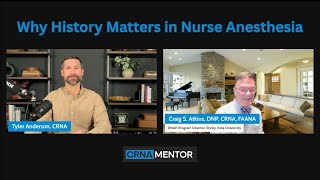
In this 2026 podcast episode, host Tyler launches an advocacy mini‑series for aspiring CRNAs by interviewing Dr. Craig Atkins, a veteran CRNA, program director, and self‑described historian of nurse anesthesia. The conversation traces the profession’s origins—from Civil‑War‑era nurses like Katherine Lawrence and the “mother of anesthesia” Alice Magaw—to the formation of the AANA in 1931, early certification, and pioneering continuing‑education requirements. They examine longstanding tensions between nurse anesthetists and physician anesthesiologists, highlighting gender‑based biases, legal battles (Chalmers‑Francis, Nelson, TEFRA), and the 1980s opt‑out legislation that let states decide whether CRNAs could bill Medicare directly. The episode also covers the critical role of CRNAs in every U.S. war, the evolution of professional titles (nurse anesthetist → nurse anesthesiologist), and the robust safety/outcome data that demonstrate parity with physician‑provided anesthesia. Throughout, Dr. Atkins stresses that effective advocacy rests on historical literacy, factual evidence, and professional pride, offering concrete advice for new CRNAs on thinking like independent providers while maintaining collaborative respect. The discussion concludes with a preview of upcoming AANA events and a call for listeners to engage respectfully in advocacy.
Chapters
The core understanding of advocacy is that it starts with an understanding and leads to the facts, not arguments or sound bites. To advocate for this profession, you first need to understand where it comes from, how it evolved, and why certain tensions exist today. Today we are launching an advocacy miniseries for aspiring CRNAs. Over the next several weeks, I want to offer insight to building your foundation as a CRNA advocate as an aspiring CRNA. The timing of this miniseries is intentional, as it will culminate at our biggest CRNA advocacy event, the ANA's Mid-Year Assembly in Washington, DC, from April 24th to the 29th. In today's episode, we will focus on the history of our profession, its evolution, and the tensions that exist in nurse anesthesiology. That's why I'm honored to be joined today with Dr. Craig Atkins. Dr. Atkins has been a CRNA for over 35 years. He He's a program director at Rocky Vista University's Doctor of Nurse Anesthesia Practice program. He is a former professor at Texas Wesleyan. He's a retired Lieutenant Colonel from the US Air Force Reserves and someone who truly considers himself a historian of nurse anesthesiology. All right. Welcome, Craig. Thanks for joining us here today. Um, I, I appreciate you coming and, and really showing us and, and really slowing down this conversation. To get it right and talk about the history of anesthesia.
Thank you, Tyler, for the invite. It's my pleasure to be here and join you today.
Let's get into this a little bit and learn a little bit more about nurse anesthesia. And, you know, most of our listeners, they're RNs and aspiring CRNAs, and they have an idea of what a CRNA is. But, you know, from your perspective as a historian, when people misunderstand our role today, Where do you think that that misunderstanding actually starts?
I think there's— from a historical perspective, I think the understanding stems often from the fact that the early contribution of nurse anesthetists has been historically invisible or actively erased, depending on how you want to look at it. But, you know, if you look at major texts like Tommy Keys' "The History of Surgical Anesthesia," they completely omitted the contributions of nurse anesthetist. Additionally, the profession began because the physicians of the late 19th century were primarily interested in surgery, and often the anesthesia was provided by the medical students. And they knew that they couldn't make a living in anesthesia, so they were more interested in watching the surgery than they were watching the patient. And the surgeons at that time realized that they could take the best and the brightest nurses, train them to do anesthesia, and they provided a competent anesthesia provider, and the patients did extremely well. And that's kind of the genesis, but that history has kind of been lost for many generations.
Yeah, so do you think that this kind of lack of historical context really plays a role as to why these misconceptions persist?
Oh, I think so. As a program director, we do interviews for RNs that are interested in going into anesthesia school. One of the questions I often ask them was, uh, how long do you think nurses have been doing anesthesia? And some of them will say 20, 30, 40 years. So I think there's a general misconception about the historical prominence of CRNAs. I should say nurse anesthetists. We didn't become CRNAs until the early '50s, but as nurse anesthetists, we were the early pioneers in anesthesia.
Yeah, no, absolutely. And that's great that you're asking those types of questions and exactly why, you know, this episode is very important as we discussed, you know, the history of nurse anesthesia. You know, can you walk us through the early roots of nurse anesthesiology and why these nurses kind of started doing anesthesia in the first place?
You know, the whys are a little bit uncertain other than the need by the surgeons. You know, Katherine Lawrence, has been well documented, was providing anesthesia during the Civil War. She was one of the earliest that we have on record. Then you have Sister Mary Bernard that in the late 1880s, 1870s, started some schools and training CRNAs. And then we have the story of Alice Magaw, who is the—
Mm-hmm.
What we refer to as the mother of anesthesia and was practicing at the Mayo Clinic as the private anesthetist for Charles Mayo and his brother. And they're the ones that dubbed her as the mother of anesthesia. I think what's really interesting about her is that she did, you know, 14,000 anesthetics without a death, and that was unheard of at that time. And she's also the first nurse to be published in any medical journal. And she documents very well her technique. And I will say, her technique is what we consider the Steele technique today, which when we do inhalation inductions for children, we still use that same technique. Mm-hmm. To kind of distract them, give them a little bit of gases, let them go off to sleep. And that was unique in her model. And physicians, nurses, and dentists came from around the world to study and see how she did her anesthesia.
Yeah, that's very interesting. And this is something that, you know, as I have brand new nurse anesthesia residents or SRNAs in clinicals, you know, I talk to them about this art of anesthesia. And as you mentioned with Alice Magall, like, It truly is an art, managing and maintaining these airways, especially to do 14,000 surgeries without a single death, managing those anesthetics. That is, it truly speaks to her expertise and the art of this profession. Craig, what do you think kind of gets lost when in history, when this isn't part of the modern conversation, Alice Magall, Where do you think that gets lost?
You know, I'll go back to some of our earlier conversations, and I think this is really a gender-based thing. You know, the world today is different than it was at the turn of the 1900s, and men were physicians, women were nurses. And I think the fact that Alice was able to do something that the men were not able to do raised some hackles, to be real honest. And I don't know that it was specifically a physician-nurse issue as it was a male-female type thing. That's just my bias on it. As I've heard, you know, other people talk about it. But I think this lack of historical perspective makes it hard for the younger generation to understand where we came from and the background that they have. I think that's important, similar to people that may come from other countries that want to retain their— some of their historical perspective of the country they came from.
Mm-hmm.
So I think they— that perspective and who you are is based in history to some degree.
Yeah, no, and I think that offers some interesting context. And I truly never thought of it that way as kind of this gender bias as to why it's not considered part of the mainstream history in understanding anesthesia. Leading up to this, we had the Beyond the Mask podcast that dropped shortly before we shot this episode. And they talked about the McMechans and the origins of the CRNA-physician conflict. They had brought in Nancy Marie and Sandy Orlette to do that. And it really offered a lot of context that helped in my understanding leading into this discussion, specifically, as you mentioned Alice Magaw as the mother of anesthesia, as we were taught in nurse anesthesia school. And they talked about, you know, anesthesiologists are our colleagues. They actually refer to Frank McMeachin's wife, Laurette McMeachin, as the mother of anesthesia because of her contributions that she made with anesthesia and analgesia, that journal. So that in and of itself, I had never known that in terms of the context of this discussion, but that's something that's very interesting when you look at, you know, our background and the history we're looking at from nurse anesthesia compared to our colleagues and physician anesthesiologists.
Yes, I think that's fascinating. And, you know, Dr. Matt Mazurek from Yale has a short article on the history of nurse anesthesia. And he talks about that there were, I believe he said there were 19 academic nursing-guided programs before World War II, which is really phenomenal when you think about it. Wow.
Wow. Yeah, no, that is. Craig, I wanna pivot a little bit here and talk about the professionalization of our profession. And this, in my opinion, is really where advocacy began. Something that stands out to me is how early nurse anesthesiology became professionalized, you know, talking about formal education, certification, and this establishment of our national association. So let's discuss for a bit our professionalization.
Sure, you know, as most of us are aware, the AAN was— AANA was formed in 1931, and in 1945 was when we had the first certifying exam, and then it became the standard, depending on who you read, either 1952 or 1955.— but then the moniker also Certified Registered Anesthetist became part of the professional dialogue. I will say we are the first healthcare professional organization to offer certification as proof of competency—
Mm-hmm.
—for any specialty, which I think is historic in that manner. And so the nurses realized at that time that there was a need to set a standard to be competent to provide anesthesia services. So I think that's been very important for us as association. I do believe, I'd have to check my notes on this, but I think we were also the first organization to require continuing education credit to maintain certification. Now we're in a different standard for that now, but I think we were early adopters of certain techniques and technology.
So from a historical standpoint, would you say that it's, relatively unusual, you know, our setting of nurse anesthesia and what they did at such an early time compared to other health professionals at the same time?
Oh, absolutely. But I think it was a necessity because I think these issues between the nurses and the physicians were arising at that time and that the certification was kind of documentation to prove, to fight off the issues that we weren't competent.
Yeah, it's, you know, I grew up playing sports. I grew up, you know, track, swimming, soccer. And I think about the back and forth between, you know, the ANA, the ASA, and, you know, this historical context of what we have done and what we have achieved with our profession. And I do think that there is, in my opinion, a healthy competition of trying to prove ourselves. And I think that that has really spurred a lot of our growth because you're always kind of looking over your shoulder and trying to protect this profession. And at the same time, I don't know, what are your thoughts on that take on this, the back and forth?
Yeah, you know, it's been going on for over 100 years, the concept that we as nurses are practicing medicine. I think that was settled in 1934 with the Chalmers-Francis versus Nelson in California. But the earliest battle was in Franken South in 1917 in Kentucky, and the judge at the same time ruled that just because certain healthcare professions do certain activities, that doesn't mean that that one activity is owned by one profession or another. I'm paraphrasing that, I apologize, I don't have the right exact quote, but that's basically what they said, and they said that nurses were entitled to practice nurse anesthesia, physicians were entitled to practice physician anesthesiology, as well as dentists, as— Dentists. To include those because they were kind of concerned about being shut out as well. So yeah, I think those were all important avenues to venture forward. You know, it takes us on into, you know, the TEFRA ruling and some of the opt-out issues as well. But I think everybody wants, you know, physicians and nurses want to be the best they can at their profession. They want to help people.
Yeah.
And so I think we have a lot more in common have diverse— I think sometimes the finances, and I tell my students this, uh, follow the money. That usually tells you where the issues are. And, uh, I think so much of this is finance-based and not necessarily competency-based.
Yep, absolutely. And that's one of the big things that they, they hit on that Beyond the Mask episode is like, if you look at that timeline, you know, right around Great Depression era, and, and so anesthesiologists and, and nurse anesthetists are kind of— it's the dollar, you know, what is really kind of causing this conflict. And that's exactly right. Now, would you say that without early organization and persistence of what has become the ANA, that nurse anesthetists may not exist today as a distinct profession?
Oh, without a doubt. And I would say also that's why I'm emphasizing the opt-out this year, going with the oohlets and talking a little about the historic history of the opt-out, I was in school when the opt-out came in place, and as a captain in the military, I was on a scholarship. I made more as income than the CRNAs that were training me. And once we got the direct reimbursement, CRNA salaries doubled overnight, and by the time I graduated, they were making substantially more than I was as a captain. So—
Wow.
And that was, that was generated by the ANA and the presidents at that time. And without that, we wouldn't have the six-figure incomes that we all enjoy today.
Would you say, you know, when people hear about these tensions between, you know, our professional organizations or what they see online, this is something that one of the reasons I really wanted to bring this episode to all of our aspiring CRNAs is that, you know, they see this dialogue online and most of them, I tell them, you know, it's less of the anesthesiologist and the CRNAs truly feel this kind of polarized way that in order to navigate this, you know, we have to frame it professionally. From your historian's lens, how would you explain the tensions in a way that are accurate and not personal?
Well, again, I'll go back to my tenet of the finances. I think it's really economics and market control. Historically, you know, physicians have viewed anesthesia to begin with as a nursing role. And you'll see the large growth in physician anesthesiologists. Medicare was the first agency to actually recognize anesthesia as a separate entity from surgery. Typically, in the early years, as a physician anesthesiologist, it was really tough to get paid. And most of the nurses were, you know, Catholic nuns, Lutheran sisterhood, and they often did this as a charity-type thing for the hospital. And so when there became a market for it is when we saw the big growth of physicians into the system. And that came— became in the early '60s, which is what we all know right now because that's where we've lived. And so I think that's— that along with some of the anesthesia care team models that have been promoted.
Sure.
And not that it's bad to work in the anesthesia care team model, but I think sometimes they're— sometimes the CRNAs that I have heard of feel disrespected And sometimes the physicians feel disrespected by the nurse anesthetists as well. So—
Sure.
I think there's work on both sides, if I may say. But I think we have more in common than we have in variance. And I think if we work together, it's better for us in the long run. I do think that we're moving to the doctoral level The quality of education, what my students today have to learn compared to what I learned 40 years ago is a big discrepancy. We know so much more about physiology and anatomy and pharmacology than I ever did. I think I had like 5 or 6 different antihypertensive medicines I had to memorize when I was in school, and now there's at least that many categories plus subcategories on top of it.
Correct. Great.
So I think it's, we're, you know, the programs are all moving to 36 months straight through. Most of the medical schools are 8.5 months with the summers off. And so I think it's, you know, when we talk about comparing educations, I definitely think now that we've moved to the doctoral level, there's very, very comparable education, which used to be the big criticism from physicians. And I am one of the two, you know, I'm a diploma nurse by training. And then went to anesthesia school with a 2-year anesthesia training, got my bachelor's degree at that time. So.
Very good. Yeah. Yeah. That's, yeah, things have changed a little bit, but you had brought it up earlier, Craig, about TEFRA and opt-out. You know, I really feel that understanding these topics really leads to this advocacy literacy. Can we kind of break it down in simple terms for all of our aspiring nurse anesthetists? I know many of them have kind of caught onto the buzzword of, what an opt-out, opt-out states are. But let's talk about TEFRA and break down opt-out and exactly how these are not just policy milestones.
Sure. You know, prior to TEFRA, there were a lot of— the vast majority of CRNAs still worked in the anesthesia care team model, although it was probably more loosely supervised than it was at other times. And because of that, the physicians as well as the government and the nurses thought there should be some guidance as far as how to get paid. You know, it would often be the physician would be— I mean, historically, is the physician would be out on the golf course and he'd be quote unquote supervising the nurse anesthetists that were actually doing the anesthesia at the hospital. And so at that time, because the CRNAs could not get directly paid there was some angst amongst everybody that was involved to some degree. Not all practices, but there were enough that it was brought to the attention of the government that that maybe is not the ideal situation.
That's right.
So TEFRA stands for Tax Equity and Fiscal Responsibility Act of 1982. And at that time, there was becoming a growing increased cost of healthcare, and the government was looking how to kind of somewhat regulate not so much the cost of healthcare, but their cost of healthcare, which is Medicare and Medicaid output. And so they felt like in order for a physician to be paid for supervising, that there were 7 rules that they have to fulfill to bill for the supervision, or medical direction, I think was the exact term they used.
Mm-hmm.
And unfortunately, as we— they were allowed to supervise 4 at a time. And those of us that are actually in the OR, you know that it's really difficult to be at induction, particularly 8 o'clock in the morning or 7 o'clock in the morning. You can't be in 4 places at one time. And so it's very difficult to meet those requirements. And it also basically claims that the CRNAs aren't competent to do those activities. And so I think, you know, having a physician in the area, if that's the model you prefer to work under, you have to find a way to compensate them as well as not just pay the people that are actually in the OR. Mm-hmm. With their hands on the patient. So I think this was a necessity at the time, but it creates some real problems now because we do a lot more complex cases than we ever did back in 1982. You know, we used to say we couldn't operate on people because they would die under anesthesia. And now we've flipped it 180 degrees that if we don't operate on them, they're going to pass away. So we've kind of changed the dynamics of the OR, and I think that has impacted the billing and everything as well. Right.
Certainly, yeah. How about in terms of opt-out, Craig?
Sure, so the opt-out came out a few years later. And when I was in school, the first legislation came in through, I wanna say '85, '86. It was introduced in '85, signed, and '86 went into practice in '86. What I like to tell the story about that is oftentimes when people advocate, they say, "Well, I'm a Republican and I'm a Democrat and neither the twain shall meet." I think that really for advocacy, you have to see that the Democrats and the Republicans, they look at a quarter and one sees the eagle and the other one sees Washington on the other side.
Right.
I think you have to look at it from that perspective. Ronald Reagan signed the opt-out bill for us. As a Republican. So I don't think, you know, all Republicans are bad or all Democrats are bad from a healthcare perspective. They're trying to meet the needs of their constituents, and that includes not only us, but it includes physician anesthesiologists as well. So the opt-out allowed the states to— actually, it was going to be a federal opt-out initially. We thought because President Clinton's mother was a CRNA that he would agree, and he did, agree, but he was concerned because it was an election year that if he signed it too early, it would impact his vice president, who was Al Gore's chance to get elected. And so he signed it later in the year. When Al Gore lost and George W. Bush won, the incoming president always can review those executive orders that were written in the last 90 days of the prior president. And so George W. Bush went in and looked at that and decided that he would overturn that specific executive order. And instead of making it federal, he would punt it back to the states. And so the states had to determine whether they— whether it was consistent with their state law and that they— whether they wanted it and it would help for— improve the patient care of their population. So the opt-out allowed the states to make that decision. It— You're still— the hospitals can still regulate what privileges each provider has, but I do believe the opt-out is best for everyone overall. I know physician colleagues would disagree with me on that opinion, but I think if you allow everybody to practice to the fullest extent of their training, it gives you more options on how to utilize them in the delivery of healthcare. And we do truly have a shortage of healthcare providers, and even in the anesthesia world.
Absolutely, yeah, and I think that offers some good context here, you know, especially as we look at our rural hospitals where CRNAs are oftentimes the only providers that are there. That really connected the dots. I guess I didn't know some of those specifics about the timing of when Clinton signed that in and then how it got booted back. That's interesting. Now, what would you say, how is this specifically relevant today, both TEFRA and opt-out and in the way that CRNAs practice and how we truly advocate?
Well, I think TEFRA creates problems for physicians in order to bill for supervision. I don't know, I think we probably need to revise that in some way, shape, or form. And with that argument, that's— they often make the— I would say they often make the argument that it should be a 2-to-1 supervision instead of a 4-to-1 supervision for TEFRA. I think the medical direction where you have a consultant physician that's a consultant is probably a better model and those rules, but that's just my bias on it. Um, and I think that's a better fit with the, the training that we have now as CRNAs. The opt-out provides options for the hospital and, and the anesthesia group. I think it's— it gives you the, the maximum flexibility to utilize your, your staff to the best of your ability. Now, if you're only interested in controlling the power system and the economics, then you would be adamantly opposed to any sort of opt-out because that, in your view, would make it less controllable, if that makes sense. So I think that's why we get the resistance to the opt-out.
Exactly, and I think that that's a great point to make, and I think that's exactly why we see the resistance to these opt-out states. You know off the top of your head how many states have opted out at this point?
I think there's 25, including Guam.
Okay.
But I have to go back and check my numbers, but I think it is 25.
Gotcha, okay. Well, all right.
And that's one of the wonderful things, again, with the recent, there's the old adage that when life deals you lemons, make lemonade. And I think with the COVID crisis that came in 2020, it allowed CRNAs across the country to demonstrate their competency in so many areas, not just in the OR. And I think that helped our profession. Establish itself to the government and to the hospitals they present.
100% agree with you. You know, this is something that, you know, when I talk to mentees and working through those COVID times, when they— if, you know, I'm talking to mentees that were in the ICU at that time, they kind of carried the brunt of taking care of all those patients, whereas CRNAs were kind of used as utility people. You know, they got floated to ICUs as intensivists. They kind of functioned as respiratory therapists, as, you know, bedside nurses. There was a lot of utility to the CRNAs. And it really, as you said, really proved our value and our ability to adapt and really highlighted all the skills that we have. You know, I have a colleague that he's practiced all over. He said, you know, if you take a CRNA, a CRNA is one of the few providers that, and I work at a level 1 trauma center, that we could get a patient from the trauma bay, stabilize them, intubate them, take them upstairs to surgery, do the surgery, take care of them in the ICU, even up to, you know, when they're discharged. And I don't know if there are any other providers that can, the entire spectrum of their care from super acutely ill to sending them home. Is there any other providers that come to your mind that could, you know, pull that feat off?
I don't think so, but historically that's what we did. You know, the early nurse anesthetists, they would pre-op the patient, get them ready for surgery, take them in, perform the anesthesia and take care of them postoperatively. Transport them to the floor. So that's, that's our historical heritage.
Yeah, yeah. Craig, going back to the, you know, TEFRA and opt-out, you know, these— it's decades later and these, these key federal policy decisions were made which, which recognized CRNAs as, you know, independent providers. Why do you still think that there's the same argument today resurfacing about CRNAs being independent anesthesia providers?
With the opt-out, my program closed in Washington, D.C., and the physicians that I spoke with, they said, "We're not gonna train our competitors." And I understand that entirely. I understand that argument. I can't criticize them. Anyways, other than it didn't hurt me 'cause they taught out the students that were there, but they closed the program. And I think that's— there's been, since that time, I think there's been a big divergence with not as many physicians involved in the education of nurse anesthetists. So I think with that comes a deficit in their knowledge of the skill set that we have. I'll give you an example.
Okay.
So the story is I was sitting at lunch table with the chief of trauma surgery, the chief anesthesiologist, and the assistant chief of anesthesia having lunch, and we were just talking about some of the pharmacological principles that involve with epinephrine breakdown at the receptor site, and they couldn't remember the enzyme, and I told them it's catechol-O-methylase transferase, and that was the enzyme that broke down epinephrine. And they just looked at me and they said, "Where did you learn that?" And I told them, I said, "I learned it at the same place you did. I read the same books you read." Right. But I think it made me realize that there's a big disconnect between what they perceive as the educational process for nurse anesthesiologists as opposed to physician anesthesiologists, And so in my program, I've tried to engage physicians to be involved because I believe they have so much to add to the educational process.
Yeah.
But I think there's been that big divergence in the educational system, and I think we need to come back together along those lines. But I think that's why the— I think that promotes that perception that somehow we're not as well trained. And I hear that, I've had that argument regarding the AAs because they've said, well, the AAs are trained by physicians, Therefore, they're better trained than the nurse anesthetists, nurse anesthesiologists are. And I would disagree with that argument, but that's the argument I have presented to me.
So Craig, one of the most emotionally charged topics in recent years has become professional titles. From a historical context and standpoint, how do titles typically evolve in healthcare and why do they often trigger such like strong reactions?
Well, I think everybody, It's because who they are, you know, you spend so many years earning those recognitions, you want to hang on to it. I do think— I will say that I was initially opposed to us as an association changing the title from nurse anesthetist to nurse anesthesiologist.
Sure.
Now, the year that they voted on that, I was on my way there. I sat next to a lawyer who was— I forget the exact organization, she was the chief representative for, but I talked to her just from a legal perspective, and what she said to me stuck with me. And she says, "You either define yourself or somebody else will." And I thought, that's very true. You know, we've been living as nurse anesthetists, and if we feel like, you know, moving into the doctoral level, we felt like it sold me on the argument that we needed the term nurse anesthesiologist, as well as the fact that physicians describe themselves as physician anesthesiologists. And I really thought gives a profound description of who we are and who they are. And it's the term that they chose first, so I don't think it's derogatory in any way, shape, or form. Imitation is always the, uh, what they say, the best form of flattery or whatever.
Right. Yeah, no, 100%.
Yeah, I don't think anybody was trying to steal the thunder that that we are physicians. But I think we do need recognition, and I think there's nothing wrong with that title, particularly as we move to the doctoral level.
Yeah, and I've noticed that amongst our colleagues as well, you know, nurse anesthetists that say, you know, why are we using the term nurse anesthesiologist? Why did the ANA change their, you know, the name of our association? But, you know, as you mentioned, it stemmed from the physician anesthesiologist doing a study and assessing, you know, do our patients understand who we are as physicians? And based on their study, there was really no clarity, which is why they added physician before it. And, you know, this is a great opportunity, as you said, to further define what we do. And, you know, we don't leave out the nurse part, you know, nurse anesthesiologist. It's just, you know, we are experts in the study of anesthesiology. And I think the more that our colleagues can understand that, the more, you know, we can, talk to patients and help them understand that. One of my wife's cousins, you know, his daughter is interested in being a nurse anesthetist. And he goes, Tyler, how long have you been a nurse anesthesiologist? And I'm like, I like the terminology here. Let's explore that a little bit more. And then it, you know, opens up these doors for more conversation.
Yeah.
But again, you know, more and more we're seeing these things and then this is a great opportunity to educate the public and help, you know, 'cause that was largely, this study is realizing that the public, you know, I go in, I introduce myself as a nurse anesthetist and they're like, "All right, doc, so you're the anesthesiologist?" I'm like, "I'm a nurse anesthesiologist." So again, this providing clarity, which I feel like oftentimes it is framed as, it is actually causing more confusion, which I would disagree. What's your take on that, Craig?
No, I think it's, I get called physician all the time, physician anesthesiologist. And again, that's what has kind of led my thought to the gender bias type thing. That understanding of the historical perspectives of the physicians and the nurses, even by other physicians. And I will tell them, thank you for the compliment, I appreciate that. I'm not a physician, but I'm a nurse that does anesthesiology, and I do have a doctorate degree, but I did not go to medical school. And I am very adamant making that clear to everybody.
Yep.
And I try to let it not be an issue. I've tried to always be transparent in that matter. So, but unfortunately, you know, we have had some bad actors in our profession that have done the wrong thing. So we have to always be cautious about that and to call people out if they're not going to be transparent as they should. So—
Yeah. And this kind of leads in my next question, you know, what's the danger when these conversations lose historical context and kind of become purely emotional? As we talk about titles?
Yeah, I don't know that you can solve— once you diverge, it's very hard to de-escalate those situations. And you're probably just best to just not talk about it or go any further with it because it's just gonna get more emotional. That's a tough one. I think it's on an individual basis. I will say I've spent— I am now an educator, but I spent most of my career as a clinician, and a good portion of that in an independent practice. And so a lot of that, and being in the military, a lot of that has shaped my view of these things. And, uh, I've worked with very few disparaging physicians, you know, as far as my role as a CRNA. Most of them are very, very supportive, I have to say. And I, I think when people feel like somebody doesn't appreciate the accomplishments that they have on either side. I think becoming a physician anesthesiologist is a huge accomplishment.
Absolutely.
Getting in and getting through medical school is a huge accomplishment. And I will say the same thing for my students because they are taking very, very comparable courses to what the medical school students have as well. So both sides need to be supported and for the roles that they play.
One of the things that you mentioned there, Craig, was briefly about the military. And let's pivot and talk about that a little bit. You know, I really feel that another part of our history that really doesn't get talked talked about enough is military service. What role have CRNAs played throughout our nation's military history?
Oh, historically they— and to this day, they are the primary anesthesia provider in the wartime conflict. You know, we mentioned earlier about Catherine Lawrence in the Civil War. They say that the ratio during World War II of physicians— of nurse anesthetists to physician anesthesiologists was 17 to 1. So in World War II, nurses were the primary anesthesia providers. Same thing in the Korean War. You know, if you look at M*A*S*H, that's a nurse at the top of the bed giving anesthesia. Vietnam, it was very similar as far as the CRNAs being the primary provider, but it was a much lower ratio, about 3 to 1. And most recently, I'll give you examples— Black Hawk Down scenario, that was a CRNA and a surgeon that patched up all those special forces operators and got them from Somalia into Germany. Right. And even in the Jessica Lynch rescue, there was a CRNA that was part of that special forces team that went into the Baghdad hospital and rescued her. So historically, CRNAs have been actively involved in, in the most intense military component of the military.
You know, why do you think the roles of CRNAs in wartime anesthesia is often overlooked? Especially when we're talking about autonomy and our ability to safely practice anesthesia?
I think it's the role in the military. Number one, typically the military has been, does not pay well for the healthcare professionals. I'll just be upfront about it. It's a service. You're doing it as a service to your country. I did it, you know, the military paid for me to go to school. I tell my students my rich uncle paid for me to go to anesthesia school and he did. And that's why, you know, fulfilled my obligation and I stayed in as a reservist to help with that. I believe in the military healthcare system and wanted to support it. But I think it's also dangerous, you know, if you're one of those folks that's on a special forces, you're put into real dangerous situations. And I think that's not for everybody and that's okay. But historically— Yeah. Because of the autonomy, I think nurses anesthetists have gravitated to the military because of that autonomy that they're provided regardless of the danger.
No, I think you're right with that. Um, in terms of, you know, looking at nurse anesthetists providing care during the Civil War compared to how CRNAs practice today, what are you— do you think are like the biggest differences, uh, in, in practice and, um, from then versus now?
Well, you know, vigilance was always the key. The drugs that we have today far exceed what they had during the Civil War. And I would think that typically they— it was more alcohol, as I understand, more alcohol-based. And so with that, you probably had higher incidence of regurgitation. Also, I think that the— it was more brutale as much as anything else. There was probably a lot of restraint when they amputated legs or feet or arms or whatever they had to do. For those that were wounded in the military. Now we put a tube in them, you know, endotracheal tubes weren't even invented until the 19th century, 20th century, 1900s, '30s and '40s in that area. So I think there's, it's a whole different world. And maybe there was some chloroform, maybe not. It's variable depending on who you read, so.
Sure. One of the words that you mentioned there was vigilance, and that's something that persisted then, especially, you know, you look at Alice McGaw and look at it now, you know, vigilance is a huge part of this job. One of the things that I truly feel, and I think we hinted on this a little bit earlier, when Alice McGaw was documenting outcomes in the late 1900s to the data that we have today, you know, this outcomes reporting has really shaped this conversation about CRNAs' practice and the safety of our practice. What is your take on that?
You know, if you go back and read If you read some of the articles, Alice McCall took very meticulous notes of each— how she did and administered each anesthetic. And I think that's really important because all of us do that in the learning process. You know, we try something, some things work, some things don't.
Yeah.
And I think that was really important. She was probably one of the best, the earliest evidence-based practitioner. Her evidence was what she was doing herself and how she was practicing. But she was taking meticulous notes so she could go back and review things and make sure that she was providing the best care that she could. I think that history of us, of nurse anesthesia providing, you know, safe anesthesia for over 100 years is a strong— I think the right word for it, but a strong precedence for us today. I think we can proudly say we do the same thing and we hold our head high. There are no studies out there that show that the safety from anesthesia provided by nurse anesthesiologists is less than the safety provided by physician anesthesiologists. And that is not to denigrate them in any way, shape, or form.
Mm-hmm.
It's just to say that the training is just exceptional these days.
Yeah, that's a key takeaway, quite honestly, for all of our listeners. You know, looking at the safety data that's out there, there's nothing to support that nurse anesthetist versus anesthesiologist versus, you know, the anesthesia care team model, there is any difference in outcomes. And that's something that's really big. One of the things I wanted to point out, and I'll include this in the show notes, the website, anesthesiafacts.com. This is a website that's maintained by the AANA and it offers citations, it offers resources for all these various kind of supporting documents that support, you know, our safety, our efficiency of our practice. And that's something I— If you're looking to learn about this profession going forward, one of the things that many of our colleagues within the AANA always say as we're advocating for this profession is we have to lead with facts. That is so critical. And as you learn about this history, as you try and figure out, you know, what the differences are, maybe you're considering becoming a physician anesthesiologist or a nurse anesthetist, and you're weighing those options. That's something that you really need to look at closely. If you wanna practice kind of the full scope of your practice and you wanna do it safely, Both options are great options. But just a quick show and tell here. This book here, Watchful Care, this is a great book. I'll include this in the show notes as well. This is the first volume. I've been in touch with the ANA Foundation in terms of hoping to get that as an audiobook because I know many of our listeners are listening. Yeah. You know, this is a podcast and hopefully we can get this into an audiobook format. Have you read that book?
Oh, multiple times and I've taught it at the academic level as well. So it's a fast— and the new one is excellent as well.
Actually, yeah. I got this one here. Let's do show and tell again here. Volume 2. Now, Paul Worden, he was out recently. Did you attend that conference?
You know, he did a presentation at the Western CRNA Conference in Las Vegas that I attended that was put on the Western States, and he, uh, Jeff Darna did an interview kind of with him. And so it was very interesting to hear his discussions. I've read through the book, that's kind of what I've lived, that book. So I might have a few disagreements in that book, how it's presented, but I think it's a good representation overall. Yeah.
Yep, yep. So, you know, to all of our listeners, this is a great place to start, you know, looking at and reading both these books. And like I said, hopefully we can get— they're in discussion of trying to get this in audiobook format for you all. But, you know, most of our audience here, Craig, you know, they're still on this journey. They're ICU nurses, they're nursing students, even some high schoolers that are kind of kicking this profession around. But from your perspective, Why is understanding the history of nurse anesthesia before entering this profession so important?
I think it kind of frames some of the misunderstandings between the physicians and the nurses a little bit. I think it, you know, when you realize that most of the medical journals or books do not reference Alice Magaw, yet she's a historical figure, you know, and she went to the Paris Anesthesia was invited to present her findings at the Paris Anesthesia Show in, I wanna say, 2012 or something along those lines. So I think there is, when you don't get all the information, you sometimes misunderstand where groups have come from. So I think it's, and it's like the need for supervision. I've spent very little of my career in a supervised model, and I don't resent physicians or anything. That's how life kind of presented it to me.
Sure.
And so I am not one of those that feels like I have to be supervised to practice. And I would actually take the other argument that if you need to be supervised to practice, this is very controversial, maybe you shouldn't practice at all. Because if you have to have somebody to tell you which drugs to give, how much drugs to give, I don't think, I don't know that you're an asset to the anesthesia care team. You're like, in my mind, you're a liability. So even if you practice in that model, you need to know everything. So, uh, but I think, I think the, uh, the historical perspective frames the dialogue.
I love that. I, that, that, you know, I, you know, you said it might be controversial, but I stand by that statement as well. And, and this, this is really the shift that, that all of our aspiring CRNAs need to make. And this is really the challenge that, you know, I bring up in clinicals. Almost every day is you need to be thinking like a provider, right? You're not asking for permission or asking— certainly if you're working in an anesthesia care team model, you are having a soundboard back and forth, but you are not saying, can I give this? Should I do this? It's say, this is my thoughts, what do you think? And that's how you open the door for conversation, not only to learn, but to take the best care of our patients. And that provider mentality is really the shift that we're looking to achieve when you get into CRNA school and throughout your clinical experience there. Craig, if you had to just—
Yeah, I'll say something. I was just gonna say one of the things we joke about as faculty is, you know, we work till the work's done. As an anesthesia provider, you work till the work's done. It's not really shift work like in the hospital. And so we kind of joke that we have to kind of get, sometimes get a little bit of the nursing out of us to become advanced providers. Because nursing really focuses on taking orders from somebody else, not thinking on your own for the most part. And I know that's kind of controversial, but that's kind of the— has been the mainstay. And so we've got to— we've got to get them from taking orders to learning to give orders and knowing exactly what they need to do.
Yep, yep, that's— I, I agree with that. And Craig, you know, if, if you had to give aspiring CRNAs one piece of advice about advocacy that's grounded in history, what would it be?
First of all, I'd preface it that there's a couple— if I can give a couple pieces of advice is physicians, anesthesiologists need to be proud of what they're doing. And I expect them to be proud of them. And I don't have to disparage them to promote nurse anesthesia. That's what I would recommend to everybody. I know people have issues that have happened on both sides and they have some PTSD from that. Try not to let it influence you too much. Bitterness is bad for you on either side. So, but I would say it's a proud profession. It has a long historical perspective. You're going into a profession that is respected throughout the healthcare community. And knowing that there's tremendous opportunities, however you may want to serve the community, whether it's at a large urban hospital or rural hospital, dental clinic or an outpatient surgery center, whatever. From that perspective, you can, you can say that we are well trained and you can advocate because of our training, uh, that we're quality providers.
It's something that, you know, as, as we look at this profession and, and as we're trying to move it forward, um, that's something I always challenge my aspiring nurse anesthetists is like, how are we going to impact this profession and how are we going to do you know, big things to move it forward. Not— I, I have this idea of like, you know, the, the goal should be to become a CRNA, but the goal shouldn't stop there. You know, it's like, what's beyond becoming a CRNA, and how are we going to collectively, you know, change your mindset to think like a provider and move this profession forward? Uh, Craig, I really appreciate this conversation today because it, it shows that advocacy doesn't require hostility. It requires literacy and, and understanding the history of this profession Leading with facts and being professional and respectful to all parties involved in discussing and advocating for this profession. So I really appreciate you coming out today and really opening the door on the history of this and sharing a lot of things that I wasn't quite sure of in terms of the history of our profession. A lot of these little details that you truly are a historian of this nurse anesthesiology field. Thank you.
Well, thank you. If I can leave on one plug for the presentation that I'm doing with some of the past presidents at the annual meeting, it's gonna be recorded. We're gonna talk about the historical perspective of the opt-out. I am just a moderator 'cause I was a student at the time. I was an observer of the history that was taking place there. And so that's my role is just kind of to facilitate the presidents talking about the issues that they went through. To negotiate that. So that'll be presented at the national meeting, and it will be recorded, and it will be, I think, presented live as well at that time.
And I'm excited for that. So just to clarify, so this will be in Boston this coming August, correct?
Yes, it'll be in Boston in August. I think it's on Monday. I'd have to look at the exact time frame. I don't have it here in front of me, but—
That's going to be very exciting and kind of bring more history of nurse anesthesia back to you know, everybody who's interested. So, you know, this, this kind of wraps up our, our first, uh, piece of this advocacy series. And again, this is going to lead all up to Mid-Year Assembly. I appreciate everybody listening today. And as always, uh, be kind. And if you need help along your CRNA journey, we're here to help. Take care.
More from Tyler


How to Make the Most of AANA Annual Congress as an RN | Advice for Aspiring CRNAs

Professionalism Starts Before CRNA School - The Kind of Applicant You're Becoming


Locums, 1099, and W-2 CRNA Practice Explained: What Every Future CRNA Should Know

From Penn to Solo CRNA Practice - The Unexpected Growth of Independent Practice





The Most Unique CRNA Role in America? Shock Trauma Go Team & Austere Medicine