Stronger Stride webinar
Curb Ivanic explains why runners over 45 need strength training: it improves running economy by 2-8%, reduces injury risk, and builds stiffer tendons and stronger bones. He prescribes 1-3 weekly sessions with heavy loads, 6-12 reps, and both fast and slow lifting to target muscles and tendons.
Chapters
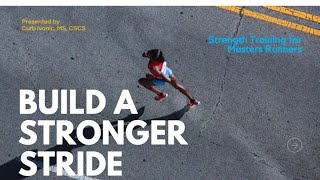
All right. Hello everyone. Hopefully this is working and you can hear me and see me and the technology is going to stay on point. But I'm really excited to be here. I'm going to be talking tonight about the Stronger Stride. Webinar is the title and it's really what it's going to tell you and help people that are over 45 understand why and how they need to strength train to improve their running and their health. And there's some specific needs and concerns for the older runner and or endurance athlete or any fitness enthusiast that is, you know, in their late 40s and beyond that they need to take some things into consideration when doing incorporating strength training into their own programming. So yeah, let's get into it and let's dive in and I'm going to put in the slides here. So this is the, this is the, the title slide here. So yeah, just how to build a stronger stride. And this is what I talk to you about and explain to you exactly what's going on and, and then we can, if you have any questions, just pop them up into the chat and I'll get to them as we go through. And yeah, happy to address any of those. So just a bit about me for those of you that don't know who I am. I've been a coach since 2000, so I've been doing this for a while. I've worked with well over a thousand people in various capacities, either one on one, coaching in the gym, in strength conditioning, online or in clinics and in various locations. So yeah, I've got a very vast experience working with level people of all different abilities and talent anywhere from beginner runners to worked with a few professional athletes and helping them. I spent some time working in a biomechanics lab at a place called Fortias that is in the greater Vancouver area or used to be. It's unfortunately shut down. We had a great team there. Learned a lot from Chris McLean who ran the lab, but we he would do detailed analysis on the fancy treadmill and then I would help runners implement his recommendations. I would do some more assessing of my own and help them incorporate drills and strength training and stuff into their program to help their gait and to help them perform better. So yeah, right now I, you know, do most of work online. I coach a lot of people remotely. I've got clients all over the world and I still see some people in North Vancouver at a gym and I've got some specific special testing equipment where we can test force outputs and really get into the nitty gritty of how strong and how powerful they are and how well their muscles and tendons are working. I love dark coffee. That's probably my favorite pre run drink and I've been known to indulge in the occasional pilsner especially post run. So that's a bit about me. Now why do we want to strength train for running? Well one of the main thing is it's not just about the running for your overall health well being strength training gives you benefits that running cannot and anyone past 40, well younger too but definitely past 40 you need to be lifting some sort of weights or resistance training. There's just so much information out there we have so much data now of the health benefits of it how it improves your quality of life especially as you get older. And so it's to me it's a non negotiable all my clients that I work with all the runners of all abilities they they strength train it's in their programming so and you know it helps. Now how does it help? Well one of the things it does is helps improve running economy and so I'll talk about that in a second but that's one of the main mechanisms of how it can help with with running. Now it also may reduce injury risk. The the evidence is the research there is a bit spotty we can't say for sure there's as like we can with performance that strength training will reduce your risk of injury but I there is some good evidence that it can help with that and then for sure for recovering from injury. Almost any type of rehab is going to involve some sort of strength training whether whatever you're dealing with. You're probably going to have to do some strength training for a particular muscle group like it band usually you have strength in your hips, you know knee pain. You probably have to do some quad strengthening or depending what it is so Achilles you have to work on the Achilles tendon and the calf muscle and we'll talk a bit more about that kind of stuff but and those are all the ways that strength training can help your both you're running any quality of life. Okay. Now running economy what does that mean? It just means that there's better you improve your performance because you use less energy for a given pace. Now you can improve that running economy anywhere from 2 to 5% with strength training and some studies have even shown an improvement of up to 8%. Now 8% improvement is pretty crazy. Like if someone said hey if you do this training and we can up your performance by 8% I think you'd probably take them up on that, right? So yeah, that's pretty wild. But you know, all these super shoes that have come out last decade or so or last five years, you know, they're showing some improvements in times of about 4%. Well, this is something that you don't depend on a piece of equipment. This, your body is your equipment. So training your body can give you just as much benefit as buying, you know, a pair of really expensive shoes. Now, you know, you can still buy those shoes and stuff like that, but I'm a firm believer that you train your body first and you depend on your equipment second. But of course I'm going to say that I'm a coach, right, A bit about more about injury risk and recovery. Like I said, the evidence isn't quite as clear cut for reducing injuries from strength training. But there has been some evidence, some research studies that come out showing some hip and core exercises may reduce injuries. There's been some foot strengthening exercises that perhaps could reduce injuries. So but like I said, you know, there's other benefits beyond just injury risk that that strength training will provide you. And for sure, if you do unfortunately get an injury, an overuse injury, that's the most typical with running, you're probably going to be doing some sort of strength training to rehab it. So, you know, we can almost take a, almost like a prehab approach, making sure the tissue is resilient to withstand the rigors of running. And we'll talk a bit about that coming up. So that's a good segue. So before I get into that part though, I just want to kind of review a bit more about running economy. So what you want to run have good running economy and using less energy for any kind of given pace is making sure you have well coordinated muscle action. And that might not make, you know, your running form seem like perfect or, you know, beautiful. Like some runners really look nice when they're running out of the reservoirs don't. But that doesn't matter as long as internally your body is finding an efficient way to coordinate its muscle action. That's what we're after. We're looking after, looking after smoothness, I guess is a good way to put it. And then the other thing we want is stiff tendons. Now I know that may sound like a negative thing, but tendons, you want stiff tendons. Tendons can be kind of what we call in strength conditioning compliant or stiff compliant means that they'll actually stretch more when they're going, when they're working. But that by stretching more, they'll actually have be able to produce less power and won't work as well. Whereas a stiffer tendon will be more like a thick elastic band. So think of a compliant tendon. It will stretch like a thin elastic band. That, that's kind of, you know, is, isn't very, you know, is more. Less elastic, I guess. Whereas a stiff tendon is like that thick rubber band. When you pull it and let it go, it's really going to snap back and provide more power. And that's what you want. So it doesn't, it's not necessarily negative connotation in this, in this instance. And so the goal with good running economy is to minimize the positive work of muscles. And so you're kind of, let's call it free energy, especially through the Achilles complex. With every step you can get about 17 energy return if that Achilles tendon is working well, which is, you know, that's quite remarkable. So one of the things we want to look at when we're discussing the older runners, there are some different changes that happen. This kind of, this diagram describes it. You know, we just are. We lose spring in our step, and that's just a natural byproduct of Patriot, and that happens. And, and we can't, you know, completely negate that. But there's definitely some things we can do with training, especially strength training in particular, that can mitigate some, some of those change that we see and bring us, you know, a better spring and earth step. And because our stride gets shorter as we get longer, because we just, you know, when you're running, you're kind of bouncing from foot to foot, and if you lose that elasticity, that stiffness in your tendons, you just, Your stride gets shorter, you're not as powerful. Now, interestingly, we may not see a change in running economy when these changes take place, but some other research has shown that even if their economy doesn't change, it still feels like more effort to run, you know, at a given speed. And so, you know, to run faster, continue to run faster, get older. You know, you might not be as fast as you are as you were when you were younger, but to still maintain at a, at a higher level of performance, you know, you've got to train those muscles and those tendons and those tissues to be able to react well. And, and so that's where strength training comes into play. The other thing too, that as we get older, we see some different types of injuries that occur. Soft tissues become more common, especially in the lower leg the calf and the foot and the Achilles are common sites of injuries. And I've worked with a lot of runners in this age group who are definitely, you know, who have had some issues with Achilles, and those can take some long time to recover from. And, but definitely, you know, by being proactive and keeping your Achilles healthy and strong, we can maintain good function and good performance as you get older. But this is something to keep in mind as you get older that the, you know, it's a real thing that happens. We have increased risk of injury, soft tissue, especially to that lower limb. And then as I'm alluding to when we're talking about strength training for running, it's more than just the muscles. I love this, this is an old meme that I've, that's been around the Internet for a while, but I think it's, it's so applicable and my body definitely lets me know about this sometimes. You know, strength training is more than just about your muscles. It's. Your muscles can get stronger, more powerful, but also what we see is improved cartilage qualities. The bones get stronger, okay, the tendons get stiffer, as I talked about earlier, and that's a good thing. And they become more powerful and be able to return more energy with each step. So, so that is something that we want to see happen. So we want to affect all those tissues. And I just want to kind of bring out something because everybody, you know, it's a common misconception that running, because it's a weight bearing activity, is good for bone health. And it's actually, I mean, it's not bad, but it's not great. And the reason for that is that bones really are particular in the kind of signal they'll listen to, to adapt. And they respond better to high intensity, high load, which means heavy or fast movements versus repetitive movements. So when you go for a run, you know, the first couple of minutes your bones might be taking a signal from the, from the actual movement from the running to, you know, adapt, but after that it stops listening to that signal. Whereas with strength training, we are providing enough load in, in short quality in a short duration. Because when you're doing an exercise, even a set, you know, it's not lasting very long, but it's high intensity or high speed, which is what the bones like. And so, you know, this chart here really kind of shows you some of the, some of the best activities for developing bone health. And you know, again, weight training is up there. One of the things I wanted to kind of bring out in this topic is some common mistakes that I see with runners that they do with their strength training. One is that they don't lift heavy enough. It's been a common misconception for a long time that, you know, hey, you don't want to get bulky. You want to do some light weights, do a lot of repetitions, build your muscle endurance. And that's near not really what you want to be doing with strength training. You build your endurance for running by running or doing some cross training, cycling, swimming, whatever. That's working on your aerobic fitness. Okay, you don't want strength training to be developing your endurance. That's not, it's. It's. You're on the kind of other side of the spectrum. You want strength training to build your strength. You want it to build your power, and you don't necessarily need to get bigger. And there's ways to do it that doesn't increase muscle size. Now, some, some runners do want to put on some muscle mass, and that's fine. You can. But lifting heavy weights doesn't automatically put on, make you a bodybuilder, make you a Schwarzenegger. That's not going to happen. The other thing too is, is doing circuit training. So it's along the similar lines. You know, runners will, you know, go from exercise to exercise and kind of try to keep their heart rate up. And this ties into making strength training a cardio workout, which is, again, it's not the intention of that. So, you know, going from one exercise to another to another and not taking complete recovery, that can contribute to too much fatigue, which is another common mistake. So doing too many reps or too many exercises, and then that will impact your run training and recovery. So you don't need to do a whole lot, you know, in terms of lifting, but just enough. And I'll cover some specifics later on in the, in the webinar of how much to do and how to do it. But yeah, you don't want, you know, you don't want running to become another aerobic workout. Use your running, use your cross training, swimming, cross country, skiing, whatever you like to help your, you know, cardiovascular performance and how. And use your lifting to work on your muscles, your tendons and your bones. All right? And so why do we want to lift heavy? Well, look at some of the contact forces that we see in different tissues. So, you know, up to eight times body weight for some tissues, it's just the, and the joints, too. The hips can be up to 10 times body weight. Contact forces, the Achilles can have up to over six times body weight with each foot strike. So the forces we encounter when running are quite high. And this is, and this is another. We want to point this out too. You want to lift heavy because look at the. Some of the things that happen when you're running uphill or downhill for a lot of. I've worked with a lot of trail runners. I used to do a lot of trail running myself and I always felt better when I had lifting as part of my program, including downhill running. I remember running in a, in a race, a local race here and, and the. It was always held in the late winter, early spring, kind of late February, early March. For those of you that know it's the dirty duo and you know, and sometimes over the winter you're not doing as much running. But I know I've done it a few times and when I would spend the winter and I was doing more lifting, even if it wasn't doing as much running, the downhills would seem much easier and I wouldn't be as beat up from being from going out and hitting some of those trail runs going pretty hard versus the years that didn't incorporate the strength training in there. So definitely lifting will help both uphill and downhill running and then lifting fast. So I'll talk a bit more about different types of strength training later in the webinar. But sometimes you want to lift fast and it's not just heavy but you know, do more kind of power cell training and apply metrics, you know. And, and so this is, this shows you the. I just realized one of my slides has a mistake here. I've copied it, but this, the diagram here is showing you the Achilles recoil and as you run faster that recall happens quicker. And so this is why we, you know, your muscles and your tendons will adapt to the, to the type of training you put on it. So yeah, you gotta keep to run faster. Obviously you gotta do some speed work and tempo runs and all that kind of stuff. But this is where doing some plyometric kind of work and some faster lifting can train those tissues specifically to again work better at faster speeds. And this diagram here really shows you why body weight training isn't nearly enough. So you can see down here on the left hand side of the chart the forces that a body weight squat you'll see on the different muscle groups and then you'll see at running and depth jump the forces that you experience. You can see that the body weight squat doesn't come nearly. It's about half of the forces that you can experience running at, you know, at a fast rate. And, you know, doing a depth jump is for sure will, will meet or exceed the forces that you see during that run at faster speeds. So that just shows you why, you know, running at that faster or training with, with heavier weights or doing more kind of explosive type training will prepare you better for the needs of running. And then so I want to quickly cover some strength turn terminology. So isometric, eccentric, concentric, that just refers to diplo, different types of muscle actions that are occurring. So isometric is when your muscle isn't changing length, it's holding a position. Eccentric is generally the lowering phase of a lift. So if I'm doing a bicep curl, you know, when I'm letting the weight down, that's eccentric. When I'm pulling back up, that's concentric. So that's when the muscle is contracting. Eccentric, think about the muscle is lengthening. Isometric think the muscle is not changing length at all. Concentric think the muscle is shortening. Okay. Plyometrics just refers their jumping type exercises, generally done without load. Sometimes we might add load, but for most people we don't. But they're, but they're done at a high velocity and that kind of mimics, you know, even slow running. Each individual running stride is done in milliseconds. And so plyometrics more closely resembles the kind of actions we see in real world, actions like activities like running. And so, you know, plyometrics, something you can include. Strength refers to, if we want to define it, is how much load or weight or force you can, you can lift. Power refers to how quickly you can lift something. So that's the big difference between strength and power. And you know, I would actually argue that kind of one of the things we want to develop with strength training with running is, is actually more power. Being able, more powerful necessarily mean bigger, but just being able to handle, because like I said earlier, every, every running stride happens in milliseconds. And so it's, there's an element of power in there that we, we kind of want to see. Hypertrophy just means muscle size. Most runners probably aren't going to want to be developing, putting on a lot of muscle. Some people might be more of that kind of hybrid athlete approach and they want to maybe get bigger but still maintain some good running and stuff like that. But generally that's probably, you know, not a big consideration for most runners. Coordination refers to just being able to organize your muscle action so there's a smoothness in that, in that motion. And then range of motion just refers to the muscle or the joint going through, you know, a wide or, you know, whatever range it needs to, to perform the action. And I'll talk a bit more about how that applies down a little bit later in this in the webinar. So we've talked a bit about lifting fast, but why do we want to lift slow? And the reason being is we lifting slow by focusing on isometric and eccentric portion of an exercise will affect our tendons more than just our muscles. And so muscles, I mean any kind of work you're going to get, you know, relatively good effect on the muscle. For hypertrophy building muscle, it's been shown that you can use light loads and high reps or heavy loads and low reps. It's fine. When we get to strength and power training, it's a little bit more specific in what we want to do. We don't want to necessarily be doing too many reps, but tendons are way more picky of what exercises and what kind of training they need. And so this is why we kind of want to lift slow. However, we also, for overall tentative health, we also want to lift fast. So we can, we can, you know, sometimes use slow eccentrics and isometrics and but other times doing plyometrics in that fast type training. And because that'll help your tendons become stronger, more powerful and springy, get that stiffness, you know, like a, we talked about earlier, compliant versus stiff tendons. We want stiff tendons as a runner, particularly the Achilles tendon. We want that to be able to spring back into action. And we want a good strength in the, in the patella tendon too. That's the one that connects your quad muscles, your thigh muscles to your go across your kneecap, attaches it to your, your shins. And we want that to be resilient too because the knees take a lot of load in running as well. So again, you want to include some fast training, some slow training and we'll get into specifics shortly. Trust me, we'll get to all that, that stuff soon. Another thing we really want to keep in mind too is there are some sex related differences in the tendons as well. So you know, women will have, will develop a bit earlier with puberty and stuff like that, but that's not necessarily great for tend, the hormonal changes that happen will affect negative reflect tendons as well. And so you do. And I work with a lot of perimenopausal and postmenopausal women. And definitely joint issues can be a thing. And sometimes you might actually experience, you know, you're doing all the right things, but you still may have sudden joint pain come out of nowhere when you're going through these stages of life. And so that's, this is something you want to be. You want to have a good doctor that you're talking to and you know, checking your hormones and seeing, noting changes and what's going on. But that is a symptom that wasn't really talked about much previously, but we've seen that, you know, more and more people are talking about it. As you're going through these stages of life, sometimes you will see that occur. I've worked with a couple of clients that, yeah, they're, I mean, they're doing, they've been lifting, they're active, they've been running and all this stuff. And sometimes it's still, these phantom joint things kind of still appear. And you know, so my, my role as a coach isn't to diagnose that, but to deal with it and hopefully get them to the right people, the right therapist and, or, you know, a good doctor to help, you know, figure that the whole solution out. But I adapt their strength training program in those circumstances so they can continue to train, but we're not, you know, making things worse in that affected tissue. So anyway, women, please, you know, keep in mind this is one of the reasons you do want to be working on not just your muscles, but your tendons as well. And as you get older. And one of the things we, you know, I've kind of alluded to this earlier, so something called the stretch shortening cycle. You know, when you're running, like I said, you're hopping from foot to foot. And when you're, when you're, what's going on there is it's think of your legs, especially the lower legs, as a spring. So you can press the spring when you step down, boom. And that spring, you know, expands and pushes you forward. And that's what the Achilles really does in, in, in the running gate. And so we want to have well functioning stretch shortening cycle. And this is one of the reasons to have a well rounded strength conditioning program. Now this is getting to the part that everybody's probably waiting for and well, what does that all mean? Curb? Like what is, you know, that's great to understand all the science and all the theory, but, well, how do I do it? Okay, well, what we want to do to, you know, we're not trying to turn into a bodybuilder. You don't, you don't want to be doing these bro splits and six days a week and chest and tries and back and buys and all that stuff. You need to be doing one to three sessions of strength training per week. How many really depends on what's going on with your, with your running schedule. So, you know, let's say somebody's trained for a half marathon or marathon or ultra, you know, their volume's probably going to get bigger and bigger as they get closer to race day. That's when you want to start scaling back the strength training sessions. So, for example, you know, over the winter, late fall, winter, as the, as the racing season is winding down the northern hemisphere, I generally increase the strength training my clients do. This is where you're going to be doing two or three sessions a week. Some of my clients are doing three sessions a week right now. As the volume of running and cross training builds up, we move back to twice a week. And then in peak season, we may move back down to once a week just to maintain or once even every 10 days. With some of my ironman athletes that I've coached that are putting in serious volume of training, they got bigger notch where we're running, but they're doing swimming and cycling on top of it. There's just no room to put strength training in. And so we might even move to like a one every strength training session, one every 10 days. And that's good enough, you know, in peak season to maintain your strength. So it just kind of depends on where you are in your training cycle. How many exercises? Well, we want to do about three or four for the lower body and three or four for the upper body. Now, I know we're, you know, you don't run on your, you know, using your arms and stuff like that. But going back to why you want to strength train, we want to strength train for overall health. It's not just performance. You're not, you know, 99.99% of you people watching are not getting paid to run. You do it because you like it, you enjoy it. But we don't want to neglect the upper body just for your overall quality of health and quality of life. And so you want to include some upper body exercises as well. So three to four for each of those regions. Okay. You want to be doing somewhere between six to 12 repetitions for a set, and you want to be doing about two to four sets for a particular exercise. Okay. Repetition, if you don't know what that is, is Just one complete execution of a movement. So let's say the bicep curl. Everybody kind of knows what a bicep curl is, right? One up, one time. Up and down is one repetition, right? And a set is a series of repetitions in a row. Okay, so six to 12 reps for two to four sets. And how much weight you use? Well, this gets a little bit tricky, but the weight you want to use, I use a system called Reps Reserve rir. It's abbreviated. And you don't necessarily have to go to muscle fatigue. So that means muscle fatigue means you go into the point where you can execute one more repetition. That creates a lot of fatigue, though, Right. And that can negatively impact the rest of your training and especially your running, which is what we don't want. So you want to stop about two or three reps short of muscle. Momentary muscle failure. And so let's use the bicep curl example again, if, you know, if I've told you to do, hey, I want you doing eight repetitions for three sets. That means by time you get to the eighth repetition, and I said I want you leaving two reps in reserve, you should feel the weight you're using. You should be able to do about two more repetitions before you'd have to drop the weight. So you're going close to failure by not getting right to that point. And sometimes it takes a little bit of work to figure those weights out. But that's kind of. You want to be lifting heavy enough if you finish a, you know, set and, excuse me, and you could do another five or 10 repetitions, the weight's too late. And if you can't hit the required repetitions that you've been prescribed. And then it's too heavy, obviously. Right. This gets a little bit tricky when we're doing talking about plyometrics and things like that. I'll talk a bit about that. That system doesn't really apply to that. This is more just for your basic lifting. And then you want to make sure you rest long enough between sets. And so that means resting one to three minutes. Again, you're not doing circuit training, but I do often use supersets with my clients to help them make the program time efficient. But what I'll do in that case is I'll pair lower body exercise and upper body exercise. So your body, you know, you're still working, but, you know, if you're doing, like, squats, and then I've got you doing a back exercise, let's say a lat Pull down. When you're doing the lat pull down, your legs are resting and so that counts as part of the recovery for that muscle group. Right. While you're doing the lap pull downs, working your back and shoulders. So oftentimes that's a really time efficient way to make your workouts is to superset and that's often what I do. But again, the purpose isn't. It's not because I'm trying to keep your heart rate up or like that. It's just because I'm trying to get enough work done without having you spend hours in the gym and do an upper lower and means that your lower body still getting that adequate rest between the sets. Okay. And then isometrics and plyometric exercises can also be done. That's going to be a little bit more individual specific. And what's going on? Are you coming back from an injury? Have you had prior energies to this certain spot? You know, you need apply metrics so all those things kind of come into play. You want to be careful and ease into something like plyometrics where you're doing lower intensity kind of work first and get stronger and more comfortable with the movements and then increase the intensity and the repetitions and things. And same with isometrics. Isometrics are generally pretty safe. But you know, depending on how you hold them out, I'll give you some more specifics about that in a couple of slides, but that's how you put it all together. Now we may not. If someone hasn't strength trained ever or for a very long time, I'm not going to throw them in there having lift heavy weight right off the bat. You want to ease into things so you want to get comfortable. You know, if you've, if you're new to strength training or like I said, you haven't done it in a while, you want to get back and doing some stuff. And we may do body weight stuff. I often start with just that, body weight squats and body weight lunges just for people to get comfortable with the movement. Then we can start adding some loads, start adding some dumbbells, barbells or whatever you want. But the idea is to get proficient in the movements before really loading it. So while I've given you these recommendations, this is assuming you are comfortable, you know, doing movements. So I'm not going to give somebody a leg press exercise and tell them this, you know, leg press 300 pounds if they've never done it. We're going to really ease into that kind of thing and like, you know, body weight stuff is fine to start with, to learn movements and progress from there. Now, in terms of what muscles we use in running, we use everything when we run, but obviously use the lower body muscle more than the upper body. The primary running muscles, in my opinion, are going to be your hip flexors, the lateral hip muscles. So the glute medius, glute minimus on the sides of your hip there, the quadricep muscles in the front of the thigh, and along with that, the patella tendon, the hamstrings on the back of the thigh, and then in the lower body, the calves, the soleus and the gastrocnemius. And with those, the Achilles tendon. Soleus particular is an important calf muscle. So those are kind of the muscles we definitely want to make sure we're targeting with our strength training exercises. And then if we're looking at exercise selection, like I said, you want to be choosing exercises that hit all those muscle groups. Compound movements. Compound. I mean, using more than one joint, like a squat or a deadlift or lunges. It would be generally termed a compound movement. And isolation exercises are like a leg extension or a leg curl. Those are exercises that mistakenly are called single joint, but let's, let's just use that term because it's popular. They tend to focus more on one muscle, so both can be good. There's no need to exclude isolation exercises. Some cases they might be warranted if you're particularly weak in a muscle. So something like a squat versus leg extension. The leg extension really focuses on the quadriceps. The squat definitely uses quadriceps. But there's other muscles that also work with the quads to create a squat and motion. Unilateral exercises are emphasized now when you're starting out bilateral, meaning both limbs, both sides at the same time is a good way to start. But eventually you do want to emphasize unilateral, meaning you only work one side at one leg at a time. And the main reason behind that is to equal out any strength asymmetries you may see. Side to side, I'll use. I'll just give you a quick case study on myself here. I've got some specialized equipment in the gym in North Vancouver, and one of the pieces of equipment I have can quantify isometric strength in different muscle groups in different positions. Side to side. I was having Achilles tendinopathy for quite a long time, and I was doing isometrics. I was doing all the things I shouldn't, should be doing. But until I tested myself and Found I had a quite a large strength asymmetry in some of my other muscles between the sides, particularly in the hip. It wasn't until I really focused on equalizing the strength in my hip musculature that my Achilles issues finally began to resolve. So that's, that's a primary reason why, you know, I do emphasize a lot of unilateral work with runners. And then one thing I want to mention too is that the hip flexors, the muscles that are deep inside your hips and connect the pelvis to the femur and are responsible for kind of initiating the swing phase of the run cycle. They're neglected often as well as the calves and soleus in particular tend to be overlooked in many strength training programs that I've seen presented for runners. Now, of course, you do use the upper body in the core when you're running and stuff, but those are more for coordination type movement. It's the lower, the legs and the, the hips that are really responsible for the propulsion in the run. But there you have kind of, you know, there's no really bad exercises, but these are some of the things you want to keep in mind when you're choosing exercises for the, your program and then structuring your workout. So generally most of the workouts that I give to people are, you know, the half hour, 45 minute, 45 minute range. My workouts are somewhere there, 45 to 60 minutes. And for most people that's, that's doable and easy to fit in their schedule. So you want to start with a little bit of a warm up, maybe five minutes, maybe jumping on a bike or rowing machine or doing, you know, a little run for a couple minutes, doing some dynamic kind of warm up, some more kind of body weight stuff. That's range of motion. So lunges or you know, world's greatest stretch is a common thing that I give out or whatever. And then you may want to do some coordination drills. This is where sometimes I have people do running drills or sometimes I have them do running drills before their runs too. So that's kind of strength training as well, but it's done on a different day. But you know, your A's and B's and C's and there's some other types of drills that I do as well that maybe aren't as common. But I have people do some of these kind of coordination type drills. Then if, if the, if it's appropriate for that individual, we'll do some plyometrics. You want to do plyometrics early in the workout when you're fresh because a, you want them done quickly because the speed of execution with these exercises, they're jumping, you want them done and when your tissues are fresh and so that'll, that's how you can make sure you're doing them properly. And we're providing the right signal to the body to adapt. So you do that early. So you might do some skipping, you might do some jumps, you know, counter movement jumps, might do broad jumps, well, one legged hops, things like that. That's where I put that stuff in early in the program. And then we get into the main body of the workout. That's where you do your, you know, your squats with heavier weight and you know, maybe rowing, whatever, whatever you do. That's going to take somewhere 30 to 40 minutes or so. And then you can, if you want, you can do a bit of a stretching or cool down. Personally, I don't do a ton of that. But your workout should be somewhere between 45 and 75 minutes long. If you really got the time and stuff you want to, you know, be, you know, do a lot more, you can do more that mobility kind of stretching kind of work or maybe take a bit longer warm up. You might be pushing over an hour, but you know, for sure you should be able to get a decent workout in, in, in 45 minutes or less. And we can, like I said, you know, not everybody has to be doing coordination drills. You don't have to be everybody doing plyometrics all the time. So that workout, you know, somet one of my clients are busy and stuff like that. We see, we just go like, you know what? All you got is 20 minutes. Boom. This is the biggest bang for the bucks. We'll cut the workout down and this is all you're gonna do. And even 20 minutes you can get a really good stimulus for your muscles and your tendons, your bones and that's, you know, you don't have to spend hours in the gym. So recommendations for plyometrics. So these are, these come from the National Strength and Conditioning association, which is, I've got my certification through them. They're kind of one of the leaders in the field of strength and conditioning. This is the rough guidelines they give. So people that are new to plyometrics jumping type exercises, you know, 80 to 100 foot contacts. And that foot contact means exactly that, how many times your foot contacts the ground. So if you're doing single leg hops, that means, you know, 80 total foot contacts with total intermediate level you can do 100, 120 and then advanced 120 to 140. Now beyond that there's different levels of climatics, you know, higher jump, you know, if you're loaded, unloaded, all those things come into play to make them either, you know, harder or more difficult. So again, you got to make sure you're doing the, the kind of plan metrics that are appropriate for you. Something that's really basic and that's actually been shown to improve running economy and performance is something is basically skipping a rope. And even if you don't want to rope, you just pretend you're skipping a rope. But I often have my clients do some of that and that sometimes I haven't knew that before. They do a track workout or a tempo run, they'll do their dynamic warm up and then they'll do some skipping and then they'll go up for the run. And what that does is again gets Achilles really fired up and gets that working, provides a bit of a stimulus. But something like that, that's a low level, great entry level plyometric type exercise that most people can do. Unless you, unless you're dealing with, you know, you're coming back from Achilles exercise or Achilles injury or you know, or knee injury or something like that. That's where you got to be careful of when and how you apply plyometrics. And we can apply it at the right time in your programming, but if you're healthy and stuff, you know, just some simple skipping is, is a great plyometric exercise. Guidelines for isometrics so this is where you're holding a position, right? And the guidelines are a bit different. So if you've got a healthy tendon, you just want to work it and really target it. You want to hold a position in a certain, in whatever movement for five to 10 seconds. And you kind of want over that set, you want the total duration to be, you know, 45 to 60 seconds. So if I'm doing a five second hold, I might do, you know, eight to 10 repetitions. If I'm doing a 10 second hold, maybe I'll only do five or six repetitions of an exercise. So just depending on, you know, common how many reps you're doing but, and how long you're holding it for. But that's kind of the rough guideline, you know, 45 seconds to a minute total time of holding a position. Now if we're kind of rehabbing and coming back from an injury and dealing, trying to target attendance. So it's, let's say again, we've talked about a lot about the Achilles tendon. In that case, we may hold a particular isometric for long duration. So we might start 5 or 10 seconds but then we'll build up and we'll hold it for 30 to 45 seconds. And I've done somewhere of how for up to a minute and I'm, I'm currently doing some of this right now myself. I, I'll do a leg press and I'm holding it, you know, four boat a minute. And I tell you it you want to stop time, do a really heavy isometric and hold it for a long period of time. And time really slows down. But it is the reason we do that is because when you hold an isometric, so even when you do the isometric once you, as the muscle is getting into that position there's, it's changing length. But as you hold it, the longer you hold it, the less change in length there is in the muscle. But then what has to happen is that tendon then needs to elongate and we call that tendon creep, right. And, and by holding that position we now we are putting more of that strain and stress on the, on the tendon and that's what we want. And so for, for you know, coming back from a tendon type injury, tendinopathy, we need to strengthen that particular tendon. Tendons are notoriously take a long time to heal and get stronger and get better because there's reduced blood flow. It's not like a muscle. And, and oftentimes people aren't doing the right things. So you know, just doing a regular exercise. And so the isometrics really help put that focus and an emphasis on the tendon. And then you also have to again apply enough load. So this is, you know, but it does, even if you're doing the right things, it'll take a long time to especially for something like an Achilles to get that back to health. There's one study actually that showed even five years down the road there was a certain percentage of people that were still having some, some symptoms with attendant. Now the good news is you can, you can get back to activity. You can do things way sooner than that. But just realize be patient. If you have a tendon injury patella, like a knee tendon issue or Achilles tendon issue, you really have to be careful and just be patient with it. You can still do things and, but you know, isometrics is going to be one of your best bets to help deal with that. And then you know, the question comes up though, what about mobility work? Well, strength training can actually help you with your mobility. I often will include exercises that kind of work the muscles in. Let's call it a shortened length range or lengthened range. And that's what you want to be doing, is taking your muscles through a full range of motion for any particular movement you're doing, but something some exercises emphasize one versus the other. So let's use the hamstrings as an example because that'll be fairly clear. So let's say you're doing something like a hamstring curl. So that's where you're sitting in a seat, like a hamstring chair, right. And you've got the pad under your ankles. And then you, you're, you're bending your knees and pulling the, the pad, the weight towards your butt. Okay. That's a hamstring curl, the seated hamstring curl. That's taking the muscle from a long position to a short position. Right. Because you're, when your legs are out straight, it's lengthened out and then you're contracting and shortening it. So it's kind of, you know, taking it through that range. Something that we, it's called a Romanian deadlift. That's where you're standing with the bar and then leaning forward, hinging at the hips and then leaning and the legs stay relatively straight and letting the bar down. Okay. Your hamstrings in that case are going from a length shortened position. You're standing and then you're, as you're lowering, they're lengthening. So that's emphasizing more the eccentric kind of portion, that's more about eccentric based exercise. So, you know, I often will combine different types of exercises to make sure my clients are working the different joints and the muscles into different ranges. And that's been shown actually one of the best ways to improve flexibility, doing some form of loaded. So even something like yoga, though, you know, it's body weight, stuff like that. But you're holding different positions for a length of time under load. So it's not just static stretching, but you know, you're holding a position like let's say your warrior pose or whatever the case may be, you're going to be stretching the tissues around those joints, like in the example of the warrior pose. Right. And around the hips specifically, you're going to be putting those muscles and tendons under, under strain for a while and holding it. So this is where you get that improved mobility from. Okay. So that, you know, if you want to do more stretching and stuff. You can. But the strength training can actually help with the mobility aspect of it. One thing I did want to say give credit to is, is the. There's two guys that I used for a lot of the images in this. That's Jake Tura. He's a strength and conditioning coach. His handle there at Jaketura on Instagram, he puts a lot of great material on, on tendons. He's got a great podcast. He's interviewed some of the top scientists, researchers around tendon health and stuff. So if you are experiencing some sort of tendon issues, I highly encourage you to follow him on Instagram. And he's got, you can, you know, go there. And he's. I think jaketura.com is his website too. Listen to his podcasts like that. But he's got some great information. And then Rich Willey, he is a researcher and a physiotherapist at the University of Montana. He runs a place called the Montana Running Lab. They put out a lot of great research, so a lot of great graphics from him. So that's where a lot of the images came from. The other stuff like this image here, that's just stock photography. So no credits there. So, yeah, thank you for coming and hopefully you learned something. You can reach me, you can go to my website, corrunning.com or you can email me at info running.com if you like. There's also a link there for the Ageless athlete Facebook group where I post a lot of info or you can follow me on Instagram at Run Sweat Beers. So, yeah, feel free to reach out to me. I'm gonna make this into a handout if you'd like a handout. You can DM me on Facebook if you're watching the live or. And I'll. And I'll send you the handouts or you can email me@infocore running.com and I'll more than happy to send you the handouts. That's where also I'm going to have the replays. I'm going to send that out to people. So you'll see that. And so, yeah, hopefully you learned something of how to structure your program to improve as a runner, to improve your performance, but more importantly, to also stay healthy as you get older so you can keep running and enjoy it and not have the aches and pains that, you know, sometimes come about from running. So I have one more thing I want to say, though. If you need help, I put together something special and I know a lot of runners when I start working with them one on one coaching. This is one of the things we help them do. Incorporate strength training into their program, kind of individualize it for their particular circumstances. But what I've done is I'm going to do a group coaching program called the Stronger Stride Challenge. We're going to do. It's going to start in January, January 6th. Okay. It's going to be four weeks and what it's going to entail is I'm going to have, I'm going to design a couple of workouts that you're going to do twice a week. Okay. For four weeks. What I'm going to do is I'm going to have a home based workout. So if you're not going, don't belong to a gym and you don't have much equipment, I'm going to have something. We can just use dumbbells and bands. You're going to need something. Okay. You're going to need more than body weight. But you know, I'll make it around dumbbells and bands and then I'll have another program if for people that are going to the gym that have access to more equipment. But I'm going to use standard equipment. It's not really any specialized, highly specialized equipment that you might not have at every gym. But you know, barbells and dumbbells and things like that, most gyms will have. Okay, so you get a professionally designed group workouts that you'll put into your, you know, into your schedule. You can have some accountability. So we're going to do, I'm going to run this from a Facebook group and, and you can deliver the workouts. We're going to deliver them via app. So you, you've got an app, you'll see all the exercises, the videos, how to do them and explanations. We'll have a weekly call so you can have accountability because the rest of the group is going to be there and saying, hey, I'm, you know, did you do the workouts or not? We'll be making sure you are. But then you can also ask me questions in a group coaching call every week. What's going, you know, if you're not understanding some of the exercises or whatever struggle is you're facing or how to, you know, I'll also show you how to best structure your workouts in the week. You know, so you don't want to be doing a strength workout the day before your long run. I sometimes do that with my clients on purpose, but not all the time. But anyway, I'll I'll sure, I'll share with you. I'll coach you through how do you incorporate strength training and make it balanced with your run training. And, and so the purpose of this, look, in four weeks, I'm not promising that you're going to drop your marathon time by 20 minutes and you can improve your mile time or anything like that. Right. It doesn't. The adaptations take, you know, anywhere from, maybe in four weeks you might see a little bit of improvement, but it's more about getting into the habit, understanding how to do it. So the rest of the year you're going to be good to go and you're going to know, okay, I'm, I'm confident in my strength training. I know what I'm doing and I can use it for the rest of the year with my running. So really the challenge is about learning how to do it and doing it properly. You've got access to a coach, you got professionally designed programs, you got the accountability. So if you're up for it. Yeah, Stronger stride challenge. Just email me infoaroning.com or send me a message on Facebook. Direct message cost is really simple. It's only going to be 99 bucks and that's Canadian. So if you're in the US that's really cheap. But as a special thank you for watching webinar, you're going to get it for 75 bucks. All right, so that's like, I don't know, if you do the math, it's like less than a Starbucks coffee a day. Right. So, yeah, if you want to join that, like I said, send me a message DM me on Facebook or send me an email infocoroning.com 75 bucks. You get professionally guided program, you get accountability. We'll have a coaching call each week to answer all your questions around strength training and that. You know, taking those four weeks, you're gonna get stronger. But more importantly, you can know how to do this and, and be able to come into 2025 with some good momentum and, and be able to do, keep that up for the rest of the year. All right? So again, thank you very much for coming. I hope you learned a ton. If you have any questions, feel free again to email or DM me and I'll be more than happy to answer. Take care, everyone, and make sure you start lifting. All right, bye. Bye.