Concrete Lifting vs Concrete Replacement
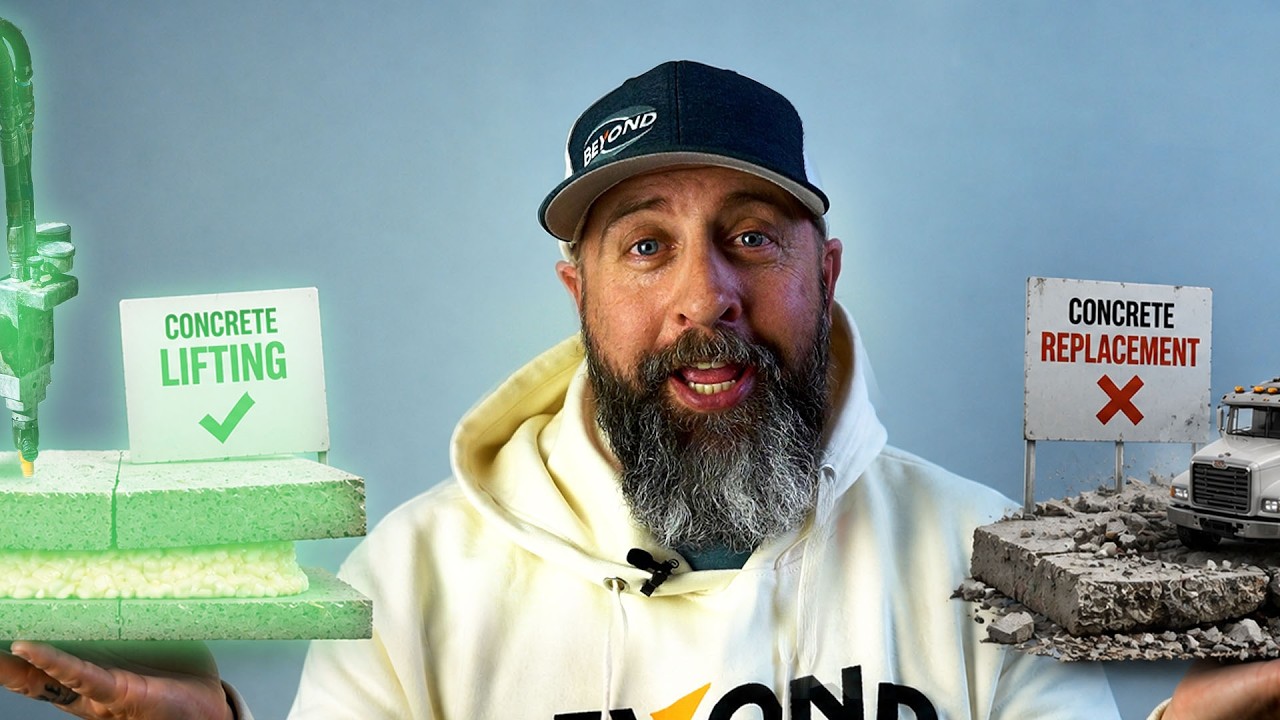
Curt Janzen and concrete lifting specialist Adam Dickinson explain how polyurethane foam can raise sinking concrete by filling voids beneath the slab. Lifting costs less than replacement but risks cracking thin slabs, and replacement doesn't fix the underlying drainage problems that caused the settlement in the first place.
If your concrete is sinking and you think you need to replace it, that may be the most expensive mistake you could ever make. I want to introduce you to one of our heavyweight lifters, Adam Dickinson, who's going to break down the differences between lifting concrete and replacing it.
Concrete lifting is a practice of coring holes through a concrete slab, like a driveway that has settled, and filling the void underneath and then lifting it, if that's our objective as well, with a certain material. What we use at Beyond is a polyurethane foam because we love our foams at Beyond. What the foam will actually do is when it gets pumped in as a liquid form through those holes that we drill, that foam will react underneath the concrete and then form an expanding foam. The pressure of that expanding foam is what actually allows the void cavity to be filled, the subsoils to be compacted, and the remaining expansion force of the foam will lift that slab right back up into place. Concrete lifting works really well when you have concrete slabs like your driveway that has settled naturally over time. That's when it works really, really well. Sometimes our client will ask us if lifting their driveway is temporary, and the short answer is sometimes it can be. If you have your driveway that's, you know, 10 years or older, has had lots of time for the earth underneath it to naturally settle, you're your downspouts are directed properly, then that lifting and that void filling should last a long, long time. If it doesn't last, like, it's typically not related to the foam install itself or the product or the service, but rather environmental conditions still around it. Things like those downspouts, you know, there's a large volume of water that comes off your roofline into your eavestroughs and then down your downspouts. If those aren't extended far enough away, then those can still emit water underneath the foam that we installed and cause the same issue all over again. So our clients will ask us like, how much does concrete lifting cost? And the real main variables that drive the cost of concrete lifting are— is like the amount of foam material that we use. And we use way more material if we're finding massive void cavities underneath that concrete slab, basically driven by just a long exposure of erosion from water. If that concrete slab is also dropped as well, it takes material to fill that void, but also takes material to continue lifting that concrete slab too. And the larger the voids and the larger the amount of settlement, it's going to take quite a bit of material to address that. One thing people worry about is damage when we're lifting their concrete, starting anywhere from the holes that we need to drill to the end process. The holes that we drill are very, very small. They're not impactful whatsoever to the, the structural integrity of the slab itself. There's virtually no risk when it comes to us doing drilling and the damage that we cause from that. That's very, very minor to non-existent. When we get into the lifting, however, that's when we have to take a step back and see, hmm, what's going to happen if we try and pump some foam and try and lift or even just shift this pad in this particular area? If we go to approach a concrete slab like a patio and that patio has several cracks in it, maybe the concrete slab for that patio is even 2 inches thick, which is very, very thin, but sometimes we see that. Those are all conditions that increase the likelihood that as we're trying to move the heavy concrete slab and apply pressure underneath it from that expanding foam, that it could cause new cracks or chips, anything like that to occur. That's the bigger risk. What does that entail to replace? It is, it's quite labor intensive. They have to bring in different power tools, different machines if they need to, to bust up all those pieces of that concrete slab to be able to haul that into the trucks and then away to the landfill. That alone is a lot of work, and if anyone's ever tried to take that project on themselves, they know how much of a pain that, that can be. Well, what's next after they demo it? They have to re-prep the base, haul in truckloads of material, and then lay it out, compact it, Grade it properly, and then they have to actually pour the concrete. They have to prepare their forms, know exactly what elevation, what direction, what thickness to pour that concrete slab. So then they, again, they have to haul in that concrete from off-site, pour it in place, and that can be finicky too. They have to do that under really suitable conditions. They have to do it just right. They have to finish the concrete as well on top and make sure that it has proper joints, proper texture suitable for where it's being applied. Replacing a concrete slab like your driveway, your walkway, or your patio makes way more sense when the existing concrete is just very cracked and damaged. Replacing the concrete doesn't necessarily mean that it fixes your original problem that the concrete slab has settled. You can spend that money to have it quote unquote done properly, but the reality is, is if the conditions around it or below it aren't resolved, all that money and all that time that was put into laying out that nice new driveway may go to waste because that settlement could reoccur. We've talked to some homeowners who have actually replaced their concrete and have ended up having the same issue some years later. So that's a really heartbreaking thing that I hear 'cause I know that from one homeowner to the next, you know, spending all that money on replacing a driveway just to have the same issue happened again can be a pretty hard pill to swallow. When we come visit your property, we don't just say, yeah, we'll pump some foam into it and help out. What we really want to look at first is why did that concrete pad settle in the first place? Was it, was it just regular backfill and natural settlement issues? Are there downspouts that you need to be mindful for and extend those? Some water drainage issues with the surrounding landscape? Do you need to bring in a landscaper to help install some drainage system to prevent that? Like, those are things we want to consider first before we say, hey, here's our solution and this is what's going to help.
So if your concrete is sinking, don't just choose on price. Choose on the solution that's going to solve that root issue. If you want to know what makes sense for your home, let us help you walk through it so that you're making the right call. If you like this video, I encourage you to both like and comment. It helps us create more great content just like this for people like you.