Internalised Misogyny, Allyship, and the Cost of Fitting In
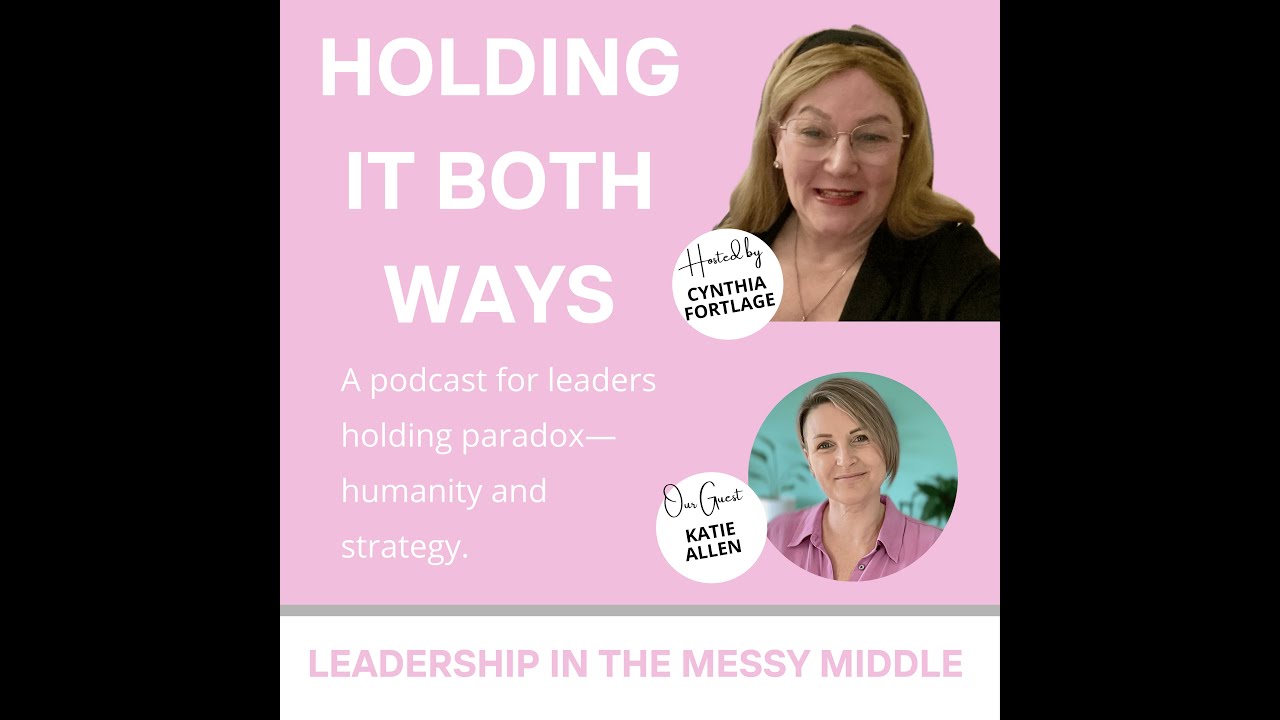
This content was created by Cynthia Fortlage. This content was uploaded by Cynthia Fortlage. This is a YouTube podcast episode titled "Internalised Misogyny, Allyship, and the Cost of Fitting In" (part of the new podcast Holding It Both Ways) recorded/published 2025-07-18. It features host Cynthia Fortlage in conversation with guest Katy (Katie) Allen, an inclusion specialist and confidence coach. The episode is an interview-style discussion about internalized misogyny, allyship, perfectionism, authenticity in leadership, experiences of women in male-dominated industries, intersectionality, mentoring and practical steps leaders can take. The conversation is in English and includes references to their professional backgrounds, personal stories (including Cynthia’s transition and leadership experience), and ways listeners can work with Katy.
Chapters
Hello everyone and welcome back. Today, in the actual first original episode on our brand new podcast, Holding It Both Ways, a podcast for leaders holding paradox, humanity, and strategy. And today, I am so delighted to have Katie join me. Katy, will you please introduce yourself to our wonderful audience?
Thank you so much, Cynthia. Thank you for having me along. So yes, my name is Katy Allen. I use the pronouns she and her. And my, my kind of day job, I suppose, is I am an inclusion specialist and confidence coach. But that's not kind of the whole story of me because I'm also a cat mum to one sphinx cat called Teapot. And I say that now because she's sat behind me quiet, but we all know that she's going to pipe up in a minute when she realizes something's going on. So I'll introduce her too. And I'm so thrilled that you have me along here on this kind of first revamped edition. I'm so excited because it really fits well with what I want to be talking about. So this is awesome for me.
Oh, well, that's amazing. So I guess the question is, what is it that we're going to be talking about, Katie?
Straight out the gate, we are going to— I want to be talking about internalized misogyny because I think this is such an important topic for when we're thinking about the paradox of leadership, which is we spend so much time and I And I speak about this kind of— I'll go through the gendered lens to begin with as a woman myself, speaking about it in terms of I am also a product of the environment that I grew up in, which means for all of the words that I use and the way that I try to conduct myself to be as inclusive as possible, I also know that I'm shaped by the experiences that I've had growing up in the society I live in. And sometimes I'm not my best version of myself, and I have to be okay with that. And I have to learn how to recognize where sometimes, and definitely in the past, and that's something that we can talk about, where I have also contributed, um, to kind of the misogynistic behaviors that have been going on. And that's a really hard, like, circle to square or square to circle, whichever way you talk about it, because it's like, you know, as a woman, you don't want to admit it. And, and, and you have to really look at yourself hard and be like, yep, yep, I've done that too.
Yeah. Yeah. It's, I relate to the topic because obviously in my lived experience, it's hit me in the face more than once. So, um, I'll bring in stories, um, accordingly as we go, because I'd love your, your insight as to what I'm able to share both from an experiential perspective but also whether or not you feel it resonates. Because, you know, one of the things very much from my background, both in women's leadership and, you know, international LGBTQ+ leadership, but also my corporate leadership days, has always been struggling to keep becoming more and more authentically myself. And in doing so, I had to keep opening myself up more and more. And the more I opened myself up, the more I find the stuff I don't like.
Yeah, it's all the, like, the dusty corners that we haven't swept in a while, haven't we? We've just got to get in there. It's like that job of, you know, washing the skirting boards in your house that, let's face it, none of us do until you look at them one day and you just think, yeah, I've really got that. That's a job for today, you know. And it's that stuff, isn't it? We don't, we don't want to do it. We don't want to face into it, but we know eventually it's going to come around. It's going to have to be done.
Absolutely. And you know what? It's amazing you use that example because the flat in London is on Airbnb for the summer. That's why I'm on my 90-day summer tour. And so I do return next week back to the UK, but I'm going to Ealing, Sutton, and then out to Chesham before I even head back into central London, because I'm actually coming back to France for another 3 weeks before I come back to zone 2. And I had to clean the baseboards. The Airbnb people. So I get it.
It is, it's a joke. Like, no one's doing that unless we have to, but eventually the moment arrives where we've, we've just gotta get into it. So yeah, this is what we're here for.
Okay, okay. So why don't we begin at the beginning and talk about where this became aware for you? Where did you become aware of this internalized misogyny?
Yeah, and that, that's the thing, it's the awareness of it actually came, I mean, it came later than you would like to admit, right? I guess that's why we're talking about it. It was one of those things that I spent— so for context, I spent a good 10 years working in the petrochemical industry. And that's, that's a really kind of male-dominated, very kind of masculine energy environment. And that was where I really first began understanding why the work of inclusion was so important, because I felt so excluded quite a lot of the time. And I kind of tried to do my best to create teams that were really representative. So people of multiple genders, people of multiple ethnicities, and just trying to be really aware of what I was building in the areas that I had responsibility for. And I did a really good job of kind of being representative. And I had to have this moment when I looked back on the work that I'd done, and I thought about the type of leader I was. And there was so much good that I did in trying to kind of challenge stereotypes, challenge some of the normalized behavior, quote unquote, you know, normalized. And also, I now recognize there were other behaviors that I was kind of role modeling that were less helpful. So I wasn't myself fully because it wasn't safe to be. So I probably participated in what we would probably call banter, right? You know, just the, the, the just rubbish comments and stuff, because that's what was going along in the environment around me. And there would have been times that I would have involved myself in that, um, because you feel like you need to. Whereas actually, on reflection, I could have stood my ground a bit more. I could have challenged more. I, you know, I didn't necessarily— like, the way I dressed it was one of those industries where no one told me I had to dress in a certain way, but I wore the blue polo shirt and the jeans and the boots like everybody else— like, well, I say everybody else, the men— because, because that's what they were wearing, and I didn't want to be seen as less than. And the thought in that environment of thinking like, oh, I'd like to paint my nails today, like, I just didn't do it even if I wanted to because I wasn't sure how that would make me viewed among my peers and whether I would be seen differently. And I didn't want to be seen differently. And now I think about it, I'm like, yeah, I wasn't authentically me. And that's not the best role model I could have been for the other women who were in my team who are watching me be their role model of what you need to be as a leader to succeed. And it was like I was a woman, but I was in a man-shaped box. And it's interesting. Yeah. And I really kind of grappled with that afterwards, thinking, like, how did I stifle their opportunities to be more them by not role modeling me being more me?
That's so intriguing. I will tell you that you just brought up about 5 things for me.
Please share.
We won't go through them all, but again, I'd love your input and kind of feedback. So, you know, and it's a question that I get asked when I'm speaking to audiences and people go, well, you must have been an amazing, you know, ally for women before transition. And it's like, I was absolute pants at it. And the reason was, is that The one thing that an ally needs to do that I didn't do was listen. I didn't follow my mother's advice. I have two ears and one mouth and I'm supposed to use them in proportion. And that's what I didn't do. And so when people ask me, it's no, I was pitiful. Have you found in your journey good men who did listen unlike me?
Do you know what? Yes. And that is one— I think one of the reasons why I stayed in that role for so long is that whilst there were— I mean, there were many, many awful people that I had to navigate and many awful things that were said about me. I mean, like, some of the rumors that people will start when— when— as soon as you got into positions of leadership and there was all the comments about, you know, well, I clearly only got there because I was handing out sexual favors. And it's like, yes, of course, that's all I'm worth. It's got nothing to do with my actual skills. And I was also had a couple of really good men who were absolutely great role models for me. I mean, I wouldn't necessarily say allies because did they challenge the environment that I was trying to break out of? I don't think so. I think, I think they did more than others, but Could they have gone further given the positions of power they had? Yes, absolutely. Um, and were they doing the best they could to mentor me, to create opportunities for me, to make sure that I was recognized for my skills, for my capabilities? Yes, they were. So yeah, they— like, I definitely had people in my corner, and that absolutely— I mean, I 100% attribute the success I had in that career Well, to myself, let's go that way. But actually, to the opportunities that they also made sure I knew about, they made sure that I, you know, their encouragement was like, why are you not stepping up for this? Why would you not do that? Yeah. And making me feel pretty uncomfortable at the same time, like, get out your comfort zone. No, but yeah, get out of your comfort zone. That's uncomfortable in a good way for once. So that was, that was good for me for sure. And I'm very, very grateful to them for doing that.
Yeah. It's intriguing because when I think of what you were just sharing, one of the aspects for me that amplified was that I became even much more focused at the time because I was a CIO as women in tech, right? Within the STEM space. Which is why I do a lot of mentoring with women in the STEM spaces. And one of the things was that we had a work experience program. It wasn't a full co-op because I didn't have the budget, but it was a work experience, meaning whoever worked with us at the time, the organization had actually, through the work we were doing, was being recognized within the technology industry for leadership for what we were executing. And so, it was quite prominent to have working with us on your CV to do it. And when I went looking for candidates, I had a couple of partners I worked with really closely. And I used to just say, well, send me your top candidates. Like, you know, everybody's going to what, get the top candidates? I mean, eventually, they're the top that they have, right? I used to say, 'Can you send me your, your top female candidates that aren't getting the attention of other employers?' Yeah. Yeah. Because I want the teacher's interpretation of that student's performance, and I'm not judging on anything else. I want to inter— because we went through a formal interview and everything else. But it meant that pretty much all of the, those spaces, which was about 2 a year that we were creating, we gave to young women. A few of them ended up working for us. We were fortunate things worked out and they were able to come work for us. What I love is that every one of them outgrew the organization in their ability and they moved on to bigger and better things, which as a leader was hard for me to get used to. But today it works really well learning to uplift other women And shout when it's— when, as you will well know, it's so competitive for women, right, right from school, right through into the work. It's trying to change that leadership mindset to be uplifting. So I want to come back to you. What was your leadership like in terms of uplifting others and creating those kinds of work growth opportunities? In the way that you were leading at the time?
Yeah, that's such a good question actually, because again, I would, I would definitely like to think, um, I did all that I could in terms of creating those opportunities for people and identify— I mean, I only had a very small team, and I definitely know, um, I hired quite a lot of younger people within to my business area, um, because I knew certainly for, for the, for the women, it's one of those environments where it's really, it's really tough to navigate when you kind of have— if you've worked somewhere else and then you come into it, it can be quite abrasive. So from my perspective, it was like, actually, it would be nice to have people who have completely fresh eyes who can come in and challenge us, um, without kind of having had any previous— like, not previously, they had experience, but, you know, they came in from somewhere that they weren't really sure what this environment was. And it's like, right, talk to us and speak truth, um, you know, speak your truth about what the experience is here. Um, and a lot of that was quite difficult to hear because they were, they were brutally honest, and I appreciated that. Um, and then it was nice to see them make it into their own. And for me, it took me a long time to realize— well, a long time to get comfortable with. I realized it quickly, it took me ages to make peace with it— that just because people do things in a way that's different to me, it's not wrong. Like, they still get the job done, they probably get it done better. And, and actually just trusting, um, that I've given them a project or I've given them you know, I've connected them in to do something, they've got it. Like, I gave them free rein on it, or I, you know, I put their name forward, or like, I did what I did because I knew that they could do it. How they go about that, yeah, that's up to them. And, you know, and it was really challenging sometimes. I'm like, oh God, please don't make me look bad. But also, that's me and my ego talking, right? Isn't it? It's not them and their development and their opportunity. And It's interesting to sit with all of that and just be like, you, I know that they can do it. What, you know, and, and also if they can't do it, that's okay too, because having the freedom to fail, um, is necessary really, isn't it? That's, it's a thing that we all need to learn how to do. Um, and I think it took me a long time to be, yeah, to, to kind of be all right with of that. And I think that comes again, comes from being a woman in those environments where you can't afford to make mistakes. And I was probably role modeling that perfectionism to the nth degree. I think, I think before I started to ease off, I was probably very— I said probably— I was hypercritical. I was, um, I was probably a lot harder on people, and that's all the people in my team, not just the women, than I should have been because I was so conscious that we have got to get this right, we cannot afford to make mistakes because that was kind of, that was the narrative of my experience and how I'd experienced that world. But actually, as far, like, it's always fine to make mistakes. And once I'd learned to allow people to make mistakes and then figure out how they're gonna fix it for themselves as well.
Mm-hmm.
It's like, yeah, okay, they have definitely got it.
Wow. And as you probably saw there, I just like, you, you actually hit on what I always equate to the first management lesson I ever learned. And I don't know if this will resonate with you. So I was working under the assumption, well, I have this role. They have given me this authority as in a formal role with roles and responsibilities and KPIs. Therefore, I must be successful at doing this job. And therefore, my job was to make everybody like me.
Yeah.
And till I realized exactly what you said, it was no. And that's why today I go, What I learned through that process was you cannot change anybody. You cannot make them— you can try and incent or to direct or to use their efforts in a different way to change behaviors, but you can't actually change them. You can't change anybody's mind. The whole bit, they have the ability to do it. Is that lesson, that judgment that you were holding, was that to you an aspect of internal misogyny that in your reflection that you experienced?
Completely. Because if you, from, from my understanding and my kind of exploration of it is that I, you know, I grew up, we have all grown up in a system of patriarchy, right? And it— and, and that's not, you know, for anybody that needs the clarification of what I mean by that, is that's not like an anti-men thing. It is the system with which we, you know, create our society and the systems we work within that favor certain people, outcomes, ways of being that are more aligned with masculinity and and kind of those traits. So, you know, for me it was quite formative in terms of I was kind of in my kind of mid-teens in the '90s with like the Spice Girls and the girl power and all of this kind of stuff. And it was almost, I mean, even now looking back at that, that was also a lot of internalized misogyny, wasn't it? But it's really interesting, almost like I hadn't— it hadn't ever occurred to me, um, that I could be anything. Like, I could do— there was all these things. Like, so we were growing up as a kid and you're thinking, I had to, had to always be perfect. I have to show up in a certain way. Um, I had to— I was really obsessed about, well, how do I look? Because that's the way that I'm going to get judged by people. Like, it's, it's just, it's those, those tropes that we fall into. And, um, and it was— it's just so interesting then that that's what you carry through. So when I say actually the way that I was leading was internalized misogyny through those kind of expectations of perfectionism, it is because I felt that perfection was what was expected of me within society, and therefore I should expect it of everybody else. Um, when really that's such, um such a destructive internal system of control, born completely out of the fact that we expect, certainly women, um, to be perfect, you know, to, to comply, you know, to meet expectations. Because there's no room. The minute we, the minute we do make a mistake, we are the example as to why a woman can't do this thing, that thing, the other thing. And it felt almost like it was doubly so in that industry because it was, you know, you already knew you were getting looked at like, well, why is she here?
Yeah.
Why is she on top of a reactor? You know, why is she doing these things? So you, you knew that I had, I had to technically know what I, you know, I had to show up. I had to, um, there, there was just no room for putting a foot out of place.
Mm-hmm.
And you— and I didn't question that. Like, I didn't, you know, I didn't. I just, I just got like, and that's what I got to do. And it wasn't until I reflected back on it thinking, yeah, actually, if I had spent some time thinking, you know, when I was new into the role, of course I'm going to make mistakes because I'm learning. And it wasn't as if anyone had told me that there was no room for mistakes, but it was just the things I would be like, I don't know what that is, I'll make a note and find it out later, rather than putting my hand up and going, What is everybody talking about? I have no idea what that is.
Wow.
And that level of role modeling. So it's almost like everybody thought I knew everything because I was pretending that I knew everything. So therefore everybody around me had to also pretend that they knew everything and they were probably doing the same. And that for me is the internalized misogyny, which is just not making space, certainly for the women on my team, because I the men would probably be more likely to, to say, Katie, what are you talking about? They would challenge me, whereas I don't think I made it safe for the women to do so.
Wow. Again, you're touching— you're bringing up so many memories for me. Um, I want to come back to the perfectionism piece, but it's intriguing because In my early transition, pre any surgeries, um, I was in— I had a therapist, a counselor that I was working with at all time, like once a week kind of thing. And early on, as I said, so what kind of woman do you want to be? And what I described was a trophy wife, because to me that was the perfection of the wife that— and I realized that that is such a misogynistic opinion of what a woman is, just like the perception of, well, how would that trophy wife dress? And I realized it was actually driven from porn from my young male days, that was— that somehow this was the normalized expected outcome. And so clearly I didn't follow that path. I realized how wrong that was and was able to correct it. And again, I'm doing this at 50 years old. So it took a while.
Yeah.
But it was intriguing, the point that you made about, you know, this idea of there's an element of how we all present. Um, and I rarely show the pictures and I'm not about to with this post, but I mean, I've got my brunette phase, my dark hair phase. I've got my red hair phase until I kind of came up with my blonde hair phase as to what feels like me. But if you look at early pictures, I was pretty in pink, girly girl to the nth degree. I used to do 30 minutes or more of makeup in 7 different layers to get the right feel when I looked at— and it was not for me because today A decade later, I'm at the point I put on lip color. That's all the makeup I'm wearing. Like, I don't wear makeup anymore. I just don't need to. And that has been a journey in itself, realizing that that look that I was trying to achieve was driven by that expectation of that system that we talked about. Now, when you talk about this idea of perfectionism because it's about in the way we look and behave and everything else. I use the analogy that from my leadership work and I talk and I know you work with leaders as well. And so, I talk about the idea you can have a male leader who I say they kind of go from A to Z. They take this giant leap and they go, "Oh my gosh! Isn't he an amazing leader? He's so brave. That's phenomenal. And he has and a particular outcome, it's positive, all good. And if you have a woman leader do the exact same thing with the exact same outcome and they go to her, why did you skip step J?
Yeah.
And it showed me immediately the micro level of anal— and I call it, it's a gendered aspect of leadership that most people aren't consciously aware of, of the way we judge women in leadership roles completely different than the way we do men, even if men, even if the outcome is exactly the same.
Absolutely.
Is that your experience?
100%, yeah. And to use that same analogy, it's almost as if, um, it's okay if, if a guy shows up at Z and is kind of like, I've got like 15 out of 26 letters sorted, and then a woman shows up and she will have all 26. Even if she's jumped, she'll have done the legwork somewhere else to be absolutely sure she's got all 26. And if she hasn't, she will be apologetic about, you know, "I'm ever so sorry, I only got half of my J, and I probably, you know, you should probably take some of my salary off me." Like, you know, I mean, there's all sorts of like this stuff that comes with it. And again, that's shaped by how we are expected to show up. And in the judgment of that, so on the other side of the table of the way that we view those people, that's not gendered. So it's men and women that view people who do those things in the same way. So, and women often more quick to notice the bits that are missing or to notice the jump and be judgmental about it. More so than men, which, so it's almost, it's like that double impact, isn't it, of if I do it, I'm going to get criticized and I'm more likely to get criticized by another woman who's looking at it going, well, why is she, why has she done that? How has she got away with that? Because we're conditioned to have to have done the steps.
Yeah. Now I've done a lot of deep thinking on exactly that last point. I'm not going to tell you what I think. I would love to know, have you done deep thinking to break that down to understand why women have been socialized to do that?
Good question. So I want to say yes, because I have spent so much time being, just being curious about, and even actually listening to my own example in that, right? Rather than just owning it and going, yes, I have, like, Absolutely, because I have. I even caveated, didn't I? I want to say it, so I'm doing it now, right? It's in all of us. And I think that's something actually for people listening and watching to this, like notice in yourself when you do those things as well, because we're all doing it. Catch it. It's quite curious to notice. But yeah, in terms of the deep thinking, so for sure, And I think a lot of it is because of the way that our society is created. We know that those opportunities don't necessarily come up as frequently for women, right? So immediately we're in competition mode.
Yes.
And we shouldn't be, but we are. And there's also, I guess, I've seen play out that the And it's more prevalent in some industries over than others. So for example, I've seen it a lot in the legal space where when someone has had to do certain things to get to a certain position, and then they're like, actually, should we have to do that, or should we make it easier? And some people are like, well, I had to do that. I had to jump through those hoops. I had to do this thing. Therefore, you've got to do that too. And it's almost like we can't stomach the fact if someone else not having to work twice as hard like we did. And when we think about that, the, the, the where did that come from? I think it's because as women we have had, we have had to fight for every crumb, like every time. We have purposefully been excluded. So therefore to be included is almost like the gift that is bestowed on us. And we'll do everything that we can do to protect that so that we don't have to give it up for ourselves. And to bring in kind of a racialized lens to this as well, if we think about the right to vote, like women weren't given the right to vote equally. It was white women of a certain class that were given the right to vote first. So immediately we are pitted against one another, which is you have to be the right type of woman to get that. And then gradually things were Well, I was gonna say those rights were more equally distributed. But so even then we were conditioned, that's probably the right word, to fight for the scraps of equality. And you see that playing out now, don't you? Which is there are some women who feel that they have achieved the level of equality and that equality for other women is a cost that is too great for them because they don't wanna see their own rights rolled back. And it's like, well, is it equality if we aren't all there? You know, so, and I find that really fascinating. So, so that's kind of my reflections. But where, where would you come at it from?
Well, I, I brought it from a lack of resource and with, you know, job opportunities being a resource. And that is, you know, whether we talk women in sport, whether we talk in the job sector, I mean, we can go through a whole bunch of stats, but the simple fact is, is Up until recently, there has never been cases where women were on par and had an equal footing. And so women were socialized from a very young age to, as you— to fight for every crumb through it. And that has created this culture that is not women uplifting each other, but don't, don't you dare take away what I think I've got, because they treat it like a pie rather than something we can actually they all have, right?
So I'm going to yank that ladder up behind me once I've made it. Yeah.
Yeah. And so, you know, very much. But I think one of the aspects that— and I don't know that you'll have specific insight to this, but it speaks to your case of this idea of this judging in the system. So I shared recently, I rewrote it again and published it recently on my Substack. And it was about kind of the effort of maintaining status quo. So when I was preparing to transition and, you know, I had been recognized as a successful executive in 2016, I was one of the top 20 CIOs in North America. And at that time, knowing that I had this journey ahead of me at that point, I had scaled back my emotional and physical and cognitive labor to about 60%, what I call just a cruising pace, the whole bit, in order to have enough in the tank to deal with everything. I didn't really know what I'd be dealing with after the fact. Yet after the fact, when I appeared at work and everything was going, in order to create the same impression I literally had to double that to about 115% to 120% of effort. So, when a man in my identity could coast and still be considered a successful executive at about 60% effort, as a woman, I had to put about 120% in order to create the same perception. It's really hard to be seen as excelling when you're always running at 120%. Does that resonate for you at all?
Completely. Yeah. It's the expectation of almost we have to be exceptional. And there's no room for anything less. And it's almost like we, you know, you're not given the benefit of the doubt of a bad day. Like, it is just like, well, maybe she's not up to it if she can't do that. You know, and nobody, and we don't even want to run the risk of that thought. Popping into someone's head. So it's like I'm constantly going to be on it. And that's how burnout creeps in, isn't it? And I can imagine the more— well, not I can imagine, I think it's true— the more kind of marginalized identities that we have. So from an intersectionality perspective, the more marginalized identities we have, the more likely we're going to experience burnout because we're not just doing it through a gendered lens, but we're doing it through a racialized lens or through, you know, a kind of disability lens or a neurodivergent lens. Like, we're constantly battling, like, I have to meet this standard, um, whatever that is, whether it's, whether it's real, perceived, imagined, whatever. Like, it's— there'll be some sort of target that we're all aiming for, um, and it's not sustainable for most people. And I find that really, really interesting. And I do, yeah, I can think of numerous examples where I will have worked my socks off to achieve an outcome that will have got like, oh yeah, good, well done, to only watch somebody else do, you know, nowhere near that and get a good job, good job, you know. And it's kind of like, how, how, how am I not getting like, why, you know, I didn't do it for the applause, but flipping heck, I deserve it, you know.
Yeah.
Um, and that's, and that's interesting. Yeah, that's really interesting. And, and I want to come back to your point as well that you said around like, you know, even in yourself, where you were kind of ranked as one of the top 20 CIOs. Like, isn't it funny how we rank ourselves as well? Like, isn't this a weird human trait that we want to be on the 30 Under 30 list? Or we want to, like, we just want to compete. Like, society, you know, and I guess we could get into kind of capitalism and consumerism and all of that jazz, can't we, right? But like, society just wants us to compete against each other. Constantly for these accolades, and it's like, you know, I've never been on any of these lists. I've never— not an award winner, I've never been on a list. I'm actually all right with it because who's making that list? Who's judging?
What are the—
what criteria are they using? And I'm like, am I doing the best I can do with what I've got on the day that it happens to be? And if I can reasonably look at myself in the mirror and say, actually, yeah, I'm showing up Maybe some days I don't have the energy and I'm showing up with the energy that I have. But if I'm always showing up, I'm like, you know, that'll do for me. And that's interesting as well. When I see, you know, LinkedIn's always full of people celebrating their awards and their nominations and then just like, I'm good, happy for you, good for you. Doesn't make me less that, like, your win is not my loss. And I find, and that's been an interesting one to kind of sit with as well and make peace with, which is Yeah, I can, I can still cheer on other people. And I don't— and it's not a competition. Like, I don't need to be ranked against anyone.
That's a shame that you haven't been recognized for the amazing work that you do.
I mean, I get recognition comes in all forms, right? Yeah. It's kind of like, for me, the recognition is I know that it makes a difference. I know that when I finish a conversation with someone, they will be in a better position. They will make more informed choices. They will be able to handle something they couldn't handle before. That, that for me, and it's almost that recognition comes from me, and I'm good with that. And it's, it's kind of like I sleep well, if that makes sense. Um, yeah, I mean, of course, if anybody wants to shower me with gifts, um, and trophies, uh, feel free. Yeah, yeah.
Yeah. And this is where they can sign on the dotted line to work with you. Exactly.
Absolutely.
Yeah. Okay. So let's bring some closure for everybody. Yeah.
Let's bring this into land.
How do you— talk us through how you can help people. And if there's the sound bites of wisdom that I know you always have in there, feel free to share them. And let's tell people how how they can deal with all of this conversation we've had if they are experiencing it themselves, but also how they can work with you in dealing with this. Yeah, please.
Yeah, I mean, I mean, much like you, right? Because I think our work is, is similar in the sense that we, we do what we do founded in a space of curiosity and conversation and asking people to be honest with themselves and vulnerable with their own thinking. And so from my perspective, if, you know, if people are looking for a space with another human where they can be really honest about some of this stuff that's going on in their head, or some of the questions they have that they don't want to ask publicly or to someone else, then, then I am your person. Because believe me, I've had the thoughts, I've done the things, I've said the stuff. And that's okay. Like, we can have really vulnerable conversations in that, you know, to use your phrase, that messy middle, where it's okay to get all of our yuck out on the table so we can rummage through it and make a bit of sense of it, and then put the things back in the bag that we want to keep and leave the things that we don't want to take forward. Just put them down and leave them. Don't carry it anymore. So I work with people one-to-one in doing that for those people that really have something specific they want to work through, or just from a leadership team perspective, if you want to really have those difficult conversations. Because for context, I used to start doing strategic work with organizations, right? Talking about how are we going to strategically bring this stuff into your organization? And 9 times out of 10, every conversation I had in those leadership spaces was things like, is it okay to say black? You know, or what is it with pronouns? Why are there so many letters in LGBTQIA+? So fine, if that's the level you're at, let's talk about that. Because if you cannot confidently handle those conversations, you've got no business rolling a strategy out. Like, you need to get clear on that first. So that's, that's where I come in. I help people work through— I call it the basics, but actually it's usually the It's the difficult starting point. So I'm here for those conversations.
Brilliant. And how do people find you, Katie?
So my main playground is on LinkedIn. So I'm there every day. So if people want to come along and follow me, it's just Katie Allen or Katie Allen Consulting. I also have a website, Katie Allen Consulting, and people can book a call with me or, you know, approach me in every way which works best for you. Oh, and I could— can I plug my own podcast as well?
Yes, please. Because I've been on it.
And let's— I was gonna say, there is a fantastic episode on my own podcast called Speaking of Inclusion where I interviewed Cynthia Fortlage. So come along, I would say, as a first port of call and have a listen to that one. And if it tickles your pickle, then listen to a few more.
Wonderful. Katie, thank you so much for making the time today. I really appreciate it. And I really hope that the readers today and that are listening and watching this podcast get out of it what I have. It's just been so rich, and I just can't thank you enough.
Thank you. Thank you for bringing these conversations to the fore with your platform. You do all just enormously brilliant work. Thank you.
Thanks so much. Well, folks, that's it for today. Thank you so much to Katie for being with us. I will put our podcast that I did with Katie in the comments so that you can easily find that, and please give her a follow. Um, I believe it's on all the platforms, the Apple and the, um, Spotify. Yes, thank you. That's it. Um, and that's probably where you're going to ultimately find this podcast too. So thank you so much, everyone. Have a wonderful day. Bye.








