Introducing Acceptance without Understanding to Remote Year
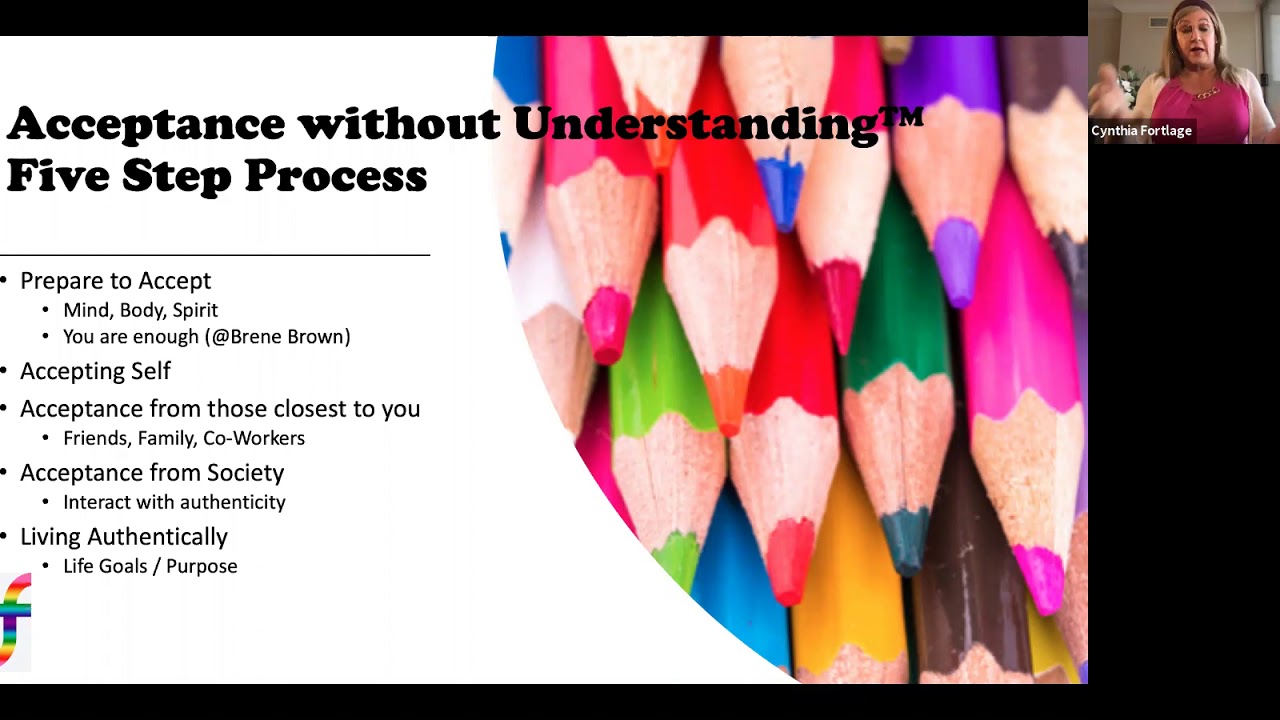
Cynthia Fortlage, a former CIO who came out as transgender at 50, presents a five-step framework for self-acceptance and accepting others without needing to understand them first. She shares coaching case studies on career and grief outcomes.
Chapters
Okay, let's take a look. So, Acceptance Without Understanding: A Human-Centered Approach to Life. I am Cynthia Fortlage, founder and owner of CAF Services. A little bit about me. Um, I have over 30 years of business experience, primarily in the business services space. I was a technology executive, a chief information officer during that time, and I've had extensive speaking experience in well over 175 events in, uh, in person. Um, numerous online, etc., um, in over 16 countries to date that I've been able to do it. At the age of 50, um, I came out as a transgender woman. Um, for 3 years I was transitioning on the job as a working executive. I was married for 32 years with two— and I have two adult children, uh, a son and a daughter with a Currently still board president for our local LGBT support center called Rainbow Resource Center, as well as the national board chair for Women's March Canada, which we're actually just in the process of winding down. And at 53 years young, I decided to start my own firm. Now, the reason I go through this and share with folks is because I like to, you know, relate to them that if the only thing that they captured from that conversation was that I'm transgender, then they're really missing the best part, um, of myself, but also the best part of this. And I'll connect that observation with the process of the 5 steps of acceptance without understanding. So why do we have acceptance without understanding? Quite simply, diversity. Um, I originally thought that this was a story, this was my story, and what I realized was that this is the story of so many people. And regardless which sector that you fall in, where you become a marginalized person, and many of us in society are, including over 50% of the population because women are generally treated in a marginalized way within society overall. And of course we have other factors such as religious, your country of origin, cultural, political, but it also goes into cognitive diversity, body size diversity, as well as, you know, a physical ability diversity. So there's many, many kinds of diversity that cause us to look at this whole concept of acceptance without understanding and bring it into reality. So what is it? Well, it's quite simply the advocating for the treatment of everyone as human beings on their life journey, as we accept each other as unique individuals on our own journeys without the need to understand each other first. So really it's about treating each other as human beings with respect first, and when we do that, that means we come from a positive place to be able to talk about our differences versus being able to— someone come up to you and talk about the differences or those aspects that they consider different right away, and we may take that as a personal attack. And they may not know it, or they may in fact be malicious about it, but that's on them, that's not on us. And so really, how do we create the presence of a positive conversation in a human-centric way? Acceptance without understanding. It was an obvious path that came to me in 2015, and it's really defined my journey through my— the last 4 years of my life, but it's also shaped my understanding of the world that I have lived in and continue to live in, obviously. Um, and in applying my skills and abilities of all those years of executive training and leadership training to mentor others, and that really has become my passion in sharing this with others and moving it forward. So let's dive into it a little deeper. The 5 steps, they're really not complicated, but they're not simple. They also are not, um, contiguous. They actually all happen simultaneously. And so for each one of these steps, you may be at a different point, and you may continuously improving. The first one is to prepare for the process of acceptance. We're talking about your mind, your body, your spirit, um, in totality, um, your cognitive ability. Are you prepared? Um, and I find with a lot of folks that they don't even think that they're enough. And I'll relate a couple of stories to kind of illustrate this for you in a moment. But, you know, Brené Brown has this saying of, "You are enough," and absolutely that is a great place to start because you need to be enough for yourself in order to undertake this journey. And then we go through the journey of learning to accept yourself, and there's many tools that we apply through these steps as you work on yourself. Now, to be clear, I'm not a psychologist or a therapist or a psychiatrist, and when I work with folks through my practice, and if I find that there are issues best handled by a mental health professional, I will direct them in order to do that versus us continuing down a path of coaching towards the acceptance without understanding. Once you continue on the path of working on yourself, and we try and establish that as one of the first wins that we create, then you can start to ask for acceptance from those closest to you. In other words, if you accept yourself, it is much easier for others to accept you. And In the same way that once others accept you, what I found is that then within those circles or circle that you've created of friends and people who are accepting and working with you because of the diversity that you have within your life, then we can take it to a societal level and look for acceptance at a societal level. And we know that it's not an easy journey and it's certainly not a straight path for everyone. And that's where we learn to interact with authenticity, an overused word, absolutely, but it really becomes how do we interact with the world in a way that is true to us, not true to what they want us to be, but true to who we are. And there are many, many tools that we bring. They're all individually applied in each person's case as we work through and understand not only their goals, but we also understand kind of their raison d'être, their why in life. And perhaps they're searching for their why, and that may become part of the journey itself. And I find as, as you mature through these 3 cycles, you start to find that you can truly live authentically and talk about your life goals and your purpose And really that's what's happened for me, was that it came in and as my spirituality evolved, as my understanding of self evolved, as my acceptance of self evolved, as I got healthier, I began to find that looking at who am I, what do I want to be, and how can I live authentically in terms of my purpose on the planet was really the process, and that's what I guide folks through. So let me take you through a couple of examples, through stories, of some of the situations that I've worked with folks already and where we've come up. But stay tuned because you'll have a chance to share in a moment if you'd like. So the way that I got started on this process was I ended up spending a lot of time sitting on my balcony chatting with friends, and they always had lots of questions. But the questions weren't as much about me and the transition in my life. It was about really transitions and stages of their life. I recall one particular situation where I was working with a young mother. She had 4 children under the age of 15. And during the conversation, she said something so powerful. And she goes, you know, sometimes I just, I'm not enough for my kids. And it struck me in that moment that some days she's not even enough for herself. And so really helping her focus on putting it first. And if you think about it, that's absolutely contrarian to the society that we live in. And certainly when you talk within families, et cetera, to put yourself first is countercultural. But the reality is that if you can't be enough for yourself, you cannot be enough for anybody else. You can't be enough for your friends, and you certainly can't be enough for society. So you really do need to go back and to work on yourself and make sure that you are a priority and important. So that's the accepting yourself stage that we work on it. I remember when I was traveling, I had the blessing to connect with a family who unfortunately they had lost a loved one. And due to a self-inflicted illness that this person had, that they ultimately passed away because of it. And the family felt they didn't do enough, that, you know, there's more they should have done, they could have done, the whole bit, and they blame themselves for the outcome of this person's passing. But in that particular case, they did not make that person consume the product. They did not buy the product and take it to the person to be consumed. That person was making very conscious choices of what to do with their life. And part of acceptance without understanding, again, is the reality that I don't need to understand your story, but if you're hurting and you're in pain, I accept that that's where you're coming from. And it's how do we learn to be okay and be present for someone when they're there. And that someone could be ourselves, or it could be someone close to us, but we don't need to own their pain. We need to be their friend. We need to be their family member and support them. And so learning that they were enough and that they needed to accept that their role was enough in the process of the outcome of this particular family member was something that they were able to take away and to process through their grief. To see where they were, where they were eventually going. And I'm happy to report that they're definitely in much better places today, and they don't hold themselves to account for the loss of their loved one. They understand that people make personal choices that may have dire consequences, and it's not upon us to do that, but we simply need to accept it People do make these choices, and if we can help to accept them, and that changes the ways, then that certainly would be an ideal state, but not always in every case. Another interesting one was working with a young woman who was a professional, a technical professional, and she approached me to help her not only— well, initially to resolve some conflicts within her workplace, to kind of improve her skill sets of how to deal with kind of difficult folks. And ultimately, her goals changed as we were working together. She wanted to evolve her career. And I'm happy to report that through the work that we did, that not only did she achieve satisfaction in the role that she had, but she also eventually did move to a new career, you know, increasing her salary by about 1.5 times and evolving it to a whole new level. So it's always very satisfying as a coach to see clients achieve the success of the goals they set out to achieve. My job is simply to provide the coaching support to help them get there. The final story that I'll share with you was of another young woman who was looking to advance her career as well. She wanted to get into the C-suite, so your CFO, CEO, COO, et cetera. And she was successful in securing that role. It involved things like looking at her resume, rewriting it from the process of an executive resume, not a tactical resume, as an example, looking at the verbiage that you use within that to talk about kind of the vision, missions, and goals of the organization, and how does what she knows and what she does, how does it speak to helping the organization, not the she knows how to use XYZ program or to do XYZ process or whatever it happens to be. And so that was really a process, and it was again very satisfying to see someone achieve the goal that they had set out to and to advance their career accordingly. And of course, these all become stepping stones of, say, achieving a C-suite title in your first company might be the goal to move to a different company if that was something that you wanted. As in the second case that I shared with you, that was not the initial goal, but once the individual, once she was able to see success from the work that she was doing, she decided that her goal was different, and so we started to coach towards that, and that involved talking about networking, etc., and how to make that advancement. And certainly I'll leave you with this, was that the evolution came of acceptance without understanding, came from my own personal journey. And it is certainly one that I relate to many clients along the way. And it really talks about others, especially family members, loved ones, And they may love us, but they can't accept us. And really, when we talk about unconditional love, what I've defined is that unconditional love is really love and acceptance. And you can have one without the other, but you do need both to have truly unconditional love. And so that's why when we see, you know, folks who are not of legal age, young adults, etc., who may come out if they're identifying within the LGBT+ sector, that they may get disowned by family. And again, they have love, but they don't have acceptance. And so really, how do we work to not only accept yourself, but how do we work to perhaps help others accept you as well? Or perhaps they need to see you accepting yourself to deal with it. And certainly my story relates to one of having to learn that lesson rather than rely on others, but to rely on myself. And when I relied on myself, I was able to show— share that with others so that again, my circles and my evolution of acceptance evolved. So In a moment, I'll ask if there's any questions and so forth, but I'll just put up my contact details in the meantime in case you wanted to reach out. I do love to get feedback on my Speaker Hub profile. If you have enjoyed this presentation or you have some feedback for me, please feel free to go to Speaker Hub and leave it there for me. If this is something that you would like to have a personal discussion and talk about your own particular situation, or to see if I might even be a fit as a coach for you in your particular situation or your goals. We definitely need to make sure we match. I've left my calendar link there. The first session is absolutely, absolutely complimentary. Please make sure you reference this webinar and this session to get your free initial consultation, and you can go ahead and book it on my calendar through there. Otherwise, my contact details are here, and I'm very happy to hear from you. And as you can see, on Facebook, LinkedIn, and Twitter, abound, easily to find. So with that, I will ask if there are any questions at this time. Okay. So hearing none at this time, I want to thank you very much for attending, and I absolutely appreciate your time, and I hope you found this of interest. Thank you, and have a great day, and travel safe.








