Inflation And Wealth Presentation
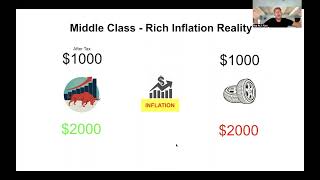
Damon Ritchhart shows how to use debt and real estate to turn inflation into wealth. Borrow at today's dollars, repay with tomorrow's cheaper ones, and write off the interest. His clients cut effective tax rates from 30% to 10% by combining leveraged property deals with strategic deductions.
Chapters
This is my inflation information presentation. What I literally have this titled is Legacy Wealth Formula. So I give this presentation to all of my Pay Less Taxes clients, um, and it's really, really important to understand the way that money works, the way that wealth works, and the way that your taxes actually are affecting your long-term legacy wealth. So I've been giving this presentation one-on-one to each of my clients, and then I realized right now because I have like 4 new clients that I need to do this presentation with, that the best thing to do would actually be to shoot a presentation and put it out there so that my clients who are all incredibly busy at different times of the day would be able to watch this at their leisure. And any questions that you have, I am, as always, am available to answer any questions that you have as you go along through this presentation on inflation. And creating legacy wealth and how they interact and how they bob and weave with each other. So pen and paper might be useful in order for you to jot down any questions or notes. As I always say whenever I give a presentation one-on-one, if you have questions, write them down, obviously. But if you have yeah-buts— I love yeah-buts— if you hear me say something and you have a yeah, but Damon, blah, blah, blah, blah, blah, uh, write down those yabots because what I really, really want to do is I'm going to get you, your family, uh, your businesses all moving in alignment and linearly towards long-term wealth. Some of you guys want to pass that money down to your kids. Some of you want to leave it to a charity. Some of you just want to use every single penny by the day that you die but have a great retirement as you get older. No judgments on any of those. We are here. The PLT Firm is here to help each and every one of you meet each and every one of your individual goals and do it effectively, efficiently, elegantly. So let's hop in on the Legacy Wealth Formula and work through it, because it's a huge part of what we do with the Payless Taxes Formula. So the first thing that everyone needs to understand, and yet almost nobody does— they don't teach this in school, they don't teach this in college, they don't teach this really anywhere— is you have to understand today cash versus tomorrow cash. And what you have to understand is that inflation has been occurring for virtually ever, and inflation can either be your enemy or it can be your friend. And by the end of this presentation, you're going to know the one way that you can take inflation from an enemy to a friend and use inflation— it's the only way to use inflation to build your long-term wealth. The first thing that you need to understand when you think about— I call it real money versus fake money— is real money versus fake money is pretty simple. Basically, you have the amount of money that's in your bank that you can use, and then you have the items that you can use that money on. So it's real goods and services. It's sort of the things that you absolutely have to have. But obviously, milk, bread— so that represents food. Uh, shelter, clothing, sort of the bare necessities of life. Those are real goods and services, and those are the things that are affected by inflation the most and the fastest, despite what you might see on TV, what you might see in, you know, on the internet or on the social media. Fake money versus real money, it's basically what I call it. And what this really boils down to is that nominal dollars are what you think you have, and real dollars is what you can actually buy. So fake money is basically the amount of money that you think you have, and real money is what you can actually buy with that money. It's like, hey, you actually get serious and you're like, I need to buy something with this money. So the thing is, is that fake money, poor, middle class, and yes, even rich people are very, very focused on fake money. They're focused on, I have, I make $10,000 a month, I make $20,000 a month, I have this much money sitting in a bank account and, you know, that number gets bigger and bigger each year. And I feel like I'm doing really, really well. Now, on the other hand, the wealthy 1%, what they focus on exclusively is they actually focus on real money. They're focused on here's how much money I have. And as of today, this is how much I could buy with it. And this is tomorrow, how much money I would expect that I would be able to buy with it. And what they're looking to do is they're looking to have their money outpace what it is that they have to buy. Again, earlier we talked about your money in your bank account. It's how much you have after taxes, et cetera, in order to spend. And then you have your real goods and services. In this case, I'm representing it with a set of tires. Almost everybody in the United States has a car, and tires are a thing that wear out on cars, you know, every 2, 3, 4 years depending on the type of car that you have. So I think this is a really, really, really good example of real money versus fake money. In your bank account, you have $1,000 and you can buy tires for $1,000. So what you see here is you see that if you take your $1,000 and you buy your $1,000 tires, you have zero money left. So this is the saver inflation reality. You are essentially saving money into a bank account, which I'm not saying that saving is a bad thing. I'm saying that we need to do it according to the Pay Less Taxes formula, not just save money to be saving money. We have to do it like the wealthy 1% does, which is keeping an eye on this right-hand column, the goods and services column, and do it correctly and do it with intention. So the Saver Inflation reality is you basically have $1,000 in your bank account, but tires cost $1,000. And so you essentially can only pay for that. What happens is inflation occurs, and when inflation occurs, Essentially, the $1,000 that you saved in your bank account was $1,000. It does not really grow. Right now is a great example. Interest rates are going, going up. And yet even with interest rates going up, the rate of return on just a simple savings account— providing an example here— is maybe like a half a percent annual return per year, maybe 1% per year. It's incredibly low. Again, we're in a great environment where you guys are going to be experiencing the real goods and services massively increase in price. On the right-hand side, When inflation occurs, the tires go from $1,000 to $2,000, right? And so the reality of this at the end of the day is, yes, okay, let's say that you had saved $1,000. If you saved $1,000 because you knew you're going to have to have tires, inflation occurs, and then when you go and you get your tires, your tires are $2,000, right? So essentially we went backwards in terms of wealth, and that's the saver inflation reality, right? Net savers, in theory, you would think would be doing really well, but the problem is, is they're missing some secret ingredients that allow them to be incredibly effective with the savings that they're having. Not to mention the fact that savers are not rewarded in the United States tax system at all. Net savers are not rewarded by the tax system. So the next thing to look at is the middle-class inflation reality. The middle-class inflation reality is pretty simple. It's, hey, I have $1,000 I'm starting with, "and I am gonna take that $1,000 and I'm gonna put it into the stock market 'cause the stock market is the thing that on TV, it's when you go to school, it's when you talk to your job, it's like, hey, get a 401 so that you'll be able to retire, put your money in the stock market, cost average into the stock market, make sure you're putting money in every single month, et cetera, et cetera, right?" Not saying that any of this is bad, I'm just basically showing you guys the reality, and this is the reality, of that sort of methodology. In this case, we had our $1,000, we put it into the stock market instead of just a simple savings account. We're a little bit more advanced in terms of what it is that we think to do with our money, so we put it into the stock market. And the stock market goes up because on average the stock market has gone up historically forever. Now, I would say that there is no greater gauge of inflation than the stock market. If anything, the stock market is a gauge of inflation itself. So stock market doubles to $2,000, we're feeling pretty damn good, right? Because we basically have doubled our money from $1,000 to $2,000. We saved that $1,000, we now have $2,000. And then we come over here and we need to buy something with that money, a real good, a real service. And when we look, car tires, still $1,000 to $2,000. So even though we thought we were doing amazing, our money doubled in the stock market, when we really look at the reality, right, the, the, the inflation reality, what we see is, is we're still net zero in terms of our actual wealth and our actual wealth building. Here's the rich, rich inflation reality. The rich, rich inflation reality starts out the same, right? You have your $1,000 on the left, and you have your $1,000, uh, is what, what the tires were starting at originally. The rich, rich inflation reality is like, hey, you know what, instead of me just put some money into a stock market, I'm gonna find the right guy who's better than average to manage my money, and I'm going to let him manage my money in the stock market, or place my money here, place my money there. And so what you do is you give that money to him. And you're right, and you're right, you chose the right guy. He outperforms the market, right? He outperforms a little bit. So, uh, your $1,000, instead of just turning into $2,000, it turns into $2,400. And he's like, man, I feel like I'm doing pretty damn good because I went from $1,000 to $2,400. $1,000 to $2,000 on the tires, which means if I had to go buy real goods and services, if I had to go buy tires, what I'm looking at is I have $400 left over, right? But this is where the Pay Less Taxes company comes into effect. And this is why I give this presentation, is to really get everybody putting their time and attention where it needs to be in order to achieve their goals. Because let's walk through this. The Rich Rich inflation reality, you went from $1,000 to $2,400, which means you had a $1,400 profit, right? But then because of the, because of the, the investment vehicle that you chose, you get taxed at, we'll just call it 30%, a nice average 30%. You know, could be a little less someplace, could be a little bit more, but you're taxed at 30%. So your $1,400 profit turns into $980 profit. You have to come over here and you have to basically buy your tires for $2,000. And so even though you're feeling pretty good, you're like, man, I'm $400 up on this, the reality is at the end of the day, you're actually net negative $20 in terms of your— you and your family, however you choose to think about it— net worth, your balance sheet, your wealth, your actual wealth that you're building. So how do you break the system that's basically working against you? Because as you guys see, if you, if you imagine, it's not just tires that are going up, it's houses are going up, it's food is going up, it's, you know, milk, eggs, bread, meat, the essentials of life, clothing., is going up, right? So how do you basically break a system that's working against you? And just so you guys know, this is not something new. Inflation is not something new. It's something that governments have been doing, uh, basically in perpetuity forever, right? So even if you go back into medieval times, what you would see is you would see a king, he would rise to power, and their coins would start out as gold, right? So they'd have gold and silver coins, and their gold and silver coins— Rome is an amazing example of this— or gold and silver coins would be 100% gold and 100% silver. And so now they're, they're doing things, the money, the money is good, the, the things are building up, um, and then they start overspending as a government. And as they start overspending, what they do is they have to make more money, they have to print more money. Well, the way that they did it before before today was they would dilute their coins. So instead of 100% gold coin, it became 95% gold, and then instead of 95, it became 90, and then it became 85 and 80 and 75 and 50, until at some point it had no value to people anymore and they wouldn't accept that coin, right? So in today, everything's ostensibly digital, right? So when we print money, I'm convinced they just— they moved the, uh, the comma to the left, add some zeros to print money. But, but they really do have the ability to print money. And as long as they have the ability to print money and, and, and can just create it out of thin air, then the system is always going to be working against you. You're always going to see inflation in real goods and services and really everything. But real goods and services are the ones that matter because those are the things you kind of have to buy., and we have to find a system to break, to break that pattern. I'm gonna clue you guys in on what it is and the way that we do it. So debt— buy with today's dollars and pay back with tomorrow's devalued dollars— is the only way that exists to basically break the power of inflation. And it's the only way that we can break the power of inflation in the United States. It's the only way we can break the power of inflation, and we can start breaking down that tax burden that you saw that affected, uh, earlier where we made the $2,400 but then we had taxes on it, and so we really ended up our net worth was negative $20 after we bought our tires. It's the only way that you can also really and truly build wealth while combating, combating taxes. So debt is the golden keys to the kingdom of wealth creation. The reason why is you buy with today's dollars and you pay back with tomorrow's devalued dollars. So let me walk you through this. So basically, the wealthy inflation reality looks something like this. Let's say that you have, uh, $1,000 into 2 houses. Your 2 houses do exactly what you would expect them to do from, from inflation, right? They, uh, basically each appreciate, um, 100%, exactly like the tires, exactly like the stock market. I mean, this is not rocket science stuff, right? They just appreciate because inflation has occurred. We're using the thing that's going to occur pretty much come hell or high water, right? So you got 2 houses, you put your $1,000 down into the houses, and you got a loan for 50%, so $1,000. So your 2 houses double in value, and that represents this $4,000 that we have here. So your 2 houses double in value, they're now worth $4,000, which means that you have essentially a $3,000 profit. Now again, guys, I'm going to take into account taxes just to try to keep it as real as possible, but even with taxes at 30% on the $3,000 profit that we made, finally, for the first time in this presentation with all of the examples that I've given you, for the first time what we have is we have a $2,100 $1,000 profit. This is the first time that our wealth has increased above and beyond the standard inflation rate. Using the Pay Less Taxes wealth formula, let's break down how we would do this. Let's say that we take $1,400 pre-tax. Everything you've noticed before, after tax, after tax, after tax. So let's take pre-tax dollars $1,400 instead of $1,000. Let's take pretax dollars and let's buy 3 houses. Profit is now $6,000 doing nothing other than letting inflation run its course, right? Profit is now $6,000. Our pretax net is $4,600. And then all of you guys are clients of mine, so all of you guys should be paying these lower tax rates if we're effectively doing our job and you guys are effectively structuring or we're effectively all structuring together, right? So then we have taxes at— I'm just throwing out 10%. I like 0%, but we'll say taxes at 10%. So you basically get $4,140 of profit. So your tires still have gone from $1,000 to $2,000. And I'm going to talk about this right here. Right. But we are up $4,140. This is a massive leap in terms of our wealth. Of over $2,140. This is the best that we've ever done above and beyond the inflation rate of standard goods and services. This is what the wealthy 1% are focused on. Now here's the other thing, because you guys all work with me, never before in this column have we talked about this, but we're going to take these tires and we're going to turn them into a write-off, right? So that's how we're getting this tax rate down to 10%. Instead of using after-tax dollars to do all these things, what we want to do is we want to pre-tax dollars. How do we set up and write off the tires for the vehicle? Every one of my clients— you guys will have the ability to do this— will have business vehicles that will, will be utilizing in order to combat the taxes that we're making in this other area of our businesses. So one thing that people like to ask me about is, does it have to be houses? Um, the reason why houses are really nice is because they have a lower down payment than commercial property. But many of my clients, you guys have spaces that your businesses are in, and that's one of the first pieces of real estate that might be a really intelligent move for us to buy that piece of real estate that your business is in with debt in order to start this process working. So if debt is the only way to fight inflation and have real money to use on goods and services, then the question always comes up, basically, is some debt better than other debt. So I'm going to walk you guys through what it is that you'll always be looking for in terms of debt on your real estate. You want the longest available time. Uh, I truly think with the way that things are going that we will probably have 40 and 50-year mortgages, but right now 30 years— I think I actually did see a 35-year, but 30-year mortgages are the longest mortgages that I have seen available. The second thing that you want You want the lowest available locked rate. Again, this is a situation where we're trying to buy it in today's dollars and we want to pay it back in tomorrow's dollars. It is very, very unlikely that the power of $5,000 and what $5,000 buys today is what $5,000 will buy 10 years, 20 years in the future. And if you question that, I think the best thing to do is either get on Google and look 20 years ago at how much a dollar was worth then versus what it's worth now. Or you can talk to your grandparents or potentially even your parents about, you know, how much money they made, how much houses cost, how much cars cost in the '70s and '80s, for example. So the thing is you want the lowest available locked rate and you want locked. You do not want something where the interest rate can go up because that's where the banks cover their ass on inflation. Is by having variable interest rates, right? The banks are not stupid. They know a locked rate over the long term, they're going to get paid back with subpar dollars. That's why in the perfect world, they'd rather have variable rate loans. And then the last thing that we always want is we want to put the lowest amount down on the property. And the reason why we want to do that is because we are going to take depreciation on our properties that we're going to basically use the Payless Taxes formula to break down the passive activity walls between your earned income and your real estate income and/or losses. And we want to be bouncing that depreciation over and taking it off against your businesses. All of this, guys, I walk you through. I hold your hand to do and help you with this, these details of the property. You know, I have clients across the United States. Some of them want to buy where they live. Some of them want to buy in a different state. All of those things, we, you know, we're here for you guys and we'll help you with that. So again, just to recap, recap longest available time frame, lowest available locked rate, and the lowest amount put down. Um, the one thing that is coming up right now, we are in an environment where the Fed is increasing interest rates. And so I've had a lot of questions lately about what do I think about, or are the interest rates going to continue to increase, or do I think that they're going to fall? Here's what I think. Earlier this year— this is 2022— earlier this year was nearly impossible to buy a house. I would have people tell me, I put 50 offers in on houses, I, I finally got one. It's not really house I wanted, but hey, at least I got one. That's a terrible time, right, to be buying, to be buying property. As we go into the third quarter of this year, uh, of 2022, they've raised interest rates. I'm literally seeing the inventory of houses doubling on the market. And flip side, interest rates are higher than they have historically been. But what I, I would offer is this: let's say that by some stroke of good fortune interest rates do go down from where they're at right now, you can refinance your property. You're going to definitely see inflation, uh, increase the value of your home if that occurs, and you're going to be able to basically go get another loan at a lower rate, which we would still basically try to do the exact same thing. Hey, give me another 30-year loan, but give it to me instead of at 7, give it to me at 4, right? Which would be beautiful. So that's That's a possibility. Rates do go up. Let's say that somehow the government is able to not crash and burn the entire economy while simultaneously raising the rates to the extent that they did in the '80s, where we're up in double-digit interest rates. We spent a lot of time in the '80s at 14% interest. In the event that that occurs, a 7% interest rate that was locked for that whole time period is going to feel really, really good. So I think either way that you, you put this, at the end of the day, the thing to remember is we, using the Payless Taxes formula, are writing off the interest anyway. This is not like your personal home where the interest rate— you don't get really any tax benefits within reason, right? Especially over a certain point. In this case, we're writing off the interest rate. We are writing off any expenses that go along with owning it. We're taking those expenses and we're utilizing them against your earned income. The vast majority of my clients are earning tons of money over here with almost no ability to protect it from taxes, and over here don't really have anything in place to, to, to basically bridge that gap. And that's what we do and what we hold your hand on doing. So again, if you have any questions, reach out to me. I will literally do a one-on-one call with you personally, uh, or you can email me your questions, you can text me your questions, whatever is easy and convenient for you as you watch this. And it's not just, hey, I had a question on this. Please, if you have a yeah, but, like, I heard what you said, but I don't agree. I want to discuss those and have Socratic dialogue around them because it's incredibly important to everything that we, that we do, that we're really having the most and deepest understanding that we possibly can around how this affects all of our long-term wealth and how the PLT firm and how we structure things basically affects and counteracts these things that are occurring. And we literally right now can see in real life as, as the government comes out and says we have another, we have another 8, 9, 10% in inflation, literally I think a week ago. So thank you guys, appreciate your time, and reach out if you have any questions at all.