After 40, These 5 Things Make or Break Your Health and Fitness
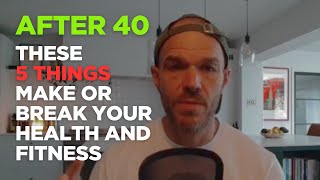
A 46-year-old shares what changed his fitness after four years: cutting alcohol, prioritizing sleep, warming up properly, redesigning workouts for longevity, and hiring a coach. He argues these five things matter far more after 40 than they did in his 20s, when he could get away with late nights and no structure.
Chapters
All right, once you hit 40, the rules change. What you get away with in your 20s and your 30s— late nights, skipping warm-ups, random workouts, a few too many drinks on the weekend, and somehow bouncing back— that all stops working. Now, I had to find this out the hard way. At 46, I'm in the best health, shape, and fitness of my life, and 4 years ago I was nowhere near that. And let me tell you, it actually feels incredible to be in a position to be able to say that. So today I'm going to break down the 5 big things that made that transformation possible for me and can do the same for you. Because after 40, these 5 things will make or break your health and fitness. Ignore them and you will always feel like you're pushing uphill. But if you can dial them in, you can be in the best shape of your life, even better than in your 20s. And this isn't hyperbole. I've done it and you can too. All right, let's get into it. Number 1, first up is alcohol. Now, if you want to be in the best shape of your life after 40, this is the one you have to dial in. And I happened to learn this the slow and the hard way, and hopefully you can avoid learning it that way. Now, it started with big sessions. Stag dos, lads' holidays where I'd drink for a couple of days and I would be an absolute wreck for weeks afterwards. Now I cut those out, but over time, even a late night out with a few drinks left me feeling awful for a full week. So they had to go too. Next went the midweek drinks, and finally, even just a handful of sensible drinks over a weekend started to leave me tired, anxious, and flat, sometimes right through to the middle of the next week. And when that was happening, I couldn't stay consistent with my training or my eating. I skipped workouts. Whole food went out the window. Whole food eating went out the window. And it became this creeping effect. The less I drank, the more obvious it became how much even a little bit of alcohol was setting me back. And at some point I realized that most of my week was a write-off because of a few drinks. And that was a turning point for me. Alcohol had to go. And once I cut it out completely, everything changed. Energy went up, anxiety went down, and for the first time I could train 6 days a week and actually stick to my habits. The results I've had since have been beyond anything I saw in my 20s and my 30s. Now look, that's my personal story, but the science absolutely backs this up too. After 40, your body metabolizes alcohol slower. So it lingers in your system for longer. It also wrecks your deep sleep. And because deep sleep is already harder as you get— sorry, it's already harder to get as you age, you notice it even more. It also interferes with hormones and recovery, and this makes it harder to build or maintain muscle. Of course, something that's already harder to do as you get older. And ultimately, it's just empty calories. And those extra calories are much harder to burn off once your metabolism slows down. Which it does as you age. So the bottom line is that every single drink has a bigger cost once you're over 40, and at some point you have to ask yourself if that cost is worth paying. Now, for me, the answer was to cut it out completely. I'm now 4 years sober, and honestly, it's the best thing I've ever done for my physical and my mental health. Now, I'm not saying that's the only path. I have friends who've been able to successfully moderate their drinking and also get similar results. But here's the point. You have to take this one seriously. You have to get your relationship with alcohol into a place where it's not holding you back from being in your best health after 40. All right, that was number 1, alcohol. Number 2 is sleep. Now, it was only after I cut out alcohol that I could really understand just how important sleep is. Once alcohol was out of the picture, it became clear as day. On the nights I slept badly, I felt exactly how I used to after drinking— anxious, tired, foggy— and my willpower would be in the tank. And honestly, it was like being hungover but without any of the fun of a few drinks. And that was a wake-up call for me. From that point, I made a commitment to improve my sleep, and I now average over 7 hours of good quality sleep every night. And that single change has been absolutely foundational to everything else I've built with my health and fitness. It's the reason I can train consistently, stick to good nutrition, and stay on top of my habits. And I notice it straight away when I slip. Just a couple of nights around the 6-hour mark and those old feelings start to creep back in— the tiredness, the irritability, and the lack of discipline. So when that happens, I make sure to fix it fast before it spirals. And like alcohol, science backs all of this up too. After 40, sleep quality naturally declines, so you need to be more deliberate about protecting it. Just one bad night of sleep drops testosterone, growth hormone, and recovery, and it makes it harder to build muscle and— and so harder to build muscle and to lose fat. Poor sleep also wrecks insulin sensitivity, which causes more glucose to remain in your bloodstream, which is eventually stored as fat. And over time, this leads to increased fat storage, particularly around the abdomen. And it also has a massive impact on mood and willpower. Studies have shown that even mild sleep deprivation can increase your anxiety by over 30%. Now, I couldn't be convinced about anything more. If you don't get sleep right, everything else you try to do— your training, your nutrition, your recovery— it's gonna be 10 times harder. And I'll leave you with one more real-life data point on sleep. So a good friend of mine, he's super into his health and fitness, and he recently got a puppy. And if you've ever had a puppy, you'll know what he's going through. Sleep deprivation becomes very real. It's like having a newborn. You're up multiple times a night dealing with whining, separation anxiety, toilet breaks, all of that. And he's gone from getting over 7 hours of quality sleep a night to now averaging probably about 5 hours of broken sleep. And I've watched in real time his discipline and consistency just fall apart. Things that were effortless for him a couple of months ago— training, eating well, keeping good habits— he's now struggling to do even half of what he was able to do. Now look, I know he'll get back to where he was, but this really hammers home the power of sleep. When it goes, Everything else crumbles with it. Number 3, the next one is warmups. And this has been a huge game changer for me. In your 20s and 30s, you can get away with skipping them or just doing the bare minimum. Your body is naturally more mobile, more resilient, and it's quicker to recover from workouts. But as you get older, things change. Your body tightens up, you lose mobility, and you start collecting little niggles. Some of which never quite go away. And here's the thing, there's no bigger threat to consistency than getting injured. An injury can completely take you out of the game, and suddenly you're forced to stop, and it can take weeks, sometimes months, just to claw your way back to where you were. Now, a good warm-up massively reduces that risk, and here's how. For a start, it raises your heart rate, which increases blood flow to your muscles, which improves their ability to perform. It also increases muscle temperature, making you more flexible and it reduces stiffness. It lubricates your joints, which helps you move better and with less risk. And it also gets your head in the right place. It starts to mentally prepare you so that you can focus on the session ahead and you will make fewer mistakes. Now I notice every single one of these benefits when I warm up properly. I feel more mobile, more ready, and completely dialed in for the session ahead. And since making warmups a mainstay of my training sessions, I've gone from, I've gone from being injured maybe at least a third, actually maybe even half of the time, to now being in a place where injuries are actually pretty rare. And that's why warmups are an absolute non-negotiable for me. And if you're over 40, they should be for you too. Number 4, how you approach your training. So the fourth point is this: once you're over 40, you have to approach your training far more thoughtfully and intentionally. You simply can't train the same way you did in your 20s and your 30s. Now, why is that? Well, first of all, the injury risk. As we've talked about, your risk goes up as you age. So your training has to be smarter. You need to program in a way that reduces the chance of setbacks. Second, life changes. At 40, most of us have a lot more on our plate— demanding jobs, kids, partners, family responsibilities, dogs, mother-in-laws, like you name it. Where it used to be easy just to go to the gym whenever you felt like it, now fitting in training can feel like trying to solve a Rubik's Cube. And life at this stage is also pretty fluid too. Kids get sick, work trips sort of come up randomly. So your training not only has to fit around these responsibilities, it also has to be able to adapt fast when things change. And lastly, your goals evolve as you age. Back in the day, you might have cared about chasing numbers, how much you could bench, squat, or even deadlift. But now most of us start to care more about looking good, feeling good, staying strong, and setting ourselves up to be healthy in the last decades of our life. And longevity starts to matter more than maxing out. So your training has to adapt for this. And for me, that's meant rethinking everything— how often I train, the volume and intensity, recovery, and the exercises I choose to do. I train completely different than when I did even a few years ago. And it's absolutely night and day compared to my 20s and 30s. And there's one thing I can guarantee: if you try and train like you're 25, it's not if you'll get injured, it's when. Now, I always like to give a practical call to action when I'm talking about things on this podcast, but this one is kind of hard to give a single prescription for because the details will— it's going to change depending on your life, your body, and your goals. But the big takeaway is that your approach has to become more intentional and adaptive as you age. And luckily, even though I wasn't able to give a kind of call to action on that one, that kind of leads perfectly to the last point, number 5. The 5th and final point is this: hire a personal trainer or a coach. And this has hands down been one of the best things I've ever done for my health and fitness and getting into the best shape of my life. I now have a Jamie in my corner. He programs all of my training and he helps me with nutrition and lifestyle decisions, and honestly, it's made all of the difference. Remember everything we just talked about when it comes to being more intentional and thoughtful when training after 40? Well, Jamie and I have spent the last few years putting all of that into practice, tailoring my training to my goals, reducing my risk of injury, and making sure it all fits in with my life. In your 20s and 30s, you can get away with winging it. You can follow generic programs online and you can still make progress. But in your 40s, that stops working. If you keep doing that, your results will plateau and you'll get injured a lot more. You have to be smarter than that. Your training needs to be individualized, specific to your goals, your body, and your life. Now, most people just plow ahead and try and figure all of this out on their own. And I think that's one of the worst things you can do because programming your training is actually really hard and it becomes much, much harder to get right as you get into your 40s. Now, I like to think I know a lot about training, and yet I still wouldn't come close to how smart and well thought out Jamie's programming is for me. I'm constantly impressed by how he sets me up for success and helps me avoid mistakes and injuries. And a huge amount of my progress over the last few years comes down to his programming and guidance. Whenever I do slip backwards or if I pick up a niggle, 9 times out of 10 is because I went off script, and that's always a lesson for me. So if you're over 40 and if you're serious about taking your health and fitness to the next level, don't think twice about investing in a good coach or a personal trainer. It's one of the best decisions you can make, and I'll put a link to Jamie in the show notes in case you want to explore using him as a coach. I super, super would recommend it. So there you have it, the 5 big things that in my experience will make or break your health and fitness over 40. For me, it came down to cutting out alcohol, prioritizing sleep, making warmups non-negotiable, being far more intentional with how I train, and deciding to work with a coach. And honestly, I can say getting these right has completely transformed my life. At the age of 46, I'm in the best shape I've ever been in. And if you're in your 40s, or if you're heading there, the same is possible for you too. And by the way, you don't have to do all 5 perfectly from day 1. Just start with 1. Pick the one that's hurting you the most right now and commit to fixing it. And over time, these things will compound. If you take them seriously, there's no reason that you can't be fitter, healthier, and stronger in your 40s than you were in your 20s.. But if you sleep on these 5 things and neglect them, there's a very good chance that you will stay stuck and you will slide backwards. All right, thanks for listening. And if this episode has helped you, share it with someone else who's in the same stage of life. It might just help them raise the bar for what's possible after 40. All right, see you in the next episode.