Thanksgiving Doesn’t Have to Derail You
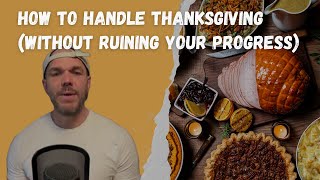
Daniel Clough explains how to protect your fitness progress through Thanksgiving by eating lighter earlier in the week, then snapping back to normal the day after. One meal can't derail you if you manage the weekly average of calories and protein, even if Thanksgiving hits 4,000 to 5,500 calories.
Chapters
All right, here's the truth. One big Thanksgiving meal, or even a Thanksgiving whole day, won't ruin your progress. It's what you do around it that matters. So let me show you exactly how to handle the day, enjoy it fully, and still stay on track with your health and fitness. Now, it's worth calling out that even though we're talking about Thanksgiving here, everything I'm about to say applies to any one-day out-of-routine situation. Could be traveling, it could be a meal out, or maybe it's just a big takeaway in. But Thanksgiving is basically the perfect hybrid. It's one big meal, but it's also an all-day event where your routine goes completely out the window. Everyone's off work, you're with family, you're grazing, and there's usually a lot of sitting around. And the whole day can easily turn into a write-off if you're not careful. And actually, even worse, it can sometimes be the inflection point that kicks off a multi-day or even multi-week slide where you end up completely falling off the wagon. Now, before we get into specific strategies for how to handle Thanksgiving, I do want to talk about a few mindset and sort of principles, because as usual, if these are off, none of the tactics will matter. So the first thing, or the first kind of principle, is that you don't need to be perfect to get great results. Your results are never determined by a single action, not one meal, Not one bad day, not even a bad week. When it comes to being fit, healthy, strong, and looking and feeling your best, what matters more is your average over time. If your average is consistently high, you can weather almost anything. You can weather a bad day, a weekend away, or even a full week that goes off the rails. And with any of these, you can still make serious progress over the long term. And that's exactly why I aim for 80% consistency with my foundational health habits every month. And I've said this on a few videos already, but I actually think there's something magical about that 80% mark. Now, I have zero scientific evidence for this, but I want you to hear me out. I believe that 80% consistency gets you most of the results. But here's the key thing: importantly, it still lets you live a balanced, fun life. And it's realistic for literally anyone. And when you start to step that up to 90% consistency, I believe it only gives you a tiny bit more results, but the trade-offs start to get ugly. Life starts to become restrictive and the margin for error becomes razor thin. Most people can't hit 90% without making their entire life revolve around it. Now, if you want to jump up to 100% consistency, which is basically perfection, it starts to become completely unsustainable. And even if you were somehow able to manage 100% consistency, it would likely be a pretty miserable existence. And here's the counterintuitive part. If you aim for 100% consistency, you're actually likely to get quite bad results. Because when you aim for 100%, you fall straight into this vicious cycle of trying to be perfect, inevitably failing, and then falling off the wagon hard. And then just repeating that cycle. And it basically ends up being a lot of stopping and starting, i.e., inconsistency. And that just doesn't land you anywhere near 100%. It actually pushes you well below 80% and often far below 50% consistency. And once you understand this, you will stop seeing something like Thanksgiving as a screw-up and you can start to see it for what it is. It just becomes part of the 20% that you're going to manage intentionally. Now look, I wanna build on that first point a little bit, and the second point is that your average over 7 days is really what counts. Now when you see Thanksgiving, or any big event actually, as part of your 20%, you start to zoom out and you start to think about the week, not the specific day. So for example, let's say your calorie target is 2,500 calories. Then what actually matters is that your weekly average is around 2,500. You don't need to hit 2,500 perfectly every day. And actually what usually happens is that you end up hitting that average through a mix of days. Some will be a little bit higher and some will be a little bit lower. Maybe some will be perfect, but that's normal and it's completely healthy. And importantly, that's quite a sustainable way of going about it. Now look, yes, you don't want to go to extremes where you have these massive swings between big binge days and then starving yourself the next day. But some natural fluctuation between the days is totally fine and normal. And my, my days actually look pretty much like that. You'll see some days I will hit 27— I actually have a 2,500 calorie, uh, target. Some days I'll hit 2,700, other days I'll hit 2,600, some days I'll come in a little bit lighter, 2,300. And what's more important is that I'm not trying to hit 2,500 very specifically every day on the mark, but just at the end of the week, I want my average to be 2,500 without these huge swings. Now, with those two principles in place, we can start to talk strategy. Now, my goal is to help you not be the miserable person weighing out turkey slices at the table at Thanksgiving. I want you to actually relax into it and have a good time and know that it's not gonna ruin your progress. So let's get into the tactics. How to handle Thanksgiving. As we've said, Thanksgiving is just one day. The goal is not to be perfect. The goal is actually to make the, the week land roughly where you want it, even with a big Thanksgiving spike in the middle. Now look, Thanksgiving is on Thursday, this Thursday coming up. So the first thing we need to do is manage the days leading into it. Monday through Wednesday. And here we have two clear goals. Firstly, you want to create a little bit of room for an extra calorie day, i.e., Thanksgiving, essentially eating a little lighter, um, than you would usually leading up to it. And the second goal we have is build an early lead on protein, because most big events involve not only calories but usually less protein. So you want to push the average a little higher anticipating that. And to make this concrete, I, I'll use some numbers. You can kind of see how it actually would like pan out. And by the way, if you're not tracking calories or protein, don't worry. You can still follow the intention of this. So my current daily targets are 2,500 calories and 180 gram protein, uh, which is 1 gram per pound of, uh, body weight. So across 7 days, that's the average that I'm shooting for. Now, if this was me, I would aim for 2,000 calories on Monday, Tuesday, and Wednesday, and I would also push the protein a little higher to 200 grams. Now, that takes a bit of, um, intentionality, but that's the whole point. When you're thinking in weeks, you naturally start to adjust the individual days to make the week work. So look, now I'm cruising into Thursday and Thanksgiving with a 2,000-calorie average and 200 grams protein in the bank. Now let's say we get into Thanksgiving and it ends up being a really big one. I have a great time. I eat 4,000 calories, which is nearly double the amount I would usually eat, and I only get 120 grams of protein, about two-thirds of what I would usually get. On paper, that looks like a complete disaster. But here's the crazy part, and I swear when I first mapped this out, I picked these numbers completely at random. That puts Manager Thursday average at 2,500 calories. And 180 grams of protein, which is basically me being exactly on track even with a 4,000-calorie low-protein Thanksgiving. And at that point, all I need to do is finish the week normally. Thanksgiving just becomes one standout spike in an otherwise normal week. But look, let's say I was to go even a little bit more extreme than that. Let's say I go absolutely unhinged and hit 5,500 calories and only 100 grams of protein, which is over double the amount I would usually eat and below two-thirds the amount of protein I would usually eat. That would put my Monday to Thursday averages at 2,875 calories and 175 grams of protein. But that's still incredibly manageable. From there, if I simply go back to around 2,000 calories per day and I probably around 190 grams of protein Friday through Sunday, I would still land the entire week almost perfectly on my targets of 2,500 calories and 180 grams of protein. So I hope this highlights that if you're intentional about how you approach days around a big meal or an unusual day, it pretty much becomes a non-event in the grand scheme of things. Now there is something that's kind of catches people up, which I want to talk about. And that's in some ways the real danger isn't Thanksgiving itself. It can actually be the day after, because the temptation is to keep going. Once you've had one big blowout day, sometimes the next day is quite hard to snap back into being disciplined, and you just want to go out and do even more. You've had a big meal, you're relaxed, you're with the family, and it's so easy for that one day to turn into two, or 3, or actually in some cases, and I've done this plenty of times before, an entire rest of the week. And that's actually when you truly mess up your averages. So the real skill here is simple. Enjoy Thanksgiving fully, but afterwards switch back into discipline mode the next day. You want to wake up, you want to hydrate, you want to get some protein in early and get a walk in so you're active again and start to return to your normal calorie target. That stops the whole thing from leaking into a multi-day slide, and it keeps it firmly inside your 20%. And this one behavior, getting back on track immediately, is what separates people who stay consistent from the people who lose momentum after a big day like Thanksgiving. So look, the big takeaway: it's never about a single meal or a single day. It's actually the weekly average that matters. If you zoom out and manage the week, you can absorb a huge day with ease, without guilt, without spiraling, and without losing any momentum. And that's really the whole point. Thanksgiving is there to be enjoyed. You're with your family. There's connection. There's great food. The things that actually make life enjoyable. And you don't need to dread it. You don't need to micromanage it. And you certainly don't need to punish yourself afterwards. You just need the right mindset and a simple strategy that lets you enjoy the day while you still keep your long-term progress moving. And once you understand this way of thinking, it becomes a blueprint— sorry, a blueprint for everything. It's how you manage Christmas, birthdays, weekends away, trips, weddings, and big nights out. Even multi-day events where your routine completely disappears. It's exactly the same game. Zoom out, manage the week as a whole, and then stay consistent over the long run. And when you approach life like that, nothing knocks you off track. You no longer fear big meals, and you start enjoying these moments while still building the body, health, and lifestyle that you want. So look, this Thursday coming up, enjoy Thanksgiving and trust that with this mindset and a little bit of intention, you'll still be right where you need to be by the end of the week. Cool. See you in the next episode.