⚖️ DORA, AI Accountability & Regulators: Action Steps for Fintech (Part 3)
Daniela Sozzi and experts discuss how DORA, the EU's new resilience rule, requires fintechs to prove they can handle AI-driven cyber threats without blaming vendors. Firms must scrutinize third-party contracts, map their entire AI supply chain, and tell clients "I don't know, but we are prepared" instead of claiming perfect protection.
Chapters
So let's switch now to accountability. Daniela, how do you see DORA helping this trend we see currently?
Technology moves faster than the law. So there is always that lag that is structural. But I think what must be appreciated about DORA is that it is outcome-based. It is not prescriptive. That allows it to be valid no matter the progress on the technological side. There is no explicit mention in DORA about AI or AI-driven cybersecurity threats. But what DORA says is, show me that you can be resilient, that you're not going to hide behind your supply chain and try to shift the blame in case of a disruption. Show me that you're doing everything you can preventively. And then if something does happen, that there is a response plan in place and that has been tested and that is sufficient to match the risk. There is prescription around the documentation, but it's not prescriptive as per the initiatives that individual firms must take. And that allows it to be future-proof. I don't think we need to redesign the DORA 2.0 anytime soon because those new technologies are coming. Legislation is needed because I believe there are institutions that would not do enough unless they were required to do so by law.
Could DORA support or push or control third-party vendors?
I think DORA is suggesting some reactions that companies can take and a framework, but the institutions also need to implement the right processes so they know with whom they're working and how they're working and how they can rely on the providers. And I wanted to mention 2 things. One is really thinking twice about the service level agreements that financial institutions have with their providers, with the adapted liability clause for their specific tools. If you think about assessment, if there's a misclassification of a high-risk loan as a low-risk loan, that's also an impact on the institution. And we cannot just rely on the provider, but the institution needs to be able to go back to the provider saying, you're selling us something that is not promising what you've been saying. Or we use a tool for KYC procedures. So asking, has this been tested for fairness, for robustness? And if it's not the case, being able to go back to the provider and say, this is your responsibility, we're claiming damages. And then the second thing is the full visibility of the AI supply chain with the different dependencies of the vendors, third-party sub-providers, the AI company. Are we talking about open source? Are we talking about proprietary tools, LLMs? And it's going to be a lot of discussion between the legal team and the IT team. Legal asking, what's inside? And IT saying, we don't know, or we think it's okay, or it's a black box. It also has impact on the IP and data processing, either the outcome that is being provided by the technologies.
Thank you. Yeah, your last question about accountability to Andrei. How can we ensure that the central entities can collaborate together, share information, help each other with this situation?
There's already a lot of initiatives for best cybersecurity practice, both across Europe and Switzerland. In Switzerland, we had recently natural Cybersecurity Center signing an agreement with the Swiss financial sector, Cybersecurity Center for improved collaborations. In Europe, you have different initiatives that have been around for over 5 years, specifically targeted cyber information intelligence sharing, coordinated red teaming, G7 Margin Cyber Expert Group that tend to focus on those topics. So we have really good institutional settings set up at a very high level. The problem is that now the velocity of things changing and new threats emerging and disappearing has gone absolutely through the roof. So the speed at which those big institutions function is just not enough to keep up with threats. And one of the things that we faced as a group that works really in the trenches, sometimes when we try to report our findings that might have immediate impact with 1 week, 2 weeks, 3 weeks, we are not being able to reach to the right people, or we need to go through the official channel that will maybe succeed in 6 to 12 months. And this is no longer acceptable. We need flat networks. They exist to some degree in informal fashion in Switzerland, but they need to be woven tightly. There needs to be this more direct coordination between the cybersecurity teams across different institutions and also implicit agreement that this information cannot be used negatively or offensively. And in my opinion, this shifting things down level way closer to where things are happening and being seen first is one of the biggest challenges and one of the biggest changes that need to happen quite rapidly.
Thank you. Okay, so we're going to the next topic and we ask Daniela, if a client is coming to a financial institution to say, Actually, are you protected? What should be the answer?
There is only one correct answer for this type of question, which is, I don't know, but I am prepared. There is no such thing as being able to say I'm 100% protected against any type of attack. Simply, we don't know. There are unknown unknowns. This is the new environment we live in. What is required is to be able to respond to those uncertainties. It's incident readiness. Caroline mentioned it earlier. It's about complementing the protection that has to be in place. And even the UK AI Security Institute when they did their own assessment of Mythos, they said the standard methods of security need to be in place and then more needs to be done and to make the response as agile as possible and to cover all different angles from which an attack could come from. No one can ever say I'm 100% protected. We should question those that tend to underestimate the level of threat.
Perfect. Thank you. We discussed at the beginning about the key pillars: trust, stability, and data protection, data security. So I would like to close with one action, one message you want to share to the audience. Let's start with Andrei.
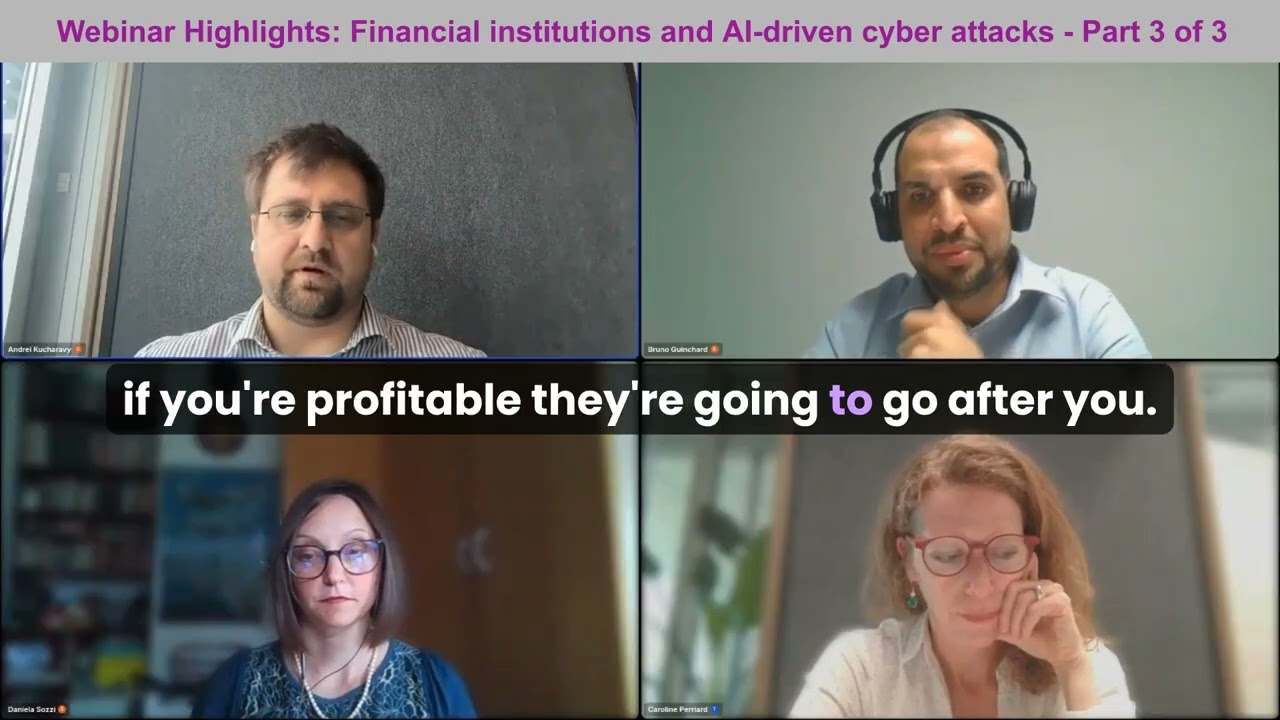
Start with doing proper cybersecurity basics, things that you have been putting off, saying to yourself that you're too small or that attackers have priorities. With automatization, they no longer care how small you are. If you're profitable, they're going to go after you. You need to start doing good practices now.
Great. Karine, on your side?
I would go back to regulation and remind everyone to protect the customer and their rights. And we cannot neglect these rights for the sake of profit or speed or efficiency. It's very important to set the right measures and limits Thank you, Daniela.
Regulators don't care about how much is spent to protect a company from cyber threats. They care about how it is spent. They want to see outcomes. So show me that there is awareness at all levels of organization to respond to cyber threats, that there is an acknowledgement that threats can come from any direction. A practical example from the UK, one of the largest companies that also had a financial arm was attacked recently from a phishing attack to the middle management. So that is to show their operations clearly were And this is my advice, practice these type of scenarios, learn from other people's mistakes, and make sure you're well positioned for any sort of eventuality.
Thank you for this input. So we have one question, what is the defensive counterpart we should be trying to build?
I think there's several elements that go into defense. The first one is automated patching. Right now, when vulnerability is found and you need to address your code, you can try to rewrite it with automated tools. But the problem is that often they will slightly change the logic sufficiently frequently so that you cannot fully trust them. And still need a human to review it, which is taking time. We need to invest more effort into making sure that we can deterministically be sure that everything there went well. The second thing is defensive tools. There's a lot of conversation about defensive agents being deployed, but the problem is that they are somewhat of a paperclip optimization machine. The safest system is a system that's fully online. The only database that cannot be leaked is the one that has been deleted. If your database gets deleted by your own defensive agents, that defeats the purpose of them being there. There's a lot of research that needs to happen into how to make sure that we ensure security while maintaining the availability, and we are not here yet. And finally, the third one is ensuring that these defensive rapid response agents are actually understood, given permissions that are understood, and intervened if they start being a problem. And there's a lot of companies claiming that they have the tool of how to manage the permissions. Unfortunately, they're not really ready for real-world production, so we need innovation going in this direction. There's some leads, but unfortunately nothing that's ready to roll into production yet.
Okay, perfect. A quick question to you, Daniela. Do you see a new regulation coming in or the regulator publishing something in short term about what's happening with these new models?
What I have seen actually changing quite a lot is the approach that the regulators have been taking. So we started originally with a more prescriptive approach and now we have evolved into a more outcome-based approach with nuances. So if you look, for example, at Germany, they're still very much prescriptive, very, very clear what financial institutions are supposed to do, what are the timelines that regulator expects in terms of incident response and resolution. In other countries, instead, it's becoming more outcome-based. There was a point that André was making about information sharing. I see some countries moving in that direction, particularly in the Baltics. It's easier for them because they're smaller, they probably have fewer financial institutions to regulate, and they tend to be very tech savvy. So different environment. But I see it as well in Switzerland. FinMA, on everything that is concerning cybersecurity, seems to be a lot more responsive than, for example, it is on other financial matters. And finally, the UK has always had this principle of requiring firms to declare their own impact tolerance, and then the regulator evaluates each individual firm against their own declaration. So it allows more freedom. Show me that you have the customer in mind. So Caroline's point, the protection of the customer and the protection of the trust in the system, those are the 2 principles that are in common to all the regulators across Europe.
Thank you, Daniela, and thank you all for all your input. Really interesting discussion. I wish you all a nice day.
More from Daniela



Webinar Highlights: Financial institutions and AI-driven cyber attacks - Part 1 of 3