Cultural Diplomacy & Creative Power with Mariya Gabriel: How Empathy Shapes the Leaders of Tomorrow
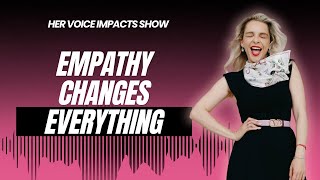
Mariya Gabriel, former EU Commissioner, discusses how empathy shapes leadership and innovation. Only 2% of venture capital goes to women-led startups, but EU programs like Creative Europe and the €75,000 Women in Innovation fund are working to close the gap. She argues cultural diplomacy and creative industries are Europe's strategic power.
Chapters
Look at what is the venture capital invested in women-led startups. 2%. We need stronger support. We need more visibility of the success stories. We need to inspire young girls. If you lost somewhere your empathy, you will never have the good intuition. You can't serve your own vision and be a leader. It's simply not possible.
Welcome to another episode of Her Voice Impacts, where we are amplifying women's voices globally in arts, culture, entertainment, innovation. I'm Daniela Eon, and we are in Bulgaria, in Sofia. And what a beautiful country this is. I am going to be taking you on the journey of cultural diplomacy and creativity. Maria Gabriel is my guest today, and she has had various roles as EU Commissioner for Creativity, Culture and Innovation, also Deputy Prime Minister of Bulgaria, and at present the President of the Robert Schuman Institute raising leaders of the future. Maria, thank you so much for joining us here on Her Voice Impacts. It's a pleasure to have you. And I wanted to start with, tell us about growing up in your hometown here in Bulgaria. Tell us a little bit about that.
Well, thank you very much, Daniela. It's a great pleasure and honor to be to be part of such an amazing initiative. So, thank you so much for helping us raising women's voices. So, well, I want really to say that I'm happy. I was born in a country, Bulgaria, that at that time was not member of the European Union. And today, the first thing that we can see the difference. I'm happy to live in Sofia. I'm happy to live in Bulgaria because we are part of Europe. The European Union is an amazing project where you don't have only free circulation of persons, you also have freedom, you also have the respect to each other, you also have an amazing cultural diversity. And this cultural diversity, it's not a reason to fight each against other. No. It's a reason to build bridges. It's to better understand the other culture, the other history, the other story. And that's something that is amazing. So Sofia is for me a symbol of that, a city of a very rich history, but also with a very positive look at the future, with perspective, with opportunities.
Opportunity.
Absolutely. Today more than ever, I see Sofia as a city of opportunities.
And how did opportunity come to you in this beautiful path of politics and being able to speak and be at events and obviously empowering women as well at the same time?
Well, I must say that I always was moved by the European Union as a project of peace, of tolerance, of freedom. And I must say that when I had this opportunity to be engaged in European politics, that was something amazing for me. That was a great opportunity because on one side, at that time in 2009, I was elected for the first time in the European Parliament. The country just joined the European Union, so there is a learning process where you learn that you, you have rights, but you also have obligations. You also have a responsibility to contribute to this project in a positive way, to learn the art of the compromise, to learn the negotiation, how you can to defend your own point of view, but respecting the point of view of all the others and founding finally a common solution. So, for me, that was a great experience because in such a way I was able to contribute, to know Bulgaria better inside of the European Union, but also to show in Bulgaria that the European Union is a big opportunity for the country to move forward, to develop itself. And that was great, that was an amazing opportunity for all of us.
How did you learn all these skills? Because I mean, people listening might think, okay, how on earth did you do that? Like, how do you get this confidence just to enter in and be doing the things that you do?
Well, actually, that was not obvious because before I studied international relations and a very precise expertise was the decision-making process of the European Union.
Really?
So I was teaching that. And suddenly when you have the opportunity to go on the other side, not on the side of the theory but of the practice, you have to dare, you have to show some courage. It's not easy. That was not an easy decision because when you are a researcher, when you are a teacher, you stay very much in the neutrality and the objective point of view. And suddenly you are going into politics, you have to stick to your principles, to your values, and to show that you can join words and actions. And that's not easy. That's not easy. So, it's a learning process. But I think very much that at that time, the fact that I was so young, I was only 40 years old being elected in the European Parliament, I was really one of the youngest members of the European Parliament. Parliament. And I will always remember this moment when one, one of the people that is keeping the door to enter into the plenary session asked me, you are the assistant of whom? And I said, no, of myself. I'm the member of the European Parliament. So you can see, but at the same time, this age is a, is an age where you dare, where you don't think about the consequences. You want to be in the action. You want to show that you have ideas, you know how to realize them, you know to work with other people, you want to be a part of a team that is proposing, that is really initiating things, and that was great. You have passion.
It's an inner passion inside of you.
Absolutely. And I think that you can't be successful in these public spheres of politics, diplomacy, if you don't like people. You need genuinely to love people and to to want really to do things with them. And that's how I discovered all these amazing topics. And I was so grateful at the same time because of this experience. I was able not only to open myself from Bulgaria to Europe, but also from Europe to the world. That's how I discovered the African continent. That's how I discovered the Middle East region. And that was great. That's something that you have it or not inside of you. But if you don't have the opportunity to show that you are able after to be concrete and to fulfill with content these ideas, it's quite difficult. So I'm very grateful that I had this opportunity. That was also the time when I discovered the issue of women and gender balance because I want to say that I arrived in the European Parliament and, to be honest, I didn't understand why they have a committee of equality between men and women. I'm coming from Bulgaria. In Bulgaria, maybe that's one of the heritage that we have from the previous regime, no one will say to a girl, you can't be engineer, you can't be mathematician. There is this mentality that women and men are equal. They can have the same job, the same profession. It's based on merit, it's on your qualities, on your efforts, and that's all. But arriving in the European Parliament, I'm discovering that there is a special committee on these questions.
Nothing I knew about either.
I will always remember I had a conversation with a colleague of mine from France. She was not apparently my age. And I asked her, why do you have this committee? Why are you in this committee? And she told me, Maria, you will see with the years that this committee is very much needed and we should always put an additional effort to keep women's topic on the top of the agenda. Wow. And that's the experience. That's the maturity. That's all these lessons from the life that all these people experience that are the expression. And that's what I learned. And actually, I became a member of this committee, and suddenly I discovered another passion.
A whole new world opened up.
Absolutely.
And this led you into this whole thing about women and raising their voices and standing for other nations as well.
As well?
Is this what happened?
Absolutely, because in this committee I suddenly discovered that there are particular challenges in some countries, but we also have common challenges when we talk about the representation of women in decision-making positions. It's not normal not to be well represented. We are half of the population, but we need much more women in leading positions. I will always remember when started the work on women in boards. Suddenly we discovered that there are no women in the boards of the big companies. And I will always remember when the topic was raised, someone reacted to the Commissioner at that time saying, but because there are not so many women that are qualified, that have the experience really following the criteria, And I will always remember, it was Viviane Reding, the Commissioner at that time. She came to the Parliament and she sorted out a list with 5,000 women actually in Europe ready to take these positions, but they are not in the boards. I will always remember this moment. That's how suddenly you realize that we need all to join forces to give much more visibility Yes. To tell the stories, to inspire, to support, and always, always to stay mobilized. And that's what I learned, and I was really very, very happy.
You had such an amazing opportunity to do that at such a young age as well, which then brings me to my next question in a moment. Maria, I want to ask you about your journey in the instance where you've had so many various roles and various important roles in society. Tell us about those roles and how they've impacted the women and empowering more women globally.
Well, thank you, thank you for this question. Actually, I already started by saying that I was member of the European Parliament. I was elected 3 times. During all these 8 years in life in the European Parliament, I was member of the Gender Equality Committee, and I was also awarded MEP of the Year on gender equality. So that was a big recognition. I think that at the same time in the European Parliament, I have seen what's about about the legislative work and the direct link with people. But everything changed when I became European Commissioner, because as European Commissioner, that's the executive power, if I may say that. And you have much more tools in your hands to be impactful, to initiate new things, and to start things as well. Absolutely. And that's not the case in the European Parliament, because following the Treaty of the European Union, the European Commission has the monopoly of the legislative initiative. And that's, that's why when you are commissioner, you, you have definitely this possibility to, to make much bigger impact. And of course, for me, it was obvious that I want to continue to work for more women in different fields. And first time I was European Commissioner for Digital Economy and Society, and I'm very proud that we launched together with a lot of amazing women, the digital for her strategy. Because at that time, 2017, 2018, no one wanted to talk about this. I remember I wanted to change some of the priorities, saying, listen, today for me digital skills, artificial intelligence, fake news, disinformation are the big priorities. That was not obvious at that time. I I felt some resistance saying, well, these topics, they are here for short term. I was convinced, and we can see 8 years later, we are in. So I think that that was really very good, especially when we talk about digital and women. The things are not only positive, for sure there is a lot of opportunities, but there is also a lot of asks, let's think about the reproduction of some of the stereotypes, because the algorithm don't have access to data. Imagine that in a company for the last 30 years, people for the post of director were only male. Yes. How the new algorithm will know that they need also to look for some female candidates? And we need definitely to work on all these things, not to forget how difficult it is always to have this fragile sometimes balance between private and professional life. So, that was great. In the second mandate, I was European Commissioner for Research, Innovation, Education, Youth, and Culture. And that was an amazing opportunity because I launched a lot of initiatives for more women in innovation. Numbers are very alarming, very alarming. I have a very, very concrete example. Look at what is the venture capital invested in women-led startups. 2% last year, decrease 1%. So it sounds like nothing.
It's actually zero.
Only 8% of the startups are women-led startups. And on The other side, we know that they are much more impact-oriented. They have better financial revenues. They are doing amazing things. But we need stronger support. We need more visibility of the success stories. We need to inspire young girls to pursue the career because that's for me always the paradox. Analyzed some of the data, and actually girls that are between 9 and 10, 90%, 90% are interested in innovation and new technologies. Really? But only 6 out of 1,000 after the university are pursuing a career. So something happened in between. Yes. We need, we need to work on this.
Is it education?
Education programs, mentorship programs, also dedicated program for those women-led startups. So, I was really very, very proud because they launched an initiative, Women in Innovation, and now there is a dedicated program with €75,000 per startup. So, that's what we need. We need these kinds of concrete examples. And also all the time not to hesitate to have an information campaign, just to show— and here is coming the important role of media— to show those stories that not everything is easy, but if you stay, if you are passionate, if you are motivated, there is always a solution.
That is so brilliant. I never knew that the numbers were what you just said, because then it should make women kind of get inspired to do something about that, because we can. When we get together, something happens.
Absolutely, I fully agree.
And we find a way. I've always found women have a solution somehow, and not in an aggressive manner. It's more of, okay, what have you got, what have I got, How can we put it together? And I've always found, and maybe you can talk about this, that we're happy to start from nothing.
Yeah, you know, like with what we have now, it's something that is not scaring us. No, it's an additional reason of motivation, because when you are entering into a system that is here for many years, the network is very well known, all the rouages are very you can't be so much innovative and creative. But when you are starting from scratch, you're creating the path. That's something that I think as women, we have a particular force when we suddenly see how to join the pieces of the puzzle and at the same time to discover for all the others that the puzzle is not anymore the same. That's good.
You've just changed the whole puzzle. Tell me about using your intuition in this, because you've mentioned things like you said, I feel this, I could see it coming, and everyone's, ah, no, no, no. How big of a role does intuition play in this path as well?
Something very personal, but yes, it is personal. Intuition, it's something very strong that I have inside.
Do you feel it physically or is it around?
With the years I tend to believe that it's also coming because I stay empathetic to people. Wow! You have intuition when you keep the empathy. If you lost somewhere your empathy, you will never have the good intuition. Wow!
That is the key.
That's what I can say with experience.
And you can see why women are so geared towards social impact because of the empathy and compassion, right? Which then creates a whole new culture, doesn't it? It brings a new way of experiencing even a nation or a community when there's empathy.
Absolutely. Yeah, when you have empathy, immediately is coming the the public good, doing good, having social impact, and all this with a very special feeling that everyone is important. You don't have only one single that is leading, but there is enough place for everyone to join forces as a team. At the same time, what I learned from my experience, you are a good leader if you allow everyone to show his own leadership, the best of his personality. And after, you can only share values, principles, and have common actions. But if you allow everyone to show the best of him or herself, that's the best way to achieve things.
Brilliantly said. I absolutely love that. We've talked about empathy and also this intuition, and then you talked about leadership, and this is how it all weaves together. What are some of the key factors that you can spot when you see someone who is going to be stepping into leadership? What are the skills that you can pinpoint? What are the skills skills that we might need to be in that position as well?
Well, definitely creativity. Today in the actual world, I can't see anyone pretending to be a leader without being creative because we are living in an extraordinary world. Things are moving very fast like never before.
Yes.
So without creativity, it's, it's not possible. On the other side, of course, knowledge and experience. Yes. You can't pretend to go on a position where there is not enough preparation and the preparation, it's not always to make studies or just to have an experience. It's something that for me is like a complex of values, actions, but vision. So, for me, if today someone wants really to be, to be a leader, creativity, knowledge, and vision, it's for me 3 very important elements. Knowledge, that could be something very personal, knowing people, knowing the position, knowing the different logics behind some actions, but definitely to have a vision. And this vision should always be for more public good, more common good. You can't serve your own vision and be a leader. It's simply not possible. You have really to want to do something that is good. I must say that that's the best motivation that you A vision that's bigger than yourself. Absolutely.
Which is vital now in a world where you said everything is speeding up and people can see straight through.
Can see, can be inspired, can be inspired too because it's very, very, very nice always to say I want to do things and I'm thinking here about the example of how to inspire much more young girls to be in diplomacy, for example. Allow me to share this example with you. When I was Foreign Minister and Deputy Prime Minister here in Bulgaria 2 years ago, actually, first I realized that never women ambassadors met the Foreign Minister separately. So, I initiated this network. And of course, we are women, only one single meeting and an idea of new initiative. We decided to put in place Ambassador for a Day. So actually, we organized a competition where we invited young girls to share with us their ideas— what is the life of a woman ambassador? And you can't imagine how amazing was this experience, because those girls that succeeded, they spent one entire day with a woman ambassador here in Sofia, different countries, of course, they always have some wishes. And that was good because on one side, we discovered that young girls suddenly were inspired, that that is an amazing career, they want to pursue in this direction. But we also had other examples, people saying after spending one day with the ambassador, I know that this is not for me. I want to do something different. And that's also good because in that case you help young people not to lose time, not to serve the ambition of parents or someone else around. That's— this kind of concrete initiatives we need more and more because here the leadership is coming. I always think as foreign minister We need much more women in diplomacy, young girls pursue a career, stay motivated. But when they have this possibility to live this experience, at the same time to have someone like me building bridges between those two worlds, that's what we need. And for me, a leader is this person that is helping communities to work together, to understand each other. To have respect for the experience, the vision, and the life of the other person. And that's something that we don't have so much in our times.
What a great initiative, and I would imagine that some of the young girls that would have come in would have come up with so many interesting ideas that we probably wouldn't have thought about, maybe. And they get to also voice their their vision or opinion and they get heard as well in some way.
Absolutely, and that's exactly what happened.
Does it build confidence in them as well? This is the thing, we need to build more confidence in these young girls to go for areas in their life that maybe they thought, well, that's not my industry, or I've been told so and so, you don't go there. But we're entering in there.
Yeah, and that's what we need, these kind of experiences where again theory and practice, real life and ideas, imagination are meeting. That's what we need because in that case you can see that there is a lot of trajectory and that is starting at that time to be shaped. It's shaped because they are personalities. Because different styles, because, because we have girls and women and people that want to invest their efforts, their time, their energy in something that is, that is noble, that will serve many others. So that's, that's something that is really good.
What a wonderful story. I want to go into the area of creativity because I know this is a big passion for you, and also in the area of innovation. Because creativity and innovation work hand in hand, and it does create new industries. And I think we're seeing that right now, of new industries being— popping up everywhere. How does that work in the sense of where we are right now in a digital world and still operating from this creative human side, but we're merging. Can you go a little bit in there with women and creativity and digital?
Of course. Well, I must say that here our limits are also the limits of the European Union. Why I'm saying that? Because it's true that every single member of the European Union, every country, is very proud of the cultural and creative sectors and industries. By the way, I really think that that's— there is a a lot of potential to unlock. Because when we think only about the cultural and creative sectors and industries in Europe, there are not so many people that are aware that they are creating more jobs than the automotive sector or the automobile sector. And it's nearly 4.3% of the, the brutal revenue. So it's 12 million jobs. Interesting. And today our member states are keeping very jealously their competencies. I believe that more and more we need a common policy on culture, on creative industries and sectors. It's good that we have some concrete initiatives like Creative Europe Program, Horizon Europe Program, also the recently the new European Bauhaus, where sustainability, creativity, culture, education can really work together and create synergies. But we need much stronger support. I think that everywhere, not only in Europe, everywhere, culture is something unique. Culture really, it's a sense of belonging, sense of belonging to a community where you can share histories, but you also can create common future where you can have joint actions, but at the same time show your particular diversity. It's so, so motivational. I don't know, I even don't know how to explain, because of course we are very proud culture, it's our DNA. That's all. And that's why we need to protect. Yes. But we need much much stronger support, um, from, from the top, I must say, because on the ground you have amazing communities. They are all vibrant, they are dynamic, they are innovative. But what we need, what we need is support from the very high institutional level. And when we look on the ground, what I would like particularly to see is to connect the different local innovation ecosystems. Because everywhere, in every single country, even inside one country, we have many local vibrant innovation ecosystems. They are not connected to each other. And I think this community is very powerful tool that we are not using. Because when you create connections, of course, that common ideas, common projects, common initiatives are coming after That's what we need, and I think that that's one of the main challenges today. It's really to connect by creativity and innovative approaches the different ecosystems that are locally flourishing, but we need to connect them to others in order to show much bigger importance of this topic.
And even bridging other countries, with other countries. Absolutely. And culturally, how diverse we are, but in the end, we all in some way are one, but with these amazing differences. And creativity explores that. It takes you into another dimension, obviously. And we have that opportunity now with digital ways of doing things. It would have to be.
Yeah, that's definitely an opportunity. Opportunity that we should see is because thanks to the new technologies, we can connect much easier to each other. We can even have new initiatives that there is, there is no importance from where you are doing it. The importance is to have the good connection, to be part of a team, to work together. Exactly. And that's what, what we should continue to explore, because I'm sure that there are many, many opportunities I think that we have already people that are completely aware that these opportunities are here, and that's what we need to do. Because also we have to think about the young generation. Today's young people are not interested in traditional and classical things. Let's be very honest, we need to change the narrative, we need to change the way of working with them, we need to change the way of convincing using them because we have an entirely new generation that is concrete, that is very pragmatic, that also knows very precisely what they want for themselves as a quality of life, as a way of life.
It's exactly— I never thought like that. I didn't think of my quality of life.
It was also my case, but now I see a new generation.
You do, you have these conversations.
They have a completely different vision of the world and on the next steps in their world. So that's why as soon as possible we establish a good connection with them, as soon as possible we also listen to them, we have more chances to be listened.
I so agree with you, and this is why we can also go into the area of education and Being a part of this new way of like the value of life, it's so interesting because you hear, I speak to some teenagers and they're talking like, well, I never spoke like that. They think from a different level and I think because of the exposure of social media and having more access to information. I didn't have that, I had Encyclopedia Britannica, that was it. And I cried for, my parents to buy me the, the leather-bound books, and all I would do is read that and go, wow, all this information. And now I look at it and I think, that was nothing compared to what they have access to, right?
It's true.
So it's time to maybe bring new initiatives and programs, after-school programs, or within, you know, the education system of how young women can work with other nations and cultures and see what they can come up with. New ideas, new—
Yeah, we are, we are also very lucky in Europe that we have for our young people a brilliant example is the Erasmus+ program.
Yes, yes.
Let me share with you something. When you— when two years, one year ago again, that was— did an analysis is asking European citizens, what are for you the 3 main achievements of the European Union? Always Erasmus Plus. Yeah, it's one of those concrete initiatives because we have a program where young people from the kindergarten, yeah, to adults, they can share, they can travel, they can work together. And that's something that we need again with bigger support to expand and to give accessibility to all those that are needed. Because today young people have a lot of access to information, but if after this information on social media they don't experience real, really on the ground, what is this information with the reality and how am I contacts and friends that I meet, I can assimilate this information. We have some risks that social media and reality is not exactly this one on the— that we— that's happening on the ground. Yes. And that's why we, we are very, very lucky we have this program. It's great with a lot of chances for young people, but of course I will always ask for more support and more young people to have access to this.
An expansion because Europe is so big, right? We can expand even greater and think of even the next generation, like kids who are even younger, who are obviously just even in kindergarten. Their brains must be wired so differently to work.
I'm also very much in favor of the enlargement of the European Union. I also think that Europe should definitely stay open to the world in order to expand, because expansion from our European point of view, it's not something aggressive and brutal. It's dialogue. It's culture. It's building bridges. It's creating synergies. It's giving opportunities. That's what we need. And that's why I think that it's also really highly time for Europe to position itself as a power of dialogue, as a power of creativity. It's something that seems quite disturbing because today when we hear the word power, we start, oh, what does that mean? No, I think that Europe has this capacity because we are living in these turbulent times to define as power that is positive, creating bridges, helping the dialogue of mutual understanding happening. That's what, what we need, and we have all the strengths in our hands. Yeah, I very much believe that, as always during the European construction, every crisis was a time of opportunity. Immediately after crisis, European Union always achieved something that was not possible before. So I also believe that today Europe preserved this capacity to reinvent itself and resurrect, and at the same time, really to use the challenges as opportunities to build, to create, to innovate.
I absolutely agree with you. Thank you so much for your time and So much wonderful insight and it's got me inspired.
Thank you, thank you very much.
Who knows what we will end up doing. Her Voice Impacts, you know, is all about, like you just said, that dialogue, which is to me the story, the soul, and bringing creativity and innovation together and seeing more women in these positions. And we call it positive power.
And that's also the cultural diplomacy. More than ever, we need cultural diplomacy everywhere in Europe. I'm very proud I was the first foreign minister of Bulgaria putting cultural diplomacy as one of the main priorities of the country. I firmly believe that with cultural diplomacy, we can definitely answer to the challenges of the actual difficult world in a positive, encouraging, supporting people way and also beneficial for the humanity.
You've said it all.
Thank you.
Thank you so much.
Thank you, Daniela. Thanks a lot.
We had a very intense conversation with my guests today, and I pinpointed something that I have heard through various interviews interviews, same thing is keeping the vision alive and always being creative with that vision. What does that actually mean for you when you're thinking about, well, what's my vision? Well, first and foremost, the vision is actually something that is bigger than you, bigger than what you could possibly even accomplish. This is done through tapping into that authentic voice, your truth, and your sound. The beauty of all of these interviews, and I don't call them interviews anymore because they're kind of like just having a conversation with amazing inspirational women, is they keep talking about empathy. Having empathy and compassion, which creates this social impact, then brings out all these creative gifts, which then brings vision. But that's done through collaboration. Who can you connect with? Who can you be a part of something, a network where the vision becomes alive? Your authenticity, your culture, Your story, your heritage, where you grew up, the things that you experienced, the places you have been to, is all part of that vision. Never forget that what you have been through is actually part of your outcome. It just doesn't disappear. It comes with you. Those experiences live with you, which then inspire other people. Think about this. Creativity is your anchor. Your own authenticity is actually your compass. This is how you navigate the world, is through your authenticity. Meet people, have those conversations, network, collaborate, do whatever you can that creates this kind of a seed that starts to grow which then becomes a vision that you can see into, and then suddenly your intuition tells you, take that step out there, do this, be there, talk to that person, take the confidence. My biggest takeaway from all of these wonderful conversations has been, is that you have been uniquely made. You have been uniquely created for something that only you can do. And you have every opportunity now. Everyone is saying there is no shortage of opportunity. It's just that you have to take action.
More from Daniela
Her Voice Impacts: Remembering the Heart, the Soul & the Power of Women’s Stories
The world is waiting for soul-led voices, for truth,courage, beauty , not perfection, but presence.