Balancing Real Estate Investing with a Full-Time Job | REIal Talk | The Freedom Show | EP.96
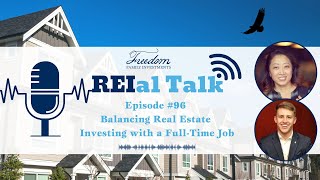
Podcast episode (Freedom Family Investments, EP.96) in which hosts Tina and CJ discuss how to balance real estate investing with a full-time W2 job. They cover time management (calendaring, batching, accepting help, hiring assistants), goal-setting and narrowing a buy box (strategy: long-term rentals, small multifamily, BRRRR-style rehabs), reasons for preferring real estate (control over asset/outcomes), active vs passive roles (strong endorsement of hiring property managers early), practical tools and organization (Rentometer, RentReady, Google Drive, Google Voice, Facebook groups), and handling stress/burnout (celebrate wins, keep the why, self-care). The tone is informal, instructional, and encouraging.
Questions this video answers
Episode 96
Up to 25 rentals
$45,000
$99,000
Rentometer; RentReady; Google Drive (also Google Voice and Facebook groups)
Foreign. Cj, Good to see you. Oh, hey, everybody. You're with Freedom Family Investments podcast. And this is, believe it or not, number 96.
Wow.
Getting up to 100. Let's go.
We're almost there. Today's topic is balancing real estate investing with a full time job. You're here today with CJ and myself, Tina, and we are looking forward to chatting on this subject and hopefully imparting some nuggets for our listeners. All right, let's jump in. We are following Coco's instructions here. How do. Oh, this one's a big one. Are you ready? How do you manage your time, cj? With, with juggling it all.
Yeah.
Yeah.
This is a big, it's a big part.
Right.
I think many people nowadays have some sort of side hustle. You have people, you know, asking for your time in so many, so many ways. So you have to decide how you want to spend it.
Right.
And who you want to spend it with and how you allocate it. But, you know, something that I've really tried to get better about is starting to work out in the mornings.
Right.
Versus in the evenings because I always found myself not doing it. Making an excuse at the end of the day.
Yeah.
But really, you know, for me, for real estate investing, over the course of the last three years, I've, you know, acquired up to 25 rentals. Now a long while having a full time job and helping all these investors, you know, raise money and put their money to work and buy investment properties. But I think it's really just understanding what is the priority of the day, what needs to be accomplished. Right. And making sure you're always getting timely responses out. But I'm by no means perfect.
Right.
What works for me, you calendar it out, you understand, but typically at the beginning of my day or the end of my day, I try to understand what the next day is to come and what those activities are that I need to, like, check off my list.
Right.
And what's the, you know, priority of everything on that list? So that's what kind of works for me. Just trying to calendar it out. And my fiance and I, you know, each month we kind of go through the upcoming month, what's happening on the weekends, you know, what different activities are going on. Just trying to fit it all in. Fit it all in.
It's like a puzzle sometimes.
It is. It's crazy. I mean, right now I'm. I just sold a home. I just went under contract for a home yesterday. And so like, you know, working with title to make sure. They have everything. And all these sell, you know, buyers who wanted to buy this property. It can be really hectic at certain points, but just, you know, working to manage it and document it as much as you can. So you have a paper trail.
Definitely. I think the biggest, biggest thing I've changed recently is just being able to let go of some things that seem so important but really aren't, and also accepting help from other people. But the calendar, that's huge because it helps. I'm very optimistic in general and. And I tend to be. I tend to underestimate how long something's going to take.
Yeah.
I don't make any room for any contingencies or things that pop up. So that's what always kind of derails the plan.
That's what I was going to ask you, Tina, is how. How do you manage your time across, because we have multiple companies here.
Right.
How do you manage your time across all of the businesses and where it's necessary to spend your time and effort?
Well, you hit on it too. You said prioritizing. So that's, that's a real big one for me because I can easily go down a rabbit trail of things and spend time on things that aren't necessarily the highest and best use of that minute, that moment. So having a place where. A trusted spot where I can throw everything and be able to retrieve it, and so it's out of my head and somewhere else, and then putting the most important things on the calendar and scheduling time and then whatever I think as far as how long it's going to take, double, triple it. Because then if it does get done sooner or, you know, I. Optimistic hopes and goals, It'll take only 15 minutes and it takes, it turns out it takes an hour. But if it does take a little bit of time, then I have that room to. To move something else in if I need to, you know, and then you. It's also important to know exactly what you're saying no to so that you have a board to like. And the calendar is kind of your chess board. Right. You can just move things and be strategic, but the key is to know exactly what pieces you're working with. So those blocks of time are very, very, very important. And then there's also all kinds of fun tools that you can play with. And, you know, I'm a. I'm a nerd for the tools and like rescue time and Focus Mate and different things like that that are out there, that are resources for people who want to. Who need a little Help?
Yeah, yeah.
All right. Oh, we, we touched on goals too. So how do you establish your goals as an investor? Like what are your driving criteria?
That's, that's a great question. And I probably am not the best person. I've really just, I understood, I think for me we spoke about this a little bit prior but understanding what your strategy is. So are you going to flip? Are you going to focus on wholesaling, buying turnkey properties, hitting a certain. And then once you identify that high level or syndications. I'm going to invest in syndications or private lending. Then you start narrowing down what is your buy box within that strategy? I think.
Right.
So for me personally, I decided I was going to buy long term rentals where I'm from in Dayton, Ohio because it is a really great cash flow market from there. Right. So that was my strategy, buy long term rentals. And then more specifically I narrowed my buy box.
Right.
I figured I was only going to buy multifamily properties, small multis here in Dayton and I was going to focus on east and south Dayton.
Right.
So there's different pockets as you're aware.
Right.
Some make cash flow better but they may have be in rougher neighborhoods or you know, there's, there's trade offs. So for me I found east Dayton is a great spot, kind of hits that middle point, B minus type neighborhoods. And you know, I've had a lot of success. I bought value add deals there. And so from a specific goal I may not be the best.
Right.
I assess a lot of properties to understand what I'm going what, you know, makes sense to purchase based off of certain cash flow and criteria that I have. But that's kind of how I've gone about it.
Right.
Identifying my strategy and then getting closer into my buy box and then whatever comes through I will take on.
Right.
I try not to say I'm going to buy three properties this year.
Right.
I haven't been that prescriptive.
Well, I'll take it to kind of the more of a broader view why real estate and not other things? And not to say you're not investing in other things, but clearly, you know, real estate is a big chunk of it. Why that area of investment?
Yeah. So out of, out of university I threw a lot of money at stocks, specifically tech stocks. I've done well. But ultimately I like the control that you have with real estate.
Right.
You control what the price you buy at and you have the power to change what you sell at.
Right.
So a lot of the properties and What I've been doing the last couple of years have been what have been like famously termed as burrs. So by, you know, rehab, rented out, refinance, pull your capital back out and then go do it again.
Right.
It's allowed me to scale quickly in that format. But again like why I care about that is because I control that asset. I control the rehab to force the appreciation or force the equity and you know, have significant gains in equity.
Right.
And make money. So for me that was the reason. Real estate, because they're not making more of it. I think you have a lot of control, whereas you may not if you invest it into a stock or you angel invest into a company.
Right.
Hoping that it eventually IPOs, you don't really have a lot of control. And I'm not a control freak. I'm actually really passive with my real estate investing. I, I don't, I. Some of my properties, I haven't even seen the interior of them, but just they met my certain financial metrics and I let my property manager, you know, take it from there.
Got it.
So I said a lot there. I don't know if that, no, the.
Control is what I picked up. Like investments. There's the spectrum of control. How much of it do you have? And real estate is on the higher end. Like you can control, control a lot more factors than these other things that we've mentioned. So and, and that kind of segues right perfectly into the next question which was are you active or are you passive with, you know, how involved are you, Are you hands on with your real estate?
Yeah.
And I think this is like with the overall framework of this session, right. When we're talking about a, a W2 person who has, you know, a day job 9 to 5 and they are busy, maybe they're trying to invest in the same city that they live in or something that they don't. I think it's really important to have professional help.
Right.
So from day one I knew I didn't want to be necessarily a landlord. Right. I wanted to be an investor. So I wanted to focus on the buying and selling and the financials of the properties, but not necessarily the day to day activities because at that time I had a W2 job and it just wasn't going to be where I wanted to focus my time on leasing out properties, dealing with maintenance requests and all of that. And yes, you know, a property manager does take typically around 10% of the revenue that you're collecting, but that's just the cost of business.
Right.
In my My eyes. And I think they also have a lot of, you know, this is what they do for a living. And you know, I remember my first property when I purchased it, I needed to get new appliances like fridges and stuff like that for one of the units. And my property manager knew a place where we could get used but still working and in good condition appliances at a fraction of the cost.
Right.
And this was a lower grade rental at the time. And so it saved me, you know, probably a year's worth of property management expenses to just do that one single thing. And that just reaffirmed, you know, my thought process on using property management. And I think especially for people who are starting out right, on your first property, you don't know what you don't know. Maybe a lot of people go through the mindset, hey, I'm gonna manage my first one or two properties and then I'll get a property manager. And I'd argue, I think you should do the opposite. You should hire a property manager, pay them those couple hundred bucks, a hundred bucks a month to learn their processes, systems, how, you know, their contacts, all those things. And then if you feel confident that you can take it on once the asset is stabilized, then do that.
Right.
And I think that's a very different mindset. But I'm a strong believer in third party management.
Oh yeah, absolutely. And especially if you have limited time, but even if you don't, it still frees up your time to look at the next deal or to, you know, spend time and spend time on other things that you care about, you know, so. And even some people kind of get a little sidetracked with that, that management fee. But there's, as I mentioned, so many other benefits. You know, you're getting appreciation when your property increases in value, you're getting tax benefits, you're getting like all these other kind of not so black and white bottom line type things that you can see every month on your, on your statement. But that is something worth considering as well. And don't get too wrapped up in, you know, the cost of a property manager.
Yeah, yeah.
I mean, unless control is important to you. Because there are like we were talking about your level of control in real estate versus other investments in real estate. You also have levels of control depending on how, how hands on you want to be.
And it's just value of time, I think.
Right.
You got to understand. So if you were buying a single family home that's renting for a thousand dollars a month, let's say in a year's time you're going to pay twelve hundred dollars to your property manager.
Right.
Ten percent of that revenue collected. And I would just argue there's a lot of other ways for you to hopefully spend all the time that would be necessary to manage that property from a maintenance, leasing, just everything that goes around with that, spending that time elsewhere to make that money back.
Right.
And Honestly, for a W2 earner, it's peace of mind.
Right.
I think. And your time should be focused elsewhere.
Right.
On your job. You're, you're there to make the decisions and build long term wealth, not penny pinch. Right at the beginning.
Right.
It's just about getting started.
Yeah. And it's really kind of just a partnership. You're not, you're not just letting them handle everything. I mean they certainly can. But you are part of the decision process, you know, and still involved to a certain degree. So I think it's just some people kind of get nervous like I don't trust or you know, things like that. But you're still involved, you're still part of the process. You're still it. It's still, you can get in as much or as little involvement as you choose. It just depends. Everybody's different. So whatever makes you comfortable. Just remember that. Don't let you know. Of course you want to hear. Take advice from other people, but always listen to your gut too. So don't ever just kind of discount your own sentiment on how to handle things. All right. How do you keep track of trends in the markets and all that fun stuff?
Wow. I'm the best at. Well, you love data, so. Yeah, I do love numbers and data and I, you know, something that's I think great for an investor, whether you're investing in your backyard or out of state. Personally, something that I use a lot is like Rentometer. Right. So when I'm trying to assess properties and understand what can I achieve for rent, you can kind of plug in the address, what is it, a three bed, two bath. And what are the rent comparables for that? Right. So you can get that top level number to drive, you know, does it make financial sense from a purchase perspective? But overall trends like this sounds bad, Tina, but I am, I don't follow all of it.
Right.
Like again, I, I have my strategy that's worked. I have my buy box. Right. And you know, if things cash flow, if I can force appreciation, I'm going to try to keep focusing on that.
Right.
Because it's been working. So again, I think it is important, right. To take an Understanding, right? Oh, our interest rate is going to continue to double in two more years from now. And like, how that may impact, right? You don't want to get caught holding a lot of properties that you're rehabbing and then need to go refinance and you can't make the numbers work. But personally, I think there's something to be said about understanding what you're trying to accomplish and like kind of putting on the blinders and doing what you need to do to keep moving forward.
Right?
Because what I see and I say time and time again is investors listen to all that noise, right? And there's so many people with an opinion and they don't take action, right? They don't go buy that investment turnkey property or they don't make that investment in private lending, and then they're sitting there three years later wishing they would have gotten started back then, right? And I think, you know, this pandemic and coming out of the pandemic is a great, you know, explanation, right? Like, people's payments are double on the property four years ago because of interest rates and appreciation. So, you know, that's my opinion. I'd love to hear what you say because you're probably caring a lot more about it. Managing freedom.
Yeah. So I'm fortunate to be like, my, my day job is in real estate, so it's really easy. I have a lot of accessibility to people who share their knowledge and, you know, I'm more plugged in. Right, but you don't necessarily need to work in real estate full time in order to, to do that. You know, just, I think going back to your advice of listening to people who actually are doing it is key. And just kind of finding those folks who, when they speak, it's. It makes sense and it resonates with you. Like, okay, are they full of hot air or does this, you know, do they really know what they, what they're talking about and finding those people and kind of just using that. You don't have to dig in, you don't have to research, you don't have to look into, you know, different things all the time. Just find those trusted resources. And that would be my advice because you don't have time to be spending time and all that stuff. Just plug into people who know what they're talking about.
Yeah, totally agree, Tina. Like, I just spoke to someone who I hadn't spoken to in a number of years, right? And he'd seen, you know, I post a little bit about what I'm doing with real Estate. And he just said that he talked to his aunt who had sold him his home, right. Who he utilized. And he had been interested in real estate investing these last three years during the pandemic. And you know, she really discouraged it, right. And said, you know, you got to be afraid of interest rates or what if you have vacancy and all these things. And you know, he respected his aunt, of course, and took that advice because she had been in real estate for 20 years as an agent. But I asked and I knew the answer to the question. I said, well, I said how many properties does she own? You know, how many rentals does she own, what you're trying to do? And he said zero.
Right.
So again, taking that advice from people who are doing what you are wanting to do and just learning to take other advice maybe with a little bit of grain of salt.
Right.
Do they have that experience to be giving that opinion that you should be listening to?
Yeah. And it comes from a place of caring. You know, a lot of times family members, they, they really try in their minds looking out for you. But you know, you have to look at, look at all, all points of reference like where, where are they really speaking from? And just whatever your gut says, trust, trust your instinct and whatever resonates with you, I think that is the, the best advice that I would give to somebody. Oh, this is fun. What tools would you recommend in real estate investing? That could be anything that could be from, you know, like you mentioned Rentometer or you know, the calendar, anything, any kind of tools.
Yeah. So I think it comes back. If you're going to self manage, you need to have some sort of property management software.
Right.
Where are you going to collect, Ren? How are you going to do your financials, things like that? Personally, I use Google Drive for a lot of documents, right. So to track my properties like rent and expenses and just hold all of my documents, right. From leases to all my closing statements, things, you know, when you're coming up upon tax time, you need so much documentation. So just being organized in that manner I think is really important. Maybe setting up a separate email account, right. That is designated for your investments I think is a really good strategy to go with. So those are a couple things that I would say from a like tool perspective to just keep in mind, like how you're going to organize it and run it as a business.
Right.
Getting a separate bank account, just making it, setting yourself up for success with just some small decisions can make things so much easier as you like, get going.
Yeah, that's huge. That's huge. Along those lines, I would say, you know, I totally agree with the separate email because you want a spot where everything can be found in regards to these investments.
Right.
And I would. What has really helped me is having a separate Google Voice. So I really, really like that because then because it tracks all the texts on all the history and you lose that on a cell you don't necessarily have, you know, years back I can, I can check years, years back. Like if I need a. Something for insurance or something for somebody's bank information that I'm transferring something to them or whatever, you know, it's like easy to find that and also be able to share it if, if needed, you know, with, with any of the professionals or anything that. Any services that I'm using.
And that's a, that's a big thing what you just said on like you have to be organized for all the accounts. You know, if you're going to handle utilities. Every utility company is different. Every loan is going to have a different sign on and you just have to have a method that you're going to be able to keep yourself organized. So if you need to go grab that account number or whatever it may be, it is accessible to you.
Right.
And people organize themselves differently.
But Google Drive, Google Voice, super big help. Separate email. I've tried a bunch of different kind of platforms to manage since I only since it's a, you know, a smaller portfolio, you know, with six units Rent ready is what I use and I've been really happy with them mainly because they have an app for the residents and I don't have to answer as many questions as I used to. Now I just direct them to rent ready support. Like oh, you have a question. Here you go. Shoot. Yeah, super easy. Happy with them. Google Voice front ready. Oh, and join Facebook groups, local Facebook groups around your. So if you're not close to your properties and they're like in a different state or wherever, join local groups around that property because it's a really good resource to find contractors, vendors, services, you know, to get recommendations from actually people who've used the services.
Yeah, I can't Tina. I. This is my crazy story of the week. I cannot encourage that enough. Multiple of my deals have come off of my Facebook groups here in Dayton that I've joined most recently. I keep almost all the properties that I buy, but I purchased recently property off of Facebook Marketplace. It was coming from a wholesaler who was looking to buy another property from a buyer or from a seller and he just decided to wholesale this very cheaply. It was a duplex for $45,000. And I looked at it. It needed a big rehab, so I was a little afraid of it. I said, let me see if I can just list this on the market. You know, I'm an agent and see what we can do. And I listed it for 85 without touching it. And I got over 10 offers in a weekend, and I'm in contract at 99. So I'll hopefully clear, you know, $40,000 or more from Facebook group. So go join them right now. Go join your Facebook groups. There's money to be made, and if not, it's just good for contractors.
Right.
Like any sort of questions you may have. Have about taxes in the area or whatever it is. There's. It's such a great resource and people are afraid to post. But no, you just do it right. Get your questions answered so you, you know, and you're more confident to take action and decisions.
Yeah. And yeah, there's a lot of opportunity for win. Win in those groups and utilize the search function so that. Because there's plenty. If you have a question guaranteed, there's a lot of people that have already asked that question, too. So save yourself some time in that. In that space as well. So it's a little hot. Oh, okay. Stress and burnout. How do you handle it?
I think this is a good question for those that are having those W2 jobs. Right. So I think something that I struggled with is, you know, had so much going on outside of my W2, and things were going well. Do I just quit the W2? And that's been. That was a big question for me. But the. The stress.
Right.
Sometimes there's just a lot going on. And so I think it is important to understand where you're at, the progress that you've made.
Right.
And that it's going to be all okay. But, like, something that I'm constantly trying to work on is, like, acknowledge the progress and the growth that I've had and you know, also get yourself grief.
Right.
Understand it's not always going to be perfect. Those stressful times will hopefully settle and just like, you know, enjoy the journey as much as you can. Like, I'm kind of bad at that. Like, I just want to get back after it and go, yeah, sold my. I sold my first property yesterday and I was ready to come back to work today and, you know, act like nothing had happened. And it was a big win, you know, is. But my, you know, fiance said, let's go out let's get dinner. Let's celebrate these moments.
Right?
And like, I think enjoying the journey, right, is what I would kind of say to, like, how I try to keep the stress levels low, but it definitely happens when you're juggling multiple things. How. How do you deal with it?
Some days are harder than others, for sure. But what has helped, what's helpful to me is realizing, is remembering, you know, not only celebrating the winds and kind of letting that marinade and set, set, you know, recognize it, enjoy it instead of focusing on all the things that might stress you out, but remembering the. The whole. The overall goal and vision of things and. And why I'm doing what I'm doing. Right. I enjoy real estate because it's just. It touches so many things, and it's. To me, it's a. The biggest lever that I can use to create impact in this life. So you're affecting communities, you're affecting, you know, just even the. The person you hire to go fix your dishwasher. You know, like, it just touches so many things on top of providing a home for somebody, right. That helps me kind of bring me back down to like, okay, I'm doing this for a bigger purpose, and this is why. So it kind of keeps things smaller. It puts the right perspective on it so I don't blow things up and, like, get super stressed out about stuff. And also it helps to celebrate those wins. Keep the why in mind, keep things in perspective and take time for yourself, because if you don't feel guilty about taking time for yourself, because if you're. If you don't bring your best self forward, then how much, how effective are you going to be? So it's not selfish to spend time on yourself and to spend time with. Spend time on things that you enjoy. That's how I. On a perfect day, that's ideal. But just on a more pragmatic level, sleep, you know, hydrate, take care of your health. All that stuff ties into your mental state. So when I'm. When I'm well rested, when I'm, you know, taking care of myself, I can handle a lot more than when I'm not. Because if I'm not, then every little thing turns in. Every anthill is now a mountain.
So, yeah, I think you hit on.
A great point, right?
Is like, spend time and money on yourself. And that's something personally I've struggled with, is that money portion, right? Like, I have really been trying to build and accumulate and, you know, buy more rentals and invest more. And with that typically means Cutting costs. But I think understanding the important things to you, right? Like, and spend lavishly on those things, right. Whether that's working out or food, that's my big one. Like, but you know, and then trying to cut costs and other things, but understanding, right. If you are, we're talking to a busy working person professional in this podcast, right. If you're taking those side hustles or real estate investing, whatever that is, in addition, right. Trying to like allocate some of those profits towards making your life better, right. Whether that's to give you more time, maybe that's hiring a cleaner or you know, someone to wash your car, whatever those, you know, day to day activities are. Mow your lawn. Like that can really benefit, right. From a stress. Like it's just one less thing to take off your plate and it may not be worth your time.
Right.
In, in, you know, the grand scheme of things.
100. I finally pulled the trigger on hiring a, an assistant for myself. And it just personally not, you know, outside of the company or whatever, but. And it is, it's like, so you don't have to hire somebody full time if you don't want to. But let me tell you, they can handle a lot for you. So if you're reaching red line, so do it. Cj. If you haven't, do it.
I know I, I know I need to. I know I need to. So it'll happen.
You know, you want your own. Jody. Come on.
Exactly.
Okay. Any last words as we're kind of wrapping up here? I think we've hit on a lot of good points today.
Yeah, I, you know, if you're here listening to this podcast, I just applaud you.
Right.
You're trying to make yourself better by educating yourself about real estate investing and probably likely have that W2 job, you know, whether you're about to purchase your first property or buy your first REITs or you know, do private lending or take on your first live in Florida flip. Like, I know it can be scary and I just, you know, encourage you to reach out to people who are doing what you're trying to do and taking action along, along whatever your strategy is going to be. Because not everyone's going to be doing what you're. You're trying to set out to do. You're trying to better yourself. So try to find those other people that can hold you accountable and push you to that next level.
Perfect. I love it. That's great. I will echo those same sentiments. If you're listening to this and you're coming at this with the, you know, learning and trying to explore the opportunities that are out there. There's a reason, there's a reason why you're spending your time on this. This is why there's a reason you're investing your time and spending your time with us. So we're happy to to welcome you to the Freedom Family Investments group anytime. If you have questions, reach out. CJ super easy to get a hold of. There's a. He's got a scheduling link on our website. Super easy. Just click that, schedule a time that works for you and we'll get you. We'll get any answer any questions that you might have answered. Well, you've been listening to which. What Was the podcast number? 96 with Freedom Family Investments with CJ and Tina. Thank you for spending your time with us today. We really appreciate all of the support support and our listeners and we will end today with Invest Smart and and Live Happy.
Have a great one, you guys.
Thank you, everybody. See you on the next one. Bye.
Nothing on this show should be considered specific personal or professional advice. Please consult an appropriate tax, legal, real estate, financial or business professional for individualized advice. Opinions and information on this show are not guaranteed. All investment strategies have the potential for profit or loss.
More from Dani











Physicians and High Earners — What Real Estate Can and Can't Do for Your Taxes