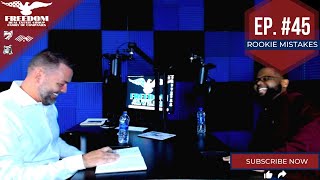
This YouTube vlog (Vlog #45) is an informal conversation between Davis and Matthew Packer about common rookie mistakes in real estate investing. They stress the importance of planning and having a clearly defined exit strategy (rent vs. retail sale), explain how that choice affects acquisition, rehab and budgeting decisions, and share personal anecdotes (e.g., buying at sheriff's auctions without an exit plan, selling a cash-flowing condo because of unwillingness to manage). The hosts offer practical reminders (use Google Maps, communicate you are looking to buy, budget conservatively) and close with a disclaimer to seek professional advice.
Hello, freedom fans. It's vlog number 45. My associate here, Matthew Packer, and I Davis, we're gonna be talking about rookie mistakes in real estate.
Yes, yes. Common mistakes. Happens all the time.
You probably haven't made any rookie mistakes though, right?
Oh, we're not going to talk about that. We're not going to talk about my mistakes.
Some of my rookie mistakes that we're going to talk about is stuff I've done. There you go.
There you go.
So, all right. So poor planning. Just like we started our recording. There you go.
That's, that's probably your number one mistake. Just poor planning and unrealistic expectations, you know, that's the number one mistake. Just got to go in with the clear path of what you want to do and just execute it.
So at lunch today. Yeah. Somebody told me, or maybe no, it was before lunch, I was in a conversation with somebody and they said, I've always wanted to flip properties, you know, because I like to design stuff and oh my goodness, that's just like, there's so many other pieces, right?
Absolutely.
Picking out paint colors. But a lot of people get into it because there's some element of it that they want to do.
Yeah.
Like, oh, I really like to sell. Like, okay, well, you got to produce something to sell first.
Exactly, exactly.
Planning is a big deal. The, I mean, I guess at every stage.
Every stage, absolutely. But so you're not too costly for you definitely make sure you have it all planned out and written down before you do anything.
Yeah, I think that's a good point. You mentioned in our prep, you mentioned having an exit strategy. Right. So exit strategy is one part of it. And then you've got your rehab strategy, then you've got your acquisition strategy. And really, I mean, you. Things can go completely wrong and completely ruin, ruin a deal at any stage.
Absolutely.
Right. You do the buy wrong, you do the rehab wrong, you do the sell wrong. If you're, if you're renting it, you do the management wrong.
Exactly.
Any one of those things could ruin a deal, right?
Yep.
So what's, you know, what are some problems you run into that are like near and dear or familiar hiccups or hang ups or things that scare you a little bit as you're running the acquisition program or seeing our deals kind.
Of live through their life cycle in acquisitions. It's, it's, it's defining that exit strategy mostly. You know, are we going to, you know, make it a turnkey, make it a retail and you know, just coming up with that arv.
Interesting.
After repair value, you know, just to make sure you're, you know, setting that correctly.
That's right.
Helps determine your exit strategy, essentially.
Yeah. And those things are kind of like they're intermixed. Right. So if you're, you're trying to turn this thing over for maximum, you know, if your exit strategy is to sell it retail.
Absolutely.
To a homeowner who's putting their life savings into what's going to be their upgraded house or whatever, you're going to finish that different. You're going to budget differently.
Absolutely.
Right. So, yeah, that exit strategy kind of defines everything right up until. Right up to, you know, what offer you make and how you go about deciding whether or not to buy.
Exactly.
I've done, I've made a, you know, I've got a former. In a former life. I was doing real estate on the side and it was, I was off the cuff. I was just shooting from the hip, like left and right, like I'll buy, buy, you know, so I'd even go like sheriff's auctions and I would determine my, my bid price without ever thinking through do I want to rent this prop, rehab and rent it, or do I want to rehab it and sell retail? I never even really got that far. I thought those were. Those two things were the same.
Not at all. Not at all.
Yeah. Living, you learn. Yeah. So obviously I've gotten into some, some hiccups or whatever during night. So as long as we're talking about how much I suck at this. I tell you what though, man, you learn a lot. Doing things the wrong way.
Absolutely. Unfortunately, and that's why we're here. Try to let you know, don't repeat the mistakes that we did.
Yeah, that's exactly right.
There you go.
That's true. So if you're new to real estate, start with the end in mind. Right.
That's the best way to do it.
To your point, your exit strategy. Do you want to be a landlord? You know what, that's another one we're thinking about all the issues that come up. I. As long as we're airing out my problems.
Sure.
Again, I just, I sold a property not that long ago, a couple years ago, because I didn't want to be a landlord. Yeah, right. Never even occurred to me to hire that out to somebody else and to let somebody do property management for me. And I was cash flowing great on that rental. Nice little condo. I had an HOA and all that stuff. But man, is cash positive. All that could easily afford property management and to think very little about that property.
Just sit back, collect a check.
Yeah. And so I got one big check out. There you go. There you go. But if you don't have the end in mind, that's just another, you know, point. Another case to that point or whatever. If you don't have the end in mind, you're going to make the wrong call.
Exactly.
Right. Yeah. What kind of. You know, it'd be great if we had Steve in this conversation. We have leader because he's pretty good at calling his shots. Oh, he's excellent. What he does.
Yeah. Budgets. Yeah.
Comes in under as often, if not more than going over. Right. So he's pretty darn close to hitting his number just about all the time. And I know he learned those lessons. I'm sure he wasn't. He didn't come out.
Yeah, I'm sure he learned.
Yeah. Maybe in our next slide between now and the podcast, when we prolong this conversation, we need to interview him. Say, hey, what do we need to drag into that conversation? Yeah, the bad, bad valuation estimates. That's a tough one because, you know, when you're using digital tools to say, hey, what would that property be worth? Then you do a drive by and you realize there's a substation across.
Exactly.
Whatever. Exactly.
You don't realize it. Yeah, yeah.
Google Maps, and we were talking about this the other day, is a great tool that people forget to use. Right. And it's right there.
It's right there in your hand. Look at you look at it numerous times a day, I'm sure.
Yeah, yeah. So I'm thinking if I'm a rookie and I'm getting into real estate for the very first time, think about what you want to do. Do you want to manage a rental property or do you want to sell a retail? So then your exit strategy should include how you're going to go about selling it.
Absolutely.
Are you going to have a cost for a real estate agent, etc. Then kind of backward planning or whatever? How are you going to get the rehab done?
Right.
Are you outsourcing that somebody? Who is that somebody? Are you doing all the work yourself? Do you have the skills to do all that work yourself, yourself?
How long it's going to take you? You know?
Yeah, I didn't. I never got good at that when I was a solo operation. Somewhere between four weeks and four months might be this year, six months might be this year, you know, never got good at that. Was with an empty property. Yeah. Like, I just had no idea I was Doing it myself and then whoever I could happen to bring along.
Sure.
And had a. You know, if it was a solo operation, I was doing it all over again. Probably the next time I do it.
Yeah. I'll have all that stuff figure it all out. Absolutely.
That's right. Absolutely. Who do you have on deck? That's a really good point. What resources do you have on hand? That's a big one. And then if you keep backward planning, then it's how you're going to make your acquisition.
Exactly right.
You don't have to give away all of our tricks. But.
Not at all.
I bought stuff at sheriff's auction. Yeah.
Sheriff's auctions are good. And just your own network, you know, six degrees of separation. You know, somebody that's trying to get rid of a property.
That's true.
You know that's true. If not that other person does. So just. Just putting it out there, you know, just letting people know, hey, I'm looking.
That's a really good point. Yeah. Once you start communicating that with people, I mean, you're. My phone's gonna start popping with that or something. Right.
Because now.
Exactly. It knows I'm looking. But that's kind of a. That's kind of a myth. But the. The reality of the conversations you get into in your.
Exactly.
Real. Right. So just doing that. More focus and whatever. Yeah. And then you. When you make an acquisition, you know, you're making an acquisition with this kind of rehab resource on hand, with this kind departure.
Exactly right.
All right. We hit the high points.
We hit the high points.
Let's come back and talk about it a little bit more in depth in a couple days now.
How about that?
All right. Sounds good. All right, guys. Yeah. As always, thank you for joining us. Invest Smart, Live Happy.
Nothing on this show should be considered specific personal or professional advice. Please consult an appropriate tax, legal, real estate, financial or business professional for individualized advice. Opinions and information on this show are not guaranteed. All investment strategies have the potential for profit or loss.