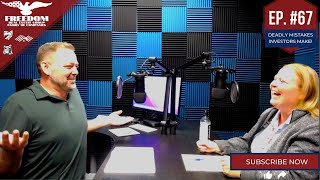
A short informal vlog conversation (Vlog EP. 67) between Aaron Davis (CEO) and Erin (founder & CIO) about common "deadly mistakes" in real estate investing. Erin emphasizes vetting partners (operators, underwriters, cap-raisers), checking track records, setting benchmarks and takeover rights. Aaron highlights mistakes common to solo or first-time investors: over-leveraging (putting last dollar into a deal), lacking cash reserves for repairs (suggested example $5–10k), unclear disposition strategy (rental vs. resale), and emotional decision-making. The episode closes with a referral to a longer podcast conversation (Podcast 51) and a standard disclaimer.
Hi, Freedom fans. I'll clue you in on what she's laughing about in just a second. I'm Aaron Davis. I'm the CEO of the Freedom family of companies, and I'm kind of lucky to be sitting with the founder and chief investment officer. And what she was laughing about is whatever my title is, I'm not the boss.
That's right.
I get to do the boss stuff now. Lucky me.
Yes. Yes. Thank you, Erin.
I still consult you all the time. You're still an expert. So we're talking today about. This is a vlog, number 67, by the way.
Okay, great.
So we're going to talk for a few minutes about that, and then in our podcast later, we'll expand that conversation a little bit more. But we're talking about deadly mistakes in real estate investing.
Okay.
In comparing notes, you had a very different set of deadly mistakes than I did.
Yes.
Right. So I thought that was kind of interesting. So where do you want to start? What's the big thing that comes to mind? The big, hairy, deadly, scariest thing?
I think it's not vetting the people that you're working with. I hear that all the time.
I didn't even think about that. Yeah, yeah. So your mind immediately went to partnerships.
Yes.
Contractors.
Yes.
You know, all the people that are helping to put the deal together and make the investment happen.
Yeah, absolutely. And my mind goes there because of how many times we get on the phone with people who are lending us money and saying, I got burned, and they did not do their homework of who am I investing with? How long have they been in business? What is their track record? And we just flip. And I just did a podcast about even telling them your worst deal. We've literally told people we've lost $40,000 in a house.
Credit scores don't do the trick, do they? You know what I mean? Like, we want to. You gotta see the resume. Right?
Yeah, exactly. So know. Know who it is. Like, I know, like, and trust you because we've been together for a long time, and. Yeah, usually you're investing with somebody you just don't know.
Yeah. Wow, that's a big. That's really different than. So I've. I've done a bunch of flips in real estate investing before. I came to you guys as, like, a solo operator.
Yeah.
Right. So I was swinging a hammer and running a tiny little crew. It was real tight. It was just me more or less pulling the levers.
Right.
And so my head didn't go there. But the other. When you're you're getting into bigger deals and bigger volume of deals.
Yes.
Partnerships are key.
Yeah, I agree. And there's so many different perspectives of investors. Right. Are you a flipper? Are you an active investor, passive investor? Are you working with company? Are you working with a team? Are you all by yourself? Because there's totally different deadly mistakes. So it's very interesting, when you started reading your list, I was like, whoa, those aren't on my list.
That's all turnkey rental property stuff. Yeah, I mean that's my, that's my lane.
Yes.
Makes sense. So where do you spend your world? Like, tell me a little bit more about the, I guess the risks that you run into in partnerships. What are the kind of, the biggest ones?
Okay. The biggest is knowing who you're working with. So we talk a lot about operators and the operators that will go into a deal find the nightmare that it.
Can be sometimes and they hedge for the big risks.
Yes.
And know from experience what they are.
Yes.
Okay, so that's why you want to know.
Yes.
Tell me the one that went the worst.
Yes, exactly. Right.
Because did they learn those lessons?
Yes. And we're always talking about the fact that you want to partner with that person who's got the grit to, who will face those challenges and just see it through as opposed to somebody who didn't mitigate those risks upfront, being prepared for what if, what if, what if. Because they lack the experience. Right.
You know, I've heard of like angel investors who fund these tech startups and stuff. And there's a, there's a, there's a kind of conventional wisdom about never investing in first time entrepreneurs. So there are a lot of like, you know, more elite investors or whatever who will only go with second or third time entrepreneur and not even necessarily successful.
Yes.
But just somebody who's done it before and know what they're getting into.
Yes.
And that's kind of what you're talking about with the real estate investment, right?
Yeah, absolutely.
So the operators are a big kind of partner to vet cap raising. And there's other aspects to the bigger multi property or multi door deals that are important as well, right?
Yeah, absolutely. I think your underwriter, the experience there is critical because a $25 mistake on a 384 unit property is a big swing. And the operator, I think those are the two key. And the cap raiser, you got to.
Think about that because do they really have the connections? Do they really have the speed?
Yes, exactly. Right. And the last thing you want to do is lose your investor's money and ruin your reputation. And when you're relying on somebody else to do it, we've even gotten to the point where we said, okay, we're going to do this with you, but guess what? If you don't meet these benchmarks, we're taking over because we know we have the experience to be able to step in and do it. Makes sense. And if you're not taking those precautions, then you can get in trouble and it's with your investors money.
Yeah. Setting benchmarks in advance is smart. I like that idea. So my list, I mean, I didn't look at our time, but we got this, our short conversation. We'll have more time to get into it. My list was more about. I was thinking more in the context of the little guy. Right. Maybe it's the first time rental property or flipper or whatever, somebody. Oh, I heard about this brrrr method and I, you know, want to jump into real estate. On top of your software development job or whatever your profession is, you're just doing a little tinkering on the side.
Sure. Yeah.
So for that investor, a lot of times the big risks, the deadly mistake is putting your last dollar into the deal.
That's a big one.
Not thinking ahead that like furnaces happen. Right. Or it's going to be the thing you don't think about that surprises you. Right. So have a few bucks set aside and make sure that you're not, you're not stuck with, you know, tenant leaves after 18 months and you got to do a little turn and it costs you a thousand bucks to, you know, pretty up the property and you don't have it.
Yes.
So now you're waiting another month and losing another month's rent or whatever else.
That's right.
That's just like, oh, I gotta sell the stock because it went low. I can't afford this loss. And then you bail at the perfect, the exact worst time.
Yes. Yeah.
So not having a little bit of cash set aside for the, for the dips is I think, one of the deadliest mistakes.
Yeah.
When you're into your first deal.
Yes.
One doesn't mean that you have to have $100,000 set aside, but correct, you know, have five, ten thousand bucks.
Yeah, absolutely.
You can afford to patch a leaky.
Roof or whatever and have the expectations that that will happen. This is an investment property. Right?
That's right.
So don't be bummed out when it happens. It's just part of the deal.
That's exactly right. I've seen. I've seen people get into real estate, too. And I just had a conversation with an investor, and he was a little bit of a side hustler. You know, he has three rental properties. He's talking about buying a fourth to fl.
Sure.
And I was educating him on the whole birthing and whatever. He was already kind of doing it and didn't realize that it was a thing.
Yeah.
Anyway, just some vocabulary. And the. The risk that I ran into there, observed in that conversation was not having a great disposition strategy.
Oh, yes.
Right. So, like, yeah, I'm gonna buy a deal. It looks like kind of a good deal. But you're not. Are you assessing it as a rental? Are you assessing it for how much you can sell it on the mls?
Yes.
And those are two very different things.
Yes.
And the renovation you put into it is very different.
Yes.
So you could. You could lose your hide if you go about it the wrong way because you're just kind of doing a generalist approach.
Yeah.
Property is a good deal, so I'm just going to fix it up.
That's right.
What?
Yes.
So anyway, I thought that was another important one to call out. I've been caught in that trap before. Oh, that looks like a good deal. Halfway into it, you're like, what am I? What's my plan here?
Yeah, right. Exactly right. I have it written on my list not to be emotional. Right. When you're an investor, it's a numbers game and you have to know, what's that? What have the end in mind before you actually make the purchase.
Plan precedes purchase.
Yes, right. Yes, exactly right. You said it better. Don't get emotional.
I think that's a good kind of starting point for the conversation.
Okay.
Let's talk more in the podcast, podcast 51, if you want to hear the rest of this conversation.
Sounds good.
Let's call it a day. For now, we hit the big ones. Right.
Sounds good.
Thank you, Freedom fans, for listening. As always, invest smart and live happy. All right, bye, everybody. Nothing on this show should be considered specific personal or professional advice. Please consult an appropriate tax, legal, real estate, financial or business professional for individualized advice. Opinions and information on this show are not guaranteed. All investment strategies have the potential for profit or loss.