Ep 10 - What is an Accredited Investor and How Do I Become One?
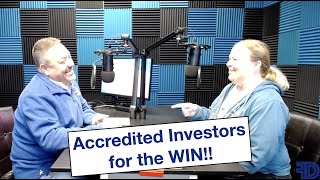
Flip and Danny from Freedom Real Estate Group explain what makes someone an accredited investor and how the SEC rules changed. You need either $200,000 in annual income or $1 million in net worth to qualify for certain private investments.
Hey, everybody. Flip and Danny here, founders of the Freedom Real Estate Group family of companies. And welcome to another episode of our podcast.
And our podcast is called Freedom through Passive Income.
That's right. And today this episode is called what is an accredited investor and how do I become one?
That's right.
Which is a very important question. We get this question.
Yes. Very popular topic.
So real quickly, I'll touch on a couple of things. How to become an accredited investor. Number one, you. You as an individual, you make $200,000 a year, and you've done this for the last two years and you expect to do the same next year. Or if you're married, as a couple, you make $300,000 for the last two years and you expect to make the same this coming year. So that's the first way. The second way is to have at least $1 million in net worth minus your personal residence. So if your personal residence is 500,000, you need to have a net worth of at least $1.5 million. Now, this is either or. You don't have to be both of those to be in a credit investor. It's one or the other. Now, there is. This is very important. And why is this important, Danny?
This is important because accredited investors have the world of investing at their fingertips. They are given the opportunity to invest in absolutely anything that they want to. And that's because the SEC says that if you have had the ability to accumulate this kind of wealth, whether it be the net worth example or the income example, then they say that they feel like you have the knowledge and the experience and you're savvy enough to be able to take risks in other investments. And so because of that definition, they say you are accredited, you get to invest in all of these things. And that's why this is such a.
Popular question right now. Real quickly, everyone knows if you know me, I'm a huge college sports fan. And when she says sec, she means the Security Exchange Commission, not the Southeastern Conference. I just want to make sure that that's clear is why the Southeastern Conference would care that you're an accredited investor. I don't know.
I was wondering how you were going to fit the fun in on this episode.
You're welcome.
All right, so what do we want to get on this one in particular? Because you can. A lot of people talk about accredited investors. And so we want to define it and say why it was important. But we really wanted to go into the amendment that happened on August 26th of 2020, where the SEC amended what the definition of accredited investors were so that more people could potentially have an opportunity to become an accredited investor. And so the first one is you can have a series 7, 65, 60 and 82. Not. Or. And you can have these three licenses.
They're financial licenses.
They are financial licenses, yes. So if you have these three financial licenses, then you are qualified to be an accredited investor and to invest in all of these funds, but without all the net worth. That's right. Exactly right. The second way is you can be a knowledgeable employee of a private fund and you are accredited for that fund in particular. So we have employees that are talking to our investors and handling investor relations and those employees that are talking about those particular funds, whether they have the first two qualifications or not, they are technically accredited and they can invest in these funds if it's an accredited investor only type of fund. Right. So that's another great one. Number three, spousal equivalence. So let's just say you and I aren't married. We are, but let's say we aren't. We're living together, we have a long term relationship. We expect to be together forever. I don't know that that last one even matters. You would be a spousal equivalent.
Oh, so like common law.
So you and I together could pool our resources and funds to qualify for the accredited status. Now I'm sure there's, there's an expansion upon that definition that I don't know because I didn't research it.
I bet there is.
Yeah. So I would recommend anybody who thinks that they might qualify for something like this to start looking into it, maybe talk to an attorney to see if that they would qualify to be an accredited investor under that new amendment. And then the last one, which isn't the only one, but I will mention this last one because there was a fifth one I believe in there that just didn't. It wasn't something that's very, very common. So I didn't want to add it to this podcast. But this last one might be somebody that's listening here. You can have an LLC or you can have a family office that has $5 million in assets. And if you have $5 million in assets and you are an LLC or a family office, then you qualify to be an accredited investor. Now, a family office is somebody who is running wealth management essentially for a wealthy family or wealthy individual. So that's not necessarily as common because that one of the bullet points was The LLC having 5 million and the family office was like two bullet points down. I was Like I'm just going to mention them both because you never know who's listening. So that's another way that you can qualify under this new amendment. So I would encourage you, if any of these things seem like something that you might qualify for, Google August 26, 2020amendment to SEC accredited status. And you're going to find these definitions, look into them and see if you qualify. And so the last thing that I wanted to mention was how do you know if it's a investment that requires only accredited investors? Most of the time you're just going to want to ask. So if you see something advertised, you're going to go, is this for accredited investors only or can I invest as a non accredited investor? But a little tip is that if you see a disclaimer or a little, you know, italicized comment at the bottom of, you know, an advertisement that says this is a 506C in parentheses, then that means that is for accredited investors only.506c means that you can publicly advertise, you can be on Facebook just going, this is a fund. This is what we're investing in. We are raising money. Come invest with us. If you see that it's 506C because anything else for non accredited investors, we're not allowed to advertise. So if you see it on Facebook, it's an automatic 506. So you have to be accredited in order to invest in a 560. So that's just one little trick of the trade to figure out, is this accredited only or does this include non accredited investors?
Nice.
And that's what we're going to get to in our next podcast. We're going to talk about a lot of non accredited investors don't think that they can invest in real estate. And we're going to teach how you can invest in real estate and the different vehicles you can invest in, including syndications. And this is where a lot of people are like, I can invest in syndications. Oh, yes you can. And we're going to teach you how.
Well. Awesome. Well, make sure that we hope that you enjoyed this information, but make sure you join us on our Facebook group, which is right up here, facebook.com forward/groups forward slash.
Freedom through Passive Income.
That's right. And if you're not on Facebook, which we totally get, right down here is our website, which is Freedom Capital investments dot com. But make sure you love like all these videos and make sure you comment. Yeah, please tell us, tell us how we're doing. Ask us any questions. That'll help us. Also, we've only got 300 more videos to do the rest of this year, so. But ask us any questions that you got. We'll make sure that we touch on those as well. But like we like to do for all of our episodes, we always end.
With invest Smart, Live happy.
Bye, everybody.
Bye.
Nothing on the show should be considered specific personal or professional advice. Please consult an appropriate tax, legal, real estate, financial or business professional for individualized advice. Opinions and information on the show are not guaranteed. All investment strategies have the potential for profit or loss.
More from Dani











Physicians and High Earners — What Real Estate Can and Can't Do for Your Taxes