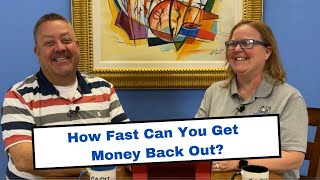
Podcast episode (Freedom through Passive Income) where hosts Flip and Danny discuss liquidity when investing in real estate, explain that most real-estate investments are not liquid because they require a sale, and outline more liquid options the firm offers (liquidity funds and private money lending). They compare timelines, trade-offs between liquidity and returns, and advise matching investment choices to investor time-horizon and goals.
Hey, everybody. Flip and Danny here, founders of the Freedom Real Estate Group family of companies. And welcome to another episode of our podcast, which is called Freedom through Passive Income. That's right. And today's episode is. Is your money liquid when investing in real estate?
That's a great question, Flippy.
Did your money turn to water? Yeah. Didn't get the eye roll.
Yeah, he did get a giggle. That was worth a giggle. So the answer is. It depends. It depends on. Well, I'm going to say generally no. Right. Because if you're investing in real estate, you're typically buying a house, you're buying an apartment complex, you're buying a storage facility, you're just buying land, whatever. And in order to get your money back out, you have to sell.
Sell it.
Yeah. And that takes time. You have to have a buyer for it. You have to be selling it for a good price. And if you're in a down market, that gets a lot more difficult than depending on how much your mortgage is. So not liquid most of the time. However, there are times in which you can be liquid if you're in the right investments. And that's a little bit about what we're talking about.
Right, Right. So it depends on what type of liquidity you are looking for. Is it 30 days? Is it 6 months? Is it 12 months? So it just depends on what type of, like, how fast you just want to throw your money in, I need to get it back in 30 days or whatever. That just. That really tells you what you need to be looking for.
Yeah. And it tells the person that you're talking to more about your goals and what they need to know in order to give you the best feedback on opportunities that may be available that will meet those goals.
Right.
So in our situation, if you're talking to C.J. or Ben and. And you tell them, hey, I want something that's more liquid, they're likely gonna ask you, what do you mean by liquid? They're gonna ask you exactly what Flip just said. The 30 days, 6 months, 12 months. What does liquid mean to you? And so. And from that conversation, they're going to present some opportunities they know about or they feel good about educating you on. So in this case, for us, it might be a liquidity fund or private money lending. Those are the two things that are the most liquid when you're investing with our team, A liquidity fund we're actually going to talk about in another episode, so you're going to want to go to that episode. And hopefully there's probably a Link around here that's saying, hey, click here if you want to watch that episode. But we'll talk to you about what a liquidity fund is. And that particular opportunity is going to allow you to get your money in and out, usually between 30 and 90 days. We're likely structuring ours to do it in 30 days, but sometimes it's 90 days. And we'll tell you more about that in that video. Private money lending is another example. That's something we've been doing for years and what we're most known for. And that type of investment, you're usually out within six to 12 months. We've had private lenders out in two weeks and a lot of times we've had private lenders out in four to six months. If it was a vacant property and the rehab wasn't huge, it was just one of our standard in and out type deals. But sometimes it was a large project, maybe it was tenanted when we bought it and so it took a full 12 months.
Right.
That's why those questions of timeline is important.
Yeah. When it was two weeks, like, yeah.
I just wired you my money, we might have gave him a little bit of a bonus.
Yeah. But typically in these type of funds and these type of things, there's a lower interest rate and that's you. You're going to get a lower interest rate if you want this sort of a benefit.
Yes.
So you need to decide how much capital you want in the liquidity funds or private money lending versus the other opportunities. That may take longer than a year, but you're going to get a. Probably a better interest rate at that for those investments.
Yeah. And you'll know how that matters because we just did an episode about the rule of 72. Right. So if you're at a 6% interest rate, it takes a lot longer to double your money than it does if you're at a 12% interest rate. But it is wise to diversify and put your money into different types of opportunities and use that rule of 72 as a very, you know, general ballpark number of saying, this investment's longer, but I'm going to double my money faster, but I can't get it out. So this investment gave me the benefit of being able to take it out in X amount of time, depending on what the fund offers or the private money lending opportunity offers. Whatever it offers, it's a lower interest rate, but I get to have it at my fingertips. Because that was important to you and your goals.
Right. Well, we hope that this episode was beneficial and informative because it was for me. As always, make sure you're going over to our website, freedomcapitalinvestments.com and join our investor club. Again, there's more information there about many more things there than we are putting in the Facebook group or the LinkedIn group. Those groups are more for you to be interacting with our team and asking questions over there. But make sure you join our investor club so you can get more information about us and the things that we're doing. If you're on YouTube, make sure you hit the subscribe button, but let us know how we're doing, recommendations, requests, whatever it may be. But we always like to end all of our episodes with Invest Smart, Live Happy. Bye everybody. Nothing on this show should be considered specific personal or professional advice. Please consult an appropriate tax, legal, real estate, financial or business professional for individualized advice. Opinions and information on this show are not guaranteed. All investment strategies have the potential for profit or loss, y'. All. Sam.