Ep 16 - Tax Benefits For Passive Real Estate Investors
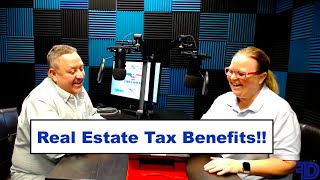
Real estate investors can use depreciation to reduce taxable income, even when the property generates positive cash flow. Cost segregation accelerates these deductions, and a rolling portfolio strategy lets you carry losses forward to offset future gains. Long-term capital gains also get preferential tax treatment.
Questions this video answers
2022
37%
0%, 15%, or 20% (top long-term capital gains rate cited: 20%)
27.5 years
39 years
Hey everybody. Flip and Danny here, founders of the Freedom Real Estate Group family of companies. And welcome to another episode of our.
Podcast, Freedom through Passive Income.
That's right. And today's episode is called Tax Benefits for Passive Real Estate Investors.
That's right. And so quick disclaimer. We're not attorneys, accountants, CPAs, all of us. It is not us. Please consult yours. But we do have all of our notes here and we're ready for this because this is one of those podcasts that I'm like, can we do this in eight minutes or less? And so I said, I promise I'll stick to the script. So tax code, tax code favors real estate investors. IRS loves that we provide housing, provide do the improvements, provide affordable housing for people. So they give us to tons and tons of benefits and incentives in order to write off on our taxes. So we're going to talk about three of them here today. The very first one we're going to talk about is ordinary income versus capital gains. Now, long term capital gains is the number one benefit. So let's talk about ordinary income versus capital gains taxes. So ordinary income right now 2022 is when we're recording this podcast, cap our ordinary income, the top tax bracket is 37% capital gains. You can have short term capital gains and long term capital gains. Do you want to explain that flip? Right.
Well, short term is just simply under a year. Anything you've done and you buy and sell under one year in a short term, anything over that year. Now you're in long term.
That's correct. So if you're in the short term capital gains tax, then you're going to be, if you're in the highest tax bracket, again, 37%. But if you're in the highest tax bracket of a long term capital gain, which is 0, 15 or 20, then you're only at 20. That's a 17% delta between the two. So that's a big, huge savings. So long term capital gains is the number one benefit that we're talking about here today in terms of how to save on taxes. Now long term capital gains are typically things that you're going to have when you have a buy and hold property, when you're investing in syndications, when you're investing in funds. Those are the three most common that we deal with on a regular basis tax benefit. Number two is depreciation. So depreciation is when you're writing off the value of an asset over time. There's two types of depreciation. There is straight line depreciation which we're all very accustomed to. And then there's bonus or accelerated depreciation, which we're going to talk about. Let's talk about straight line first. Straight line appreciation is when you buy a property and you depreciate that asset. It's a single family residence, not conversional. That's important. It's a, you depreciate that property over 27 and a half years. If it's a commercial property, you, you have 39 years. But most people we're talking about, it's 27 and a half. So let's use that as an example. So we talked about two examples for you to be able to provide. What is an example of straight line depreciation? If it's your primary resident.
Right. So a $400,000 property, $330,000 of that is just the land. So the actual building is $370,000. Now, over that 27 and a half years, that allows us to depreciate $13,454.54 each year.
Every single year.
Yes, because it's, that's the 27 years of the 300 of the building.
Without the land.
Yep, without the land.
And you can, you can also include closing costs and improvements right into this number. We just, for simplicity sake, we just didn't do that. Right. Okay, can you give me an example of a rental property?
So like a rental property, say the property is $150,000 again, land $20,000. So the actual building itself, $130,000.
Okay.
Now over that 27 and a half years, now you're at $4,700. Just a little bit over $4,700. But now this is a rental property. So it's giving you cash flow.
Yes.
So say you get $2,400 cash flow in that year. Well, you're depreciating $4,700. That 4727 is the actual number. So on paper loss, you're at $2,327. That is a loss that can be applied towards other income investments.
That's right, yes. So not only did you not have to pay taxes on your $2,400 of annual cash flow, but now you've got this extra paper loss that can carry into another passive investment. So that's huge.
Huge.
I love, love that. So that's an example of straight line depreciation. The second part of the depreciation is the bonus or accelerated depreciation. This is more often done, not always, but on commercial Investments. So it's a cost segregation study. A cost segregation study is an engineering report that provides some details about what you can depreciate faster. Because they say, hey, some things in real estate depreciate faster than others and you can take them immediately. And that's fantastic for all of us who get to, you know, take this deduction as a part of, you know, how we're saving in our taxes. So the losses on the typical cost segregation study is going to allow you to take anywhere between 20 to 30% of a loss. And so as an example, in syndications, a lot of our investors are investing $100,000. So what does that look like?
So that's 20 to $30,000.
Yes. For every $100,000 that they invest. Right. So if they're investing $500,000, it's 20 to 30,000 per. Right. So that adds up quick. So that's, that's really, really fantastic. So those losses can also be carried forward and applied to other passive income investments. And we're going to talk about the power of this and what I'm calling, and I'm probably going to change the name sometimes, but I'm calling it a rolling portfolio.
I like it.
But before we get into that, let's talk about the third benefit, depreciation recapture. And that really the depreciation recapture isn't necessarily a benefit until I get to the rolling portfolio, but it is a benefit because it's less taxes. Right. So depreciation recapture means that the irs, they want some of their money back. You just talked about how much depreciation we are able to take every single year. Right. And then have more losses that we can apply to other passive investments. IRS is going, oh, I want that money back.
Yeah.
So as soon as you sell a property, you're gonna have to decrep, you're gonna have to, they're going to want to recapture the depreciation. So let's just say you had $70,000 of depreciation on a property. When you sell it, if you profited $100,000, that 70,000 that you had already taken as a tax, a benefit and a deduction, they're going to want some of their money back, but they're capping it at 25%. So of that $100,000, 70,000 is going to be, is going to be taxed at a cap of 25%. The other $30,000 is going to be a long term capital gain if you held it for longer than a year. So that could be 0. 15 or 20%. Right. So still, if you're in the 37% top bracket that we've been talking about, no matter what are those scenarios, you're saving money. Now we're going to talk about, I've got to go fast, the rolling portfolio. This is where it all comes together. So, so you buy a profit, an investment property or you invest in a syndication, or you invest in a fund one, one of those things, you're going to be taking some losses, depreciation or accelerated and bonus depreciation, depending on all that, how that goes. When you sell, that's when you have a bigger tax implication. So you're going to be paying capital gains tax, you're going to have that appreciation recapture event happening. But if you invested in another property, well then you had losses from that property. Right. And so as you build and start accruing all of these losses that you're now carrying forward, by the time you sell something and have to have the long term capital gains applied and the depreciation recapture, you're using all those losses and you're, you're using them towards what you are now having to pay. And then you just do it again and, and investment two happens and investment three, it's a wash, rinse, repeat type cycle and it's freaking phenomenal. And my time is almost done, so I'm going to stop here. But I am going to say that this is such an amazing topic. We're probably going to do a series, we're probably going to do some examples on whiteboard or something that's going to give numbers because there's, you can learn all you want but without seeing the numbers and how they all, you know, add up, oh, it's just going to blow you away. So I'm super excited about that, but I promise I'm done for now.
Well, again, we like to try to keep these short and sweet.
Yes.
So again, make sure that you're joining us on our Facebook group. And again, I'll put that link right up top here, facebook.com group freedom through passive Income. And we also have a group on LinkedIn. So if you're not on Facebook and you're on LinkedIn now on LinkedIn, there isn't a cool little link. So you're gonna have to go just, just go to the search bar and.
Search Freedom through Passive Income. Or in the description, if you're on YouTube and not listening in the car, on a podcast, in the YouTube channels, we're putting the links in there for you.
Yep. So just go down there and you can click the links right there.
You can also go to our website.
Which is right down here in the bottom, which is Freedom Capital investments dot com.
Excellent.
So again, make sure you hit the like the love button. Make sure you comment, make sure you let us know how we're doing. Tell us what questions you have. But we always like to end these with invest Smart, Live happy. Bye, everybody.
Nothing in the show should be considered specific personal or professional advice. Please consult an appropriate tax, legal, real estate, financial or business professional for individualized advice. Opinions and information on the show are not guaranteed. All investment strategies have the potential for profit or loss.
Okay, look in there.
It.
More from Dani











Physicians and High Earners — What Real Estate Can and Can't Do for Your Taxes