Ep 170 - Our Journey Episode 2 - Pros & Cons of Being a Realtor
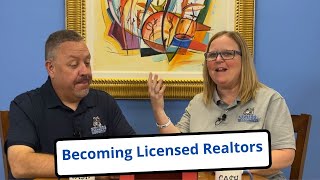
Flip and Danny passed their real estate license in September 2008 and joined Esmeralda's team at Elk Realty Group. They break down the job: flexible schedule and commission potential against difficult clients and the need for an established local network. Real estate professionals can qualify for special tax treatment at 750 hours annually.
Questions this video answers
June 19, 2022
Episode 2 of 12 ("Our Journey: Pros and Cons of Being a Realtor")
They studied in summer 2008 and passed their licenses in September 2008
Esmeralda's Elk Realty Group
Hey, everybody. Flippin Danny here. Founders of the Freedom Real Estate Group, family of companies. Like that.
Yeah.
Okay. Welcome to another episode of our podcast.
And our podcast is called Freedom through Passive Income.
That's right. In this episode. This is part of our 12 part series called the Journey. This is our journey. This is. This is number two. Yes, number two of 12. And the title of this episode in our Journey is Our Journey. Pros and cons of being a Realtor.
Yeah.
Most people start off right.
Yeah, yeah. And we're going to try to keep it as serious as possible for us.
That's right.
So anyway, so real quickly, why we did the realtor thing. So again, I was still doing the art auctions, I was still selling artwork. You were. You had done the New York life and the insurance, and then you went into mortgage industry. But it was a friend of ours that you had met there named Esmeralda. She said she kept putting a bug in your ear saying you should do real estate, you should do real estate. And so. And then I got done with the art stuff and then we're like, hey, you know what? We should do real estate. And what's the first thing you do when you do real estate?
Become a realtor.
Get your Realtor's license. Duh. So we studied that summer. That was the summer of 2008. And then. And then we got our license. And like I said, we both thought we failed the test, but we both passed with flying colors.
Yep.
In September of 2008. And we immediately joined Esmeralda's team.
Yep.
Elk Realty Group.
Yes, that's right. Wow. Good memory.
It's also her initials.
That's what I'm saying. Right. That's true.
But anyway, so we're going to touch a little bit on the pros and the cons of being a realtor.
Yeah. So as a reminder, we're walking through our journey to try and share with you what we've gone through and what we saw as the pros and cons to help those of you who are exploring. Because I would say the number one thing we get when we're asking people, what do you want to do? Is I don't know. And so we're trying to build some paths for people to be able to follow based on what they choose. But to help people choose and to determine what they want to do or what they want to explore, we're sharing these episodes with you. And here's some of the pros of being a realtor.
And these are flippin dandy pros yes.
Flip and Danny, pros, of course, only tell you from our perspective. So first thing for me is real estate education. So when you're getting into real estate for the very first time, part of the reason why people don't know where they want to go or what they want to do or how they want to start is because they lack the education. They don't know how many things that you can do. And it's so many. I was going to say endless. I'm sure there's an end to it, but it feels endless sometimes in terms of the niches and things that you can do in real estate. So getting our Realtor's license for us was a really good way to learn some foundational principles that people know as Realtors. And if you've worked with a Realtor, they're kind of snobby, quite frankly, and they think they know everything because they pass the Realtors, you know, board and license.
But I do know everything.
So this was also a way for us to get on the same level of those Realtors to say, hey, we passed our Realtor's license as well. So, you know, and we're never as smart as everybody else. It's been, you know, in the industry for 10 years, so. So I don't know why it matters, but they're still snobby. So we went ahead and got our license. That was a pro.
Yep, that was definitely a pro. And with that also came MLS access. And now we have access to, you know, this biggest pool of properties, you know, and we were in Austin, Texas, at the time, and so that was a pretty big pool, you know, when we first got the MLS access, you know, and then it was just. It was. I was like a kid in a candy store inside. You know, the first time when I got my login, I was, wow, I was in there all day.
Yes.
What are you doing? I'm still on mls. Anything I'm doing. And so that was the number one thing they gave us. MLS Accents.
Yeah.
And it was a good way to get commissions. Right. So depending on what you're doing in real estate, you really don't know how you're going to get paid. Jumping in as a Realtor was going to give you the foundation of education, but also was going to give us a payday whenever we help somebody buy or sell a house.
Yeah. Because, of course, everyone has the dreams of the, I'm going to make a million dollars being a Realtor. And then you become a realtor and realize, wow, no, I'm not so anyway, but that was a great way. A great way to get things started. And then also because you and I, we worked, especially when we worked on cruise ships, we worked on our own. You know, we didn't have anyone yelling at us. Well, except for when we were in the band stuff, but. But, you know, we didn't have any. We created our own schedules. And, you know, and. And that. That immediately went into our, you know, being realtors is we created our own schedule, we ran our own business. We had our own company. We, you know, we. We set it up that way. And so that was the start of the. That was the pupa, I believe, of the Freedom Real Estate Group way back in 2008, because that's where we started everything. That's, you know, hey, let's start a business. Hey, we should do this. And, hey, let's try. Let's do it this way. And so that's where it all started.
Yeah.
And anybody listening that's got that entrepreneurial spirit. And you really do want to be a little bit more on the active side than the passive side. I think that part's key, because that's absolutely. Us. We wanted to be active and passive. Right. We wanted to build both sides. So as entrepreneurs, we also wanted to feel like it was our own. Right. We didn't want to be working for somebody else. So anything that allowed us to be a part of a group but still be building our own thing was a big deal. So I think that relates to entrepreneur mindsets. Let me see, where are we at? Many avenues to pursue. Not boring. So that's me. I am not. I cannot stand boring. It's one of the reasons why I didn't like mortgage. It was okay in all of the things that I was studying. I Even insurance, to some extent, was boring. Real estate, it's the last thing that will ever be boring to us because we learn new things literally every single day. So for those of you who are like me and don't like boring, well, then you're gonna definitely like real estate. And it. Probably most aspects of it.
And then there's also multiple options when presenting options, because even. Even in the mortgage industry, you know, you look at what they've got, what do they do? What about. All right, here's the loan for you.
Yes.
You know, but with real estate, it's like, okay, we can do this or we can do this, or if you want, we can do this. And lastly, we can do this one or this one.
Yes.
Yeah. You know, so it's. It's multi. It was, it gave us a bigger palette to work with.
Yeah.
It also relates to when you're talking to sellers or buyers. If you're a realtor and an investor, you've got multiple options. So when you're sitting at the table and saying, hey, we can do xxxx, you get to present, I can list it for you, I can, you know, lease it for you. Whereas if you're just an investor, you can't say those two things. You have to partner with somebody else. Right. So I think that that's important. And one thing I didn't put on here is if you are in this active part of real estate and this will apply to many of the things that we're going to be talking about throughout this journey, then you have special, like tax treatment in terms of classifying yourself as a real estate professional because you have, I think it's over 750 hours or something like that. As long as you work in real estate for that length of time. Usually if you're a Realtor, if you're a flipper, or if you're doing a lot of the things that we're going to talk about on your journey, that's one of the pros that I forgot to list on most of those. So again, that's why there's a key, why we're actually recording these in order. We don't always record everything in order. We're doing this one in order because we said we're going to be yapping about it and we're going to forget something and remember on the fly. Yep, exactly. Do you want to start with the cons?
Yeah. So, cons. Well, boy, we got some unrealistic sellers right off the bat, you know, and we learned there's different approaches to talking to sellers. And we learned, you know, what do you feel your house is worth?
Yep.
Because that, that's really going to tell you because if you go, because we just went in there, boom, boom, boom. Here's this, here's this, here's this. This is what your house is worth. Oh, I don't think so. Yeah, I don't know. Jim down the street sold his house for $30,000 more than this.
That's right.
And we're on the same street.
That's right.
Okey dokey.
That's very, very good. On the other side of the coin, we also had demanding buyers. I remember we were at lunch and I can't even remember where we were.
Just. You don't even need to remind me. I remember that yeah. We had just gotten to lunch and we had just sat down, and I.
Think we even had a couple beers.
In hand, and buyers called me up and said, I need to see these two houses. Okay, great. I'll set those up and show you tomorrow. Now we can't see them tomorrow. We need to see them right now.
Yeah.
So you are the one that left, right?
Yep.
Flip literally had to leave lunch and get in the car, and I actually. I don't know if we were with anyone. You had the better memory than me.
Yeah, we were. Their friends were with us.
Okay.
So Flip had to get up and leave and go show properties.
I had to go home and change first.
Oh, yeah.
Yeah. So that was, like, if there was anything to tell us, this is not the right career path for you. That was it.
Oh, yeah. That's why it's burning. You know? Plus, it's emotional versus logical. You know, in real estate investing, it's just logical. Give me the numbers. Yeah, you know, if the numbers work, I'll do it. But, you know, in. In being a realtor, we saw these people being so emotional about everything, you know, and, you know, just even the slightest thing wrong with the inspection, oh, we can't do it now.
I know.
Another thing is direct mail and advertising. So if you're an investor or. Sorry, if you're a realtor, but also an investor and you're doing some direct mail campaigns, perhaps because you want to buy houses in a certain area, but you happen to have your license as well, one of the cons is that you have to disclose that you are licensed. What this means is this is not a con. If you're sitting in front of a seller. If I'm sitting in front of Flip and I'm talking to you about your options, I'm absolutely going to tell you I'm a realtor because it's an advantage to me, quite frankly, that I tell you that I can do both. I can buy your house, I can list your house, I can lease your house, I can do it all. But if you're doing direct mail, those people who have had a bad experience with realtors and are tired of realtors, like, calling them and knocking on their door, they don't like them. The second they see your realtor, they throw your card out. And it doesn't matter that you want to buy their house for cash. So that is one of the cons.
Yep. Last one that we're going to talk about is the. And this is just for Danny and I, because as being realtors, again, we had just come off cruise ships and we were in Austin, Texas. And the only people that we knew in Austin, Texas at the time was my family. My family's not that big and Austin, Texas is. And so we did not have the inner circle. We didn't have all of the friends and family and all of the people that we've known for decades, you know, while we're growing up, you know, and you know, aunts, uncles, brothers, sisters, neighbors, daughters, dog sitter, when, you know, everybody, we didn't have that. And so that was a major con for us as being realtors, which leads us into. Well, I won't say it yet.
Okay. I don't even know where you're going. All right. We said we were gonna end every single of these journey episodes with five things so that we can kind of tell you what we think about them. Cause these are factors that you consider as opposed to. With regard to where you want to start your journey. So risk tolerance. What do you think for a realtor?
Not much risk for. No, no.
Anybody can be a realtor. Really easy time availability for.
Well, for realtors, it's all day.
Yeah, yeah.
You need to have your time. A lot of people do do it part time. They don't also don't have a lot of business. They're usually just got their license so they could help friends and family and that's it. So if you're going to do it full time as a career, you probably.
Need to call them the weekend warriors.
Yes. You need time availability, knowledge.
Oh, you need the knowledge.
Definitely need the knowledge that's part of the license. Absolutely.
Yeah.
I don't like weekend warriors because they really don't have the expertise to do what I want them to do. I want them to be specialized in the areas and where I think that specific property needs that specialization.
Yeah. Because the more you do it, the more you know.
Yes.
Inner circle.
Majorly important.
Yes, Majorly important. Access to capital as a realtor. No, no, I don't think so either.
And so again, that whole inner circle thing that leads us to tomorrow.
Episode.
Number three, we're going to be. Let's be an investor instead.
Yes.
We'll talk about how that happened.
Yes, exactly. So we look forward to seeing you on episode three, where we turn into investors instead.
Yeah, that's right. But so make sure you head on over to our website, Freedom Capital Investments, so you can join our investor club. Make sure you're hitting the subscribe button. The little bell thing that you were talking about yesterday.
I think it goes ding whenever there's a new episode. That's what I hear. I need to practice on our own website.
Yeah, you need to show me what that is. And hit the like button. Hit the like button.
If you like this journey of episodes.
The journey. Anyway. We like to end all of our episodes with Invest Smart, Live, Happy.
Bye, everybody.
Nothing on this show should be considered specific personal or professional advice. Please consult an appropriate tax, legal, real estate, financial or business professional for individualized advice. Opinions and information on this show are not guaranteed. All investment strategies have the potential for profit or loss.
More from Dani











Physicians and High Earners — What Real Estate Can and Can't Do for Your Taxes