Ep 173 - Our Journey Episode 5 - Seller Financing for the Win
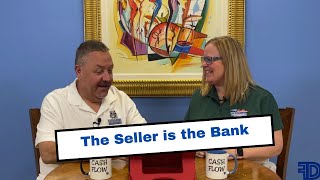
Flip and Danny break down seller financing in real estate, where the property owner acts as the lender instead of a bank. It cuts through bank red tape and works for distressed and non-distressed sellers, but you face legal complexity and the risk of a due-on-sale clause triggering a loan payoff.
Hey, everybody. Flip and Danny here, founders of the Freedom Real Estate Group family of companies. And welcome to another episode of our.
Podcast, which is called Freedom through Passive Income the Journey. That was very quick.
Yes. Welcome to another episode of our podcast. This one is called Our Journey.
You already did that part.
I know, but I had to do it again for dramatic purposes. This one is called seller Financing. Owner financing for the win.
Yes.
So again, this is. We were asked numerous times, like, what our journey was. How would you get from here to point A to point B when there's a whole lot of steps in between. And so this is what the series is now we've talked about, you know, where we started, cruise ships, and then going into. You went into the insurance and then mortgage industry. And then that was when I was getting off ships and we were doing. Getting out of art auctions. And we got into what we wanted to do next, which was real estate.
Yep.
And then how we went from realtors real quickly over to real estate investing, and then our first couple strategies, which was short, short sales, mortgage assignments, sub two. Sub two reps. And then today we're transitioning to the new or the next section, which was seller financing.
Yes.
So, hey, Danny, what is seller financing?
I'm glad you asked, because there's been previous episodes where Flip just kept on telling the story.
I know. I just went and didn't tell you.
Exactly what we were talking about. So seller financing and owner financing are used interchangeably by different people. And it doesn't matter. It's both the same thing. But they will often say that a mortgage assignment or a sub 2 wrap, that those are seller financing, and they really are a form of seller financing because the seller is allowing you to take over their existing lien. So I personally will use the proper terminology of it's a mortgage assignment or it's a sub 2 or whatever it ends up being. I'll use that terminology. But sometimes, again, people are going to confuse that. So when you hear the word seller financing or owner financing, you might want to ask what they mean. Here's what we mean when we say seller financing or owner financing, we. We mean that I'm going to use you again as a seller. Flip actually has a house, and he has equity in the house. So in this example, let's just say you have a house that's valued at $200,000. You have a $40,000 lien mortgage still on it. You're going to sell it to me for $150,000, but you're going to Let me take over the mortgage at that $40,000. And then you're going to sell or finance to me. Let's just say. What were you selling to me? 160.
No, I was selling it to you. I have a $200,000 house selling it to you for 150 plus the mortgage, which is 190.
Oh, no, no, no, no, no. You got it all screwed up.
Oh, geez.
You were giving me a discount. I'm a seller trying to get everything I'm trying.
My house is worth 250.
All right, let's make. Okay, we're gonna start all over. We're gonna make this simple. Your house is valued at $200,000. It needs work. That's why you're selling it to me by letting me take over the mortgage.
But Joe's house down the street didn't stop.
$200,000 house. Let's just say there's a $50,000 underlying lien, and then you're going to sell or finance 100,000. So my total purchase price is $150,000. Why are you doing this? You don't have time to put it on the market. You want people trips and through your house, you don't want your neighbors to know that you didn't take care of it. Whatever it is, your motivation is, you're willing to do this for me. So when we use the word seller financing or owner financing, we're going to say we took over his mortgage of $50,000, subject to the existing lien. Okay, that. But the seller, owner financed or seller financed another hundred thousand dollar note at whatever interest rate, 2%, 4%, whatever it was. And that's a whole different episode, about 10 of them, about how you can structure notes like that.
Oh, yeah.
So we're not gonna go there in this episode, but that's what it means, is Flip took his equity and he decided to create a note and finance it to me. He was my bank. Right. But that $50,000 mortgage, I took that subject to the existing lien. If you don't understand subject to. Watch the previous episode, because we're not going to go through it again. And it really be. You'll understand a lot of this if you start from the beginning of episode one all the way through to here. So that's what seller financing and owner financing is to us. It's taking the equity that you already own and creating a note. But it could be interchangeably used via the other terms.
And seller financing is actually huge in the commercial business.
Oh, yes. Very, very common.
Yeah. Very comm. So our assignments in the commercial business but. Or commercial industry but in the residential it's not as big and there's times where the market doesn't really allow. Just doesn't make sense.
Yeah.
So some of the pros for. Can we move on?
Yeah, yeah, we can move on to the pros.
Wow. We're way ahead.
Thanks for selling your house to me for $150,000.
Absolutely.
Appreciate it. Dude.
Not a problem. I hope you don't mind the 16% interest on that. Some of the creative ways to do deals that most people don't know about, which is so true. A lot of times when we would talk to people like is this legal? And a lot of people that don't know about it going they're doing something illegal.
That's right. It's also a great option for distressed sellers as we've said many times. But it's also an option, great option for non distressed sellers. So as he said this is very common in the commercial industry. Commercial industry. It's very unlikely that you're going to see people in a distressed situation when they're not paying their bills. There's a reason why they can afford big places like that. They like to not get their cash back for tax consequences or anything. They just want to leave their cash in place to be earning interest or to have. Like I said we could structure this million ways. So there's many times in which you could have a non distressed seller that has equity in the property and you can structure a seller owner finance note that is going to make them so much happier than getting all the cash.
Out of that property. Yep. And the next one, this. No banks or red tape. You know when we're talking about the sellers.
Yeah.
Then there's the buyers. You know, what about that guy that makes just a ton of money but he writes everything off and he's got all these tax credits that he can use and so his tax return says he makes nothing.
Yep.
So he can't get a loan either.
Yeah.
But he makes bank.
Yep.
He's got enough money to pay for the property.
Yeah.
This seller financing is perfect for that person.
Yes, it is.
And yeah.
Yep. So that's another pro. Usually great terms. So usually when you're going to structure note between a person and a person. So between Flip and I we're usually going to come to terms. I'm not going to pay him 16% interest. I'm just going to go get myself a loan. But usually sellers of this, you know that are savvy enough to be agreeable to this type of structure are going to be also amenable to like, you know, 2, 4, 6, something very, very reasonable. So that's a good pro.
And the transaction's way easier. You're not dealing with title companies and attorneys and well, sometimes you do still do inspections, but the ease of this transaction is way better.
Yes. And you are going to still go to a title company and attorney. You're still going to close it just like normal. But it's just a lot easier to do because you're not having to go through the bank, you're skipping the bank. It's a win win scenario. So usually in this type of situation, the reason a seller would agree to it is because it truly is a win for them. And not necessarily the least worst option, like we explained in different episodes, but certainly a win depending on how it's structured.
It's an option.
Yes, Yep.
Absolutely. And also you typically not in my situation that I sold you my property.
I'm a good negotiator.
Yeah. For some reason I sold it below. But typically you would get a premium for doing this. So it's usually typically a higher price.
That's right. And we only have one con on this one. And that's if there was an underlying lien, then there might be a due on sale. And so we talked about this for. You can go back to episode. I think it's three and four three. We really describe it. Go back to episode three and you're going to really understand what a due on sale clause means. There are situations where if it's very low, the lien is very low and you have a lot of equity, there's a higher probability of the due on sale being enacted. But there's a lot of work for the bank to go into that scenario.
And.
And again, they're in the business of loans, not homes. So it's very, very unlikely with this.
Like with the example that you use with me, there's two due on sale. Cause there's the due on sale with the bank. Cause I've got a $40,000 mortgage. Right. But then the part that I own, Solar Finance to you has a due on sale with me.
Yeah, yeah. If you are smart enough to put it in there.
Oh, of course I'm smart enough. I just charge you 16%. Of course I'm smart enough. Anyway.
All right, let's go through our five. So what's the risk tolerance on this again?
There's a good risk with this because you got lots of different moving parts.
Yes. Yeah. Whenever you get into the legality of different things, where you're structuring something and there's legal nuances to it, there's risk, time availability.
You need time.
Yeah, yeah, yeah. Time. Time is important because this is a tougher transaction.
You have to find the seller, and then once you find the seller, you need to make sure that you keeping the seller happy while trying to find the buyer. And then while you're doing this, you're also looking for other sellers because you don't want to do one deal at a time. And so you're also looking for another seller while keeping this seller happy while looking for a buyer. And then once you got these two together, then you want to make sure this transaction is going together while you're still looking for other sellers. Yeah. You need time.
The only exception to that rule is if you're the one buying it. So many times we would buy the property and not even send it over to somebody. We just buy it using seller financing. So that's the only exception to his role. But I agree with him for the most part. Time availability is big knowledge.
Yes.
Need a lot of it. Inner circle.
Yep.
Yep. Again, access to capital. Mm. Mm. Not always depends on the seller.
It depends on what you're doing with the seller financing. If you need to put a bunch down.
Yeah. So if I was buying your house.
You might have asked me for 20% down.
You're a tough cookie, man.
I'll do 10% if you go to 18% interest.
We've been doing this too long. All right, so that sums up episode five in a very short manner. Obviously, we can talk and talk and talk, talk about this type of stuff because we did it for a very long time, and there's so many. Oh, no. You. You friend. All right, the next episode is going to be episode six. In this episode, we are going to move.
Yeah. Because we live in. Right now. We're in Texas.
Yes.
And it's not hot enough, so we need to move to somewhere where it's hotter. So we move to Phoenix.
Yes. And in Phoenix, we started wholesaling. So that's what episode six is going to start to dive into.
Yay. All right, well, make sure you head on over to our website, freedomcapitalinvestments.com to join our investor club to see what we're doing today. But make sure you're hitting the like button and you're hitting the like button.
Because this is the coolest series ever.
There we go because it is the coolest series ever. It's kind of fun, but make sure you hit the subscribe button and the bells and the whistles and all those other things that are out there to hit. But we like to end all of our episodes with Invest Smart, Live Happy. Bye bye everybody. Nothing on this show should be considered specific personal or professional advice. Consult an appropriate tax, legal, real estate, financial or business professional for individualized advice. Opinions and information on this show are not guaranteed. All investment strategies have the potential for profit or loss.
More from Dani











Physicians and High Earners — What Real Estate Can and Can't Do for Your Taxes