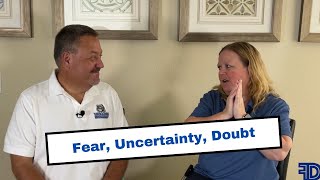
Episode: a YouTube podcast (Freedom through Passive Income) hosted by Flip and Danny of Freedom Real Estate Group. They contrast two investor mindsets—FOMO (Fear of Missing Out) and FUD (Fear, Uncertainty, Doubt)—and warn that FOMO can lead to reckless, under-researched bets while FUD leads to paralysis and missed opportunities. Practical guidance: set aside a small, defined amount you can afford to lose or test with (examples given: $1,000–$5,000 or dipping into a larger IRA in smaller tranches), get educated via their investor club and investor relations team, and consider incremental exposure ("dip your toe"). They note current typical deal minimums (~$50,000) and a planned fund with a ~$1,000 minimum, provide FreedomCapitalInvestments.com as the sign-up, and close with a standard investment disclaimer.
Questions this video answers
August 28, 2022.
Fear, Uncertainty and Doubt.
$50,000 minimum (at manager's discretion).
Approximately $1,000 minimum (planned fund).
FreedomCapitalInvestments.com
Hey, everybody. Flip and Danny here, founders of the Freedom Real Estate Group family of companies, and welcome to another episode of our.
Podcast called Freedom through Passive Income.
That's right. And welcome to another episode now, this one is entitled Investing F Words, Part Deux.
Yes. Yesterday we talked about fomo, which stands.
For fomo, Fear of Missing Out.
You do the joke twice, and I still laugh. How do you get away with that?
I don't know. It's my good looks.
Today's Investing F word is fudd. What does FUD stand for?
Elmer J. Fudd? No, no, no. I own a mansion at a yacht. See if anyone knows that reference. Anyway, no. Fear, uncertainty and deviled eggs. No doubt. Fear, uncertainty and doubt. Yes.
Thank you for the humor. Yeah, so I read an email that was talking about this, and I thought it was just a really incredible play on the F word thing, and I thought, oh, this is kind of a fun. Because it does teach a really good lesson. Yesterday's episode was about fomo, and that's the really aggressive type of style where you're doing no research. You're just. You're just like, they're making a lot of money and millionaires are being made, and I'm gonna stick my money there. And you potentially lose life savings. You know, all of the potential wealth you could have had, you know, spouses, relationships, depending on who you brought in or who you didn't consult before doing something like that. So very, very, very bad. FOMO is not good unless you are somebody who says, hello, spouse. This is something I'd like to invest in. How much do you agree that we can actually throw away, burn whatever, and you're on board, and so you take that little small bucket of money and go throw it in there, and you get to go, I might get something at least. But you're on the same page with whoever it is that you're investing with. But not everybody's married, so, you know, not all of you have to do it if you're single. Well, then just have that discussion with yourself. How much am I okay losing? Okay, because, you know, your shot at glory may turn into something, but you don't want to lose everything in the process, right? So fomo, that's what we talked about yesterday, fud, which is fear, uncertainty, doubt, is the exact opposite. It's like, oh, you're way ultra conservative that you wait so long, you miss the boat entirely, even on safe investments. So when we talk about safe, it's something that we don't say often because investing is risky. Like, you can buy a house, and then the market could fall out, and you're stuck with that house that doesn't have a lot of value for a couple of years, and you got to wait for the cycle. That's why I like real estate, because even if the bottom falls out, you still have an asset that you can rent out and get cash flow until the market comes back up and you can sell it. It's really like, the only time I tell people, don't get yourself in real estate is when you need the money. It has to be liquid, because if the bottom falls out, well, you're not going to want to pull out a quarter of your money when you're at the bottom of a market, right? So. So if you need liquidity, you should be in some type of other investment. But otherwise real estate's pretty safe, as I would call it, because you can just wait it out. But there's people that will even just have that fear of an alternative investment that they're uneducated about, and they'll sit and wait and they'll sit on their hands and go, oh, eventually I'll learn about it, or I'm going to keep listening to these podcasts and eventually I'll invest in it and. And eventually turns into years later where other people have made mucha mucha money and have built up their passive income and you're still sitting on your hands because you had fear, uncertainty, and doubt.
I'm just not sure. I just don't know.
Yes. Yeah. And we know those people, right? We've had conversations with people where they're like, okay, I'm gonna ask all these questions. Okay, I'm gonna think about it. And then, like, six months later, I heard you on another podcast. I wanted to ask you some more questions. Okay, I'm gonna think about it. Then six months later, 12 months later, I heard you are. One of our investor relations team members goes, I talked to this guy and was like, well, he's in the FUD category. I don't know if he's ever going to do anything. So you don't want to be in that category either. You don't want to be so super aggressive, but you also don't want to be so conservative that you're left in a state of inaction, because inaction doesn't get you anywhere. You have to overcome both in some way. So we. We told you how we suggested overcoming fomo, and that is setting aside a certain amount of money that you're okay with and that your spouse is okay. With if you have a spouse.
Right.
For overcoming fud, my opinion, and maybe you can drop your words of wisdom in here too, is to again, set aside of money. So if you're afraid, go, okay, I'm going to not be afraid of putting $1,000 or $5,000 or if I've got 300,000 dol ira, I'm not gonna be afraid to dip in $50,000 of that. Right. It's not all of it. So I'm gonna leave 250 in my FUD category. I'm scared to move that. That money even though it's in the stock market and losing money, or it could be gaining money. If you're invested in some of the things that you have told me recently, I'm making money on. But anyways, it's big ups and downs if you want to leave your money. But Maybe you say 50,000, I'm okay with that. I'm gonna put it here and you test it out. That's my way of overcoming fud, is again, taking the discipline to say, I'm going to take this small chunk and I'm just going to take my one step forward out of inaction into action so that I can experience it and see how it feels. That's how I do it. What would you do?
Yeah, you actually used. The word that I was going to use is dip your toe in the water. You know, you dip your toe in the water to see if the water is cold. Right. You know, just dip your toe in the water. Start off with a thousand, five thousand or whatever, you know, start off with the smaller amount to see if it's something that you're comfortable with. To see if it's something. Not only does it. Is it a good investment, but are you comfortable with it?
Yes.
You know, are you able to sleep at night?
Yes.
You know, and there's. There's been people that, that have invested with us and they just said, I just need my money back now, you know, because they couldn't do it.
Yeah.
You know, and that's fine. We're not going to tell you that you have to keep your money with us or you have to invest with us. No, that's not what we're. That's not what we're doing at all. You have to be comfortable with the process. You have to be comfortable with your children, your children monies leaving you and going off to make more money.
Yes.
You know, and so it's. I don't know, it's a mindset, you know, and you Just. But start little. Like the big green elephant. How to overcome overwhelm is same thing. Start off little. Do a little bit at a time. I mean, I just. I think it's funny that I even have money in the stock market, because I never, ever thought I would ever do that. And I started off with just something that you and I talked about. Can I burn this money? Because I'm gonna burn it doing this.
Yeah.
And actually this money's not burning. This money is actually doing well. But the crypto money is burning well enough for both of them, you know, so it's. But it's still. It's. It's. I never thought I would ever do that. Right. You know, but it's just trying it. Dipping your toe in the water, you know, we're not putting our life savings into crypto or stock. Because you would never let me do that.
No, I would not.
But again, it's just testing it and going a little bit at a time.
Yeah. And getting educated in the process. So that's really what our call to action was yesterday. It's our call to action after every single podcast open episode, is to really tell you, hey, join our investor club. Because that's where you. You learn things and you see things that we don't share publicly because some of the stuff we can't share publicly, depending on the nature of the investment and how it's been filed with the sec. But it's also where you get your questions answered. You just get on the phone with our investor relations team and ask them every question under the book. And honestly, if you're in the FUD category, you probably have already done that. If not, you're seriously in the FUD category, because most people at least get their questions answered. But that is the first step. Get your questions answered, get educated, get comfortable with the investment, and then take a very small step, whatever that small step means to you, depending on that bucket of money. Right now, most of our investments, I think, are a $50,000 minimum at the discretion of the manager. We can do less. We don't typically do that, but we can. We are creating a fund where I think the minimum is literally going to be $1,000. It's based on this concept of, hey, there's a lot of people out there that are in the FUD category. They're too busy to learn to get educated, to ask the questions. And they want to. They're like, I really feel like I can trust you. I just. I'm scared. And so we're creating an opportunity to go, hey, let's just walk you step by step, just a little bit at a time. And as you get comfortable and as you get educated, then we can help change your life through what we're building ourselves. So you not only get to watch us do it, you get to be a part of it, because we're allowing you to enter it, enter into it in a way that's comfortable for you, and that's really what we're all about. So join that investor club. It's really, really important to avoid both FOMO and fud, two very bad investor words.
That's right. And where do you go to join that Investor Club, Danny?
FreedomCapitalInvestments.com that's right.
And also, where else are we?
We're on Facebook and LinkedIn and a whole bunch of other social media platforms like TikTok and Instagram and I don't.
Know what else, and Snapchat, MySpace. Anyway, we like to end all of our episodes with Invest Smart, Live Happy. Bye, everybody. Nothing on the show should be considered specific personal or professional advice. Please consult an appropriate tax, legal, real estate, financial or business professional for individualized advice. Opinions and information on the show are not guaranteed. All investment strategies have the potential for profit and loss.