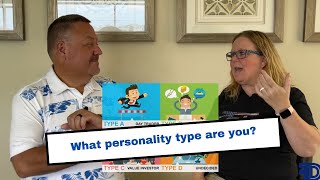
Flip Robinson and Danny introduce a six-part series on how investor personality types shape returns. They'll cover four personality types (A, B, C, D), explain that most people mix traits from different types, and end with the hosts revealing their own profiles.
Hey, everybody. Flip and Danny here, founders of the Freedom Real estate group family of companies. And welcome to another episode of our.
Podcast, which is called Freedom through passive Income.
Thank you. My mouth was not moving as fast as my brain was and I couldn't get the words all out. So I figured if I just slowed everything down, everything would come out fine.
And if he puts the blooper at the end of this episode, you'll know why. We just slowed things down a little bit for the intro.
Felt like that. Commercial Liberty Bibbidi. Anyway, welcome to another episode. This episode is entitled how your personality dictates your returns. And now this is our series introduction. This is going to be a six part series. This is part of part un.
Yes, one. Yes. Uno.
Uno.
Uno.
Yeah. And so this is the introduction and this talks about. Well, we're just gonna kind of give the overlay of what we're going to go into over the next five.
Yes.
Four. And then a finale.
Yes.
But it's very interesting because, you know, in yesterday's. Because I think we're doing these in order. Yesterday's episode, we talked about, you know, when I was, you know, I don't know, this was probably 30 years ago or whatever, you know, and no, it was only 20 years ago anyway where I actually had a 401K, you know, and they said, okay, here's your 401K and company's gonna match this about whatever. And, you know, how do you want your investment? You know, And I made a joke. It's kind of like salsa doing a mild, medium or hot? And I just said mild. You know, I didn't want to go into it and you know, but it's personal, you know, and everybody talks about it, you know, it's their own person. And so. And it's personal finances, which is why it's called personal finances.
Yes.
You know, you're different than I am. Even now we're still different.
Yes.
You like to save money, I like to spend money. But before we go too much further, though, I do want to give credit, though, to Total Balance blog. This is where you saw the article and you were like, oh, we need to do this and we need to talk about this.
It's something that you and I study a lot. We talk about it a lot. We did a episode on the Culture Index quite a while ago. I think it was like in the first set of 100 episodes or something. We did.
That was forever.
It wasn't even the Culture Index. It was. That's the other personality profile. It Was, think of it, think of it.
It's on the tip of my tongue.
He's gonna remember it while we're going through this episode. But it's what we bought for our company to take these assessments so that we could. In our. We showed in that episode, you can see Flip Robinson and then like the graph of his and the same thing with mine. So it's something that we've studied for a very long time because it's important to us about how we think and how does that applied our decision making ability and what's our personality types in terms of being aggressive or being independent or needing a collaborative environment, things like that. That was really important to the workplace, but it applies to investing as well.
Yeah.
So the more we study this, the more we learn. And I read this article and I thought, gosh, we do talk about this a lot already. This is something that we even should talk about when it comes to yesterday's episode, depending on where this plays out. But the top 1%, how the top 1% invest differently than the middle class. And so it was something that we were talking about in terms of investing to your personality type. And I thought, what a great opportunity to continue to dive into this personality type thing so that people can continue to learn about themselves. And in this series, what we're gonna do is we're literally gonna take four personality types and we're gonna read them to you so that you can say I am very much like a, or I'm a little bit like a. And you can say 10% or whatever it is. But in the end, when we put it all together in episode six, that's where you can kind of say, now I understand exactly where I fit in my investor personality profile. And you maybe hopefully get a little bit more comfortable about where you're choosing to put your money because you understand yourself a little bit better. That's the goal of these episodes. So I'm going to just give you a quick preview. There are going to be four personality types that we go over. The first two personality types A and B, was originally discovered in the 1950s by cardiologists Meyer Friedman and Ray Rosenman. I thought that was interesting, so I wanted to share that and then just a quick preview. So with the advances in the field of psychology and the deeper understanding of the psyche of man, psychologists have come up with the type of A, B, C and D personalities. People from every walk of life, based on the behavior and personality traits that they exhibit, can be grouped under one of those types. However, rarely do we find a personality type that solely exhibits the traits of one type of personality? Usually an individual is classified under a type that he predominantly exhibits traits of, but there are several other traits that he exhibits as well as depending on the situation. So that's what we mean by. As you listen to these episodes, you're going to hear personality type A and then B, then C, then D and you're very likely going to have a mix of them. Flip and I are going to do it with you. So in the Putting it all together episode, he's going to tell you what his percentages are. I'm going to tell you what my percentages are and how they relate to each of us in our investing profiles. And again, we hope it helps you kind of put together a full circle game plan in your head about what you are probably most comfortable with so that you can take better action steps going forward. Because the more I know myself, the more confident I am in taking action.
Right. And I don't want you to get confused either. This is, you know, it's not to be confused with like the A personality, you know, like when you get a worker that's an A team, you know.
Oh, oh yeah, you're a player.
Yeah, you're a player. You know, this is, I don't want any confusion there. It's different. This is strictly just for investing these types.
Yeah, yeah. And it's strictly a study that was done by somebody else and written by somebody else. I will say I've read this, of course, before we're recording this. And type A, it does kind of tend to lean towards that type A profile of the type of a player that you want to have. But it's two different conversations, two different personality types. I think that's what you're getting. Don't get too confused. This is a separate article. We're just, you know, having fun and trying to help everybody understand themselves a little bit better.
And it's funny, as you were going over it, I'm just like, well, there was a period in my life when I was type B and then there was a part when I was type C and then there was a part when I was type D. Now I'm type no.
It is the stage of your life matters.
Yep.
Right. Because yeah, I would say I was a much different type of investor a long time ago and I've gradually gotten so comfortable in my skin and my knowledge that. That I'm a totally different investor now.
Yep. That's awesome. Well, we hope you enjoyed this episode. We've got five more of this series. I look forward to this series, but make sure you're heading on over to our website, freedomcapitalinvestments.com to join our investor club. Make sure you're checking us out on all the social medias and all that as well. But we like to end all of our episodes with Invest Smart, Live Happy. Bye everybody. Hey everybody. Flip and Danny here, founders of the Freedom.
I'm ready.
I'm ready. Whatever. Nothing on the show should be considered specific personal or professional advice. Please consult an appropriate tax, legal, real estate, financial or business professional for individualized advice. Opinions and information on the show are not guaranteed. All investment strategies have the potential for profit and loss.