Ep 291 - Dave Ramsey - The Long Road vs Short Road To Financial Freedom
Flip and Danny compare Dave Ramsey's budget-and-save method to a faster wealth-building approach using four tactics: multiple income streams, tax reduction through syndications, cutting underperforming investments, and paying down high-interest debt first.
Hey, everybody. Flip and Danny here, founders of the Freedom Real Estate Group family of companies. And welcome to another episode of our.
Podcast, which is called Freedom through Passive Income.
That's right. And welcome to another episode. This episode is called Dave Ramsey the Long Road versus Short Road to Financial Freedom.
Yeah, I'm excited about this episode because we don't really create a lot of controversy. So people. Yeah, I think people are going to go, they're talking about Dave Ramsey.
Yeah.
What's this about? So we're not like, we're still not creating controversy. I'm not saying Dave Ramsey's bad. I'm just saying that there's a different point of view than what Dave Ramsey teaches. So if you follow Dave Ramsey, you know that he talks about creating a budget. He talks about living below your means. And ultimately the road to financial freedom for him and how he educates people is saving money for 30 years of your life by living below your means. Make more than you spend and therefore you can use the rest. Save it, and in 30 years, you get to retire. That is not foolproof by any means. And it's in my opinion and Flip's opinion that that's the very long road to getting where you want to go. So we want to provide our opinion on what we think or what we're doing and what we think you should open your minds to in order to be on the short road to financial freedom. So the road that isn't meant to restrict what you have in life means scarcity to me. So when you're trying to live on a budget and. And you're trying to save your way to 30 years from now, I feel like you're restricted. You have no room to move. How do you enjoy life? I only have this much per month. And as, like, look at inflation right now.
Yeah.
Like, is your pay going up? You know, how does that. I don't. I can't even wrap my head around how that works and how people live like that because it's just limiting. As opposed to how many ways can we make more money? Right, right, right. Because those are the things that you could be saying instead of, I'm stuck in this box and I have to save to retirement and old age, you could be doing other things that allow you to grow. And that's what we're going to talk about. So while reducing expenses is always a good exercise, you can do a whole lot more. And I've written down four things, Flippy. What's the first one?
Four things. First thing is expand your means. Create more revenue streams.
That's right, it does rhyme. I didn't even think about that. There's lots of things that you can do depending on who you are to add more value and serve more people. So for us, one of the things that we're doing is now business number seven is going to be like a hard money lender type of business. And why? Because we have an abundance of money, more than we can use. So we are going to underwrite other people's deals and use the funds that are sitting there that we're paying interest on anyway and allow other people to get more deals done. And we're going to earn interest and we're going to be able to pay our investors and we're gonna be able to take on more investors and help people like you the more we continue to grow while we're helping the other flippers who are doing deals. And so this is one of the ideas that we said, hey, we're doing this anyway. We've got $300,000 sitting over here and we're paying interest on it anyway. Well, I know that guy and I know that deal. That's a really good deal. Let's just loan it to him for 90 days. And so we've done that with money of ours and we've done it successfully. That we said this needs to be another business. Look at how many people win. So that's one. You could be in any profession. There is a way for you to expand what you're doing now and earn more money. And if you can't open up your mind to that, then reach out to us because we can help you open up your mind to lots of stuff.
For those of you keeping score at home, she has now stopped referring it to as starting the seventh business. The business has been started.
Yeah, it has. We've done plenty of private money loans at this point in time.
It's done that business has established itself.
Right, but what else can you do? You can, number two, learn how to.
Reduce your tax burden.
That's right. We talk about all that, that all the time. Tax free wealth through the syndications and funds. We are helping people reduce their tax burden. So you can essentially save more money by not having to pay taxes on it. It's legal, it's written into the tax code. They tell you to do it, so why not do it? You just have to learn how.
Number three is cash out investments that have high fees or are underperforming.
Yes. If you've got your money in mutual fund, for example, many Times the return you're getting is poor, and then the fees that you have on top of it, it's just eating away most of your returns. If you've got something like that, move your money. A lot of our investments, in fact, most have zero fees. In fact, I think they all have zero fees. I can't think of a fee right now at all in any of our investments. Meaning you're getting a straight return, nothing else. So if we say 12%, guess what, you get 12%. Even on our private money lending loans, if our private lenders have to pay a $25 fee to the bank or to the. Yeah, to the bank for wiring the money, we reimburse them, like no fees. So get your money out of things that are high fees that are costing you money in the long run, because you're not getting the return you should. Or if it's an asset that's underperforming, sell it, cash it out. Do whatever you got to do. Put it somewhere where you're going to actually be able to put your money at work. Get those soldiers out there. Bring more soldiers back.
That's right.
Bring back prison number four.
When reducing debt, tackle the high interest first.
Yes. This is something we talk about when we're talking about freedom numbers. So Dave Ramsey's ideas about budgets and living below your means, they're sound, especially if you have a lot of debt and you're at this very, very starting point of your financial journey. One of our exercises was listing out all of our credit cards, and as we were paying them off, Flip chose the one with the highest interest rate, paid it off, and then we knocked down the next one and the next one and the next one. Same thing that you're going to want to do. These are ways that you are able to put more money and keep more money within yourself as opposed to giving it to somebody else for absolutely no reason at all.
That's right.
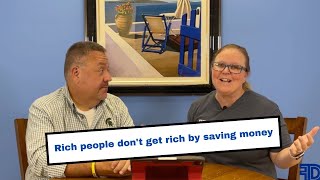
And then this is something that I read that I love. And so we're going to shout it from the rooftops. Rich people don't get rich by saving money.
That's right.
And that's the only thing I think I really have against what Dave Ramsey's teaching, is that he's teaching sound advice. And it's probably for the majority of the country, right? But for those of you who are listening to something like this, it's not you, right? You are somebody who is opening up your mind and trying to grow and preserve your wealth. And in order to do that, you need to be doing the other four things that we've talked about here. So can you achieve financial freedom with Dave Ramsey way? Of course you can.
Sure can.
But it's gonna be very slow. Slow. So do you want to walk to Florida or do you want to fly to Florida?
I've driven it a few times and I prefer flying.
Okay, that's the perfect example then. Right. We're just trying to compare it very easily. So if you really want to build wealth, you need to get out of the slow lane by jumping on a call with our team. We are going to. We are just now launching a roadmap. It's going to be like a custom blueprint of sorts that tells you this is where you are and this is where you want to be. And we're going to start developing that roadmap for you so that you don't have to try and figure out how to get there yourself. So if you are somebody that says, I'm here making $2,000 a month in passive income, or I'm making zero, but I want to make $10,000 a month in passive income, we're going to ask you specific questions so that we can take you from point A to point B. And so that' something that we're now developing. We're very, very excited about it. So if you want to learn more, schedule a call with our team, Ben and CJ or just send us an email and say, hey, I want to learn more about this blueprint, this roadmap that you guys are creating, and we will get you started because again, we're at the beginning stages. I always tell you guys things way too early. It's like it's not finished product, but let's just talk about it and let's get everybody going because it's just fun. And I'd love to get you started even as we're building it. And you'll be one of the first people to do it. So I'm excited. I want you guys to enjoy the journey of freedom through passive income. That's why we're here.
That's right. That's right. Well, we hope that you enjoyed this episode. Make sure you're heading on over to that website, freedomcapitalinvestments.com to join the investor club. Reach out to CJ and Ben. Get that first strategy session. Make sure you get that phone call in with them. Make sure you're talking to them. We do have a lot of stuff going on right now, so make sure you're checking that out. Make sure you're checking us out on Facebook, LinkedIn, YouTube's, Instagrammers, TikTokers, whatever else there is out there, we're on it. I'm sure. But we like to end all of our episodes with Invest Smart, Live Happy. Bye everybody. Nothing on this show should be considered specific personal or professional advice. Please consult an appropriate tax, legal, real estate, financial or business professional for individualized advice. Opinions and information on the show are not guaranteed. All investment strategies have the potential for profit and loss.
More from Dani











Physicians and High Earners — What Real Estate Can and Can't Do for Your Taxes