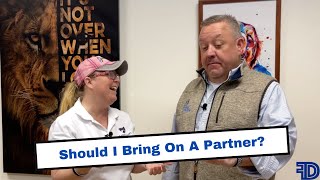
A conversational YouTube podcast episode (Freedom through Passive Income) hosted by Flip and Danielle Robison that teaches how to avoid bad business partnerships in real estate. They summarize four core tips from their experience: 1) build the relationship first ("dating period"), 2) avoid creating a general partnership immediately — instead test collaboration deal-by-deal, 3) explicitly define expectations, roles and profit splits for each deal, and 4) include a breakup agreement in the operating documents. The episode closes with CTAs (social, investor club) and a standard investment disclaimer.
Hey, everybody. Flip and Danny here, founders of the Freedom Real Estate Group family of companies. And welcome to another episode of our.
Podcast called Freedom through Passive Income.
That's right. And this episode is called how to Avoid a Bad Partnership.
Yes.
And I think everyone. If you've ever had a partnership, I'm sure you've had a bad one.
Yes.
I think they outnumber the good ones by a lot.
Yes.
So we wanted to talk about this. We actually get asked about this quite a bit. We went through a number of partnerships ourselves. So typically the question is, should I partner or do it by myself? That's a question that, you know, whenever you want to do something, that's the first question. Oh, should I do this one by myself or should I partner with somebody? And so many people are too busy to do it by themselves, so that's why they partner. Many don't have the knowledge or strengths. So, like, for example, multifamily. Some of the things that we're doing with our partner, what he does, he's. That's his superpower.
Yes.
I don't even want to. Nope. Nope. And another thing, too, is you'll go farther and faster with partners. And power of numbers.
Yes.
And so that's typically the first question, and the first, you know, what is going through people's minds going, should I bring on a partner?
Yes. And so we decided to do this episode for you because this is a common discussion. We're asked about it a lot. And quite frankly, one of my team members now is developing a partnership, and he's just asking for tips about what he should do, how it should be structured, how to avoid the pitfalls. And I thought, this is something that we went through when we were beginning to, because we brought on a lot of partners as we were growing, and it was at the very, very bottom. We knew it was going to be a lot of work, and it was going to take a lot of years to get where we wanted to be. And unfortunately, not everybody has those same expectations. And partnership after partnership after partnership fell through. And so we learned a lot of lessons. Now, I would say we're at a stage where we do own our companies 100% between Flip and I. But there's been some people that we are going to bring into those companies in a strategic manner because we've been working with them so long, and that's going to be one of the tips that we're going to talk about.
All right, everybody, if you're watching on LinkedIn or Facebook or YouTube, this is your Chance right now. I know you see the like button right here and you see the heart button right there. This is your chance in the video to customize these buttons. Make sure you hit that heart button. Make sure you hit that like button if you like what you're seeing and if you enjoy what you're watching. But this is your chance right now at ulxmash.
And just remember, this is how we show social media algorithms that you like what we're sharing. So if we're adding any kind of value over this 365 day series, we hope you'll help us out by sharing the love.
Yeah. So again, Hulk smash.
But we're also doing some other partnerships in a lot of them right now. And through all the lessons that we've learned, it's very strategic. And so that's why we thought this episode would be good for you to hear.
Yeah.
So here's four things that we wrote down on how to avoid a bad partnership.
Dun, dun, dun.
Based on our mistakes that we've had in our past. So number one, build the relationship first. So you want to take some time to watch them. And I say that because if you don't know somebody, you don't. You don't know yet if they're trustworthy. You don't know yet if they're reliable. You don't know yet if. When the going gets tough, if they're gonna keep on going or back out and run across the street.
This is what I call the dating period.
Yes. So that's very, very important. You need to understand their character in general before you decide to partner with them. So take time, build a relationship, and then choose the people that you think carry the same values with you and can carry through a long term relationship and be reliable in that. I will say one of the people. Well, all of the partners that we have now, we have known them for a while and we know their reputation, we know their history. We've seen them through situations of thick and thin and where maybe we don't know everything. We do this number two thing, and that's avoiding a general partnership and doing it deal by deal.
Yeah. Onesies.
Yes. So general partnership would be flexible. Lip and I creating a company together. Right. And so we're going to build. I've got my cash for Ohio houses shirt on today. And you have Bulldog Renovations. So we've got two companies and we're going to decide. We don't know each other that well. I mean, kind of well, because we did build a relationship, but we're going to decide to build these LLCs together.
Right.
That's bad way to start. What you should do instead is do a deal by deal. So, hey, let's do renovations on this particular project. Let's see how it works. Let's see how we work together. Let's get paid mutually on the profit. Let's go find houses together and cash for Ohio houses. Wholesale it or buy it and flip it, whatever, on a deal by deal basis and see how we work together and where the strengths and weaknesses lie and see if we like it. So avoid the general right off the bat and do things deal by deal instead. So that if one deal goes wrong and you guys had bad expectations, you can either not move forward on another one, or you can address it, fix it, and be more strategic about the next one. And then number three is just define expectations.
That's key.
Yes. Perfect example is one of our multifamily partners, Ken. So we decided what we wanted to do, he decided what he wanted to do. And a lot of it was based on our strengths. And so somebody can do acquisitions, somebody can do underwriting, somebody can do asset management, somebody can do capital raising. And it doesn't mean on every deal, it has to be the exact same person playing that role. But overall, we knew what strengths and weaknesses might be. We had a discussion of what we think we might be doing. And every deal, we decide what part are we taking on and therefore what percentage of the deal that we're getting.
Right.
So set those expectations and define them in your partnership. And then the last one is have a breakup agreement.
Yep. Actually, when the first time, I remember where I was when they said, hey, this sounds like this is gonna be a great relationship. This is gonna be a great partnership. Let's make sure we put the breakup agreement in the llc. And I was like, so we're gonna break up before we get started.
Yes.
I didn't get it, but now I get it.
It's the best time to break up. Right. We're still friends. We're still in our honeymoon.
We still like each other.
That's right. So we're going to figure out how to divide the pie if something goes wrong on an equal basis.
When we're happy.
Yes, when we're happy. So that if something happens, we've already defined that upfront, and everybody kind of went in with understanding exactly how it was going to work. So you're gonna want to lay all of that out in your operating, the properties that you buy or whatever thing you're doing in the deal. This was what this person is in charge of and this was what that means. Not just a general blanket because somebody say, hey, I'm doing the asset management, I check on it once a month when you, the other person wanted them to check on it once a week or be meeting with the property manager once a week or be evaluating reports a certain amount of time. So you have to define what is it they're doing and what does that mean to each person. So you go into it in full detail and then if something, you know, happens during the relationship, what do you got? Do you guys agree up front you're just going to sell it? So that way you can both, you know, take your profits and run or are you going to hold onto it or somebody going to buy each other out? Any of that stuff. But that's the top four tips that we have for avoiding a bad partnership.
Yes. Well, we like to try to keep these short and sweet. I don't know about this one.
Sorry.
But again, make sure when you're out on Facebook and LinkedIn and YouTube and whatever, make sure you're clicking all the applicable buttons. The like, the love the subscribe buttons. But make sure you join our group on Facebook, it's facebook.comgroups forward/freedom through passive income. And then on LinkedIn it's just go to the search bar and search for.
Freedom through passive Income.
There you go. But and also we have our website right down here on the bottom, which is freedom Capital Investments, plural.com. and on that website you can join our investor club.
Yes, our investor club allows you to get emails from us about deals and just different, you know, updates and things like that.
Right. Well, we always like to end these episodes with Invest Smart, Live Happy. Bye bye, everybody. Nothing on the show should be considered specific personal or professional advice. Please consult an appropriate tax, legal, real estate, financial or business professional for individualized advice. Opinions and information on the show are not guaranteed. All investment strategies have the potential for profit or loss.