FCI Hartstown Syndication Webinar - March 30, 2023
Webinar presentation by Freedom Capital Investments (C.J., Ben, others) describing a value-add multifamily syndication near Cleveland (Mentor, OH): a 48-unit townhome-style property being purchased for ~$4.6M (~<$100k/unit). The operators offer a 12% preferred return (7% paid quarterly, 5% accrued to exit), expect to deploy ~$450k capex to renovate large 2–3 bed units, plan a cost-segregation (estimating 30–40% bonus depreciation), and project raising ~$2M equity with a 7-year hold and possible refinance earlier. The session includes live investor Q&A on taxes, structure, timing, and minimum investment ($50k).
And you know, introduce people as they join. What was that? Go ahead, Ben.
Yeah, no, we want to welcome everybody here and as CJ just said, we'll have people trickling in throughout our time together. So we, some of the people that will be attending today are new to syndications and we're excited to have you here to be able to learn a little bit about this type of investing and some tremendous advantages and features that CJ is going to be talking about here today. If you're not familiar with C.J. and I, I started off as an investor and was later invited to join the investor relations team. CJ has helped hundreds of people, investors to invest in hundreds of doors that we've offered through the years and himself has Investing, has over 20 personal properties that he owns and works with. So a tremendous resource. So CJ is going to share with us a little bit as we go through the slides here. C.J. take it away.
Yeah, appreciate that, Ben. And you have way more experience than I in helping others. So appreciate you being in here and your insight as always. So today like, like Ben said, we're going to have people who are jumping in and out that may just have questions. So we want this to be informative and you know, your time is valuable. So we want you guys to get to whatever questions you may have right out of the gate. So feel free to come off mute at any point or just post your questions in the chat and we will try to get those answered because I, I know many of you probably have already watched Danny's webinar video kind of overviewing this opportunity. But we're really excited to kind of talk to it today as well and just answer any additional questions that you guys may have. So without further ado, I will just kind of start going over some of these slides and guy, Raj, Dan, Della, if you have any questions, just put them in the chat or come off mute and we will get those answered for you. So why are we all here today? We're here for an opportunity. Just northeast of Cleveland in Mentor, Ohio. And this is a 48 unit property townhouse, larger units, 3 bed, 1 1/2 baths or 2 bed, 1 1/2 baths. Townhome style livings in the class A neighborhood. It's currently severely under rented. It's a landlord that is looking to retire and you know, kind of that great recipe for a value add opportunity and a huge opportunity for us to come in, increase the net operating income and thus have a great return for our investors and hopefully ourselves as well. Okay, awesome. Yep. So just want to call out this disclaimer that, you know, we use assumptions for our financials and we always try to be extremely conservative, but we, you know, encourage you to do your own due diligence and ask us any questions that you have and we will make sure we get those answered for you. Yeah. So this is Flip and Danny. I think many of you probably know them, but they have a family of companies here in Dayton, Ohio. And Freedom Capital Investments has been around for the last two, two and a half years buying large apartment complexes here in the. Here in the Ohio region and all down the east coast. I saw someone. Okay. But really wanted to focus on the next slide here that just kind of talks about some of the things and accomplishments that Flip and Danny have done. Last year we paid out over a million dollars to our investors. That was via our private money lending that we do, along with the syndications as well. And we over $75 million of assets under management, which I think is pretty impressive. And we're nearing 1,000 doors under management here in the Ohio region. This is our team, myself there at the bottom left, Ben, and we also have Jody who helps run all the operations day to day, along with Joe. So really thankful for our team and all that we've been able to accomplish the last couple years.
Della here tonight too.
Yeah, yeah. So we are partnering with a. Basically a mastermind individual that knows Danny very well for a number of years. They are, they've managed real estate for dozens of years and they knew Danny was here in Ohio and thought it was a great opportunity to partner up, to execute on this opportunity for this asset. Yeah. So what, what stands out on this deal kind of with the economic environment I think that we're in, People are looking for how to de. Risk opportunities. Right. Or where they put their money and feel like it's in a safe place. I know with the, the banking crisis with Silicon Valley Bank a couple weeks ago that scared people that were just holding cash, Crypto's down, the stock market's down. And that's why we, you know, really truly believe in real estate, multifamily real estate and long term holds if possible. So to me, what stands out about this opportunity is this is a class C asset that is located in a class A neighborhood. The homes in this area go for 300, $400,000 a door. And we are purchasing these large townhomes under a hundred thousand dollars a door. So huge opportunity. The units are under market rent by about $350 a door, which is A significant amount. And there's really a lot of upwards opportunity because these unit sizes are so large for us to increase the net operating income or inject capital to do the cosmetic rehabs, paint, flooring, fixtures, cabinets, for us to thus be able to demand market rent or even potentially above market rent from the money that we look to place into this opportunity. Ben, is there anything else that kind of sticks out to you about this deal or what makes it, you know, unique, safe, however you want to define?
Well, we've got a variety of investors that we work with that have very different situations. And for some that are retired, for instance, they want to have that consistent cash flow. For others that are growing their accounts, they want to have, they want to have that growth, but with some level of predictability that they're not experiencing some large swings in the market that we've seen recently. So that together with tax benefits, the biggest expense is to. CJ talked about here, the biggest expense we'll have in our life is taxes. So being able to have an investment that has that built in, all those together is that combination that was very, very. Speaks very powerfully for me.
Certainly. Yeah. So this is just the high level overview, kind of hit on some of this information already. But we are, you know, why this is unique is this isn't just all one bed, one bath units, small units, where there's going to be a lot of turnover. There's a lot of long term tenants that desire to live in these larger type units, three beds, two beds, one and a half baths, you can have a family, there's a pool, just really encourages the, you know, lower turnover, which thus improves our cash flow or the net operating income and the value of this property.
And there's this growing demand for renters that for me as wanting to be a homeowner, it's not where I am in this season of life. But not only do we have millennials coming up of age and starting to earn money and wanting to have a apartment to live in, but there's a lot of the baby boomers who are wanting to move back into an apartment after decades of home ownership. And so the demand for this type of housing, not only just in this area, but across the country, is one of the reasons that we're so very excited about this space.
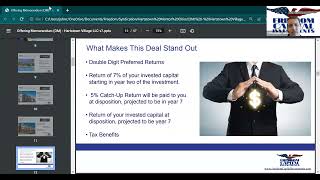
Exactly. Yep. So some investment highlights. So this is going to be a 12 or a 12% preferred return that we're offering to investors plus a the tax benefits. So we will be performing a cost segregation on this property in 2023. And we estimate 30 to 40% of whatever investment amount that you make, we will be returning to you via K1 tax document at the beginning of 2024 that you can basically use that 30% as a write off towards any capital gains that you may be incurring in the year of 2023, or you can carry that forward into future years. It's that 12% preferred return is going to be paid out as 7% quarterly and then the other 5% will accrue and be paid when we actually recognize the equity at the exit when we sell. So that would be in the projections here we'll go that we're projecting at year seven. There is strong likelihood that we would have a refinance in there and be able to return a large portion of your cash at that point. I think there may be. Okay, just seeing if there were any questions, feel free to just add them to the chat or just stop Ben or I and we will.
There's a question.
Yeah, Guy, you can take. So there's two ways that you're able to utilize the tax, write off or loss. So if anyone is able to take those against their capital gains. Guy. But if you are deemed a real estate professional, which is a certain status and typically that means real estate is your main employment. So someone like a real estate agent, someone in property management or something like that, they're actually able to take those deductions via their actual income where it can be really powerful. But anyone is able to take it against any other capital gains that they may be incurring. Let me know if that answers your question.
As Guy responds. Welcome to the new people just joined us. We are, as we go through here, we're talking about some of the various aspects of syndication investing. And you see some of the highlights here that C.J. has talked about. And if you have questions, you know, feel free to type it into the chat panel or be able to unmute and talk to us as we go along here.
Yeah, an answer to your question. That does answer my question.
Awesome.
I have just learned that it's much more powerful for one who is considered a professional real estate or a professional realtor and perhaps less advantageous to those who are not.
Yes, certainly it is more advantageous for a real estate professional because they're able to take it against their actual income. Whereas so if you were to, if you're not a real estate professional, someone invests $100,000 into this deal at the end of 2023, we're going to give a tax document that'll have a $40,000 write off. And that write off can go against any capital gains you're incurring. So you won't have to pay taxes on those. On that 40,000 in that. In that year. And you can delay that tax payment.
And you can use that in future years as well.
Correct? Correct.
So, Guy, it is. This is against, you know, your unearned investing income. There is, it's a very. We're not going to talk about this tonight because it's outside of our scope here. But being a professional, a real estate professional has some tremendous advantages, but it also has some tremendous complexity to it to make sure that you can qualify as a professional. So for those of us who are not, and many of the most. I would say most of the investors that we work with are not real estate professionals. This is still a fantastic, amazing part of the investment that you can, over the course and life of your investment, be able to have a tax benefit that will offset 30 to 40% of your gains during that investment.
Hey, Ben, you're kind of hard to hear. I think you're like leaning back, possibly. CJ's a lot louder than you are. So.
I could hear you there, Ben. Yeah, not a problem. Appreciate that.
I think you can be. The real estate professional does not have to just mean you have to be a realtor or property manager. I think it's based on the number of hours. I think it's something like, like seven or 50 hours.
And it has 750.
Sorry, income. You can't make more somewhere else than here and be considered a real estate professional.
Correct.
And I do have a question about the write off. Is it based on a percentage of your contribution or how does that work?
Yes. So it will be. I mean, it'll be typically what we see from our past cost segregations. So we will do what's known as a cost segregation. And we will then be able to take a certain amount of bonus depreciation in year one. So that will then be distributed between the general partners or operators, Danny, and our, our company, and then the investors. And from the past history, that typically amounts to 30 to 40% of whatever their investment amount was. So if you invested 100,000, it would look likely be somewhere around 30 to 40,000. You invested 200,000, it would be double that. Right? 60 to 80,000. Thank you. Awesome.
So can I ask you one more question?
Yeah, of course, guy. That's what this is for.
So you and I have talked about the signature series. So the difference between that and this one would be the fact that you have that depreciation, not, well, what do you call it?
So not sure I'm using the right term. No, not a problem.
You don't have the advantage of that is, I guess what I was getting to the tax advantages.
Yeah, yeah, I can expand on that. So what Guy had asked is, do you get the same tax benefits if you were to buy a single family home rental property versus the tax benefits of a multifamily investment property like this? And the answer is no. You still can use depreciation on a single family home, but that is depreciated over 27 and a half years. So it's not going to be as significant in year one. There's such thing as bonus depreciation where you're able to do a cost segregation study, which costs thousands of dollars. You have to bring in an engineer to assess all the different parts of the property and then you can accelerate that depreciation. So for this multifamily type investment, like we said, we anticipate getting, getting 30 to 40% of whatever your investment amount was. Whereas if you were to buy a single family home for $100,000, you're likely only going to be able to depreciate $3,000 in year one when you maybe put down $25,000. So it's a much smaller amount because you're not able to bonus depreciate and take so much in year one. Hopefully that answers the question.
Okay, so you're able to offset the gains that we're anticipating to receive over the seven year period?
Yes. So you could use them against the gains from the interest distributions that you'd receive. But if you have any, any other sort of capital gains that you are incurring via stocks, home sales, any business, any type of capital gain you're incurring, you can utilize it against that. And like you said, yes, you can carry it forward into future years. Okay. Yep. And Guy, we can connect offline as well if you want to go into that any, any deeper. I'm happy to do so.
Thank you.
C.J. it's probably good to, it's probably good to just wrap up this topic with this reminder to people that the bonus depreciation is something that is set up on a scale that's decreasing currently. This year it's 80% and I believe next year's can be scheduled for 60%. So one of the reasons that we've enjoyed really good response on this type of investment from all types of investors is that they want to be able to capitalize on this higher bonus depreciation that C.J. was talking about. And again, this is for each of you a good conversation to have with your tax professional to talk about what specifically that means to your particular tax situation.
Yep. Okay, I will keep, keep going here. The main thing that I want to point out on this page real quick is we're purchasing this property at 4.6 million, just under $100,000 a door. And I mentioned it earlier prior to some people joining the surrounding single family homes are 3 to 400,000. This is a very desirable suburb of Cleveland. It's right very close to the water. And these are desirable units because they're large. Where their true opportunity is is that the last line here is the current average rent is $860 whereas market rent is closer to 12 $50. So that is a 400 or almost a 50% increase in market rent that we believe we, we feel confident we will be able to attain. Especially after we go in and do the renovations that we have planned for this. So we have about $450,000 allocated towards our capex budget to come in and renovate the units for this property. So these are some of the renovations that will look to update. So new flooring, paint. This is the level of renovation we expect for the units post our rehabs and I just wanted to, I kind of hit on this but I wanted to show some rent comparables. So the top line here is a, our current property. That's a picture of it, the townhomes with the pool. But these are some rent comparables where you'll see that these two three bedroom units are running for 1200-1300 dollars a month. And with that the, some of these are not even renovated units. So we think we'll be able to pass these projections that we, I think we had a question here from Raj. Including W2 or K1 income or only capital gains on the sale of a business or property. So Raj, as we said in order to take the depreciation against your W2 income, you would have to be deemed a real estate professional. Otherwise it will only be able to be your capital gains that, that you're incurring. Let me know if there's any follow up question to that. Yep, yep. So we'll be putting in an LVP flooring guy, refreshing paint, painting cabinets, replacing when necessary. There's some H Vacs that we will need to renovate. I think there's actually a slide here that talks about the renovations. I Can skip ahead to it here. But yes, we'll be putting a new. New flooring in the majority of the units. Okay. All right. So risk, I think this is something that I just really, I do want to hit on for a minute. Some syndications, you will see they are in C class neighborhoods, 60, 70% occupied, very low occupancy, and need significant renovations in order to attain their projected rents. That is not the case for this property. It's in a great location. It is. It's a tired landlord that hasn't done recent updates, but they are mostly cosmetic, like I said, paint, flooring, fixtures, stuff like that. But I think this is key to know that we're not going to be overextending ourselves with this investment. We're allocating 450, $500,000 towards our renovation budget to increase the desirability of these units and thus being able to charge a higher rent, which will increase the value of the property or the net operating income. Some people really like this. In order for us to pay all of our bills necessary, we need to have occupancy at 63%. Currently, the property is operating at 88% and we plan to get that on average up to 95, 96%. Just knowing there will always be a little turnover there. Partnerships. Yep.
Is that projected 63% based on the current rents?
Correct. I believe it's as is right now. That's what we would need to be able to pay our. Pay our bills. Okay. Yep. So from a structure, I hit on this earlier, but I'll just go into it one more time. What we are offering Here is a 12% blended preferred return. What I mean by that is you are going to get paid 12% first before freedom Capital is able to make any profit. So you get paid first as the investor or the limited partner of 12%. Now, that is going to come in two ways. We are going to make a quarterly distribution of 7% every quarter, and then the other 5% will be accruing through the lifetime of the investment. And you will be able to. Then you will basically get all of those distributions at point of sale or refinance. We may be able to return funds to you at that point in time.
Vijay has a question.
Hey, Vijay. Yeah. So the property manager that we are utilizing for this, I can send you their information here afterwards. We just agreed. All right. We kind of talked to a couple, but we settled on this one that operates a number of other properties in the area and has good relations with a couple people that we have worked with previously. So we personally are not doing the property management. Our focus right now for ourselves is just in the Cincinnati Dayton area where we manage a thousand doors. But we will be utilizing a third party property manager that has experience, experience with this asset class and this neighborhood for, for it. I will send you their information here shortly. We just came to that agreement within the last couple weeks who we're utilizing. Okay, yeah, this, this story and please you guys feel free to stop myself, I don't want to just be talking if you guys have questions, that's most important. I know a lot of you have probably already seen these slides but this is the opportunity we have. A seller that's a tired landlord who's owned the property for a number of years looking to retire, hasn't been making the necessary renovations or increases to rent. Hence why they are 3 to $400 under market and thus the huge opportunity for us to significantly increase the net operating income over the course of the coming years. It's a high desirable area right near the water. So we're really, we're really, really excited about these larger units. Townhomes. Yeah. So we already hit on some of the capex improvements that we're planning. Mostly cosmetic. There are some H vac, some water heaters for some of the units that we'll need to replace but for the most part it's cosmetic interior. So the overall financials, you've seen some of this purchase price, 4.6 million. We're raising roughly $2 million. A combination of that is for the down payment but also our capex and like renovation budget or contingency as you can see here, the second item, 589,000. For that we have a locked in interest rate at 6.3% which we were, we felt was very favorable at the time of seeking lending. At this point in time, as you guys know, interest rates have certainly been on the rise and we are looking to close with about $2 million. We're almost there. So looking forward to having some more of you guys join us on this journey. So I hit on this earlier that this is just a nice visual to understand when and how you're going to get paid. So like I said, we're paying a 12% preferred return right now. Our projection is to hold this asset for seven years. There may be a refinance in there at year three, at which point we would return some of your funds most likely due to the new value that we've hopefully achieved. But if you see this, your overall return would be 84%. Or if you invested 100,000, you would be receiving a total of 140 or 184,000.
Question in the chat.
Yep. So, Raj, I'm not positive I'm going to answer this correctly, but feel free to just re ask it. So this is a 12% preferred return. Preferred return means that you, the investor, will get paid your 12% for the life of your holding before. Before Danny or Freedom make any return. So for every 100,000 that someone is investing, we have to pay out 84,000 before we were to receive any capital. So it's a nice way to feel assurance that we're not trying to work for free. We're going to do everything in our power. And, you know, I think this asset speaks for itself, that we'll be able to increase the net operating income enough to pay that 12% out and then above. Not sure if that that answers that question. We spoke to the cost segregation already. I'm happy to speak on it further. If you need. We can set an example of one just so you can understand it a little bit more. The let me know. Happy to go through that in greater detail. And then these are just some additional details about Cleveland. I think I've covered most of the things that I was wanting to cover here, Ben, so we can maybe just hop into questions for everyone. If anyone has anything they want to come off mute to ask, we'd love to be able to answer and get your questions answered.
Yeah, these are great questions so far. As you formulate and think about your questions, one of the things that I'll talk about each time when we get together with a group of investors like yourself is, you know, each of us have unique situations and things that are important to us. Guys heard me say this several times and it is, you know, as you look at all the features that CJ's talked about, each of you as an investor decide, well, what's most important to me. And for some of you, it's going to be the tax benefits because you're making a lot of good cash flow and tax is a concern of yours. For some of you, it's a steady income that avoids the market volatility. For some of you, it's cash flow that you want to live off of. I know as I look at the actual structure and deal of what CJ's talked about, knowing who the operators are is huge. And I've known Flip and Danny for many years now as friends, before I became a client, a customer, before I then joined the team for that so their ability to be able to their integrity is a huge deal. Their judgment in real estate experience is huge. But also in this particular deal, for me, the low occupancy to be able to still pay the bills is huge, as well as this under market rent that they have. So again, just a quick review for those of you who joined us a little bit later. Those are some of the key factors that CJ has been talking about here during our time together that are very meaningful to me. And the question is, for each of you, what is it that's most powerful for you that draws you into an investment like this? And so if you have questions about each of those things, let's talk about it here. It's a great time for each of us to hear each other's questions.
Yep. And this is a little dated here, but I will drop in the soft commitment link. So the next step would be to submit your soft commitment. How much funds you are looking to get placed into this investment. We are looking to close this upcoming week. So there is a little bit of a time deadline. We need to receive funds at the beginning of this next week in order to secure your spot, most likely. So we want you to feel comfortable with all your questions answered. But the next step would be submit your SOP commitment. We will get the docusign or agreement over to you so that you can review it and sign it with the wiring instructions. Yep. So we just placed it there for the soft commitment, the soft reserve.
I'm just odd at how long that document is and how many pages there are in that thing.
Yeah, I think all of us would like to have it as a shorter document. The phrase I always say is these lawyers are paid by the word. But no, I think it's, it's one of those things that due to this being SEC regulated, We, you know, there's a lot of. There's a lot of language that needs to be communicated and agreed upon by all parties involved. So, yeah, yeah. If you have any questions specific to the document, guy, happy to connect offline about that.
And when is the end, the date you're planning to close or that we had to have to get this to you?
Yep. So we will, we will be closing this next week. Our. We will have the funds, utilize our own funds if necessary to close on the property. But we're hoping to get funds in by this coming Monday or Tuesday.
So CJ as they start to look through and review the documents, they can reach out to either one of us as far as their questions.
Goes, yeah, of course, yeah. And I think you guys should have our contact information already. I'll drop my phone number in the chat just so you guys have it. If there's any additional questions that you may not want to ask to the broader group. And similar with Ben.
C.J. as you, you know, as you work the last several years with a lot of investors, what are some of the most common questions that come up for especially first time investors? They're just getting into those syndications. The many advantages and features of it. What do you find are some of the most common questions that people have?
I think there's always a lot of questions around the tax benefit which we, we hit on to a point. I think some people want to know what assurances they have that they are going to get paid for their investment. And so that is what that preferred return looks to accomplish. You, the investor or the limited partner get your return of 12% annually. But before ourselves or before freedom is able to take any of the profit. And with that in that document that guy mentioned was so long, it details the number of units that you are purchasing versus the total number of units of the property. So you have a certain ownership piece of the property itself.
Hey, Ray, glad you're here with us tonight. C.J. talk a little bit about this limited partner and how that equates into passive income and how investors ultimately move towards passive income, even though right now they might be in the full swing of their careers and really enjoying that. Talk about that combination.
Yeah, that is a, that's a huge point and I think reason why people choose this style of investment versus maybe active ownership. Right. Some would say, well, I, you know, I could just own my own, you know, single family home or duplex for the cost of what it would cost for me to come into this type of investment. But this is, to your point, truly passive. Right. You are going to put in your, put down your down payment after you've done your due diligence on this property, hopefully gotten all of your questions answered. And then from there the only communication, what you will really have from us is on a quarterly basis unless something major is occurring that will tell you about the business plan, plan, how it's progressing and how the property is doing along with your quarterly disbursements. Right. So your passive income that you're going to be receiving every three months and then it's a, it's a long term hold. So you just know that money is at work and you're earning interest on it. So we see a good Number of people who choose to utilize their tax advantaged accounts even in these investments. Right. Because they love the idea of getting a 12% return versus what the market may bear in the coming years. Right. When I can't say that it's guaranteed. But hopefully from the overview of this presentation you see the opportunity of how we are going to increase the income of this property and thus the value which will in return be your interest disbursements.
And I love how you made the distinction about truly passive. It's like a lot of people say, yes, I have passive income. They have to put in a lot of effort and time and review and it's like sort of passive.
Yeah, yeah, well, no, totally. I mean, I just dealt with. I got told today actually that one of my units is now vacant. Right. So I have to worry that I'm not getting income from that unit this month and I have to cover the turnover costs and all, you know, the property manager to get it re, you know, relisted. Whereas in this type of investment, you know, exactly the return you're going to be making, which I think a lot of people value. Jan, seeing your message Here, these are 48 units and they are, the majority are two bed, one and a half bath, townhome style units. And then there's 12 units that are three bed, one and a half baths. Oh, sorry, another question there. Oh yeah, any way we could get a copy? Yep. Ray, we'll send the presentation to you immediately after. In the original email, which you probably click the link to get signed up for this. There was a review, the offering memorandum or the opportunity and that would be. That would be that link. Jodi, if you're on it, maybe can you post a Google version doc that people could click to get that link? Yeah, and Jan, I think hopefully that answered. Okay, perfect, perfect. Yep. And from the sizes, if you're asking like the square footage, I believe they're just over a thousand square feet on average. Yep.
Back to the passive income for a second. I think one of the biggest insights that I've had over the last couple of years as I've been an investor and then later on the investing team with freedom is realizing that passive income is the end game for all of us. It's the end game. And right now many of you on here are enjoying great careers and making good money. But there will come a time when all of us will either no longer want to work or we will no longer be able to work. And at that point the passive income that we have, which starts With Social Security, it goes with any rental properties that you have. The income from that or income from your savings or stock as far as dividends. But the passive income that you have is going to directly determine your lifestyle when your active years of income producing come to an end. And so this is one of the exciting things that so many investors are really drawn to this is they can start to develop this passive income now, even in the middle of their career, that makes a significant and consistent movement, progress towards being able to live that totally retired life where you can spend your time and have your attention the way that you want to be able to live.
The one thing that I may not have mentioned actually in this is the minimum investment for this opportunity is 50,000. We typically see a lot of investors doing 100,000 or sometimes even greater than that, but the minimum is 50,000 to invest in this opportunity. I just wanted to call that out because I don't think I had previously.
Is the wiring information for the funds in the documents or is that a separate email?
We will provide it when we send the agreement. Yes, but I think it's separate.
The signed agreement from both parties or.
Or yes. Okay. Yeah, we can provide it right away if you need it, but typically we send it once we've had signatures from both parties.
Question for me.
Yeah, Amy, I think our goal is to achieve the highest net operating income for this. This asset. So if we feel that we can continue to pay investors that 12% preferred return and there's still room to increase the net operating income by either decreasing expenses or continuing to increase the market rents, then we will do so. So as of now, we plan to hold this long term for seven years. If we get an offer we can't refuse in five years, we will certainly consider it at that point. But the. Danny very much has the mindset of trying to hold real estate as long as possible. And like I said, this is just depending on how interest rates go in the economic environment and how this asset is performing, there is a chance that we will refinance the asset in year three or four. And at that point, likely there would be a return more than just your quarterly returns. Right. We would hopefully be able to return either some of your capital or pay off some of that other 5% accruing interest. Yep.
So, Jay, can you talk a little bit about something that really drew my attention to multifamily? And that is as we move away from single family properties and we become involved with larger multifamily properties, how that allows us to be able to use some of the larger, more experienced players in the real estate industry that manage and oversee hundreds of millions of dollars of real estate. What advantage that is?
Yeah, I think the true advantage in single family versus or in multifamily. And I'm straying a little bit away from your question there Ben, but what I really want to make clear for those of you who maybe haven't invested in multifamily versus single family prior to this multifamily real estate is anything that is over five units is, or four units is considered commercial. And with commercial it is no longer based off of the neighbor's property. Right. Or comparables like single family homes are. It is purely based off of the cap rate and the net operating income. So that's why you probably heard me talk on that at so many points in time because that is a number that we can control by controlling our expenses and controlling what rents we are able to achieve with the property. So that is what is going to drive the value of the asset. As I said, we are three to four hundred dollars under market rent. That is going to significantly increase the revenue and thus the net operating income and then the value of, of this asset. And no guy, we don't, we don't intend to hold this and hold individuals capital longer than seven years. Okay, anything else? Any other questions you guys? And I totally understand that some of you may not want to, you may just want to talk one on one. So in the chat there, Ben and I put our contact information and you know, please reach out to us or email us if you have anything additional that we can answer for you. We are open and available, would love to be of help and I think this is an extremely solid asset to invest capital into. It's very safe, very straightforward. Ben, any last words?
Well, we just, we appreciate so much the fact that you're here and investigating and looking into the details of this particular investment and for all the reasons that CJ has just reviewed there. We're very excited about this and excited about answering your questions and helping you in the steps ahead.
Okay, well we will, myself and Ben will stay on as long as you guys are here if you have any additional questions. But yeah, I just want to echo my appreciation for you guys being here on a later Thursday evening and you know, just looking to grow your wealth and increase your financial literacy and education and you know, create more of that passive income. I, I love talking about this stuff. I get pretty, pretty fired up about it. So really happy to have all you guys here. Awesome. Thank you, Ray.
Yeah, Ray. Appreciate it.
Thanks, Scott. Thanks, Janet. Thanks, Amy. Thanks, you guys.
More from Dani











Physicians and High Earners — What Real Estate Can and Can't Do for Your Taxes