Freedom Vlog 34 - An Interview with Randy Brown, CPA + GREAT Tax Benefits for Real Estate Investors!
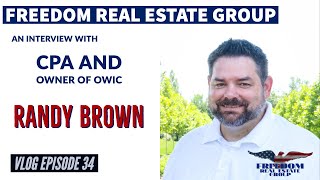
YouTube vlog interview (Freedom Vlog 34) featuring Randy Brown, a CPA, discussing tax strategies and deductions specifically for real estate investors. Topics covered include capturing expenses and mileage, startup-cost rules, the de minimis safe-harbor, depreciation (including recapture), and using 1031 exchanges to defer taxes and trade up investment properties. The video closes with a brief rapid-fire personal segment.
Questions this video answers
58 cents per mile (2019).
$5,000 (first-year startup cost immediate deduction limit).
$2,500 (de minimis safe-harbor limit).
27.5 years (residential real estate recovery period).
45 days to identify replacement property and six months to close (1031 exchange identification and closing windows).
Hey, Freedom fans, Erik Jones here, director of sales and marketing for Freedom Real Estate Group, coming you today with another awesome vlog video. Today's guest is Randy Brown. He is a CPA with owick, which stands for only what is Caesar?
Is that correct?
That's correct. So first, before we even get started, tell us a little bit about the background of how you got the name and then also sort of what you do with your company.
So we're a full service CPA firm. Well, I say almost full service CPA firm. We don't do audit work, but pretty much everything else we do compilation, payroll, tax work, all that stuff. The name OIC actually existed before I decided I was going to put my or put my own shingle out and.
Start my own firm.
It's a biblical reference and not to get too spiritual or anything like that, but the folks came to Jesus while they were trying to quiz him and they asked him, is it even lawful for people to pay taxes? And so he told that person to pull out their money. And so he did pull out his money and he looked at it and said, well, whose name is on the money? And Caesar's name was on the money. So he then said to them, render unto Caesar, what is Caesar? So our position, my position as a, as a, as a CPA and our position as a firm is that we have a responsibility to pay taxes, but only the minimum amount of taxes.
Right.
I can't believe I blew that.
Yeah. So render unto Caesars what a Caesars, but only what a Caesar's, not a penny more. So that's what we do. We aggressively learn and interpret the tax code and then apply that for our small business owners.
Sure.
So Randy is actually my personal accountant. He's also the accountant for my business for also Freedom Real Estate Group. So he is a very great asset to our team. So if you're in need of any kind of advice, if you're wanting to ask questions, if you're looking for a new CPA to do your business with, we will include Randy's information below how you can get in contact with him. So if you ever want to get connected with him, he's a great guy to be connected with. So first question is, tell our investors out there, are there any tips you have, anything they may forget about? That is a great deduction for a real estate investor that has buy and hold properties. Any advice for them? Tax season is right around the corner, so anything you got.
So yes, but for each individual investor, things are going to be different. So if you're managing the properties yourselves or self, or if you have a property manager, those things kind of change. But with any business and real estate investment especially, you have to capture all of your activity. So when you are going to a city to look at properties for potential investments, you have to log the travel, the time that, you know, the parking that you paid when you, when you left, the rental car that you get while you're there, the, the meals that you eat while you're in town, all of those kind of things. If you're managing, if you're managing your own properties, you know, when you run out there to fix something, take care of a repair. The mile, I mean, 58 cents a mile is the deduction for 20, 19, 58 cents. So that's, that's real money and it doesn't take long for that to, to add up. You know, people make their trip out to your office. If you're going to go see your sales agent that's going to show you properties, the trip from your house to their office. That's just one example of all of the little things that add up throughout the year that a lot of investors miss. I would say 70% of investors. When we're sitting down during tax time, we're looking to recreate the expenses that they incur during the year. There's not a solid plan in place now that's new clients, right? Because when we sit down, we develop a plan that says, hey, here's how you capture that activity as you go.
Right. So is there, I guess so let's say I'm a new investor, I don't have a property yet. Can I even, you know, once I maybe start driving to see properties or visiting a new market, can I take those expenses off or can I only do it once? I'm an active real estate investor.
That's a good question. That is a great question. That's actually on the CPA exam. So the answer to that question is an in service point. So all of those are startup costs. Until you actually are able to collect money. Once you go into that business, your startup costs are deductible. Before you go into that business, they are not deductible. Okay, now here's a little bit of a way around that. So if you are currently a real estate investor and you're looking to go into a different market, you can write off the expenses for exploring that market.
Okay.
Because you're currently an investor. But if you are thinking, hey, I'm gonna go to this workshop, I'm gonna buy A few books, and then I'm gonna take a trip to an area and then you never end up investing.
Okay.
So if you're doing some stuff, maybe beginning of 2020, and let's say, you know, you're gonna go travel to three or four different markets, Dayton, Ohio being one of them, if you eventually buy something, let's say in September, you decide on, you know, a market you want to, to invest in, and can you. In 2020, you can take off those expenses.
Yes.
Bring it all back.
Cool.
The, the first year, your startup cost before you're in service is $5,000. So try not to spend more than $5,000. There's some rules that kind of kick in once you get above the $5,000 mark. Another thing we talked about for tax planning for the, for the end of the year, and I should have mentioned it before, is that the government has done a big favor to folks who are investing and spending on their business. There's a lot of incentives for writing off strategic purchases. The de minimis safe harbor limit is now $2,500. So when I got into the game, it was $500. So if you purchase something that has a useful life of over a year, or if you make a repair that has a useful life of over a year, you would have to capitalize that.
Expense to do a.
Was over $500. That number is now $2,500. So if there are things, if you're looking, excuse me, got a little bit cold. But if you're in a profit position and you're looking at a way to minimize the tax obligation, and you have some things that need to be done, and you can make a strategic repair or make some strategic purchases, those kind of things, things that need to be done, you Never spend a dollar to save 30 cents. Never look me in my eyes. Never spend a dollar to save 30 cents. Right, exactly. But if something is coming up, might as well do it now to save the tax obligation. If there's going to be a change in the tax code and you're looking at the rates changing, maybe you look at a forecast to there and move things up or move things back.
Yeah.
And two, of course, I didn't say this at the beginning, but definitely if you have your own CPA that you work with, consult them on, you know, your personal expenses and deductions. Randy, certainly a CPA and a great asset to have. And of course we'll include his information. But be sure you always consult your personal accountant as well. They're going to know your situation the best. So make sure you do that. The other question I had, and one tool that I don't know if a lot of people know about or it may be something that may be confusing to some people or I don't know, but the power of like the 1031 exchange. So that's a really, really great tool to be able to sort of grow your portfolio. So tell our viewers out there just I guess, the basics. We don't want to get too micro, but just a little bit about sort of what you can do, especially if you have maybe even a property in California or one of these bigger markets where it's worth $800,000 or a million dollars, how you can turn that into something else.
Right.
So one of the benefits, and we didn't talk about this too much, I actually encountered a client who had not been depreciating a property for 12 years. So one of the huge benefits of having buy and hold real estate is that you get to take depreciation which then offsets your cash flow, which basically turns it in a lot of cases into free money. But.
And that depreciation is even if the property is appreciating, right? Oh yeah. Let's say you're in a market and you, and you're getting appreciation on like a retail level, retail market, owner occupied, it's, you know, increased 3% annually. You can still use that depreciation as a tax benefit.
Oh, Absolutely, yeah. It's 27 and a half years for residential real estate. It's, it's a beautiful thing and it's one of the things where the government will double dip you. I know this isn't your question.
That's all right.
But we're going to come back around.
All right.
So whether you take that depreciation or not, when you sell that property, the government is going to assume that you took the depreciation, depreciation. So you're going to have to pay that depreciation recapture.
Okay.
And that depreciation recapture is what triggers most of the tax consequence for exiting real estate properties.
Okay.
And so let's say you have a hundred thousand dollar property and just, let's just say it depreciates at $1,000 a year. Now that would be over 100 years. So that's not the right math. But just, just to say that, so you had the property for 10 years. It's now you've taken that thousand dollars. So now your basis in that property is 90,000.
Okay.
If you never took that tax benefit, the government's only going to allow that $90,000 basis. So if you then sell it for 150,000, you're not just paying the difference between the hundred and the fifty that you spent, you're also paying the depreciation regattur. So there's an extra $10,000 worth of tax taxable gain that shows up. Okay. Okay, so this is where a 1031 exchange comes in. Say you've had a property and it's half of the way depreciated. So that same hundred thousand dollar property has depreciated down to on your books, it's worth the value. The basis is 50,000. You've taken that depreciation over time and in that time the property value has doubled. Of course, if you've had a property long enough for it to have depreciated halfway, it's probably doubled or tripled. Okay, so this hundred thousand dollar property is now worth $200,000. Okay. Okay, so we have now a taxable gain of the original 100 plus the depreciation recapture. It's $150,000.
So that would be what you would be responsible for in terms of a taxable, like taxable gain.
Yeah, taxable gain. Now it's a long term investment capital gains tax depend on what your, your income bracket is and you know, how much money you make. It can be anywhere from 15 to 23.8% and that can change every year. But there is going to be a tax consequence. So the beauty of a 1031 exchange is that I can take that $200,000 because I got the cash flow in and take that $200,000 and I can place that with an intermediary and assign this as a new real estate investment. So I have 45 days where I can, where I can take to identify a new property and then I have six months to close. And as long as I use this $200,000 in a new real estate investment and I can upgrade. So I can go from a single family house to a four unit. I can go from a couple of single family houses to an eight unit apartment building. As long as it's investment real estate into investment real estate, I can eliminate the tax consequence completely. So let's just say you had $150,000 taxable gain and your tax rate was going to be 20%, $30,000 real money. And there are some costs involved with, with doing a 1031 exchange. It's not $30,000.
Right. You know.
Yeah, right. So it's a huge, it's a huge. Especially as the numbers and the time gets longer because one of the things that you can do with this is that you can continuously roll, continuously avoid tax, continuously avoid until you get into. So let's say I know I'm bouncing.
Around a lot here.
Let's say you're in an empire building game. I'm going to start with a couple single families and then I'm going to sell those. I'm going to go to a 4 unit, I'm sell that, I'm going to go to an eight unit. But eventually what I actually want is 100 unit apartment complex.
Okay.
So over the course of a lifetime, a, you can continue to trade up, continue to trade up, continue to trade up, end up with that 100 unit apartment building. And this is my legacy piece. There's never going to be a tax consequence. I'm never selling this baby. And then, and then when it comes time for me to pass this on to my children, now it becomes part of my estate deal with an estate planner with those type of things. But there's income level thresholds and your beneficiaries get fair market value at about, at, at the date of death, so it transfers at the current value, not at what your basis was all the way back when you bought those two single units.
Yeah, yeah.
I mean it's a really great way to upgrade and to like you said, to build which for most of our investors out there, the goal is to build up, whether it be five single families, then they want to build to 10 or they want to build into multi unit, multi family type properties. But this is a really great way to take, take advantage of your property and be able to avoid that tax burden in a way and to build up to higher units and more cash flow. I mean after all, that's the whole investment strategy and that's what turnkey investing is all about. So I had a buyer recently that actually sold, I believe it was a condo or a house in California for like $800,000.
So.
So he took that 800,000 and he reinvested. And I believe his portfolio now is around 1.4 million. And it was just off of that 800,000, was able to use some leverage. So it was a really, really super great benefit for him and he avoided that tax consequence as well. So any last words of advice, any nuggets of wisdom for investors out there?
For investors or any business owner, the, the most important thing we hit on this already is just capturing the activity. Treat these investments, treat your activity, that is income Generating as a business. And make sure you have systems in place that you don't miss out. Because a lot of the folks that are investing in this, they're higher income earners. Right. So you're in the 30 to 36% tax bracket. When you miss $100, it doesn't really, it doesn't really affect us, our lives or anything like that. But it's very easy for 100 to turn into a thousand or a thousand to turn into 10,000 when you have, you know, a portfolio of, you know, double digit and triple digit properties. So having systems in place to capture the activity is the, is the most important piece of any business. Real estate investing especially.
Yeah, absolutely. So, you know, if you're a usual listener with all of our team members, we always do a rapid fire segment. And although Randy doesn't work in our office full time, he's in there quite a bit, probably more than he wants to be. We love him. We love having him. So we're gonna do rapid fire with Randy. Are you ready? All right, let's do it.
Okay.
Favorite book?
Favorite book is the Testament by John Grisham.
Favorite movie?
Rocky II, 2416375. In that order.
There you go. Favorite place you've ever visited?
Favorite place I've ever visited. Probably Tuscany in Italy.
Nice. Any reason why?
Yes. We stayed with the family there at our Airbnb. The host family, the paterfamilias, the elder there, he was the mayor in the town for 10 years and he took us on a tour of the city. The wine was great, the food was great, the hospitality. We sat there at their table. Rented an Airbnb. Sat there at their table. Every night they did. Or 8 o'.
Clock.
We sat there till midnight until people stumbled back to their rooms.
It was amazing.
Awesome.
Yep.
Need to get their number. Okay, so favorite job?
Favorite job besides this one?
Yes.
Okay.
I love this job. I love what I do. My favorite job besides this one was when I was in high school. I worked at Burger King and we were the third busiest Burger King in the state of Ohio. And we knew exactly what the task was at hand. And we clocked in, cranked out Whoppers all day. Looked up because we were super busy all the time. Looked up. It was time to clock out. My mind was engaged the whole time. I knew exactly what I needed to do. I was able to do it and then get out of there.
Cool.
Last question. Favorite person that works at Freedom.
All right, Freedom fans. So that's where it cuts out. Unfortunately, we ran out of space because the video was so long. Super informational, but very long. But I can assure you that Randy said his favorite coworker was or team member at Freedom was me and if he says otherwise he's lying anyway. No, Randy actually said after that that he really loves working with everyone, loves the great team that we have here and it's been a great partnership working with him and our business and our team. Again, if you want to get in touch with Randy, he really is a great asset. Super knowledgeable and very strategic in how he can get the most benefit for you. When it comes to tax benefits, any kind of real estate investing opportunities, he would be great to talk to. His information is going to be below in the description of this video so you can reach out to him directly. If you have questions for me about any possible real estate investments, be sure to reach out salesreedomrealestategroup.com in the meantime, make sure you follow us on Facebook, Instagram and of course YouTube so you don't miss any content because we've got a lot of great things planned for the upcoming year. And until next time, everyone happy investing.
More from Dani











Physicians and High Earners — What Real Estate Can and Can't Do for Your Taxes