Introducing our President, featuring special guest, Aaron Davis | EP. 40
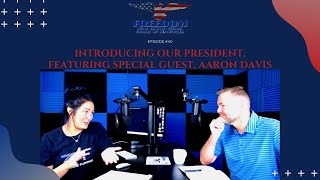
Aaron Davis became president of Freedom Real Estate Group after joining as an operations consultant in May 2021. He came from IT recruiting and talent acquisition, holds an MBA, and focuses on customer experience and feedback loops. Father of four who invests in real estate flips and rentals.
Questions this video answers
Episode 40
May 2021
Around August 2021
Four children; oldest is 22, youngest is 4
Hi Freedom fans. Welcome back to another vlog episode. This is episode 40. I cannot believe we are already at 40 episodes. And today I'm here with another very special guest, Mr. Aaron Davis. He is our president of our Freedom Real Estate Group family of companies. We are going to be doing kind of intro video that we guys can get to know him a little bit. Just a small background. I'll kind of introduce him a little more and then let him take it away. But Aaron actually came on with one of our sister companies, Independence Property Management, AKA ipm. If you hear that come up at all during this conversation as an operations consultant. And he was just absolutely amazing and we somehow were able to talk him into staying with us now full time. You want to speak on anything like that before we get started?
Yeah, sure.
So.
So. Hi everybody. Caitlin, thank you for hosting and interviewing this little conversation. So yeah, a little bit about my background. I got into that role or was invited into that role in Independence Property Management because I have a business operations experience. I run a small business that was considerably larger than IPM and so right away there was a good fit. There were low hanging fruit there that made sense in terms of some problems that, that I'd seen before.
Right.
So I always kind of like to call, differentiate problems between good problems and bad problems. The bad ones are the ones you don't know how to solve. The good ones are the ones you have a recipe for. Right. So there's a recipe for a few of those things that were ailing us and we were able to make some great improvements. So anyway, it was, it was a fun way to enter the organization. It really is the product that we're selling as you know, our, our turnkey investment product. A big part of what our investors ask us is how is that property going to be managed. So you know, we, it was a good place to start learning the customer's experience as part of the whole frig family.
It's actually interesting that you say that thinking of how I got started, I started with another one of our sister companies, Cash for Ohio Houses. And so it was probably different on how we learned about the operations of all the companies and how they intertwine. So going back now, I wonder how different it would have been if I would have started an IPM to see the difference. I think it would have been cool.
Yeah, you know, it's like, you know, it is, it is the same end game. We and we all figured it out. It's not, it's not an enormous enterprise here. It's A pretty small business, but it kind of my entry into the organization or the family of companies kind of maps my ideology about how to start optimizing a business, which is you start with the customer's experience.
Yeah.
When the customer's experience. And I didn't invent that. I mean, Bezos is saying that and every, you know, every. Everybody who's putting out memes and blogs and whatever about business is saying that. So, you know, when you start with the customer and then kind of work backwards in terms of how the business should run, you're going to create a better experience for people who are paying your bills.
Absolutely. Yeah. There's been a huge change already, and a lot of good things are moving.
So definitely appreciate that I could pitch in.
Of course. So I'll go ahead and jump in with who is Aaron Davis? Kind of already got into a little bit. Do you want to elaborate on that a little more?
Sure. So, like, as a human being, as a person, I'm a family man, father of four. My. My oldest is 22. My youngest is four. So pretty good spread between a couple of adult children and a little dude again. So I get the benefit of being both an old dad and a young dad. Got to enjoy both of those things. The, you know, coach soccer, play a little disc golf. You know, all the. All the things. Right. Professionally, I kind of got my start in leadership in IT recruiting and headhunting. Kind of segued into, you know, sales and then large enterprise talent acquisition. So I've run some large departments for large companies and also after that, ran professional services for Software Shop. So became Senior Professional of Human Resources, certified SCRUM Master MBA Acronyms. Acronyms.
Right.
You know, it's interesting, all those acronyms put together. You know, the SCRUM methodology that is heavily utilized today in software shops is really useful in business across the board. I've pulled more from that little body of knowledge than, you know, everything else put together.
Right.
In terms of what we can apply here. So.
Absolutely.
It's been a fun background to translate then into the real estate investment world.
Yeah. So we're kind of answering a lot of questions right at the beginning of this, which leads into the next question that I have, which is when and how you got started with Freedom Real Estate Group, family of companies. So when exactly did you start?
Okay, so I think I came on as a consultant in May.
Okay.
Yeah, May of 2021. It took almost no time at all before my curiosity about other parts of the organization. Here's the thing, you know, like the There is no. All the handoffs matter. Right. Like, all the interactions with the customer, all the interactions with the family of companies that interact together, they matter, they impact. So there is no way to completely isolate what any one of us does.
Right? Absolutely.
So, I mean, even recording this, it has all kinds of implications on everything else.
Right.
And, you know, I'm kind of a business integration person. Right. I mean, as an operations kind of guru or leadership guru or whatever, I'm always curious about how things interact. So I accidentally started sticking my nose into other stuff sooner than later. And then I guess it was sometime in August, Danny and Flip asked me to be there, and Randy really kind of was instrumental in that kind of agreement or whatever and asked me to become the president of the frag family of companies. It felt fitting to me. You know, I've always been a real estate investor myself.
Yeah.
Passively and actively.
Okay.
Both. So now getting to apply some of my experience in like, talent acquisition and software development and whatever to what has always been a side hustle is kind of cool.
Yeah.
Because it's something that kept me energized even after a long day of work. And now I get to do it during the day.
Yeah, absolutely. And that kind of. That goes into previous vlogs and podcasts that we've had with, where we've talked about. Our team members are investors themselves. So a lot of. I don't wanna say a lot of times, but sometimes they'll start in the real estate investing industry and then become a real estate investor themselves or vice versa. I know. So like, in your example, you are an investor and now you are starting in here. So I think that puts a lot of really great perspective because you can come in here and say, okay, I've been a consumer, now I can put that in place.
Yeah, true. Yeah, true. I mean, I find myself. One of the early projects you and I were involved in together is this whole Ivan the investor creating a Persona and defining who exactly are. And it's really easy to project myself into that because I am one of those people. But interestingly, despite that empathy, we have to be a little bit smarter about being broad in our definition, because not every. All the real estate investing I've done, for instance, has been local to me. Right. So a lot of our consumers are long distance. You know, they're buying into our market. So there's always a different Persona or angle that others will bring to the table. All that said, it certainly helps when you've been through it a couple of times yourself. You Know, I've done flips and sold them retail. I've done acquisitions and flips that then I rented and utilized for passive income. And then I've acquired tenanted property as a passive income. So I've, you know, I've done all the work myself. I've hired it all out. So I've done a few different versions of real estate investment.
Right.
Not at the volume we do here for our customers, but enough to have some perspective and some empathy for who our customer is.
Absolutely. Absolutely. That, again, intertwines with. The next question I had is have you always wanted to be in the real estate investing industry?
Yeah. So it wasn't a childhood dream. Right. Like, I wasn't like one day, you know, interestingly, if I do. If you do, indulge me a little bit and go back to my childhood. We were renters as a kid. As a kid. Right. And so I always was always a little bit envious of my friends and connections or whatever that we had who owned property. And I think, you know, I did know some folks who were landlords and whatever, and I always thought, oh, what's it going to, What I got to do to be them or whatever. So there's a little bit of lifelong connection to it. But even if you just dial back to the early days of my professional career, I've always had my hand in it a little bit. Again, usually just a side hustle. So you can tell a lot by somebody about somebody by what they do in their free time. And in my free time, I was a real estate investor. So the long answer to your question is yeah, I guess kind of, you know, it's always kind of been a. I never really. I guess the reason I hesitated is because I never really imagined that I would do it professionally until I just kind of connected with the right people, you know, the right people, you know, who are doing things that were familiar to me and were cool and needed some of the expertise that I brought from my professional life. So.
Absolutely. I always love hearing, learning about people's backgrounds when I'm asking these questions because we don't really get to do this a whole lot. True. So I kind of getting benefit here compared to a lot of other people.
You probably know everybody more than anyone. Right.
So I love doing these. I know earlier you were saying it's kind of hard to say exactly what you do just because all of the companies work together in one way or another. So this may be a little bit of a tougher question on what exactly do you do now that you are the president of the Freg family of companies.
Yeah. It's not as hard as you would think. It's like a lot of things, it's easy to say, it's hard to do, right?
Yeah.
Like, well, building a house. Oh, you just put the foundation in the frame it. And it's easy to say hard to do. Right. So it's not that hard for me to say what I do. But, you know, it starts with. It's really. It's kind of simple. First we define what needs to be accomplished and the next step between there this. The step between there and the next step is where a lot of times we miss. It's. Then figure out how we measure whether or not we've done that well.
Okay. Yeah.
And then from there the real hard work begins. And you've been party to some of these conversations and meetings and tasks and stuff that we're getting engaged in, creating a hard coding, a healthy feedback cycle that then enables us to continually improve that measurement.
Yeah, absolutely.
And I would say if there's any one consistently themed thing I do, it's that it's improving and optimizing the feedback loop from our customer base, first as that's where we start. And then secondly, and also very importantly, our team. Right. I'm a big believer in. I don't think that I'm going to bring to frig all of the answers. You know, I have a background in software, I have a background in personnel, have background in like operations leadership or whatever. With some. With some real estate stuff on the side. I don't think that matters that much because I'm a big believer in the collective intelligence of a group. Both our customers, there's hundreds of them. Right. Thousands of them, depending on who we all count. You know, they know a lot. And if we're asking them the right way, the right question, they're going to inform us of the right answers. Right.
Yep.
Same is true for this team. Like they collectively. We don't have to go to Randy, say, hey boss, what should I do about this? And that. If we figure out a good way to collectively inform how the operation should run, it's going to be, you know, multiple times better than a single owner making decisions from the top down or single leader making decisions from the top down. So a big part of what I do is figuring out how to qualify and translate the voice of the stakeholders that. That have the bigger body of knowledge that informs how we do things.
Right. Absolutely.
Sounds real simple.
Right, Right.
It's tricky though. Because people are, you know, people are hesitant, you know, to speak up and say, hey, boss, I don't like the way that's done, or hey, thanks for selling me that. You know what I mean? Like, customers don't tend to inform you how to run a great business. If they don't like something, they go elsewhere. Right. So figuring out how to get that voice heard in a meaningful, contextual way is a big deal.
Yeah, absolutely. And for those of you, that reminds me, for those of you who are watching this, if you guys ever have any suggestions or questions or any anything, please put it in the comments below or email us, call us and we will be glad to answer that. Even if we do it, even if we end up keep coming up. We could even do a vlog or podcast episode on it. So please, we do appreciate your feedback and we study it and figure out how we can better not only ourselves, but also the company.
That's right. We're listening.
Yes, absolutely. Turning things a little bit. You kind of already touched base on this a little bit. In your free time, what else do you like to do? I know you mentioned soccer and disc golf.
Yeah, yeah. So I'm an avid disc golfer. I'm not very good at it, but I enjoy playing. My boys play some, my older boys, so I'd like to play with them. And you know, I don't know if, you know, you start coaching because the league, the rec league says, oh, we need more coaches. And the next thing you know, you've been doing it for a decade. That's me. That's me. So, like, there's actually a drawing on my fridge right now that this little four year old girl gave me at soccer practice on Saturday. Aw, coach, coach. And she drew this picture for me and her parents told me all about it. So it's a pretty charming, endearing thing. It's easy to get addicted to, you know what I mean?
Yeah.
Those poor children, they think I'm great. I'm like one chapter ahead them, you know what I mean? Like, I don't know the curriculum like that great. But they're for. So, yeah, anyway, I get out there and run some laps with the little kids and teach them how to dribble the ball and take shots and that's a lot of fun. Honestly, a lot of my. You know, when you become a parent, your life stops being about yourself completely and it starts kind of shit. And I've been a parent for so long, since I was 21. So then your life kind of takes shape based on what you're facilitating and enabling and helping your kids accomplish and that kind of thing. So. But, you know, your friends become other parents and whatever else, right?
So, yeah, absolutely.
Yeah. So a lot of those things, it's just I've got older kids that are now growing up and I'm like helping them get their careers going, you know, figure out their, their school income, finance, you know, life situation and whatever. And then I've got this little dude. So we literally. My wife, his mom, took him and delivered him to preschool for the first time today. Today was his first day of school.
Oh, I hope he does well. Hopefully he has a good day.
Yeah, he was, he was excited and nervous and he was role playing. Like his inner voice was like, oh, I'm going to pretend to be the teacher and whatever. Anyway, that's what I do. You know what I mean? I chase these little guys around and any given day you can find me, you know, pushing my son down the street on his bicycle.
And I love that. That's amazing. All right, we're kind of going to keep going on this roll a little bit. If you could have one superpower, what would that be and why?
Hmm. I think I'd want to extend my life. Like, I like learning. So, like, I would say I want to know everything or whatever, but, like, the aha moments are kind of fun, you know what I mean? Like, the transaction of, like figuring something out.
Yes.
Is fun and energizing. So I would kind of hate to miss that. So I, you know, I feel better at 40 than I was. I'm 40 something, by the way, than I was at 20 something. You know, Like, I feel more equipped for the world and have more perspective on stuff, and I certainly don't have all the answers. I'm rarely the smartest guy in the room, but I, I'm better, you know what I mean? And I'll be better, I think, at 60 and at 80 and so on. I just wish I could be better at like 220. So I guess it would be longevity of life or immortality or something. Maybe not, but longevity. Longevity of life would be great. Yeah, I'd love to go five, 600 years.
Well, I'll go about 500. But live longer. Yeah, absolutely.
Yeah. Until it got boring.
Yeah. Would it ever, though?
I don't know. Nobody knows.
Yeah, that's a good question. All right, turning things back, how do you handle stress?
That's a great question. I talked to my little 4 year old about this all the time. Take a deep breath. Focus on what you appreciate. It's crazy how you, you know, like I learned soccer, teaching soccer to kids. Right. When I said I'm one chapter ahead, I'm literally like day before, night before. Okay, what drills to teach a five year old for soccer or whatever.
Oh yeah.
So this is what you do as a parent as well. You see your little kid is stressed or he's not taking bad news well or whatever and you're like, huh, how do you learn these things? You talk to other people, whatever. So I'm learning being via teaching, if that makes sense.
Yeah, absolutely.
I was literally just teaching my 4 year old how to cope with disappointing news and whatever else. And what I was teaching him and learning in the process was to think about the things you're grateful for. And so I will literally say, okay, let's take turn. And usually when he's in a funk, he doesn't want to start. So I'll start by saying I'm really thankful for mama. He's like, yeah, yeah, thankful for mama. And then we go a few cycle and by the third thing he's listed, he's in a great mood and so.
Am I. Oh good.
So anyway, gratitude is so powerful, right. I mean, every time I complain I realize how unlikely it is that I exist in the first place. And then you know, that I'm healthy and well fed, you know what I mean? So absolutely, you know, it doesn't take long at all to get your head right.
Absolutely. Yeah.
I start thinking about gratitude, you know.
Yeah, I'm going to start doing that.
That.
And that's another reason why I love doing this is I get to hear what other people do. And I really, really like that one. That's going to be a takeaway. That, that's going to be my biggest takeaway, I think, for the day. I really appreciate that. So thank you.
Sure. Yeah. It's a tough balance between that and ambition, which is essentially founded, rooted in discontentedness.
Right.
Like I don't have enough, I haven't accomplished enough, I don't know enough. And so balancing those two things is tricky and you inevitably run into stresses. Right.
So right.
Then get grounded, you know, thinking about gratitude.
I love that.
Cool.
Again, a lot of these are tying into each other very well, which is if you could give one piece advice to everyone in the world, what would that piece of advice be?
Oh man, we're all doing our best, so just be kind to one another, you know what I mean? People are going to disappoint you sometimes. It doesn't mean you need to stick around and tolerate them necessarily. But whether it's in business or customer relationship or product or personal relationship or family or whatever else, you don't have to tolerate horrible things. But you can be kind and gracious to folks no matter what, right?
Yes.
So, I mean, to me, that's the. Again I reflect back on, like, I'm teaching myself how to be a grown up by teaching my kid how to be a grown up. It's this whole like, Instagram conception kind of mentality thing. And I told him today as he was getting ready for school, the most important thing you can do is be good to, you know, be nice to other people. And at the end of the day, we make money or we don't make money, we're successful, we're not, we're whatever. All that stuff is secondary in my mind to just being nice to each other. As simple as that is. It seems really simple, but it's hard to do, right? Yeah, no, sometimes it's hard to do.
So if I were asked that, that's the same exact thing that I would say, and I believe Tina also said it. Our chief of operations and growing up, my stepdad, he was a real estate investor himself as well, owned a construction company here in the Dayton area. And he always instilled in us when we were growing up, no matter how successful or big you might get, always be kind and give back. So that is. And even lately, more so lately, that is my biggest thing, is just be kind, be kind.
You know, that makes me think about to what do you attribute your success? Whenever, if you ask people who are, you know, your father or others or whatever who've had some measure of success, it's always tempting to say, well, I worked hard. And there usually is some truth to that. And there's also always some truth to the people who rallied around you and were at your disposal to help you in situations where you were in a pinch or you needed advice or help somebody to help push you up. So again, that kind of goes back to my philosophy about gratitude kind of being a foundation for your headspace. Because there is nobody who. There is no self made person. Nobody's self made. Yeah, right.
Yeah.
Everybody relied on somebody.
Yeah, right.
Or everybody enjoyed some good fortune in their life to be at. So try not to pat myself on the back too much.
Yeah, no.
Helps me be kind to people.
Yeah. Yeah. All right. Well, that is all that I had. I got a lot of. A lot of really great feedback from you and I learned a lot. But before we go. Is there anything else that you want to add?
Oh, it was a great, great Q and A session. I guess I don't have anything. Customers were listening team. We're listening and hopefully we'll get better at listening and improve the way we run things here.
Absolutely. Well, that's all that we have for you guys today. You may not know this, but we will be doing future podcasts with you.
Oh yeah, I think I did see that.
Yep. And probably some other vlog episodes. I know you mentioned Ivan's process map. That is going to be an upcoming podcast. I believe we decided to do podcast on it. That way you guys can understand it a little more. We'll get into that. That will be a very good episode. Again, that will be on our podcast, which is real talk, which is real talk for real estate investors. And that's all that we have. As always, remember to invest smart and live happy. Bye, guys.
Nothing on this show should be considered specific personal or professional advice. Please consult an appropriate tax, legal, real estate, financial or business professional for individualized advice. Opinions and information on this show are not guaranteed. All investment strategies have the potential for profit or loss.
More from Dani











Physicians and High Earners — What Real Estate Can and Can't Do for Your Taxes