Investment Methods: Options for First-Time Investors | REIal Talk | The Freedom Show | EP.93
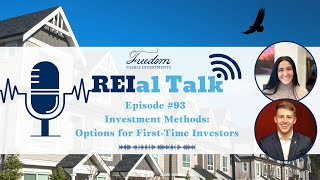
Five ways to start investing in real estate: REITs, crowdfunding, rental properties, fix-and-flips, and owner-occupied homes. The hosts break down costs, liquidity, financing options like FHA and VA loans, and how to take your first steps with a lender or realtor.
Questions this video answers
About 25% (example average home price cited around $100,000–$120,000 so ~$25,000–$30,000).
Around 4–5 months on average for their flips.
Up to $250,000 (if lived in the home over two years).
Purchased for $275,000 with about $10,000 at closing; now rents over $4,000/month and estimated value over $400,000.
Generally 3.5%–5% down for common loan programs (FHA/conventional variations discussed).
Hi, guys.
Welcome back to another episode on Real Talk. I am Caitlin, this is cj. If you've watched any of our previous vlogs or podcasts, I'm sure that you've seen him before. He is our investment specialist, primarily with the syndication and fund sides of things things, but he also invests in real estate himself. He knows the turnkey aspects. He, I feel like, knows it pretty much all. So today we're going to be talking about different kind of real estate strategies that you can do to kind of get started in real estate. And you know what those strategies are, what they look like, how much you need, and all kinds of different things. So if you watched our vlog on this, we talked about five different strategies. There's a lot more, but we just touched on the top five that we kind of thought were the most prominent. So we have Real Estate Trust, Crowdfunding, Rentals, Fix and Flips, and owning a home. C.J. do you care to elaborate on what those five different strategies all are and kind of, you know, what it takes to be in those?
Yeah, let's. Yeah, we can just start in order that you kind of started. But yeah, let's get into it. So real estate Investment trusts or REITs are another form of almost stock investing.
Right.
Many people can be familiar with purchasing an Apple stock or a mutual fund. And a REIT is simply a conglomerate of all different real estate assets that you're able to buy via a certain price and see that appreciate through time. So that's what a REIT is in its very simple form. And there's all different types of REITs that based off of different types of real estate that you can choose to invest in. It has a low barrier to entry and also has relatively easy to buy into and buy out of.
Right.
It's not as illiquid as some other types of real estate investments are. And crowdfunding is a similar type of thought in this. There's a couple, you know, really popular crowdfunding sites that have popped up in the last couple of years and they, you know, really go into. They're really, I would say, more user friendly than what you think of as a reit. They're going to tell you what their past history has been, really let you know the assets specifically that you are buying and tell you about the performance of those assets, taking you a little bit more active.
Right.
In showing you what is happening day to day with that crowdfunding site. Does that make sense?
Yes. Yeah.
And then I think the third one you said was Rental properties themselves. So rental properties could be anything, right? That could be short term airbnb, rental properties, midterm, or what people think of as a long term rental. Someone who's staying for 12 months or more. And you know, that's something we specialize here at Freedom, we sell investment turnkeys, we which are basically done for you ready investment rental properties. And those range depending on the market that you're in. Here in Dayton, Cincinnati, I would say our average price is probably around $120,000, $100,000. So someone's going to need around, you know, $30,000, typically 25% down, to purchase one of those rental properties and start receiving cash flow. This is a much more active type of real estate ownership because you are actually purchasing the price the property. There's closing costs and it's a little bit more illiquid because to sell it is going to take 30 to 60 days. When you go to sell it, there's going to be transactions costs, but you're typically buying it for the cash flow and the long term appreciation in that. In that situation, I believe number four was flipping. So flipping is a shorter term strategy. Normally you want to get in and get out as quick as possible. So our average turn on our properties that we flip is around four to five months, I believe. So we are purchasing a property in this case. In our case we're purchasing it cash. But someone who's getting started may get a loan. You're just going to pay more transactions costs when you're buying a loan up front as and then selling it on the back end because there's just more costs involved with that. But it does allow you to obviously purchase a property at a lower down payment price if you're gonna go about that. And there's, you know, I would say with flipping there's more risk and more reward.
Right.
You're gonna make more money hopefully in the short term if you're buying, right, making the necessary improvements and selling it good. But in the last year, right, flipping has become a lot harder because interest rates have been going up and then some markets prices have been going down. So it's really difficult if you are buying something with the plan to sell it at 200, but you're only going to be able to sell it at 180 because six months later prices are lower.
Right.
From a comps or comp sales. What was the fifth one was? Oh, owning your own property.
Right.
So in my opinion this is the best way to get started.
Right.
And you can get Started in a number of ways. You can just buy a, some people like to call it a live in flip. You buy a property that you're going to live in for a couple years, improve it during your time living there. And when you, if you've lived there over two years, you're going to be able to sell it and not have to pay capital gains up to $250,000, which is super attractive. Not having to pay those tax taxes back or owning a home. You can choose to house hack it right by getting, getting, you know, roommates, or you could buy a duplex and have a renter live in another side. And what's attractive to those options is you're lowering your living expenses. And again, there are a lot of loans out there for homeowners, first time home buyers to kind of get into a property for a low down payment. So I think a lot traditionally think you need a 20% down payment. But a lot of these loan programs, you can buy a home with only 3,5% down, which is really attractive and I think a great way to get started. Whereas with flipping or rental properties, you're going to probably need 20, 25% or more to buy and get into that type of real estate investing.
Yes. And I believe too, correct me if I'm wrong, but if you are buying a duplex, you can still buy it as a primary residence. So then it wouldn't be an investment loan that you get on it. So then you wouldn't be required for the 25%.
Yeah, correct. Yeah. So you can actually it's with an FHA mortgage and you can have one FHA at a time, but you are able to actually buy up to four units. So I actually bought a quadplex, lived in one of the units for one year, improved that unit while I was living in it and the exterior of the building and then I moved out. But I was able to buy $275,000 property with only like $10,000 coming at the closing table.
Right.
And that property now you, you know, rents for over $4,000 a month and it's probably worth, you know, over $400,000. So it was a great way for me to own an asset for a very low amount and start receiving that cash flow. So yeah, it's really attractive. You're going to pay a little PMI and those things. But to be able to buy multiple units for such a low percentage is really attractive.
Yeah, absolutely. So we just kind of described all of those. So you touched on a couple of things that I Want to also touch on a little further. You talked about active and passive. Do you care to explain what the differences are between those for maybe first time listeners or people who are just getting started in real estate?
Yeah, of course. Yeah. So the way that I like to think of it is active versus passive, is are you worried about it or are you having to deal with the problems of that investment? That may not be the true definition, but some of the options that we mentioned there, the first two, like REITs or crowdfunding, those are going to be passive. We also personally here at Freedom, we have private money lending and people who invest into our syndications. Those are passive opportunities where they are simply coming with the capital side of the investment but letting someone else manage the asset. Whereas typically with rental properties or flipping or, you know, buying your own property, those are going to be more active types of investments where you're dealing with some of the problems that arise with the property and just maybe handling the day to day. You can still outsource some of it to property management, but it is more active in a sense. So does that make sense?
Yes. Perfect. The other thing you talked about was risk factor, which I think that's important to kind of weigh in because it ties into. My second question is how do you get started in real estate? I think one of the first question, first two questions really that you should ask yourself is, is how active or passive do you want to be? And then what's your risk factor? Do you want to touch on that a little bit?
Yeah, yeah, I'd love to. And I think, you know, risk or the fear of the unknown or potential risks is what keeps 90% of people from investing in real estate.
Right.
I think a lot of people fear, you know, the roof caving in, you know, toilet getting clogged and flooding the house. Right. All of these things that keep people from all of the great potential upsides of investing in real estate.
Right.
So, and again, going back to that risk slash reward, that's why we have people who have hundreds of thousands of dollars and could go buy real estate on their own, but they choose to invest or passively invest with us via private money lending or syndication because they don't want to deal with the headaches, Right. They would rather know that their money is at work, they're earning a certain interest return that is better than what they can get in the stock market or other options, and they don't have to deal with any of the headaches.
Right.
So it just depends where your risk and what your fears Are and just potentially how you value your time as well.
Right.
It may not be worth the active approach, depending on how you value your time or what type of returns you're looking for.
Yeah, definitely, because that's a. Time is another really important factor, especially if you, you know, you have a family who maybe the kids are in sports and they're going to school and everything. You know, how much time do you have to put into the investment?
Certainly.
Great. So if, you know, knowing all of this, someone's listening, what would you say is, like, one of the first steps that they should take to kind of get started?
Yeah. So we'll just take the scenario that I'm saying to maybe purchase your own house, whether that's to live in it long term, to, you know, live in and flip it, or live in and turn it into a rental. I think the first step is to contact a couple lenders first.
Right.
To understand what house you can qualify for, like what type of mortgage, see where your credit's at. Also understand the different loan programs that are open to you, whether that's fha, conventional va, usda. There's a lot of different loan programs that are available, and there's different benefits to each of them. And then the second would be to reach out to a Realtor in your local area and potentially start going and seeing homes and, you know, familiarizing yourself with the market that you're looking to invest in. I mean, you can start on Zillow even, and just put certain parameters for certain locations that you're looking to invest in. I think those are two great steps that you can go to someone and help educate yourself. If you're more on the real estate investing side, you can go into biggerpockets.com right. There's active forums there that are great resources. You can talk to me here at Freedom about maybe purchasing an investment property, if that's the route that you're looking to go. If you're not wanting to buy a house to live in. There's so many resources out there.
Right.
It's just, you know, doing a little research and talking to individuals in the space.
Yeah, definitely. And even the biggest part is, you know, educating yourself on it. Whether you're listening to podcasts, like you said, there's bigger pockets. There's even a ton of Facebook groups you can even narrow it down to, like, if you find a market that you're interested in. So obviously we're in Dayton and Cincinnati markets primarily for turnkeys. You can get on Facebook groups and you can look up Dayton, Ohio, real estate investing. And then all kinds of groups would just pop up. And most of those groups are very investor friendly. There's people in there who are just getting started. Joining the group was their first step to well seasoned investors who have a whole portfolio built out and they are there to ask questions, they'll answer questions, they'll recommend different types of services in that area and things like that. So there's all kinds of ways to get started and help with that. I will say so far, the real estate community, I'm in a ton of groups across bigger pockets, LinkedIn, all the platforms and the real estate industry, everyone is so friendly most of the time and always super willing to help. So definitely. And then like CJ said, we're also more than willing to hop on a call with you and answer any questions that you may have about it.
Yeah, but I think what you bring up is really true. Like, I think the great and also the hard thing with real estate is there what we've talked about, there's so many ways to invest in real estate and there's so many options, you know, to make money. Flipping, wholesaling, long term rentals, short term rentals, syndication, private lending, like so many different things, but it's really. And you want to understand those options, but you know, you got to pick a strategy and, you know, commit to it.
Right.
Because I think people get overwhelmed with so much information that they just choose to sit back and not actually take action. That's the biggest thing I see from all of our turnkey buyers is they're trying to educate themselves, but they're the fear of the unknown.
Right.
And you're never going to know 100%. Or maybe eventually you will, but that'll be years and years later and you would have been better off just getting started.
Yeah, and that goes for any investing, really. It doesn't just have to be real estate investing. You know, there's always that risk factor, but then the reward that has to be considered and factored into all of it. I know, like me personally, one of the things that we're doing, we bought a house and our goal is living it a couple years and then rent it out and then buy another house. And that's how our plan is at least right now, to build our portfolio to just kind of get started. And one of the things that we were doing when we were house shopping was looking for properties that were going to be in an attractive area for renters. You know, you go out into a more rural area, you're just slimming the margin there with the amount of renters that are going to be available to you.
Yep. Yeah, certainly.
So, you know, we've talked about this, you know, buying and needing the down payments and the percentages of all that and everything. Is there any way that you can tell how much money you need to get started? I know that's like, always the biggest question is, how much do I need to get started?
Yeah. So, you know, let's take the scenario of you're buying your own primary residence. Whether you're going to house hack it, live in, flip, or flip it. Most loan programs that are going to be available for you are going to be that three and a half to 5% down. So you would just look at your market, right. If the average home or the area that you're looking in is priced at $400,000, that's going to mean that you're going to need, you know, 15 to $25,000 for the down payment and then probably an additional, you know, five. $5,000 for closing costs. Right. So, okay, I'm going to need between 15, 20 and, you know, $30,000 for me to get started in this, you know, personal home buying program. You know, there's. But there's also assistance programs.
Right.
For your down payment. There's different things, but I would say in that range, you got to take five. I would just say for easy math, take 5% of every $100,000.
Right.
For whatever price point of homes you're in for your area. And that's like a safe number to know of what amount you need.
Yeah. So now do you know what the entry is for, like, maybe like the REITs or the crowdfunding?
Yeah. So some of the crowdfunding platforms will allow you to invest with as little as $100 down. REITs, similarly, you know, you can probably get started for under a thousand dollars.
Right.
As a way to start, like, you know, it might be a great way to dip your toes in, start, like, learning. Right. And being surrounded by that investment framework. Because I think a lot of it is, like, mentality and just exposure and knowledge. So it is a great way to, like, get plugged into that community and, like, learn more cheaply than maybe buying a personal residence house and especially like, buying a rental property where you're likely going to need 25% down.
Right, absolutely. Okay, perfect. So now we've talked about it a little bit in past episodes and maybe even a little bit here, but I think another. I don't want to say Misconception, but it's kind of what it really is, is that you need experience to get started or you need to know you to have a real estate license, or you need to be realtor, what have you. But that's not necessarily true. It kind of goes back to what we were talking about earlier, is you don't have to have any experience or any knowledge at all to get started. And what you know, everyone's path is a little different. Whether that's going on Facebook and just joining groups or doing a bunch of research first and talking to financial advisors or finding a provider. Like Freedom, there's all kinds of different ways you can get started and you don't have to have experience to do so.
Yeah, certainly you just. And again, it's like taking that leap of faith, right? Educating yourself enough up until a certain point, have feeling like you have a network, whether that's realtors or your lenders or you've had enough conversations or reading enough online or listening to podcasts. That was a big thing for me when I bought my first property was a duplex. A hundred thousand dollars duplex. I put $25,000 down. I didn't know anyone who owned rental properties personally.
Right.
Which is kind of wild. I just listened to hundreds of podcasts, read some books, been on blog forums, gotten into the Facebook groups, and I felt confident enough. I ultimately was like, I just need to get started. I think this is a good property that will cash flow well. And I just looked at it as, you know, worst case, as I sell it in a couple months, I don't like it and I lose, you know, five to $10,000 potentially just in the transaction costs. But I was like, that's worth it. If this is the way that 90% of millionaires are making their money.
Right.
Via real estate, that's worth, worth it in that lesson. And I just need to get started because, you know, once I got started, it just snowballed from there. Right. And now, you know, a couple years later, I've 20 plus rentals, helping people invest in syndications, doing private money lending. So it's, it's been an awesome roller coaster just these last couple years and just would encourage people to get started, whatever form of investing with real estate that is.
Yeah, absolutely. And one of the things too, that is so tangible with real estate is it's, it's a piece of land, you know, it's, it's a physical asset. It's going to be there and people are always going to need shelter. So whether that's like we were talking about for yourself or later down the road to renter or doing a fix and flip a new homeowner. There's always going to need, always going to be a need for shelter. And I think that's one of the reasons why real estate investing is so attractive to many, is because it's always going to be needed where the stock market could crash at any day.
Yeah, I think that's a big, that's a good differentiation and that's why I looked at it. I was like, I'm not going to be able to necessarily identify the next tech company that is going to blow up and 10x my money.
Right.
Real estate is very much a tried and true investment model. And I think our generation sometimes gets the shiny object syndrome. Right. And they want to invest in what's cool, you know, Nvidia, Apple, the big fang companies, whatever that may be. And that's great too, you know, and I did some of that. But you know, sometimes the best investment is the not as sexy or attractive type of investment.
Yeah, yeah. And another thing too is depending on the strategy that you are doing with real estate is it, it takes time. Most of the time you aren't going to see an immediate, the immediate benefit of it. So it takes time and patience to grow those.
Yeah, certainly. Yeah, it's. And you know, just everyone in general, I think is impatient. They want the quick hit and reward right away. But you know, I think just starting to hold some of these properties over the last couple of years, you start to see the appreciation, a little bit of the debt pay down and you know, rents going up and it just makes it more and more attractive each year.
Yeah, absolutely. Another thing too, if you are interested in learning anymore, the owners of our company, Flip and Danny Robinson, actually just came out with a book. It's called Get Real. It's available on Amazon. But it kind of talks about their real estate journey and how they got started in it and not to wait for things. And you know, sometimes you just have to take a leap of faith in it, you know, so it talks about all that and it kind of will show you the different ways that you can kind of get started and get real with, you know, your finances, your future, your life and all kinds of things. So definitely check it out on Amazon, but that's all that I have. Cj, do you want to add any kind of final words?
No, just get educated and get started.
Yes. Perfect. All right, guys. Well, we always end these with invest smart, live happy.
Thanks you guys. Bye.
Nothing on this show should be considered specific personal or professional advice. Please consult an appropriate tax, legal, real estate, financial or business professional for individualized advice. Opinions and information are on this show are not guaranteed. All investment strategies have the potential for profit or loss.
More from Dani











Physicians and High Earners — What Real Estate Can and Can't Do for Your Taxes