Learn How to Build Your Real Estate Investing Portfolio | Freedom Vlog | The Freedom Show | EP. 106
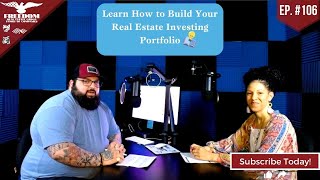
Chris Sonino and Darcy, an investment specialist, walk through building a rental real estate portfolio. They cover rent-to-value ratios, cash on cash returns, and the research and due diligence you need before buying.
Hey, everybody. Chris Sonino here with Freedom Family Investments. I'm joined today with by Darcy. She's our investment specialist. Is that what we're laying on the title changes? Yeah.
Official new name. It was investor relations.
Yeah.
And now it's specialist.
So we're here for another episode of our vlog. This is vlog number 106. Today we're going to talk about how to build a rental portfolio. Interesting. A couple interesting things we're going to talk about today. Let's see, Darcy. The first thing we have on our list here is researching. Let's jump right in.
Okay.
Do your research.
Right? Yes. Figure out what you want to invest in. Whether it's a single family or a multifamily property. Right.
Or syndications or funds or whatever. There's multiple different ways to get involved. One of the things that we always encourage is get involved in groups. I joked today on a meeting with one of our founders that, oh, there's probably a Facebook group for that. It used to be. There's an app for that. Now it's.
There's a Facebook group or YouTube channel or.
Yeah, exactly. So get, get involved in just getting into content, hearing conversations, getting familiar with the terminology. If you're like a bare bones starter, you've never done real estate investing but you heard, you know, somebody at a bar or something talk about how they just close this deal and you know, cash flowing X or whatever and you're like, oh, that sounds interesting. Yeah, get familiar. Get, get involved in some sort of content generation, Whether that's Facebook, YouTube, Instagram has good stuff too. I don't like to advertise tick tock with tick tock stuff.
Local, like local meetup groups too.
True, true.
Investing groups that are local.
True. Yeah. But yeah, just starting getting in there and getting familiar with the terminology.
Yes. Yeah.
A couple. Speaking of terminology, there's a couple things that we use a lot. A couple rules, loose rules to live by. One of them is a 1% rule. We call that RTV or rent to value. Essentially it's a. An equation that calculates what the estimated rent of the property should be based on the value of the. Of the property or vice versa. What should the value be based on the rent? If you're new to investing or all you really care about is that, hey, am I getting a good deal as far as if it's rented and one of them be cash flowing, it's a good baseline jumping point. So we always talk about that. One perfect example is we recently rented a property here Our property management company did for fifteen hundred dollars, I think.
Okay.
And we're trying to assess what the value should be. So we ran basic comps and all that, and we kind of say okay, based on the market. We're saying this, but we want it to be attractive. Right. To our investors. So we look at several different, other numbers at several different indicators to determine how we're going to market that. And one of the things is the, the RTV, the rental value. So in order to get a 1500amonth property to look good on paper, as far as the rental value, we would say it should be right around 150,000. $150,000 as a list price. We don't want to go too much over that because then it drops your rent to value you want to go to below. You go below it. It's fine, fine. But it just makes it a better deal for the investor.
Right. And investors always want, you know, the rent to be size positive.
Oh, yeah, absolutely. Luckily, you know, the market also supports the price at a 150, so we'll probably come just below that just to sell it. But a couple other things you, you mentioned were cash on cash.
So cash on cash. Actually, that's. I wanted to kind of use an example from one of our existing properties to explain that because I've seen as a, you know, looking on YouTube for all kinds of stuff people give random examples of, you know, if the property was at this price, here's what it would be. So, but I wanted to use one of our actual properties, which would be 221 E. Siebenthaler St. So to calculate the cash on cash for that, using our pro forma that you can find on our website, you would use the annual cash flow of the property, and the annual cash flow of that would be $4,670.09. And then you would just divide that by the cash needed to finance the property or the cash that you would be bringing to closing, which if you're using financing that would typically be, you know, around 20% of what the, of what the purchase price would be. So that person or that dollar amount would be $27,025. So your cash on cash percentage would be 17.28 based on our numbers. And like you said earlier, there's not really like a rule of thumb. It's just, you know, it's just kind.
Of what you prefer. Yeah, yeah. Cash on cash is one of those things where different people, different companies and organizations calculate them a little bit differently. The Goal is, the goal is cash on cash is it's a percentage based on cash in the deal.
Yep.
Versus cash returned. Right. So cash, all that.
Right. All the, all the cash stuff. All the cash, what you're getting, what you're putting in.
Yeah. So we calculated, as you said, pretty straight a couple numbers. Just didn't figure it out. Some investors do it differently. I know that one of our sales channels, they. They strip it down, they come back with a whole different number than we even do. And then we have some that add things that we normally don't have. So.
Right. It's hard to figure out.
That's why it's really important. Especially if you're like, if you're thinking about investing with us, do your due diligence, go through the numbers. We share our pro forma with investors before we sell. So you would be able to look at and be like, hey, I don't actually agree with that number. I'm going to tweak this, I'm going to calculate this in. Or hey, this, I'm financing this. So this is actually what my mortgage payment is going to be. So then you can get a real cash flow number. So definitely do your due diligence on that. The one thing we did mention was cash flow. So that's the way we feel about that number is the bottom line number. So if you have X number of dollars in, X number of dollars out, out each month, including management fees and taxes and insurance and all those things, and cash flow is that nice number at the end that you get to pocket. Right. And that includes after you've allocated some funds to set aside in case there's maintenance costs or anything like that. One of the great things about investing with us, and this is something you were a part of when we first brought you on, is we rolled out a warranty package that actually strips down a lot of expenses for investors the first year. So they shouldn't have to even eat cost of anything unless they have taxes and financing.
Right, Right.
We're not going to pay the mortgage necessarily, but the property should do that. Right. The tenant's rent should pay for that. So the first year the performance looks great. You don't have to pay for management fees. There's usually money toward closing costs. Depending on the situation in the property. We cover all maintenance costs. It's a brand new renovated property, so there shouldn't be a lot of maintenance costs anyway.
But things then keep more money in their pocket too.
Correct. Things do happen. So sometimes, you know, there is a cost or two, but we'll cover that for the first year.
Okay.
So that's. That's great. And that also helps the cash on cash and the RTV and all those things.
And our warranty package.
Yeah, exactly. All right, so that's like the basic meat and potatoes. Let's roll back to due diligence and just doing research. There's lots of different investment strategies. You mentioned single family homes.
Multifamily homes.
Syndications, and private money. We're going to go into a little bit more detail on the actual podcast about those specific things. But what's important is that you start learning. You start diving into material, figuring out, talking to Darcy or Ben or cj. They've all been on this podcast as well about the different offerings that we have or that other investors may have or other organizations may have. Figuring out what's the best investment for you. And then you start the process of talking to lender and picking out a property.
Running the numbers. Running the numbers and asking questions and analyzing.
Exactly.
You want to know what you're getting into and that the numbers make sense for you.
Yeah. Luckily for what you're buying, a rental, the contract, the transaction process is pretty much the same. So once you've done it once, you can probably do it a thousand dollars more with a few quirks here and there. You might run an appraisal thing or, you know, inspection thing or.
Yeah, but it's pretty much. Pretty much cut and dry.
Yes.
Find the property that you like.
Right.
You know, send the contract to your lender, and your lender does all the stuff that they need to do on the back end for underwriting. And end, like you said, if there's an appraisal or an appraisal issue. And then you just kind of coast until we get to the closing table.
Right? Yeah. So we have a pretty good team that helps make that as smooth a process as possible.
Cool.
Yeah. So, quick recap. Interested in building rental portfolio or just a real estate portfolio in general? We're going to have a podcast that we're going to record shortly that goes over the specifics on what we just went over a little bit with Sieben$, and a couple other. A couple other situations, as well as talking of like, the different investment strategies a little bit, because it's not one shoe fits all. There's definitely lots of different things you can do. And even two rental port rentals operate differently. So if you like what you're hearing and you've maybe click on some of their material, feel free to subscribe, maybe leave a review if there's something you want to hear about. Maybe we touched on something in this vlog or in another one that you're like, hey, I want to hear more about that. Let us know. Give us some feedback. There'll be a button somewhere on the screen that you'll be able to say, hey, like subscribe. Yeah, we always like to end these things by saying, invest smart and live happy. Take care.
Bye.
Nothing on this show should be considered specific personal or professional advice. Please consult an appropriate tax, legal, real estate, financial or business professional for individualized advice. Opinions and information on this show are not guaranteed. All investment strategies have the potential for profit or loss.
More from Dani











Physicians and High Earners — What Real Estate Can and Can't Do for Your Taxes