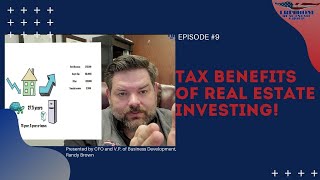
Randy (CFO & VP of Business Development, Freedom Real Estate Group) presents an overview of tax benefits for real estate investors, focusing on depreciation (a non-cash paper deduction), how to accelerate depreciation using cost segregation and bonus depreciation for 5- and 15-year assets, and using 1031 like-kind exchanges to defer capital gains — potentially across generations through step-up in basis for heirs.
Foreign. What's up, everybody? I am Randy. I am CFO and VP of Business development for Freedom Real Estate Group, family of companies. And today I'm going to be talking about the tax benefits of real estate investing. All right? And so if you've seen my vlogs in the past, you know that I like to kind of scooch over to the side and leave a little bit of room for a visual aid here. So hopefully we'll pop something in, but let's get after it. So, number one and everybody's favorite, depreciation, right? Depreciation is my favorite because it is a paper calculation. I do not write a check every month for the depreciation on my rental property. I don't write a check every year. Yet I still get to write off or offset my rental income with the depreciation calculation. Now, depreciation is a recognized expense for the diminished value of an asset over time. Right? So on the surface, that makes sense, but we understand as real estate investors that most of the time real estate does not depreciate, but it actually appreciates, so goes up in value. So we're recognizing an expense even though our asset value is going up. It's a beautiful thing. So depreciation. Now, building on depreciation, there is the opportunity that we could potentially accelerate that depreciation. So realize it faster. When you buy a building, there are things that you buy that aren't necessarily building. And the depreciation period for residential real estate is 27 and a half years. Right. But there are things inside that building that, had we bought them outside of that asset acquisition would have been depreciated on a much faster schedule. You know, there are appliances, there's carpet, there's a mailbox, potentially, there's landscaping. And those kind of things is not depreciated at all. So if you hire someone to do a cost segregation study and parse out the things that aren't necessarily building and classify them into the 15 year and 5 year buckets, then you can accelerate a lot of that depreciation, recognize it much faster. So if it makes sense for you, you can accelerate the depreciation. In fact, again, if it makes sense, you can actually take bonus depreciation right now if nothing changes on some 5 and 15 year property. And so this can be a huge impact when it comes to tax time, especially if you are a full time active real estate investor. All right, so depreciation, accelerated depreciation. And now we talked a little bit about. Excuse me, excuse me. We talked a Little bit about the properties appreciating in value. Instead of going down in value, you may end up in a situation where the value has gone up so much that you just can't help it. You're a buy and hold investor. You want to continue to buy and hold, but this particular asset is just priced out. I mean, it's just the price of command is ridiculous. So you might want to do a 1031 exchange. And a 1031 exchange is a way that you can avoid the taxable event that would be selling an asset. So for capital gains, you can defer that capital gain. You can roll your basis into the new property. And so here's how that works. You do a 1031 exchange, you hire an intermediary third party to collect all of the proceeds from a real estate sale and then you use those proceeds to identify and purchase within a specified period of time, a new property. So I'm not not tasting any of the money, I'm not bringing it into my budget. I'm using the increased value of one asset to acquire another asset. And they're like kind. And so in this situation, the like kind would be rental real estate or income producing real estate. And you can go from a single family to a duplex, or from a duplex to a strip mall or whatever. The idea is it's income producing real estate. Right. And so we can use that 1031 exchange and avoid the tax consequence because we're not getting constructive receipt of the funds. All right? And so actually you can use that tool to potentially defer your capital gains on this forever. And here's how that would work. Within certain limits, there is no estate tax. If you are to accumulate your empire of wealth through real estate. And you, you know, 1031 from one property into the next and then 1031 into the next, and then you are at the level of property you want to be and you stay there. You've 1031 all the way. And now you are at, you're happy with how your portfolio sits, you're not interested in exiting. When you pass your heirs get a step up in basis to the fair market value at the date of death. And so even if I take buy a property all the way back in 2021 for $100,000 and that appreciates to 200,000 and I 1031 into a $200,000 property and then that property appreciates to half a million and I 1031-into-12 a million dollar property and then I'm happy with that. Half million. And I hold my basis. My cost in that is only $100,000. If the fair market value of that property is, let's just say, 750,000 on the date of my passing, my heirs get that as their new basis. So that's a step up in basis. Now that's as of today in our political environment right now that may change, but there are a lot of investors who are using that strategy because the idea of real estate investing is to build wealth in perpetuity. So we hit those on pretty high level. If you have any questions, please feel free to reach out or to put them in the comments below and see you next time.