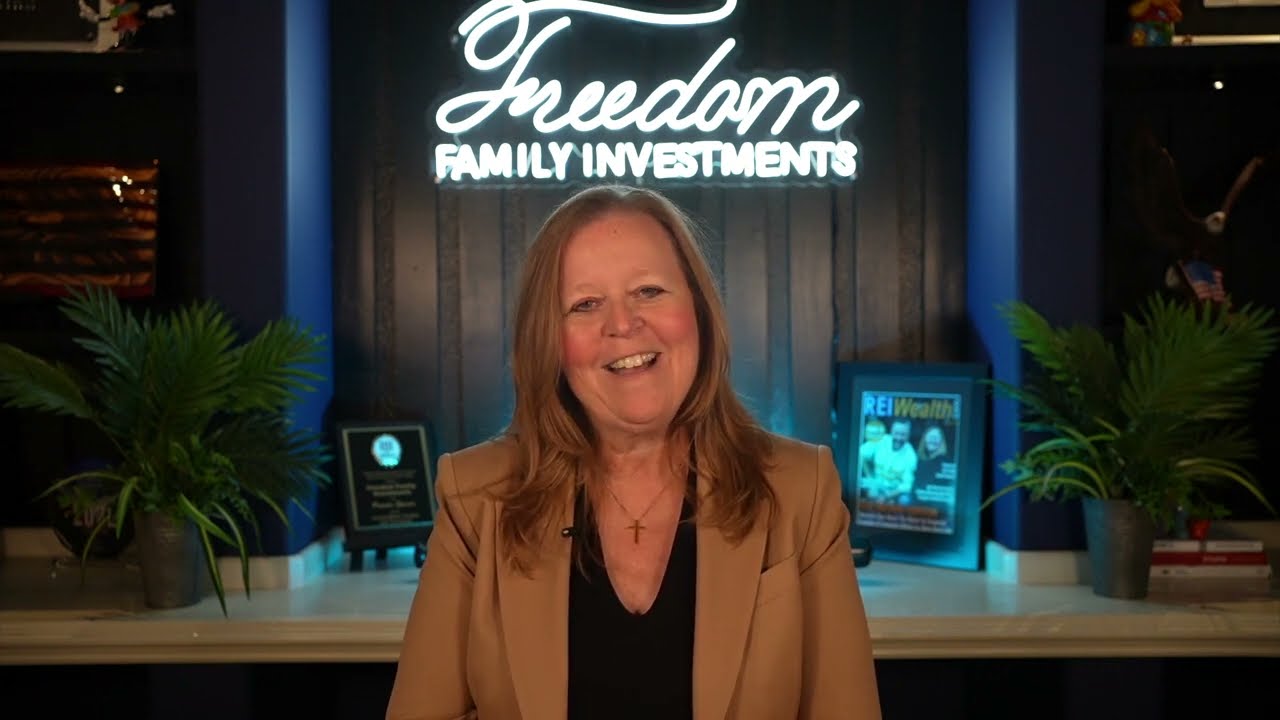
Dani Lynn Robison of Freedom Family Investments explains why the firm owns four types of real estate: workforce housing, senior housing, self-storage, and build-to-rent homes. Each passes a "necessity test" that checks if demand survives recessions. Together they generate stable cash flow through undersupply, demographic tailwinds, and counter-cyclical demand.
Chapters
Your money goes into 4 specific types of real estate, all of them tied to what people need regardless of what the market is doing. So today I wanna walk you through exactly what we invest in and why, not just the categories, the reasoning, because I think the best investment you can make is one you actually understand. Every asset class we invest in has to pass one test before we consider it. I call it the necessity test. Will people still need this in a recession? Will demand hold up when markets are down, when fear is high, when headlines are bad? And if the answer is yes, we invest in it. If the answer is no, we don't. It really is that simple. And every asset class I'm about to walk you through passes that test. That's not an accident. That's the foundation of how we build. The first category is workforce housing, also called multifamily housing or apartments. Workforce housing is not luxury rentals and it's not government subsidized units. It's housing for middle-income families—teachers, nurses, tradespeople, working professionals—who earn too much for subsidized housing and not enough for a luxury building. Here's why we invest in it. People need a place to live. The United States remains significantly undersupplied in rental housing. At the same time, high home prices and elevated mortgage rates are keeping people renting longer than they planned. A slow home buying market doesn't reduce housing demand, it redirects it. More renters staying longer. JP Morgan has reported that multifamily housing historically holds up well in mild recessionary periods because housing remains a necessity regardless of economic conditions. That's the definition of a needs-based asset. The second category is senior housing. 10,000 Americans turn 65 every single day. That number is not slowing down, and the senior housing industry is currently projected to fall 50% short of the units needed to keep up with the growth of the 80+ population. Senior housing occupancy reached 87.4% in the first quarter of 2025. The demand is not coming from consumer sentiment or investor enthusiasm. It's coming from demographics. An 84-year-old who needs assisted living does not delay that decision because the stock market dropped. This sector has 15 to 20 years of demographic tailwinds behind it, and that's not something any market cycle can stop. The third category is self-storage. And I know that one sometimes surprises people, but here's what drives self-storage. Life events, moving, downsizing, divorce, a death in the family, a job change, a business transition. Those things happen in recessions too. In fact, some of them happen more during economic disruptions. The National Association of Real Estate Investment Trusts has reported that self-storage demand is often considered recession resistant. Because the demand drivers exist in both strong and weak economies. Some analysts describe it as countercyclical. That means the harder things get out in the economy, the more demand certain types of storage can actually see. It's a cash flow machine, consistent, operationally efficient, and driven by the kind of human events that don't stop for market conditions. The fourth category is build-to-rent communities of single-family homes built specifically for long-term renters. The American dream still includes a yard, a garage, and a front door that belongs to you. What's changed is the math. Home prices are near all-time highs. Mortgage rates have stayed elevated, and millions of families who want single-family living are making the deliberate decision to rent rather than buy, not because they failed, but because it's the smarter financial move for where they're at right now. Institutional build-to-rent investment grew 27% year over year in 2024, reaching $14.8 billion, according to Major Industry Research. BTR home starts hit 130,520 in 2024. That's a 134% increase compared to 2019. This is not a new idea that might work. It's an established, fast-scaling asset class. These 4 categories look different on the surface, but they share the same foundation. People always need a place to live, a place to age, a place to store their belongings through life's transitions, a place to raise a family without overextending financially. That's not consumer sentiment. That's not a market trend that could reverse next quarter. That's human life, and human life keeps running whether the market is up or down. Our core rule at Freedom Family Investments is simple. If an asset doesn't cash flow in a recession, we don't invest in it. These 4 categories have passed that test for us consistently. That's why they're the foundation of our strategy and the backbone of what backs your Freedom Notes investment. We don't invest in sentiment. We invest in necessity. In each of our next videos, we go deep on one asset class at a time. The specific data, the demand drivers, the supply picture, and how we think about investing in each one. So if one of these categories is the thing that makes this click for you, that's the video to watch. Go to chatwithfreedom.com if you wanna understand how these assets work together to back your investment and what our current portfolio looks like. I hope this was helpful, and I hope we have the opportunity to work together.