The Hidden Game of Wealth: What the Wealthy Know (and You Were Never Taught)
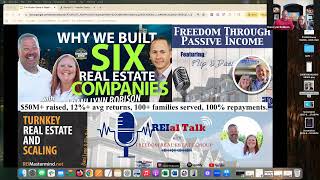
Danny Lynn and Flip explain wealth-building strategies the wealthy use but schools don't teach, contrasting basic advice like saving in a 401k with tax-aware moves like Roth conversions. They cover real estate funds, multifamily housing, and how Freedom Family Investments structures deals for passive income.
Questions this video answers
freedomfamilyinvestments.com/realty411
844-877-0888
Over $50 million
About 12% (they said this is expected to increase with a new fund)
$25,000
Well, thank you. Thank you. Thank you so much for having us. We're so excited to be here.
Yes. And thank you, Linda. We're always excited to be a part, whether it's virtual or whether it's over in California, because we always love to find any excuse possible to have to fly to California. Thank you so much for inviting us and having us do this. And for everyone that's listening, please forgive me because I can't see who's on or I can't see any of the comments right now or any of the questions. So we'll get to those towards the end.
Yes.
But I just wanted to say for everyone that's joining us, whatever time zone, it's 10:00am In California, it's 1:00 clock in the afternoon. It's fall here in Florida. It's college football weekend, and you are here with us. So congratulations to you. I would be telling everyone to give yourself a round of applause, but you know what? Give yourself a round of applause, maybe a high five, because you're here with us today. And that's just so awesome that you're spending time for yourself.
Should give you a high five because it is football season.
It is.
All right, give me some.
I'm not checking scores or nothing.
This is all you.
Okay, so let me ask you something. Why are you here today? For some, it could be for networking, ideas, inspiration. But underneath all of that, why are you really here? The truth. We attend events like these because we're here to learn how to make more money. Myself included. Not because we're greedy, but because we know money shapes everything. Because money equals choices. Money equals freedom. Money equals peace. And, yeah, most people never learn how money actually works. We were handed the wrong playbook. We were told to play checkers, hoping one day to win, while the wealthy are 10 moves ahead of all of us. Learning the rules of chess. That's what we're going to talk about today.
Yes, indeed. So have you ever felt this way? How many of you have ever felt like you did everything right, worked hard, saved, followed the rules and still felt like you're behind? It's not your fault. We've been there, too. It's misdirection. And here's the truth. If you just keep doing what you're doing now, where will you be in five years? Maybe the same stress, maybe the same worry, maybe the same uncertainty. But today, we're going to show you how to finally see the real game. The game that we saw, the game that we learned, the hidden game of wealth. And how it leads to freedom, choices, and peace.
So Danny just talked about misdirection. Magicians make a living out of this. They get you to focus on one hand while the other hand is pulling the real trick. And that's exactly what's been happening with money in America. We've been handed the wrong playbook. Told to work hard, save, follow the rules, go to college, while the real game, a game of wealth, is happening somewhere else. What banks don't want you to know is this. The rules weren't written for you to win. They were written for the institutions. So here's the truth again. It's not your fault. You were groomed to believe the system would take care of you. Work hard, say, put your money in 401k, invest your wall street, buy stocks. Someday you'll retire comfortably. That's what everyone tells you, right? But the system was never designed to make you wealthy. It was designed to make banks, brokers and advisors wealthy while you hope for security inflation. Sorry, where you hope for security inflation silently ate away at your future. And every dip in the market reminded you how little control you really have.
Truth.
And you're playing. You're left playing a game where the rules were never written for you to win. The system wasn't built to set you free. It was built to keep you playing truth again.
So the average American is playing checkers, while the wealthy are playing chess. Same board, different game. And just like checkers, the moves are limited one step at a time. But chess, Chess has strategy. Chess has power and different pieces that can move in different ways. And this is why nice guys or gals, they don't finish last. They're just playing the wrong game with the wrong rules. In the hidden game of wealth, there are only two types of checker players who are moving fast, reacting, hoping for short term wins, but always starting back at zero. And the chess players who are moving strategically, thinking generationally, and structuring their money. So every move compounds into the next. Neither is good or bad, but the rules are completely opposite. That's why the wealth gap keeps getting bigger and not smaller.
So let's look ahead. Imagine you keep doing exactly what you're doing today. Playing checkers five years from now, ten years from now. Nothing has changed. Inflation keeps eroding your purchasing power. Volatility keeps you anxious. Retirement looks smaller, not bigger. And that whisper in your mind says it's too late, you'll never catch up. Or maybe you're in a different place. Maybe you've already tried something different. You've invested in that hot deal or that startup or that fund, and it went south. That sting of loss is still there. And now the idea of risking your money again feels unbearable. This is where most people stop. They let fear win. They let time slip away. But fear feels safe while quietly costing you the game. Said another way, fear feels safe. But fear is the most expensive move you'll ever make.
Truth the wealthy have a different board entirely. Their pieces aren't just savings accounts or retirement plans. They're using real estate, private funds, businesses and strategies most people never even hear about. 13 basic accounts and strategies the wealthy use the banks don't want you to know. And that's where the Freedom Academy path comes in. This is where the hero meets the mentor and the guide who finally shows them the real board. Here's what the chess players know Mitt Romney legally turned $46,000 of Roth contributions into $100 million tax free.
Makes sense.
Peter Thiel grew $2,000 into over 5 billion tax free. Yep, they didn't cheat. They didn't gamble. They just played by different rules. Meanwhile, most people keep trusting the process in their 401k. Same effort, same game board, radically different outcomes. Romney and Thiel show how Roths turn tiny inputs into massive returns. But the chessboard isn't limited to Roths. Freedom seekers use strategies like buy borrow die municipal bonds for tax free income, smart charitable giving to reduce inheritance tax, dynasty trusts for intergenerational control, and even the infinite banking system strategies that let you keep what you make and build for the long game. The wealthy play by a different set of rules.
When I first saw the Mitt Romney and Peter Thiel thing, I said the math doesn't math on those guys. Let's talk about where investments often go wrong. Not in theory, but in reality. First, 401k fees over a lifetime fees can quietly eat away nearly $155,000 from a median family's retirement. Almost one third of the returns. And here's the kicker. Just a 1% difference in fees, say 0.5% versus 1.5%, can slash your retirement by 28% over 35 years. That's the difference between $227,000 and $163,000 from the same $25,000 starting balance.
That's big.
That's huge. Second, market crashes. In the Great Recession of 2007-2009, the S&P 500 was cut in half. The U.S. households lost over $16 trillion in net worth. That's trillions with A t wiped out. And for many families, decades of savings vanished overnight. This is the reality. Fees and crashes are the hidden traps in the system. And this is why so many people feel like they're running hard but never winning. Doing nothing feels safe. But let's be clear. Doing nothing is the riskiest choice of all. Because inflation doesn't care about your fear. The system doesn't care about your fear. Time doesn't care about your fear. If nothing changes, nothing changes.
But here's the proof that the game can be played differently. We're going to share with you a little story. And if you've been with Realty411 for a while, you know who we are, because we love Lynda and we've been with you guys for a while at the events in California and these virtual events talking about whatever it is that Linda said that we could add some value into your lives as active or passive investors. And this time here virtually, we're talking about the hidden game of wealth because it means so much to us and it means so much to us to help people find freedom and to change their story. When we were both growing up, we were both poor. And not poor in love, but poor in money. Poor financially. We had really great families, but we didn't have a lot of money. And I know when I was growing up, I just wanted to find a career, find a path, and where I could make as much money as possible so I could take care of my family, my parents, and all the people that I cared about. And so that pursuit to freedom, that pursuit of wealth is what drove us to where we are today. And we met in a very unique way that we won't get into today or Flip might. You never know what stories he wants to share. But our path was destined to find each other and to build together. I don't know how many of you are maybe husband and wife, and you're listening to us today and you are like us, and you're building something together and you're trying to achieve freedom. You're trying to get to a point in life where you don't have to worry about money anymore. And you can spend your time doing the things that you love, what you feel your purpose is giving back to the people that you care about. And that's where we got, after a lot of hard work of really trying to understand where each other were in life and what we wanted to do and what we wanted to see for that outcome for us, for our future. And we both love helping other people on that journey, too. And so every single time we did something, whether it be investing in real estate or learning a different strategy or something new, we would take other people on the ride with us, and we just share our story. We say, this is what we did. This is what worked. This is what didn't work. This is how much we made. And we'd build these great case studies. And that's why we get on events like these, because many times we're sharing those case studies about our drugs, thugs and bugs apartment complex. That was a huge story. But the reason we got where we are today was through a lot of trials and tribulations, and it was really chasing for many years what we saw as that freedom, the freedom number where we're taken care of. And we feel like we can do anything that we want in our lives because financially, we don't have to worry about the numbers, about the money in the bank account anymore. And I'm really, really happy that we got there. But what we didn't realize at the time was we had freedom back then. We had the freedom right at that opportunity. And we made some wrong moves. But it taught us so much that we get to be on sessions like today. We get to talk to groups like yourself to be able to share what we did wrong, what we did right, and everything that we did wrong, I believe was just meant to be. Because without those lessons, we wouldn't be where we are today. So we're super excited to be here with you. We're super excited to share our story. We're super excited to be able to answer any questions that you have here at the end. But do you want to add anything before I just keep going?
Well, yeah, I do want to hear. Yeah, yeah. So number one, she said that we were both poor. I wanted to make it a little editor's note. So I didn't grow up poor. We just didn't have any money. There's a difference. Second thing is that you used the word destined, that we were destined. And so because you said that, now I have to say the story, because actually, one time we did an event and we did our talk, and we didn't tell people the story. And we were told afterwards that, oh, my gosh, you guys didn't tell your story.
And so, okay, just everybody check your watches right now. Let's see how long it takes.
This is the abridged version. So Danny and I are both going to college in the state of Florida and in two different locations. We didn't know each other, and Danny was working at Disney. And if you look behind us, you see a lot of Disney stuff behind us, because we both love Disney. My office, yeah, Walt is right here over my shoulder. And so Danny was working at Disney, and she was a trumpet player in a group. And when I was going to school in Florida, they said, hey, you need to play. Because I was also a trumpet player, both trumpet players. And so they said, hey, you need to play this one group over Christmas time at Disney. So when I went down there, very first rehearsal, the guy next to me says, hey, do you know Danielle? And I said, no, who's this Danielle person? And they said, they told me who Danielle was. And that was the last of it. Never heard about, you know, that while I was at Disney, three months later, I get on a cruise ship. And as I'm walking on this cruise ship, a Carnival cruise ship, I was going to replace a trumpet player that was getting off that day. And that night in my first rehearsal with the band, the trumpet player next to me looks at me and says. He says, hey, do you know Danielle? And I'm like, oh, you've got to be kidding me. What is this, like a joke? Is there like a camera somewhere? I'm like, this is too weird. And I said, no, why? He goes, oh, well, she just got off the ship this morning. I said, oh, so I replaced her. He goes, yeah. And so he talked more about her. And so I'm always one step behind Danielle. And now it's. Now I'm mad because now I have to meet this person. And about eight months later, a hurricane came into the Caribbean and all the cruise ships diverted to Nassau. And we were in Nassau and we were playing a dance set for the captain. And the curtain opens up and there's no use. I didn't expect anybody to be in there. And there's. The whole front row is full. And the trumpet player next to me taps me on the shoulder and says, hey, remember Danielle that I was telling you? I said, yeah, that's her in the front row. And I was like, oh, my gosh, I finally get to meet this person. I've been following her ever since. And so we get done with our dance set for the captain, and the curtain opens up afterwards and they're gone. And so I was like, I'm not going to let this happen. I have to meet this person. And so I'm in full tuxedo, head to toe. And this is Nassau, Bahamas. Six o' clock in the evening. It's probably 90 degrees and 100% humidity in Nassau. I am running down the pier after her, yelling her name and waving at her, going, danielle, Danielle, Danielle. Now she, if you've been following, has no idea who I am because she's always one step ahead of me. So she turns around and she's like, who the heck is this guy? So anyway, so that's how we met. Our very first time we met. And then, funny enough, two months later, I got promoted to another ship. And when I got on that ship, she was there. And we've been working together ever since. And the name of that cruise ship was the Carnival Destiny. He said it, you're destined. And so that's why I had to tell you the story. And we've been working together ever since, since that. That day on that cruise ship. So now back to the originally scheduled.
Program that actually only took you four minutes.
Thank you.
Everybody else was watching the time. So that is a great story. We love telling it. And it is something that people remember. They always, you know, walk up and just say, hey, we. I've been following you guys for a long time, but we really, really love your story and we love everything that you guys have been through and how much you've shared. So this is just a part of who we are. We really believe in taking other people along for the ride. And we believe in that because we've always hired mentors and coaches to take us along for the ride so that we can learn from their mistakes, learn from their achievements, most importantly, of how they got to where they wanted to be. And that's why we really are here today. It's our passion. Freedom is our passion. Our family of companies. I don't know if it says it on this slide anywhere. You can see Freedom through Passive Income. That was a 365 day podcast that we did. You can see behind us in that picture, our Freedom family of companies right there, that's in front of our office. But freedom means everything to us. And that pursuit of freedom meant for us financial freedom. It had to start there. We had to get to the point where we stopped worrying about money. And once we stopped worrying about money, we started to feel freedom. But reality is that we had freedom originally. We had freedom to just be at peace and to sit and enjoy the life and be present with each other and be present with our family. But we were so busy chasing this idea of freedom, this idea of the goals that we wanted to achieve. There was a lot of our lives that ended up getting missed. And so part of the passion that comes across in Presentations like this for us is trying to teach people how they can achieve freedom and achieve it financially so they stop worrying about money in a different way that we did. We did it on a very active way and it was very, very hard. We now know how to do it in a passive way and we're inviting people to do it in a passive way with us and with tax advantages. So you can compound on those tax advantages and immediately you're going to see us in a slide in a second. How you can turn $7,000 into 2.1 million without putting another penny in. Like those are the secrets of the wealthy. That's how people grow their capital so much without doing a whole lot because they understand how to use certain vehicles and how to play the game right. That's why we're here. That's what we are passionate about telling you. Fast forward to today. We have over $50 million in assets under management. We average 12% returns. That is about to go up because we're just about ready to launch a fund to that's gonna give higher than 12% returns. So by the time we speak again, I think we're coming to California. That is gonna continue to raise up higher and higher. And we're super excited about that because it allows us to help others achieve their freedom. Number we've served over 100 families and the most important thing that I say on podcasts and stages is that we have a 100% repayment track record. Why that's important to me is because we made mistakes. We always make mistakes. We are humans. We are going to continue to make mistakes. But what is important to us is the long term game and the relationships that we have with our investors. Even if we lose money, we do not allow our investors to lose money. That is our historical track record that has proven true over and over and over. I think a duplex might have been the thing that we lost the most money on. We told that story many, many, many times. But our private lender on that particular deal got everything back paid in full and all the interest that they were owed while we lost quite a bit. And why? Because trust is important. Trust is earned. And the relationships over the long term mean something to us. And doing what we promise means something to us. And I think that's something that's really, really important to look in the character of the people that you work with. And so we're going to talk about a few people that have been with us for years, real people like Ben, Christina and Alana, who replaced uncertainty with clarity. And that's really where we came in. But I want to be really clear that we are not the hero of this story. You guys are. We're just the guide. We're the mentor. We're the ones who've walked this road. We've been through the market cycles. We've paid investors on time every time. We've built the systems, the protections and the track record and the transparency. So you don't have to gamble, you don't have to guess, you don't have to figure this out alone, and you don't have to keep playing checkers if and when you're ready to play chess.
Yeah, I don't know how many houses we've done. I could walk you to that duplex. So Alana was playing by the rules that everyone told her to do. She worked harder, sacrificed more time, pushed through the stress. But like many of us, she discovered the rules weren't written for her to win. They were designed to keep her in the grind. Trading hours for dollars. She stopped playing checkers and started playing chess. Instead of being trapped in the grind, she discovered a way to let her money work as hard as she was working. Her story shows us this. When you learn the hidden game of wealth, you don't just grow your money. You get your time, your freedom, and your peace back.
I love those words. Ben and Christina had built a life most people would envy. A thriving consulting business, a successful CPA practice. And by all appearances, they were winning the game. But behind the scenes, they were stuck in the wrong game. Managing tax liens, rental headaches, and endless tenant issues. The very investments that were supposed to create freedom were eating away at their time, their energy, and their peace of mind. They thought they were playing chess, but it turned out they were still playing checkers. Chasing rental income that cost them more in time and stress. Then it returned in freedom. When they shifted into freedom families, real estate funds, they found the clarity and consistency they've always been searching for. And just like Alana, Ben and Christina's story proves when you stop playing the old game and start playing the hidden game of wealth, you don't just gain returns, you gain your life back.
We know the fear you're carrying. For some of you, it's the fear of losing the little you saved. For others, it's the fear of making a bad decision again after being burned before. But fear is part of every heroic journey. The difference between those who stay stuck and those who transform is this. They say yes, in spite of fear.
So like we said before, We're Danny and Flip. And here's the thing. We're not the heroes of this story. You are. Our role is simple. We're here to be the mentors, the guides and the ones who hand you the playbook the wealthy have been using for decades. 10 plus years. $50 million in assets under management, 100% payouts. That's not just a track record, it's a map that you can follow. So let me show you something most people don't realize. Wealth isn't about working harder. It's just about playing the right game. It's about knowing the rules and playing with a better playbook. Using tax advantaged vehicles most people never even hear about. Most people only know the basic accounts, 401ks, Roth IRAs, HSAs. But the wealthy use advanced strategies. Like solo 401s, self directed accounts, opportunity zones, life insurance wrappers, charitable trusts, even owning companies inside tax free vehicles. In fact, there's 13 basic accounts everyone should know if. And another nine advanced strategies that the wealthy quietly use. But if you don't know the rules, you can't play. And if you can't play, you can't win. The wealth gap isn't a money gap, it's a knowledge gap.
I like how you say that. There's 13 basic accounts. These accounts are anything but basic. That's what's so funny about this. Let me show you how powerful and simple this is. Imagine making just one $7,000 investment inside of a Roth IRA and never adding another penny. When this is compounded annually at 10%, it becomes over $2.1 million. Tax free. Tax free. I just want to say tax free one more time. That's the magic tool in the hero's journey. Something small that turns into something life changing. I just want to make sure everyone caught this right. You can start with $7,000 and never add another penny and become a millionaire with the right knowledge and in the right investment vehicle.
And this isn't just about $7,000. If you've got a hundred thousand dollars or a million dollars sitting idle, the same principles apply. $100,000 can grow into millions. And a million dollars can grow into tens of millions. That's the power of compounding plus time. That's why boring long term investing is actually the true wealth strategy. The wealthy don't win by gambling. They win playing the hidden compounding plus time plus the right rules. The wealthy don't gamble, they compound.
But this isn't just about you. What if you started this for your kids, for your grandkids Imagine teaching them how money works and giving them a snowball that grows from for their entire life. By the time they're adults, you've created generational wealth. Not from speculation, not from chasing hot trends, but from steady, boring, compounding. Imagine being remembered as the last person in your family who struggled and the first who played chess with money. That's the power of shifting from checkers to chess. And here's the emotional truth. When you do this, you become the hero in your family story. The one who changed everything, the one they remember as the last of struggle, the one who started abundance for generations. You may not come from abundance, but abundance can come from you.
So powerful. Picture this. You wake up in the morning and instead of checking your account in fear, you feel peace. We've been there.
Yeah.
You feel confidence, redemption, legacy. Your story changes from fear and scarcity to abundance and freedom. You stop worrying about money. You stop second guessing yourself. You spend more time with the people you love because you've bought back your time. You provide for your family and those you love without hesitation. You give generously without checking your balance. And for the first time, you feel like your money is working harder than you are. There's more than enough. And in that moment, you feel powerful. You feel smart. You feel good enough. You feel deserving and loved by the universe because you're no longer struggling. All because you took the step in the face of fear to change your story. You didn't just change your future, you changed the future of all those you love. You are the hero of this story. That's freedom. That's safety. And that's peace. And above all, that's abundance. Knowing there is more than enough for you, your family, and generations to come. That's the treasure waiting on the other side of this journey. And today, you've been handed the playbook. You may not have been inherited wealth, but you can be the one who creates it.
At some point, the pain of doing nothing becomes greater than the fear of taking that step. This is that moment. You can keep your money idle in the bank, slowly watching it lose value, or you can put it to work. This is the fork and the road. Stay where you are and keep playing checkers, working hard, moving fast, ending back at zero and living in fear and regret. Or you can play the hidden game of the wealthy. And this. And step into the chessboard, where every move builds on the last. Where you keep what you create and where you finally win the game. Because now that you've peeked behind the curtain and you know the truth. There's no going back. The choice is yours. But know this. When you change the game you play, you change it not just for you, but for generations to come. You are the hero of the story and your wealthy family begins with you. If you're ready to stop struggling and worrying about money, if you're ready to change your story and be the hero your family deserves, we want to take that step with you because we've been there.
So most investors feel stuck in the same cycle, working hard but never getting ahead. But what if there was a better way? A way that doesn't involve risking at all in the stock market or sticking with Low return 401ks our hidden game of wealth guide is here to show you how everyday families are unlocking financial freedom with simple, predictable income streams. From real estate investing to building passive income through needs based assets, this approach is designed for long term stability and growth without the jargon or high risk. So what I want to do right now, before we get into this next part, is just explain to you a little bit about what will happen if you're ready to take that next step. We have freedom coaches who will sit and talk to you, no obligation about your freedom number. Your freedom number is the key to time, choice and true independence. When you reach that freedom number, every day becomes the day you choose. That's why financial freedom is so important to Flip and I, because it's the first step of feeling the freedom that we've all been searching for for such a long time. So we want to help you figure out that path and unlock your financial freedom. We've told you our story and we've told you our road of being on these webinars and being a guest in California at the events. Talking about our drugs, thugs and bugs, talking about our turnkey rentals, talking about our journey in real estate. Between being an active investor and passive investor, we're now helping people gain back their life, gain back their time, gain back their peace. It really is about freedom, safety and peace for us. It really is about freedom and abundance and being able to live the life that you were meant to live. And we want to take all the pain and all the work that we have gone through as active investors and invite you to be a part of a fund where we're actually doing all the work continuing because we've built, I think in total, nine companies over time and we know how to do the work. And now we invite people to invest passively and allow their money to work harder than they do to compound over time to allow them to get on a path and have a roadmap that's going to take them to their freedom number and beyond. So, so that they can start living life on their own terms and make the choices that are going to give them the joy that they deserve. So to help you unlock your financial freedom, this is where you're going to go and we're going to stay on and answer any questions that you have. You'll visit freedomfamilyinvestments.com realty411. So that again is freedomfamilyinvestments.com forward/realty411. Or you can call us at 844-877-0888. That's 844-877-0888. I know nobody gets on the phone these days, but we will answer the phone. Our team will answer the phone.
Can I call you from my my phone in the kitchen? I do want to make one quick mention because somebody asked me about their freedom number the other day and asked, do we tell them what their freedom number is? So this is something that when you call in, we're not going to tell you what that freedom number is. We're going to ask you questions to find out and to help you get to your freedom number. We don't tell you what your number is. We find out what your number is by asking you questions. But then we help you get to your freedom number. We don't create any of that.
Yeah. I love it. So we are here to hang out with you guys. If you have questions, you can ask us anything. Doesn't have to be specifically about this particular presentation. We're just here because we care about you. We love Linda and we're here. So feel free to throw anything in the chat and we can answer anything that you want.
Well, wonderful. That was a fantastic presentation. Danny, Lynn and Flip, thank you so much.
Thank you, Linda. We're so excited. We love being here with you.
Awesome. Well, we love having you. And I want to open it up to questions. So, folks, if you have any questions for Dannielyn and Flip, now is the time to ask it. If you want to know, you know what they're focusing on. If they have any tips for your particular situation, we are here for you. So be sure to let us know what questions you have. You can go ahead and put them right on the chat and we will answer your questions. And don't shy. We're here for you as well.
Yes. I love it. And by the way, Hi, Eric, Stephen, and Mike. Because at least I did see your chats. Thank you for chiming in, even though.
Stephen's from Notre Dame, Indiana.
Oh, you know, come on.
I had to throw that in. It's called. It's football season.
Yes. Welcome, everyone. It's a pleasure to have you here. Joining us from around the country now, Danny, lan, and Flip. I'll go ahead and start it off with the question. In your experience, what do you think has been one of the most important lessons that you've learned about investing in real estate that you can share?
Yeah, for me, gosh, it's really. I'm going to say trust. I'm going to say real estate is a tough game, and there's people out there who say one thing and do another. And I can't tell you how many times we have been in situations where we lost money, not because we didn't understand real estate. We were just trusting the wrong people and we didn't do our due diligence. And that's why, Linda, we come on webinars like this with you and go to your events because you're somebody in our circle that we trust. So when you're looking for those people that you trust, it really helps to find somebody that you feel complete and total trust with and ask them for references. Because we've all been in a game for a really long time, and we now know the good players and the bad players. And if we meet a player that's new to us, we're doing a lot more due diligence than we did at the very, very beginning. So for me, I think that's the biggest lesson is when I was first starting out, I just simply trusted everybody. Not understanding that the world of real estate is actually harder than most things in life. And I don't know what it is, but it's just. It has a lot of bad characters. One of our investing clubs, bad actors. That's what they say. That's like, he's a bad actor. It's our way of saying, don't. Don't do business with him. So I would say find a mentor. Find people that you trust. Keep attending events like this that Linda's putting on. That's my biggest lesson. Do you have one?
I was trying to think of something better than that, and there really isn't. You know, yeah, we've lost money because of bad deals, but we've done other deals to make up for that money. It's that trust that you can't. You can't put a Price on them.
Yeah, but don't let fear stop you. Yeah, right. Yeah, you. There are people that are trustworthy in this space. Just do your due diligence, Talk to people like Linda, talk to people like us. We'll help guide you as best we can.
Oh, yes, I totally agree with that, folks. I mean, let's get one thing clear. Real estate is not a quick, rich, quick scheme. The ones who are successful in this industry, they've been added for a long time, some even decades. Like, like I have. I mean, I've been an agent for almost 18 years now and an investor for as long. It's not a quick, rich, quick scheme. A lot of times, you know, people get anxious when they don't make money right away or they start saying, oh, it doesn't work because they're not a multi millionaire in less than a year. And you know, that's just not the way it works, guys. It's a long term effort, a long term investment. And yes, you do need to align yourself with the right people that you do trust that know more than you do and that have been in it for such a long time. They're not, they're not, you know, gonna like take advantage of one person and ruin 20 years of a wonderful reputation. I mean, that's just, you know, the smart people in this industry, they know that, you know, trust is everything. What you say matters and they're in it for the long haul. So, you know, and I commend Danny, Lynn and Flip for sharing this because a lot of people don't talk about it enough. That there really needs to be more trust in the business and more transparency. I think it's so important.
I agree. One of my favorite questions that I tell people to ask is tell me about your worst deal. What happened to you and what happened to your investors. And I think that's a really good question to start with. Obviously you should be asking about their experience and their knowledge, how long they've been doing it. Like there's a whole bunch of general due diligence questions that you're gonna hear from a lot of people that I don't have to go through and repeat that. But a question that doesn't get raised a lot, and that I think is the most important is having people talk about the bad stuff. Because the bad stuff happens to us all, all, no matter what. If you're in real estate, be prepared for lawsuits, prepared for bad deals where you lose money, be prepared for walls that you peel back and have more than you anticipated. When you did your rehab budget, just be prepared for it. And if you prepare in that way, then you understand at a different level exactly how to play the real estate game and how to win. And when you're starting out, aligning yourselves with people who have that knowledge and experience can help you just save lots and lots of time. And then secondarily, I will say understand and ask yourself whether you truly want to be an active investor versus a passive investor. Because a lot of people go into investing as an active investor investor thinking that that's, that's the way they have to get into real estate. I have to become a realtor. I have to go do a fix and flip. I have to own a rental property because it's what they hear the most. Right. But that's not true if you don't have the time. That's actually where you end up going down a wrong path, losing time money. When you can learn about passive investing routes and do your due diligence and making sure that you're aligning yourself with somebody that you trust. So I know in California, we actually did a full presentation of this map of like, here's the active investors and here's your passive investors and here's all the strategies. And we went through that and man, like, we had so many questions as we went through that because it was such an eye opener. I think that's just another thing that I think is important to pursue.
Yes. And can you, for those investors that may not be so familiar, can you talk about the difference between an active investment and a passive investment?
Absolutely. So an active investment would be, I'm going to do a. Okay, I'm going to tell you three things. Active investment would be a fix and flip. I'm going to go buy a house and I'm going to renovate it and then I'm going to put it back on the market and sell it for a profit. That's active. You're actively doing things in order to make money. A passive investment is I'm going to be a private money lender or I'm going to invest in a fund or a syndication, something like that. I'm going to give my money to somebody else who is an active investor and I'm going to passively earn a return. I'm going to give them my money, they're going to do the work. I'm not active. They're active. I'm just getting the mailbox money, essentially, that's passive. And then right in the middle, I'm going to put rental Properties. Because a lot of people think rental properties is even turnkey. We have done turnkey real estate. A lot of people think that's passive. It is a mix of passive income and a mix of active. Because in order for your rental property to perform at the level you want with passive income, you need to actively manage it. If you have a property manager, you need to actively property manage it. Because tenants and toilets are a real thing and that's the active part of rental real estate. So I always feel bad when people think they're going down the passive route doing rental properties and then they learn later. I just, I still do have a job. Even if I have a property manager, I'm actively managing that property manager.
I believe we call that class actively passive.
Yes, exactly. You made up that one. Yes, I remember that you're actively passive. So I see Eric, here you said which asset class does your fund invest in? How long does it hold for minimum investment? So those are good questions. So our fund invests in needs based recession resilient properties. So we classify that as multifamily, workforce housing, senior housing. Three things that no matter the cycle of the market, those are still going to be very needed. So we aren't dependent upon a good market to make our return. How long is a hold for? We actually are doing something really, really unique in the real estate space and it turned out to be the most popular thing. We are launching the new fund to capitalize on exactly what that does. The hold is actually one year. And when I say that, people are like, what? What are you talking about? You're doing senior housing and multifamily and workforce housing, build to rent, things like that. And it's one year. So what it is is it's auto renewable note. So it's a fund of promissory notes that allows you at any given time to grab your money within a year. You have to give six months notice. We have Marva, it's accredited and non accredited. I'll get into that in a second. You have to give six months notice to get it out. So all that is explained in the promissory note. But here's what happens. People go in wanting liquidity, they want the safety and the peace of mind that I can take this out if I want it. Because real estate just doesn't do that. You're usually locking up your money for three, five, seven years, sometimes more. What turned out to be the most popular thing that we ever created was a five year auto renewable note. And I told our investors when they were Private money lenders. I said, do you want to do this instead? Now you're not going in and out of the deals that we're doing and having your money sit with you, not earning anything. Would you like to do this program? And I worked with an attorney to create it, and it was actually one of my investors ideas. And they're like, oh my gosh, this is brilliant. So I have the liquidity that I want, but I can keep it in there. And I would say over 90% of people keep their money in there the full five years. It's the peace of mind of being able to get your money out that you actually want. You want to know you can grab it if you want it, but in the end you're like, no, that's earning so much money. I don't want to touch it. Like, I love it sitting there. And so that's the lockup. Minimum investment is $25,000. And then to go to Marva's question, it's we have accredited and non accredited. Let me explain that. Non accredited is our masternotes program. This is where the fund is built off of. That's the most popular vehicle we've ever had. We allowed accredited and non accredited to go in. It is a promissory note program. So we didn't have to build a fund in order to do it. But we have separate bank accounts for every single investor. Now we have gotten to the point where we've got so many bank accounts, we're like, okay, we actually need to build a fund and put our accredited investors in the fund. It's a 506C, so we are allowed to talk about it. So all of our accredited investors go into the fund and then our non accredited investors stay with our masternote program and they have a separate bank account, similar terms, but it just makes sure that we can open up the door to everybody who would like to participate in a different way that follows SEC guidelines and all the rules that we need to abide by in order to make sure that we're serving you in the best way possible. There is no fees. There is no profit sharing, so we don't have fees in the fund. What you earn is exactly what you earn. That's another reason why it's so popular, because it's really straightforward and simple. So many times you'll get into funds and it's very confusing. There's hurdles, there's waterfalls, there's all of these things. There's equity pieces and you don't actually know how much you're Making. So in our fund you're going to be able to learn about it from our team. But there's two series and the series is dependent on how much you invest and if you want quarterly distributions or if you want it to compound. And so the range I think goes from 8, 16%, I think in those two series. So it's really incredible. It's one of the most powerful things that we've ever done. It's very simple, straightforward and yeah, talk to our team to learn more because absolutely, hands down, we've rolled out many different things listening to our investors and what they want. And the masternote program was the most popular. People are like, yes, yes, yes, yes. And then so we created the 506C fund to essentially mirror that and really do a little bit better.
I think I remember showing a friend of mine because I told him the same thing, that the options are quarterly distributions or compounding. And I showed him what the numbers looked like if they did one or if they did the compounding. And he looked at me and says, why would anyone not compound the power of compounding?
Hidden game of the wealthy. So, yeah, yes, it's a minimum one year hold. So you're going to go in and on the promissory notes it tells you exactly when to give us notice if you want to get it out in one year. So it is real estate still. Right. So everybody understands real estate is not liquid. So we do have to plan. So I think it's six months notice. So you're going to put it in and then there's a date in there that says please notify us by this date that you would like it out. So that way we do all of our redemptions at one time. So you notify us by that date and then you get it out. So you'll have to look at the documents or ask the team exactly what the details are. Like I said, we are still. I think our new fund goes live next week. It's already been approved by our attorney. We're just creating the bank accounts and stuff like that. Masternote program has existed for years and years and years. So yeah, talk to the team and then, yes, you choose between. Even in the masternotes program, which is for non accredited investors, you choose between quarterly payouts or the reinvestment. Yes. So once you choose though, you're done. If you have $100,000, you could do 50,000 where you're getting quarterly payouts and 50,000 where you're doing compound. So elaborate more on quarterly and compound interest. So let's just say you go into the fund and you're getting 12% interest. You could, in my example, for $100,000, you could say 50,000 of this 12% annually. Let's say 200,000. I'm trying to do easy math. So you have $200,000. You say $100,000. I want invested and I want quarterly payouts. So that means on $100,000 at 12% interest, you're earning $12,000 a year. Right. So divide $12,000 by four is $3,000. I just want to check my math. That means every quarter you're getting $3,000 because you're getting that $12,000 on that $100,000 invested on the other hundred thousand dollars. You put that in and you said you want to compound interest. That means every single quarter that $3,000 is being reinvested and now your interest is earning interest again. That's the power of compounding. And when you realize and you see that math, that's when everybody's just like, okay, there's just, that's why sometimes people will split their money because the power of compounding is just so much more appealing that they're just like, it's a no brainer.
So just. And I just want to explain that just a little bit better. So the $100,000 compounding at the end of the first quarter, the $3,000.
Yep.
So now it equals $103,000 for the compounding? Yes, yes, for the compounding. And so then at the end of the second quarter, you're earning the 12% interest on $103,000. And then that 12% on that $103,000, which I know this is not the right math, so please do not get mad at me, but let's say it's another 3,000. So then the next quarter you're making 12% interest on 106,000. But it's actually more than that because the interest on that and it just keeps. It's. It snowballs. And it snowballs quickly. And if I know we created an Excel form or whatever that show that shows you, because I wanted to see. Because the first time. I wish you could have saw my face. Because we put this was a number of years ago when we first did this and we put a large amount in there. I didn't look at it. And like three years later I said, oh yeah, let's see where we're at. And I went, holy, it moves quickly.
Yeah. So as he just said, we are investors in our own Master Note program ourselves. Yeah, we love it. All right, any other questions? Thank you. Mike and Marva and everybody else that asked those questions. We love talking about it.
Yes. Mike also wanted you to please elaborate on the quarterly. Oh, did you already do that? On the quarterly interest. Oops. Reading everything. Sorry about that. Great folks. Let us know what other questions you have. You guys have amazing questions.
Yes you do.
So thank you so much for these fantastic questions. Questions. Now Mike would like to know what are you currently focused on investing in?
Yeah. So if you're going to talk about us personally, we invest in our own funds and masternote program as well. So we do what we tell you to do. I think that's so important. I don't believe in a lot of the other investments. I will tell you. Flip tried crypto and, and he still has, I want to say like I don't know, a very, very small amount in crypto.
I have 0.0005 of Bitcoin.
But we do what we, what we preach. So all of our personal, personal money is invested in our businesses, in our, in our real estate funds and masternodes and things like that. So that's what we do personally. Our fund and masternodes are invested in multifamily senior housing. We're starting to do build to rent. We've built out the portfolio of exactly what we're investing in and it's going to be written in the PPM. For those of you who see the 506C, you'll see all of the guidelines. If you're investing in the master notes, just talk to our investor relations team and they will tell you exactly what we're investing in. But it's really needs based recession resilient properties. And we say it that way because for example, a multifamily A class building is not something we're investing in. Cash flow is important to us. But sometimes when you get in those A class and the market starts to go down, sometimes depending on the market that you're in, depending on the city that you're in, sometimes that asset may be affected by it. I think that happens more in single family than you're going to see it happen in multifamily because multifamily at least has forced appreciation. So there's that factor winning for it. But we're just very careful. It doesn't mean we're not going to invest in an A class multifamily. We're just very, very careful to make sure that what we're investing in it doesn't matter where the market's going, it's a stable investment no matter what needs based means, workforce, housing, what's around it, what are the jobs around that particular area and is that going to be needed long term or is this an area that has got a plant that is the only thing of its kind? If that industry goes down with AI for some reason, then that particular piece of real estate may be at risk because it was the only thing supplying jobs for that particular multifamily building. That would be a red flag for us. So that's what I mean by needs based is we're really looking at each asset based on what does it look like over time, how much is it going to perform, can it cover the returns that we've promised our investors for? First and foremost, because you get paid first. So that's something that's important to us too. You get paid first, then we get paid. That's why when we lose, we lose. We gotta pay you. And we just lost money on this investment. That sucks. So we don't lose very often. We always play the volume game. So when we lose. When I say volume, when we were doing turnkey real estate, I always use this example. I said, hey, for every 10 deals that we do, we know and we plan on probably losing money on one to two of them. So 10 to 20% of the time we're going to make a mistake or we're going to not know something that's behind a wall. And we're just honest and transparent about the fact that that's real estate and we know that going in. So we're going to do enough volume that we can win more than we ever lose to make sure that we're paying our investors and actually making a profit ourselves. So I hope that answers your question. Okay, tell us about your first transaction. What is the biggest transaction you have done? Okay, so I'm going to answer the second one. The biggest transaction, because it's top of mind, was a 384 unit in Daytona Beach, Florida. And I think we bought it for around. No, it was a recapitalization, which means essentially that we bought it and refinanced it. So there was a Lloyd Jones, if you're familiar with multifamily real estate, he's been in the business for like 40 years. He's an operator. He used Wall street money and his Wall street money was very, very expensive. So we came in with cheaper money, recapitalized the loan, and then I think in 18 months we sold it for like $56 million. It was top of the market. Thank you, God. Good timing. And we knew that, like, things were getting. We're either holding it for a really long time or selling it right now. And so the right buyer was there, made the offer. And so we went ahead and sold that. That's the biggest deal that we did. And then the very first deal. So when we learned real estate, we learned from Phil Grove out of Austin, Texas, and we learned 12 different ways to buy and sell real estate. And so as realtors, we were doing short sales. As we transitioned from realtors into investors, we started doing assignments. And so it's a little bit like a subject to wrap, if you're familiar with those. Except for this time, instead of wrapping it, we're just going to broker a subject. Subject to deal, essentially. So I'm going to say, hey, flip, you can't sell your house. It's $100,000. If you agree to sell it to me for the loan, then I'll be responsible for it. I'm going to assign it to another buyer who's going to give me a down payment and then they're going to pay your mortgage. And so we did those as our very first deals. It was back in 2008 when we got into real estate. So that was perfect for that market. So what I love about our journey is that we have been through the ups and downs. And I think that's one of the due diligence questions that you need to be asking when you're talking to people that you're working with is have they done real estate in a down market and what, what, what strategy do they do? Because as the market swings, we're doing needs based, recession resilient real estate so that we are not so worried about the up and down roller coaster of markets. But when it happens, you have to have the knowledge and experience to be able to know exactly where to pivot. So we have that. We started when it was down and we did subject to wraps, we did mortgage assignments was the name of it from Phil Grove. We did short sales as realtors. So that was our first journey when we started out. Mike, great question.
I could drive you to that house too. I know right where that house is.
And then Nicholas asked, what makes a senior housing project work? That's a great question that I really. If you want to talk underwriting, I'm going to lead you to my fund manager. He does all of the underwriting. But for senior housing, we know the silver tsunami. So for me, if I'm going to talk it at a very high level. We know that senior housing is continuing to grow and continuing to be an opportunity where high income people want to take care of their parents. Parents, and they want to take care of their parents close to them. We're actually in this boat. My mom recently passed away, so I didn't have the opportunity or need, I guess, to ever have to put her anywhere. But my dad is now moving close to my, my, my sister. And so I say that because family means something to most people. And when you're in a position to be able to take care of your family, you want to put them somewhere because you still have to work and the burden on caregivers is intense. And so the senior housing is one of those niches that it's just getting bigger and bigger and the need is getting greater and greater and greater. And so we're investing in not investing. We are partnering with best in class operators of those facilities. And I will tell you a deal where we said no to. So we were in a senior housing deal. So I told you about Lloyd Jones on the biggest deal. You said Daytona beach, right? That was a guy who's been in the industry for 40 years. So I'm gonna, I'm gonna say this, I don't want to talk bad about anybody, but I'll say it this way. So 40 years he's been an operator using Wall street money. Like he's got a track record like nobody's business and he knows how to do deals. And it just, that's why we partnered with him on that, that Daytona beach deal. And it was a home run. We were getting ready to do another deal with another great operator. And it was a senior housing deal because we believe in the senior housing market and have it for a long time. And this was an operator that had been in senior housing for a very long time. They're like in like, I want to say five or six other markets. Really, really great track record. They were going into this new market and it was already managed or managed by Best in Class Senior Housing. I can't even remember the name of the people that were managing it. But we did all the research and we were like, bam. Like, this is a deal that we are willing to do with you. And so we started the process, I want to say, like it was a couple weeks prior to closing. They decided that they were going to let go of the existing team that was managing that facility and have the history in that particular market and they were going to do it because they had experience, just not that market. And so it's something so very small, but big enough that we pulled out because even though you had experience in that industry, you didn't have experience in that particular market. And there was just something about that that, you know, when you get that instinct or that gut feeling, there was just something about that that didn't feel good. And we were going to put our money or our investors money into a situation that we didn't have full 100% faith in. And so we pulled out. And so that's the senior housing. I hope that actually answered your question and told you a couple examples of why we do deals when we don't do deals, why we might pull out last minute and how much. How important it is for us to believe in the project ourselves. Any other questions?
Wonderful. Well, such great information. Thank you so much for sharing your journey with us. It's quite incredible and I commend you for working hard and staying humble. Just. Just like your. The artwork in the back says, be kind. Oh, be kind. I love it. I love it. So important. Such great information and such wonderful, wonderful statements to make. Mike Chandry says. Thank you, Linda. Wonderful couple. Yes. And I would encourage everyone on this call making a point appointment with Flip and Danny Lynn. They're so knowledgeable in what they do. And if you're considering investing in real estate at this time, I would encourage you to talk with them, see if one of their opportunities is right for you. I just think they're wonderful people. They really know what they're doing. And, you know, I'm. I'm all about promoting people that I personally like and believe in. And, and this is why I wanted to host them and to share their journey with you. So I hope that everyone here can go ahead and make an appointment with them. Marva says thank you. Definitely love to talk to them. Marva, great. Make an appointment with Flip and Danny Lynn and you will not be sorry. So please, everyone, thanks for joining us today. Really, really wonderful webinar. Dannielyn and Flip, thank you so much for your time. It means so much to us because we know that you're really busy. It's a Saturday. You could be doing a lot of fun stuff and you took time away from your schedule to be with us. So we truly appreciate you.
It's our pleasure. Thank you again for inviting us.
Of course. So go ahead and make an appointment with them, folks. And we're going to be sharing this video on our YouTube channel for. In case you want to show it to your spouse or an associate who's also thinking of investing. So thank you so much for sharing this video with your friends and your sphere of influence so we can get even more people to know about Danny Lynn and Florida Robinson. So thank you again for everyone. Thank you, Danny Lynn and Flip and go have fun and enjoy this wonderful Labor Day weekend.
More from Dani











Physicians and High Earners — What Real Estate Can and Can't Do for Your Taxes