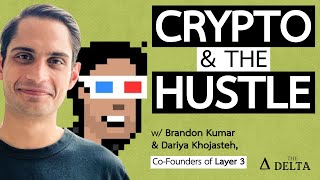
Web 3 Founder Spotlight: Dariya Khojasteh of Layer3 on the Future of On-Chain Marketing

In this interview, Layer3 founder Dariya Khojasteh shares her unconventional path into crypto, sparked by early experiences with censored payments and digital advertising, which led her to envision an open, pseudonymous on‑chain advertising ecosystem. She explains Layer3’s core product: a consumer‑facing hub that matches token‑issuing protocols with users through performance‑based incentives, distinguishing brand marketing (impressions) from performance marketing (action‑based rewards). The conversation covers Layer3’s token economics—using the L3 token as a unit of account, fee‑discounts, and staking requirements for protocol distributors—along with moderation and future governance plans. Dariya reflects on fundraising timing, the importance of hiring slowly, and lessons about product‑market fit, emphasizing the need to avoid over‑servicing large customers at the expense of broader roadmap. She describes user segmentation (hunters, gatherers, farmers) and the platform’s role as a “Google‑like” entry point for on‑chain actions, highlighting cross‑chain support (32 chains) and plans to expand to multiple VMs. The interview also touches on the rise of AI agents versus human users, the shift from vanity metrics to substantive value, and Layer3’s new Launchpad product for long‑term, targeted token campaigns. Throughout, Dariya frames Layer3 as the emerging efficient distribution layer for crypto incentives, drawing analogies to credit‑card reward programs and traditional ad platforms.
Chapters
Hello everybody.
I have an amazing founder here, Dariya Khojasteh from Layer3. Thank you for being here, man.
Thanks for having me. I really appreciate it.
Indeed. So I'd like to start off with your origin story, Dariya. How did you get into crypto?
Yeah, I have a kind of a non-traditional one. So I got into crypto because during my teenage years I was building random products on the internet. And those products were mainly iOS games and apps. And, you know, as a kind of an indie app developer in the, you know, my early teenage years, I was debanked by PayPal. And I was very frustrated by the fact that, well, I've just been censored at the ripe age of 14. And I was hanging out with other programmers on the internet. And when you're hanging out with other nerds on the internet, you're probably familiar, you find out about crypto very naturally. And so I first really got into crypto when I was about 16, when I just began to understand, or sorry, 18, when I began to understand the concept of Ethereum as a world computer. And I was building these iPhone apps. I had to market these apps. So I was building social media accounts and sitting in many ads managers on the internet. You know, Facebook Ads Manager, Reddit Ads Manager, etc., driving incremental downloads. And what really fascinated me about Ethereum was the promise of this new internet where activity was all open but still pseudonymous. And what that— what really fascinated me about that was I had spent days building targeting in these ads managers trying to get my product into the hands of very relevant users. And if all of that data was open, I'd be able to do that significantly more efficiently. And so, you know, the real salient point for crypto that I became very captivated by was this idea that you could advertise really well to a pseudonymous audience. And I know that's not like particularly sexy to many people in crypto who might say, okay, decentralization was their main thing or settling value across borders. But that was what opened the door for me to really try and understand, well, what does an internet look like when all activity, all data is open? Though you're not saying, you know, I'm Dariya Khojasteh on the internet. I'm this string of numbers and addresses that, you know, you can come to me, you can understand who I am without knowing who I am.
Yeah, which I found very interesting. There's an open, transparent method to see all the transactions I've made, which clearly show that I care about certain asset types and specific types of transactions on specific apps.
Exactly. Yeah. And it's much less predatory because that data is all open, which means, you know, any new platform can access that data, say, okay, if you're very into NFTs, then I might target you with an NFT-related product. You're very into gaming. I might target you with gaming-related ads.
And so then you realized marketing advertising could be completely remade based on people's on-chain activity. Let me hear the way the dots connect. Then how do you get to Layer 3 from there? What's happening between that recognition and say the company incorporation?
Yeah. So when The distance between those two events was about 4 years. I was in school, I was in college at the time, and I didn't really plan on starting a company immediately after college, but it just so happened that I met a DeFi founder right after DeFi Summer. And what we were—
He was crying.
He was crying, yeah. He was crying. He was a very young guy at USC. We just bonded over the fact that all of these teams are issuing these tokens. These tokens are creating customer acquisition, like dollars out of thin air essentially. And they're distributing these tokens via liquidity mining, via airdrops, et cetera, to acquire users, to acquire and retain users, which is all marketing really is. And so when we set out to, When I started Layer 3, it was because I was working with this guy to understand, well, hey, we have all these tokens as a treasury. How do we distribute these tokens to serve company goals? Is that brand marketing? Is it performance marketing? And what we realized is there's going to be 100,000 of these companies, each with their own tokens, that are all going to be used on customer acquisition costs. All of these tokens will ultimately get distributed for either brand marketing or performance marketing in some way or another. And the difference between brand marketing and performance marketing is brand marketing is impressions. It's emotional. It's, you know, FTX Arena. It's, you know, the Tezos sponsorship of a, of a Ferrari or of the, the F1 team. And performance marketing is, hey, take this action and I will, I will pay some amount for that action to, to happen. It's, it's all based on conversions. And if you're able to facilitate deploying this token in return for some valuable protocol action that drives revenue to a protocol, that drives user acquisition to a protocol, and that connects a user with the right product at the right time, then you've served a very, very valuable need for the ecosystem, which is, hey, we have built all these very cool things, we are trying to get in front of users, how do we make that happen? Oh look, we have this giant pot of tokens that need to be used for some productive, you know, use case in the ecosystem. And ultimately you decentralize your protocol at the same time that you make it succeed a little bit more, which is where Layer 3 sits. You know, we have consumers coming to our, you know, our front end, which is essentially a consumer fund hub. And on the other side, we have protocols that are distributing incentives either on-chain or off-chain sometimes. To actually make valuable protocol actions happen.
Have you thought about performance-based or action-based marketing or advertising that is not distributing tokens but rather displaying something, right? Where you can airdrop a token specifically to those wallets that have performed an action. Did you rule that out? Did you evaluate that at all? What was your thinking around that advertising based on on-chain actions?
Just to clarify here, this is targeting users based on the things that they've done, but not necessarily with tokens.
Yes.
You know, we started out that way because we realized how could we convince people to distribute their tokens through us if we have not bootstrapped any basically like ability to to target these things. And so what we did is, you know, we were what I like to think of the first points program. You know, we've had XP since day one on the consumer side of the platform, and users, you know, it's worked very well. Users come back, if you look at our leaderboard, 800 days in a row, which is nearly since the inception of the company, because we've given them a very simple action to take every day through our platform that we can essentially take credit for.
And what's that simple action?
That simple action is you just, you check in every day and if we can get you back to the platform, you check in on-chain and then we expect if we can get you there, we can probably capture some latent transaction demand. We can get you to probably do something on-chain, which if you look at the data—
You just market the opportunity to earn tokens for specific actions.
Exactly. Yeah. And One of our investors did a deep dive in Our Network, which is a data storytelling newsletter. And what he saw was users become nearly twice as active on-chain after they become a Layer 3 user. And so we've been able to capture a lot of latent demand for these crypto products that is frankly why we've been able to work with so many amazing teams. Is because we have figured out a way to take— hey, user, user A comes to a platform and historically does maybe one thing on-chain per week. And now we've been able to get them to do two things on-chain per week. I'm just using a random number there.
But you're not trying to market Lambos to Ape holders. You're trying to market specific on-chain actions that will reward them for those actions to specific wallets that have taken specific actions.
Ultimately, Yes. So it's not as perhaps degenerate as a lot of things you might find on Twitter would be. This is, you know, a user likes to use DeFi protocols and there's a new chain with a new DeFi protocol that's offering boosted yield that's trying to bootstrap initial liquidity. That would be a very clear example of something we've done. Or NFT marketplaces that haven't really seen a lot of demand in recent months, given the fact that NFTs are perhaps out of style. And so they're looking to incentivize users to come back and actually purchase NFTs, maybe they're doing so through some sort of rebate or even for, you know, more creator economy stuff, you know, mints on Zora being able to provide some type of subsidy to actually go and mint these things, which ultimately drives revenue to Zora, the creator, the referrer, which is us in that case, and the user.
Yeah. The idea of giving airdrops to specific prior token holders. Died off pretty fast, right? Because it led to just dumping heavily. There was an iteration of smart drops where you could prioritize specific kinds of action-taking wallets to receive certain drops. And it was mainly for a launch where it wasn't really specifically for a campaign, but now you can make it more granular at the feature level. A new product level where a new app might say there's this new category of actions you can take, go take them, and you can earn this token for these specific actions. And that's the kind of very tailored invite to take certain on-chain actions, right?
Right, exactly.
I hear you. So at the inception, what were the ideal customers you had in mind and were you right about your guess?
At inception, the ideal customer was any DAO and this was kind of peak DAO when there was these very slow faceless organizations allocating capital to—
Maybe some days.
Yeah.
Yeah.
And That was our initial customer base and it was very difficult to work with that profile. And ultimately, that is not who we serve today. We work with either foundations or centralized companies who move quickly and have very clear KPIs for what they're trying to do most of the time. And I think we anticipated that treasuries and winning over individual token holders was probably the best path forward initially. And we expected, okay, we'll go capture $10 million clips at a time, essentially, of token incentive packages that we would end up distributing. But what's actually been the empirical kind of outcome here has been very frequent smaller token distributions, which I think will actually probably be what governs the next, call it, 10 years of token distribution is teams will emit very small amounts of tokens on a very continuous basis such that most tokens will be earned, not airdropped, and not purchased. They will be very much in exchange of kind of value in one way or another.
Do this thing for the protocol.
Yeah, exactly. Like very, very transactional to some extent. And I really think that we'll see this play out over the next few years because there's what, 1,000, 2,000 tokens that are about to launch, a token that'll all be like on exchanges over the next 6 months. Yeah. And where's all the demand for each of those tokens going to come from? I think the demand won't come from capital necessarily. It'll come from capital in the form of time or effort.
Right.
In the sense that I'm not going to be spending $100 to acquire these tokens. I might spend 100 button clicks or 100 usages of your protocol to do that over a multi-month period.
Yes. So if you think of this as paying for on-chain actions.
Yes.
Other than marketing, what other use cases are you excited about?
Well, as most commerce comes on-chain, I think that the primitive of do X earn Y at scale still somehow has not been solved in crypto. And you go to, you look at Balaji's writing very early on, or even Balaji's company earn.com, This idea that we can use crypto to facilitate some action or outcome, I think, is a really important primitive that we just have not figured out. So as agents enter the fray here and you say, hey, I need something to happen in real life, on-chain, on the internet, and agents are the people fulfilling that kind of outcome, you'll start to see what I call this action reward primitive. It's one action, one reward, and regardless of a human or agent is doing it, you will need some way of validating that that occurred. And, well, some way of discovery for this action reward primitive, validating that that action happened and then settling the reward, which is fundamentally what our tech does. Right. Right. We show these, opportunities to a user, whether a human or an AI, we validate that that happened. And then our tech does the handshake so that the user gets the reward if they checked all the boxes.
I see. So starting from this micropayments for microactions, now we've edged into agentic payments.
Yes.
Because in the last 4 years, Some things foundationally changed and AI is more prevalent and it's easier to build your agents to take on-chain actions, right? Yeah. When your users are distributing tokens, how important do they find now whether it's a human or an AI?
So this has been a very contentious topic in crypto. Yeah. You know, bots versus real humans. And, you know, to a protocol, to a blockchain, which are, you know, primarily our customers, most people understand that the unit economics don't discriminate, right? They understand that I'm looking for fees, actions, and ultimately, you know, sometimes vanity metrics. And so if there's a human deploying those tokens, they usually have some KPI goals that they, you know, have to present to their boss or the ecosystem to ensure that, you know, they're they're hitting goals for the ecosystem. And I think that it has not been fashionable to serve computers as users until very recently. And these task platforms like us and some others in the ecosystem are probably pretty undervalued when you realize that these bots are now considered agents and you're now serving the agentic economy instead of the bot economy. But it really depends. It depends on the deployer of incentives. Historically, we've seen some people really, really care that a human is receiving these tokens. And that's why you can select whatever KYC or kind of civil resistance mechanism that you'd like to. We have our own credential. You can kind of, combine these Lego blocks to say, well, if this person has 100 transactions on chain and they hold an ETH and they've done 50 things on Layer 3, like we can be like 80% certain that they're not a bot, that they're probably a human. But I think we'll see a lot of those qualifications kind of die off as we realize, okay, like blockchains are inherently friendly to other computers on the network.
Mm-hmm. I see. So this non-fashionableness of rewarding AI bots to enhance the vanity metrics. Tell me more about that. What's the current thinking? How do you anticipate it'll evolve?
I think it'll be very easy to spot when things are just purely vanity metrics. And so there will be this return to substance, which we hope to help facilitate with just the way people build these incentives. And a lot of times, the lowest common kind of denominator for these incentive deployers is transactions or unique wallets interacting with things. And ultimately, that has very diminishing returns for the success of an ecosystem over time. Usually things are much more correlated with, you know, capital volume and quality of capital, I suppose, whether that's a human or an agent. And so if I wanted to spin up 100 million wallets to interact with some protocol and I had the capital to kind of, you know, pay ETH mainnet gas fees or whatever, it'd take me 100 lines of code, maybe, maybe even less. And so it's not very difficult to to perhaps bought vanity metrics. Yeah. And so I do think protocols will probably just become a lot more clear about who they're, about scoring the test for the general public. So they will say, this is what success looks like. And they will figure out a way to distribute tokens in a way that basically creates that success. So if a protocol says, Uniswap says, we don't care if it's human on the other end of this or an AI agent. And then they say, we had 50 million humans and 100 million agents interact with the Uniswap protocol. You will look at that and say, they are successful. They did what they set out to do. And I think that when you optimize for purely vanity metrics, that is going away. And it's because you're able to not optimize for vanity metrics if you don't want to. But right now in the, a bear market and a constant fight for attention, people have been trying to do this because it kind of cuts through the noise for them.
Yeah, I agree.
They feel like it does.
So that helps me contextualize the value proposition a little bit. I want to hear about your journey ever since founding the company. What were some of the key challenges that you faced? That were maybe taking you for a detour. Now in retrospect, it makes sense and you'd—
Of course.
You'd want to share that scar tissue with other founders.
The fundraising journey's always an interesting one. I think my co-founder and I learned very early on that if the capital's there, take it. Yeah. And I've shared that experience with many other founders and they feel similarly. And the age-old phrase, bird in the hand or two in the bush, In fundraising, you should probably take the bird in the hand instead of doing the motions. We definitely had to learn some short-term expensive lessons there in the sense that we had the opportunity to say fundraise more capital in early 2022, right before Luna, and instead chose, okay, wait till the end of the year when we have perhaps built out the team a bit more, hit a few of our internal milestones, et cetera. Ultimately, you know, FTX happened later that year, and it became a very, very difficult thing to fundraise at the time. So that I think is lesson number one. You know, I saw a clip recently of just Tom Hanks saying, "This too shall pass." And my mom used to always say this, and I always, I always thought of this too shall pass as only in the bad times.
Mm-hmm. But this too shall pass applies very much in the, in the good times as well.
And I didn't understand that until recently. And I think that really helped me contextualize, um, just being grateful for all of the ups and all of the downs that you encounter on this journey. Because when you start a company, everyone tells you this is going to be the most challenging but rewarding thing that you'll ever do. And, and they're right. And you, You really don't understand that until you feel the highest highs and then you also feel the lowest lows and just have to understand that most things in life, like our entire industry, are very cyclical, including all of the good times, as we're all very familiar with. So those are the biggest two things that I think if I had learned to have an appreciation for early on, may have saved me some short-term pain, but ultimately That's what these experiences are for. You come out on the other side a little bit better.
Yeah. What about team building?
On team building, we have hired very slow, and I think that's been a great thing for us compared to some of perhaps our peers who hire 20, 30 people very, very, very quickly in the span of a couple months and ultimately realize, well, hit rate is more so like 55% on that. And then you now have to kill more albites. By firing a bunch of people at a time. I'd say I'm still figuring this out. I don't know that, you know, I think there's always things to learn in team building, but the lessons that I have learned are probably, you know, one 10x or 100x hire can do more for team culture than any founder really can. What's been very interesting is that if you're not only able to say, look, metaphorically look up to the founders as having some certain bar, but able to look left and right and say, this is the bar that everyone at this org has, that is a really, really important lesson that I think is very valuable to learn early on, is that no matter what, if you are very capable founder and want certain things to happen, you have to make sure that every node in the tree has this set of characteristics that you're looking for, especially early on, or else it will compound very negatively. And so the power of compounding in team building has been very important to see.
So fundraising, eat when the dinner is served.
Right.
And team building, hire slow.
Yeah.
What's your take on finding the right product? It sounds like you went through some iterations.
Yes.
What, how do you balance like talking to users or clients or just having your own internal conviction?
Yeah, so this one is especially difficult in crypto, it seems, because there are a lot of solutions in search of a problem. And in many cases early on, and this second part is probably more applicable to any industry, which is that as a startup, if you have a very big logo come to you and want something, your instinct is to go out of your way to support that thing. And a lot of times that will take on the form of some almost like a services relationship instead of a product relationship. So instead of building this thing, if you go through with that, instead of building this thing that you know you'll be able to sell 100 more times, you'll build something that will kind of expire in 90 days or less. And—
And that will have one customer.
Exactly. And you'll capture the short-term win and everyone will feel great, And then at the end of the year, you'll look back and say, what did this enterprise make me do? Right, exactly. You'll look back and be like, I spent 3 months on this. We were pulling our hair out to make this person happy because we believed that this would be some sort of validation for what we were doing. But it's very rarely ever the case that is true.
Don't listen to customer too, too much.
Don't listen. To don't get blinded by the very, very big customers because that has definitely been— it's worked sometimes, it hasn't worked other times, and I generally think as a rule, the org that we work on has so much context, much more context than the sexiest customer could ever have. So if they demand a bespoke product from from you, it shouldn't be that you jump at that just to make this one entity happy while kind of at the expense of everything else, of the roadmap that may be truer to the business you're building. So listening to customers and knowing when to unfortunately say no, like focus is a very hard thing, especially when you have a very important customer come your way. And then also because Layer 3 is somewhat of a marketplace to some extent, we have consumers on one side and token distributors on the other, right? In crypto, there's a few different archetypes of users.
The hunters and the gatherers and the farmers.
Exactly. And there's kind of one thing in in crypto that has true, true PMF and it's finding alpha. It's figuring out a way to multiply your capital to some extent. And a lot of times it's very hard to serve that type of user because there's very low switching costs because you can kind of move money between chains, between protocols, between wallets, whatever. And it's also just been, you know, we're all very spoiled, right? When someone says, oh, because you hold this cartoon penguin, I'll give you $16,000, in the case of like the Dimension airdrop, you know, last year, we all become very spoiled and entitled to certain things. And so when you listen to— when you over-index on the loudest voices, that's perhaps not the best way of doing things. So That's just been a very interesting thing to learn. And in the case of Layer 3, we have a lot of users who, you know, some might consider folks who try to earn tokens via, you know, airdrop farming. And we have users who have, you know, $5 million in their wallets and they just use these products because they're looking for alpha and we're their source of alpha. And so it's a really, I would much rather listen to, to that type of user profile than the first loud pitchfork. Yeah.
The good news is all the actions are on-chain and you can actually listen to that. Yeah, absolutely. So I want to shift gears a little bit. I understand the value proposition, the journey, and kind of where you are now. Tell me about what happens next. Where do you see this growing? And how the industry that Layer 3 lives in evolves?
Yeah, so because there's no what I would call efficient distribution mechanism in crypto, the way I look at Layer 3 is the same way I look at Google or, you know, Facebook in Web2, and that's you know, I'm— and I'll focus on Google for this analogy, but if I have an intent to take an action, I generally start on Google. I say, you know, I'm looking for Nike shoes. Where do I go from here? How do I get these Nike shoes? I don't go directly to Nike and search for them. I'm looking for, you know, Google's kind of my top of funnel for every action. And that's the way I look at Layer 3, because what we have seen is our users trust us now so much that they come back to Layer 3 before they take these actions. They're like, okay, I learned about this, this DEX, I'll come back to Layer 3 before doing this thing. I'll see if there's any incentives or I'll see if this is still the best way of doing things. I trust the fact that Layer 3 has indexed these actions and I don't really have to think. I just go to Layer 3 and I feel pretty confident about being able to take this action through the Layer 3 frontend. And so we've been able to integrate a ton of chains in that regard. And at the end of the day, there'll be hundreds of chains. And I want to capture intent for every single chain. If a user is going to take an incremental action in crypto, I want that to happen on Layer 3. And it happens there because we've, candidly, we've made it the best user experience and the most rewarding one possible for an end user. Now on the other side of this consumer hubs marketplace, you have protocols that are looking for distribution. Sometimes they deploy token incentives. Yeah. If you're building distribution for your product, you usually have to do that from the ground up, net new every single time. And there's zero distribution efficiency in crypto. And if you're a builder in Web2, you go and you run Google Ads or you run Facebook Ads. And it's a very clear path in my mind. Like, how do I find the right user with my product? There's really no way to do that. On Twitter, that's kind of possible. Farcaster, I know, is moving into this direction as well. They call it suggesting transactions to people instead of just ads, which is what they are. And I think that's a, it's a positive thing for the space. You know, we have to capture latent blockchain demand so that these chains, these apps can actually succeed. And so if you are a protocol who's looking to get distribution, you know, I want the only place for that to happen to be Layer 3. And if we're able to help you decentralize by handling token distribution, Well, I think that's a very valuable place in the stack to be because we are closest to that use case on the protocol side and ideally will capture billions of dollars in demand for token distribution. And on the other side, because we're so close to the end user, I think that's the most valuable place to be for any consumer product.
Did it occur to you to think about this as a similar user experience to what credit card reward points are like, where you have your Discover or Amex or MasterCard or Visa through your bank. You go to a portal and you select the deals you want to sign up for. And next time you perform transactions with those merchants, you get some money back.
You know, there's definitely a parallel to that. I haven't We've taken a lot of inspiration from just credit card rewards, you know, programs in general. I think that's the true financial gamification that's present in all of our lives. You know, if you go out to dinner with someone and you're in a group, someone will pull out their Amex and be like, oh, I want the points. Yeah. And it's really, you know, penetrated very deeply into kind of just like payments culture at this point. It's really crazy to think about. And I think that that's where ultimately we will see a lot of activity is in those, you know, continuous style partnerships where, you know, we partner with, let's say, you know, some new DEXs and they say, well, get get 5% back on all your trading activity this month, or chains that are trying to bootstrap liquidity. They say, you know, get a 10% boost in your bridging, in whatever you bridge in the first month and whatever, you know, you kind of keep on the chain for the next 12 months.
Get a discount on your Soul Gems if you're playing Serum City.
Right. Yeah. We were talking about this last night. No, and I think, you know, gaming will actually be a very, very big vertical here. I mean, when I was doing digital advertising, the largest customers were games because the LTV, the lifetime value of any customer, is so high. If you're downloading Clash of Clans, you'll probably end up spending $80 on that. So anything less than $80, they're using— that's a random number, but they'll often spend $10 to acquire a a certain demographic or a certain type of user because they know, well, I'll make this back in spades because games are so retentive. And I think, you know, if we see games get true product market fit in crypto, they will, one, be the primary consumers of block space just because of how, how often people interact with them. And two, I think they'll be some of the largest token distribution events we'll ever see because it'll happen continuously and they'll pay a premium to users to actually stick around. Yeah.
So you mentioned you also had your own token.
Yes.
So I get the point about, hey, I want X type of users to do Y type of behavior. Dariya Khojasteh, I want L3 to help me with that. And I'm willing to pay the users to perform these actions. You can get a cut. How does the token factor into it?
The token is the unit account the unit of account for the entire Layer 3 economy. And I liken it a lot to BNB on Binance. And Binance integrated BNB not only as a gas token on the chain, but very deeply to the trading experience. You can convert all of your dust to BNB in one click. You get discounts on trading fees if you denominate those trades in BNB. And for Layer 3, a few of the most interesting aspects of that for us, because this is a consumer hub, we can do the same thing. Users are trading on Layer 3. If they denominate those trades in L3, that's a fantastic way for us to offer a bonus to them. We'll zero out fees there. If they are claiming token incentives, right, in and perhaps OP will give them one-click auto-convert so that they can automatically convert all of their rewards to Layer 3 if they want to actually do that. And then for, on the kind of customer side, if you want to access this distribution network, you should have to prove that you have a financial stake in the success of the ecosystem. And that means you will not try and harm it, because when you come to Layer 3 and you deploy these incentives, you are essentially borrowing against the network's aggregated distribution. All of these users that we've aggregated from all around crypto, you are tapping into that for a limited period of time. To set up a community, you should have to put up tens of thousands of dollars in the Layer 3 token so that we know that you're aligned with the success of the ecosystem and not really just some predatory actor that's looking to harm users.
And you'll be able to track whether there is harm or foul in the kinds of transactions that they've encouraged and slash their stake?
Well, so the Layer 3 Foundation is actively thinking through the best way to implement moderation mechanisms. You know, slashing is a very clear answer to that. And so I don't want to wed us to one solution on that, you know, just yet. But at the end of the day, the North Star is ensuring that there is, you know, safety and moderation on the, you know, the kind of deployment side, but also, you know, financial alignment with the success of the ecosystem.
Gotcha. So painting a little bit more of that future scenario, do you anticipate there being a governance mechanism?
That's definitely the goal.
Okay.
And I think one of the most interesting things that is a result of a governance mechanism is when we distribute tokens, the protocol takes a fee in that native token and accrues a bunch of these tokens to, you know, at some point the community treasury, at which point if we become the destination for distribution in crypto, we're able to, you know, have a lot of meta governance games that then go on. Our token holders will be able to use, you know, the tokens that are in the community treasury to go influence, you know, the outcomes in other—
Or choose to sell it for something else.
Correct. Yeah. Yeah. Exactly.
It's like we don't care to govern about that.
Yeah.
You know, it's no longer a useful product for us. Yeah. That's a likely outcome. So in some cases, sure. No, that makes sense. And who should work with you today and, you know, next month before 2025? What are the ideal client groups?
You know, anyone who has a token who's, who's looking to distribute it or planning to, to distribute, you know, a token in, in the coming years, I think is, a clear customer for us. And we recently launched a Launchpad product, which is custom longer-term campaigns that are very targeted to specific actions. And we're able to create a very enjoyable community kind of event leading up to decentralization events that kind of is a departure from traditional farming, join this Discord, follow this Twitter, which we really don't do social actions at all on Layer 3 anymore. And we're partnering with a bunch of really amazing products that are just looking to create something that's net positive for their community, enjoyable, so that users don't really hate them going into some type of new product releases and stuff like that. So really anyone who's looking to, either use their token more effectively or incentivizing specific behaviors. Exactly. Or wants to launch one in a positive way to the community.
Do you anticipate you'd be interoperable cross-chain or will you be rewarding specific behaviors on select few chains?
So Layer 3 is currently live on 32 chains. We've worked with actually a lot of the L2s. And that's across primarily Solana and the EVM. And we're obviously looking into the kind of up-and-coming VMs just to ensure that we're effectively supporting those ecosystems. But we began very EVM-centric and like the rest of the world, we're open to the possibility that there will be multiple VMs that work for very that are great at very specific things.
Yeah. Dariya, thank you so much for taking a moment to tell me about all the stories, how you got started, and the latest and greatest with L3 and your forward-looking vision. Thank you so much.
I really appreciate it. Thank you so much for having me.
More from Dariya
Building at the Frontier: The Delta Interview with Dariya + Brandon of Layer3 | Ep. 11