The Missing Piece: Find Trade Setups Before the News Hits

Dave Barnhart explains how institutional block trades and dark pools move before public news hits, and how retail traders can spot large prints on charts. He walks through a UnitedHealth case study where traders caught a 10x options spread before Berkshire's stake became public.
Chapters
Why, hello everyone! Thank you so much for joining The Missing Piece: Profiting from Dark Pool and Institutional Trades. So now, previously, before all of this— and I'm talking back into the, uh, late '70s, early '80s— the institutions had a massive problem. How do you trade massive share sizes and not move the market? And I'll give you an example here. Here's the problem statement: a large trade on the open market wouldn't get filled at all. Retail would jump in beforehand. Now, this here is a Level 2 order book. You can call it Level 2, Level 3. This is the NASDAQ Book Viewer. And so I doctored this image because you would very rarely see something like this, but this was the other day. A couple weeks ago at 8:30 in the morning. If if you were watching this order book and you saw that at $254 there's somebody wanting to buy one million shares of AMD, what do you think would happen to the price of the stock? Would this get filled? You can put you can put something in the chat if you like. Oh, and actually I prefer the engagement really. If you guys want to ask questions, chime in, anything like that. please do. So what happens to the price of the stock if there's an open order for 1 million shares here at $254? Guess what happens? I'm buying it at $254.01, and then the institution doesn't get filled, or they get terrible prices, right? Same thing on the sell side. If this was over here at $256.89, if you see a million shares to be sold on AMD, At 256.89, are you going to buy it? Absolutely not. You're going to short it at 256.88 because this guy is not going to get filled either. So this is the problem that the institutions actually have. So the problem is solved with the creation of dark pool exchanges. We'll talk about that for a minute, and then we'll get into the really juicy stuff. So the institutions have an edge. They can trade massive share sizes. They don't have to report the trade until it's complete, no matter how long it takes for that order to complete. Once it's, once it's finished, then they have to report it. It's perfectly legal, and they're in and out before retail, and retail traders like us are left holding the bag unless you know better. So what we're going to discuss is how to see where institutions are positioned before the market moves and how to profit from it. So let's dive in. So block trades and dark pools. I'm only going to spend 2 minutes. I'm not going to bore you with too much history. In the land of the blind, the one-eyed man is king. And these are the institutions. And this is by this guy. I'm not even going to mention his name, but clearly he's old. So You guys might have heard this guy, Gus Levi. He was an investment banker. He worked for Goldman Sachs since 1933, and he passed away in 1969. And he headed their trading department. But the big— the point here is that he pioneered the development of trading strategies such as block trading. And what on earth is that, do you ask? Well, these block trades are high-volume transactions in securities that are privately negotiated and executed outside of the open market. Now remember, I showed you that Level 2— a lot of these trades will never show up on the bid and ask as limit orders. They're done outside of the exchange. Once they're completed and everybody's happy, Then it gets reported to the exchange, right? So that's where retail is left in the dark. You can have these backroom deals, billions of dollars traded, and then boom, there you go, out to the market. Everything's there. Look what we've done. So dark pools, April 1979. Well, how do institutions fix their problem? Clearly, they lobby government. The SEC allows securities to be traded off exchange. Before that, you couldn't do it. 1980s, these large block trades or prints. So what you'll wind up hearing, I'll interchange 3 words: blocks, trades, and prints. All the same thing. It all goes back to the historical sort of thing of the ticker tape where they used to do it by the wire and the stock quotes would come out. Anyway, that language has remained. So these large trades placed privately to avoid market impact. In 1986, the Instanet machine first came out, the dark pool trading venue. And in 1987, the first intraday dark pool called Posit was out. Now, this is where things get interesting. 2012, 40% of trading volume is done in dark pools. Now think of it as a retail trader. Up until then, now you're actually seeing less than 50% of the trades because more than half of them are traded in alternative exchanges called dark pools. Okay, so as traders, if you've never heard of the dark pool, you've never traded it, could you imagine being able to pull back that curtain and see where institutions are— have their positions. Well, let's look into that. Prints come before the news. And we've got some examples, and you can see these examples every single day. And I'll tell you, when I pulled up some of these examples, it only took me 2 minutes to find them. So let's go ahead and have a look. Here's a chart of UnitedHealth with the massive prints overlaid on it. And so this is an older one from a presentation that I did previously. I'm going to get my little laser pointer. But remember I told you I fainted when I saw 50,000 shares on Bank of America? I would be in the hospital if this was new to me, right? Oh, I Fix my laser pointer. We have this consolidation period here. Look at this and look how long it is. And look at the size of these shares. 2 million at $300, right? That's $600 million. 1 million, 1 million, 2.5. You see this consolidation, and we're going to talk about these patterns a little bit. But you see how we get these prints. We test the print. We upthrust. We break below. This is a this is a distribution pattern. We'll learn a little bit more about these, but let's have a look and see what happens. So here's the down move that we're going to discuss. Look at the news, and this is July 29th. This is right here. July 29th. UnitedHealth signals prolonged pain with new far lower profit forecast. Shares fall. Uh-oh, that's some pretty bad news, especially if you hold stock in UNH and you've struggled through this massive pullback. But wait, there's more. There's 1.2 million here 2 days— the next day, actually, the next day, 1.2 million. Now on this day, this is the print. 2 days later, look what happened— increasing volume. We held this print the next day, increasing volume. Now my friend Stephanie that I mentioned earlier, she did a trade Where she bought UnitedHealth 340/350 call debit spread for January 16th, risking $95 to make $950. So any of you that don't know about options, it's a long position. And so she was risking $95 to make $950, a 10x, right, on that, seeing this print. But remember, we just looked at the news. You know, we haven't hit bottom on UNH. So what happens here 10 days later? UNH stock is among Buffett's final picks. Should you follow? So UnitedHealth is one of the stocks Berkshire Hathaway disclosed in its Q2 filings, and they bought 5 million shares, roughly $1.6 billion, in a clear vote of confidence. Now, as a retail trader, how much pain could you stand? At what point would you have gotten out of this mess down here, especially increasing volume, massive red candles? There's news, it's gonna get worse, I'm gonna cut my losses, right? But wait, we've got a nice break, retest, and we're off to the races. And Stephanie and most of the traders in her trading room saw this. Stephanie took half of her profit 10 days later for $295. So she risked $95 to make $300. And this was only taking a part of the position off. And knowing this, everybody sold down here. But if you followed the dark pool, You're buying at the bottom. News is irrelevant in the dark pools because they know what's coming. Patty, Patty B here. She saw this trade August first, and when people were taking profit, she said, "This made me enter." Thank you, Moby. Moby made my month. Some of the traders that are around have larger accounts, trade stock or options. And when you have some sort of, you know, I'm going to make this much a month or whatever, for one trade to make your entire month, that's well worth the price of the subscription. So what happened to UnitedHealth? Because Stephanie took profit 2 days, 10 days into her contract that had 6 months to expire. Watch this. What happened to UnitedHealth? This is the entry date down here at the bottom. This is the exit up here, 200 exponential moving average on the daily. We know that— well, that's where it ended. The— you can't tell from down here that that's where it's going to end. That's where it did end. We can see that. So there's ways of managing your trades in order that you can stay in it for the longest period of time, and then one of your trades will not work out. Because we've kept rolling up the hill and then one doesn't work out. But you've made a fortune doing this. It's a $130 move, 52% for the stock. So imagine $237 to $353, right? That's nice, especially for 5 million shares. Watch the full webinar now on our YouTube channel. Follow and subscribe to stay updated with every new insight.
More from Dave


ServiceNow $SNOW & Hewlett Packard $HPE earnings trade setups following Institutional Positions
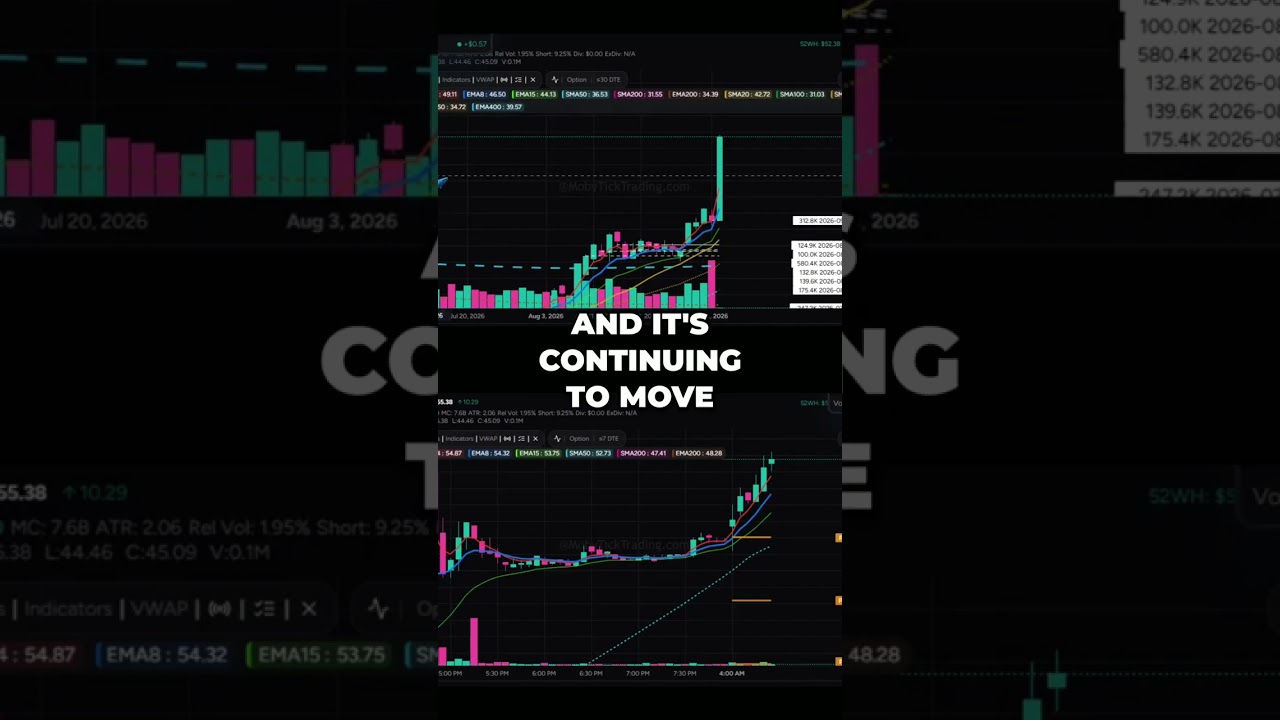

GTLB GitLab Explodes +$10.31 Breakout! vs CRDO Credo Technology Major Dark Pool Flush


Massive Dark Pool Prints on Nasdaq $QQQ and Gold $GLD! Smart Money Positions revealed
