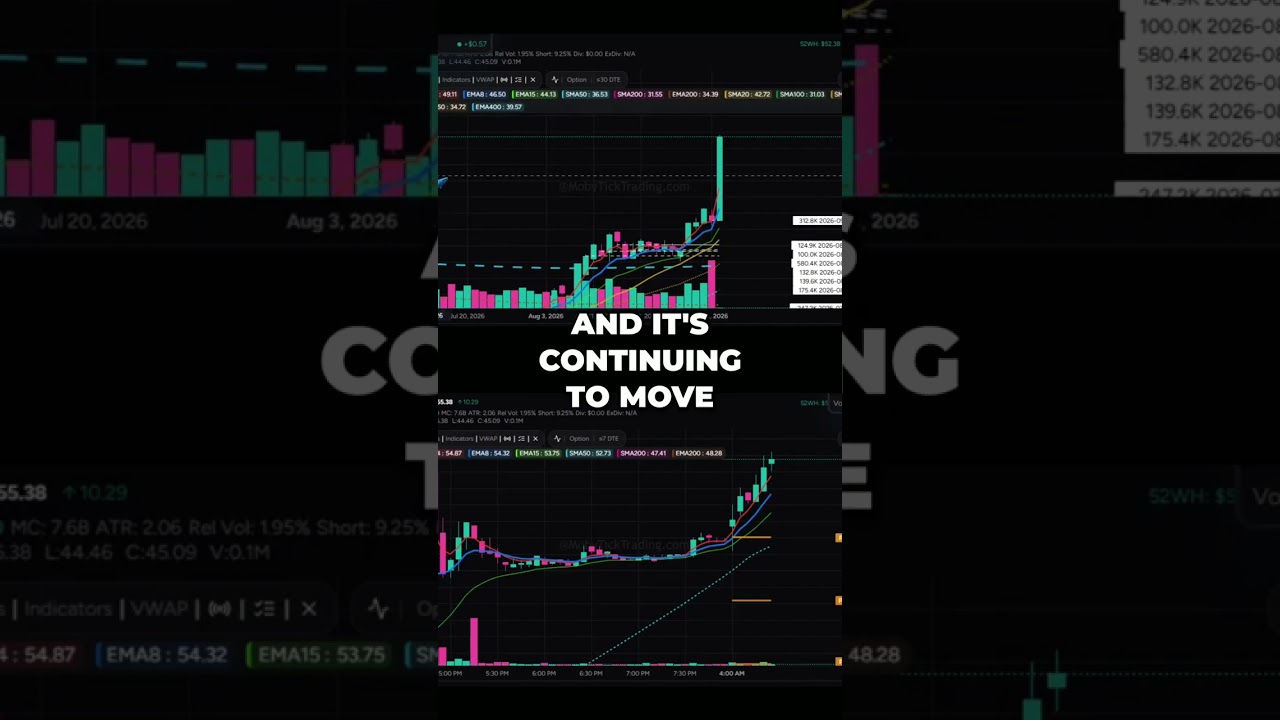
Dave Barnhart shows how small wins in trading discipline compound fast. Risk $50 on a $5,000 account with a 1:3 reward-to-risk ratio, and your account can double in months instead of years. Win rate matters less than position sizing, journaling, and following a pre-trade checklist.
Chapters
What if I told you that improving your win rate by 1 in your trading could help you reach your profit goals 64.7% faster? In the next few minutes, I'm going to show you exactly how small tweaks to your win rate can dramatically accelerate your trading success, and I'll break down the exact numbers to prove it. Plus, I'll reveal how institutional money flow can be your secret weapon for finding these high-probable trades. If you're tired of inconsistent results and want to transform your trading, stick around. This could be the game changer you've been looking for. Most traders track their win rates, usually out of 10 or a percentage— 7 out of 10 or 70%, for example. Win rates can be a great measure of success, but does your profit and loss reflect the same? You can have several great trades and blow it all in one or two trades. The concept of risk is not new, but to truly measure profitability, we need to measure apples to apples, as they say. Risk is something that we can control and calculate our potential reward depending on our trading plans. Therefore, risk assessment is paramount, which is also capital preservation. That said, most traders are looking for at least 1:1, 1:2, or 1:3 risk-reward. Set a risk of $50 per trade on a $5,000 account. This means if we lose $50, we're out of the trade. Our target is 1:3, so we're looking to take in $150 for our $50 of risk. Right away, you're limited to what you can trade due to our risk parameters. Highly volatile stocks may be immediately excluded since the chance of being stopped out is quite high. Most think of return on investment, or ROI, but here we're going to flip the script and focus on return on risk, ROR. Let's say we have a 4 out of 10 win rate, or 40%. Our risk is $50 per trade, and our winners yield $150 per trade. We would have $300 in losses, but $600 in wins, leaving us $300 net over 10 trades. This is still profitable, and our P&L goes up over time. In the table below, we'll focus on the first colored column. With a starting balance of $5,000, our account would double in 170 trades, here highlighted in green. Let's compare this by increasing our win rate to 5 out of 10, or 50%. In this scenario, we've eliminated one losing trade and gained a winning trade, increasing our $300 per 10 trades to $500 per 10 trades. That's a 66% increase in profits, and now we're doubling our account in 110 trades, rather than 170, which is 64.7% faster. If we extend this to a 7 out of 10, or 70% win rate, then we're doubling our account in 60 trades, which is almost 3 times faster than when we have 40% win rates. We're now averaging $900 in 10 trades instead of $500 per trade in the 6 out of 10 example. In this scenario, we reach our goals 283% faster. The table also provides some other astonishing information representing drawdowns and trades to recover. Many traders panic when they hit a 40% drawdown on their account, as seen in yellow. The drawdown percent row indicates the current value of the trader's capital in relation to the starting point. Going back to our 40% win rate example, if a trader is starting at a significant drawdown such as 40%, The red section of the table indicates it would take 67 trades at this profit rate to reach breakeven. Although this seems dismal, it's relevant information no matter how we feel about the fact. What do I do if I'm in a position of significant drawdown and my trading isn't working out? First off, I need to determine the cause of my drawdowns and act accordingly to remedy it. At MobyTick, we focus on following the institutional players. Tracking block trades that move the market. Seeing where these whale traders are buying and selling can have a massive impact on your profitability, as we do not bet against them. It'd be better to follow the trend set by these players instead. If you're unaware of these trades, it can be detrimental to your profitability. Trading requires both education and experience. Humans are the cause of many psychological issues with trading. Such as fear, greed, uncertainty, and doubt. There's also revenge trading and our poor egos. The market cares not about these things and is completely oblivious to our existence or our need for the money we're trying to make. Checking our emotions at the door is helpful, but having a well-designed trading plan will help to alleviate the stresses traders put on themselves unnecessarily. Learning more about trading psychology should be at the top of any trader's list if they find themselves in this situation. How do you feel when you click the buy or sell button? Am I hesitating to get in or getting in late, missing most of the trade, only to see it reverse when I get in and then sell at the bottom? Revenge trading, anyone? These are all psychological behaviors that need to be addressed in order to improve your trading. Journaling is paramount. That doesn't just include entries and exits, but also your emotional state. market conditions, and the reason for getting in and out of each trade. Risk and reward are also important, and as discussed earlier, these data quickly become historical and repetitive, so you can see what needs to be improved. A pre-trade checklist is also important. With a defined trading plan, you choose the best possible trade setups that fit your strategy. What are your confluences that must line up in order to take a trade? Does the trade meet your criteria for getting in? This helps to eliminate emotional trading and reduces the likelihood of entering low-probability trades. Mastering risk management through proper position sizing, as demonstrated, even a 40% win rate can be profitable with the right return on risk. Never risk more than your predetermined amount per trade, regardless of how certain the trade setup appears. Also, focus on the highest probability trade setups in your chosen timeframe. Rather than trying to catch every move, wait for trades to come to you. You do not control the market; it does its own thing. Trading is about the process. If you master the process, the money will come. The right tools are important as every carpenter needs a good hammer. Mobitik offers real-time institutional money flow alerts, one-click trade setup scanning, real-time block trades, and other investigative tools. to help traders find the most profitable trade setups in as few clicks as possible. For example, if we see a $9 billion trade on the SPY and we close below that price level, it's a good time to go short, therefore never arguing with the tape. To find out more, visit us at mobiticktrading.com to start your 7-day free trial. Hit that like and subscribe button to keep up to date with our daily trade callouts and educational videos. Happy trading, everyone, and we'll see you in the next video.