Webinar; How do psychologists, teachers, and parents work together?
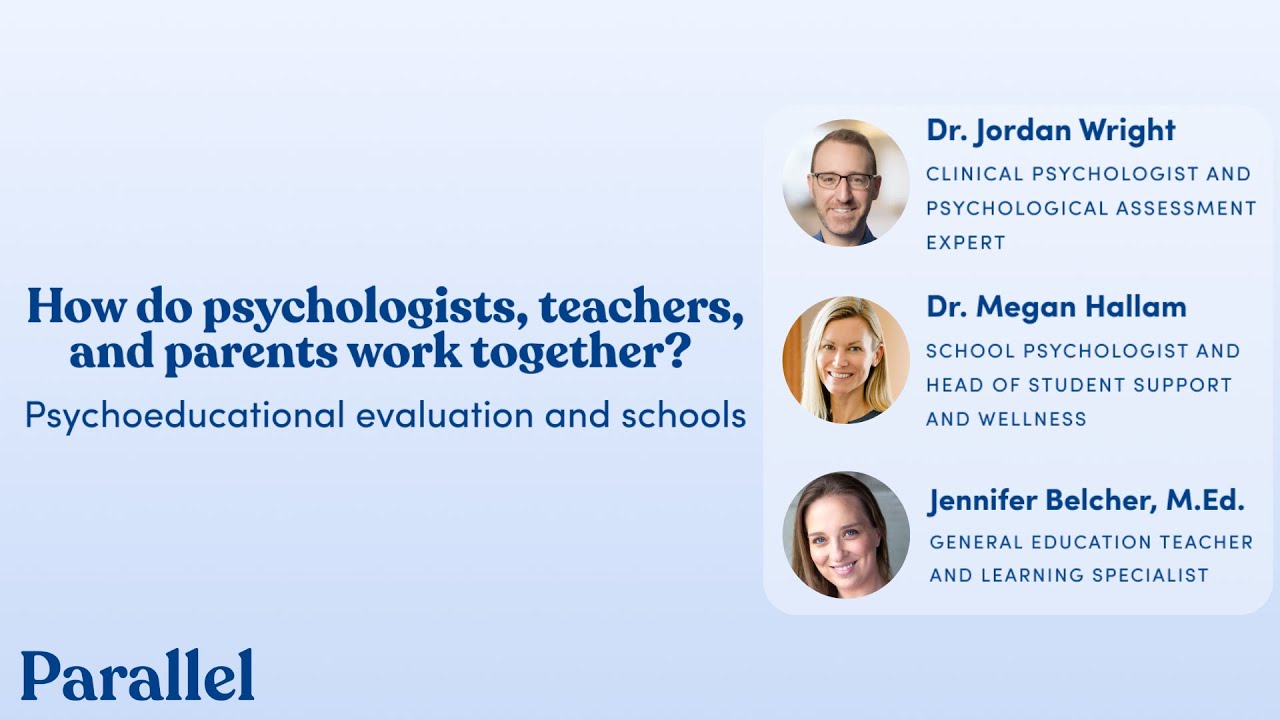
A clinical psychologist, school psychologist, and classroom teacher explain how psycho-educational assessments work and how parents, schools, and evaluators collaborate to support students. They cover the difference between test performance and real classroom functioning, how recommendations become accommodations like extra time or preferential seating, and why staff training and ongoing communication matter.
Questions this video answers
Dr. Jordan Wright explains that a comprehensive psycho‑educational evaluation can differentiate a brain‑based learning difference from general developmental variability by examining underlying cognitive processes, patterns of strengths and weaknesses, and ruling out factors like anxiety or simply being a slower learner.
Dr. Megan Storey‑Hallam says the school psychologist and the multidisciplinary support team translate evaluation recommendations, model interventions, provide resources, and may request professional development or research recommended programs to ensure staff understand and can implement supports.
Dr. Jordan Wright lists extra time on tests, preferential seating with discreet fidget tools (e.g., Velcro), separate testing rooms or noise‑cancelling headphones, and pull‑in or pull‑out specialized instruction (reading or math remediation) as the most frequently suggested accommodations, noting they are individualized.
Jennifer Belcher advises establishing clear boundaries and structured routines, setting time limits on homework, communicating struggles to teachers, creating a predictable workspace with breaks, and being kind to oneself as a parent.
Dr. Megan Storey‑Hallam clarifies that the FBA (Functional Behavior Assessment) is one data point; she recommends parents request a full independent educational evaluation (IEE) or psycho‑educational assessment to obtain a comprehensive view before any service changes are made.
Chapters
Good afternoon, everyone. My name is Shawna Beyer. I am the speech-language pathologist lead for Parallel Learning. Welcome to our webinar, How Do Psychologists, Teachers, and Parents Work Together? Psychoeducational Evaluation and Schools. Today we have a panel of experts to speak with you on this subject, and I'll introduce them one by one. We have, um, we have Dr. Wright, Dr. Megan Story Hallam, and Jennifer Belcher. But first, before I introduce them, I will talk about who we are. So Parallel Learning is a groundbreaking virtual education platform. We provide various services for students with Differences in thinking and learning from evaluation and diagnosis across different services such as behavioral therapy, speech and language therapy, and psychoeducational evaluations. We have learning specialists and skills-based tutoring, as well as executive functioning coaching. And we are proud today to have a panel To speak about our specific subject. And we have— first up, we have Dr. Jordan Wright. He is our Chief Clinical Officer at Parallel Learning and is one of the nation's top clinical and developmental psychologists with expertise in psychological assessment and social justice issues. He is the author of multiple widely used books on psychological assessment, including the Handbook of Psychological Assessment and Essentials of Psychological Tele-Assessment. Next, we have Dr. Megan Storey-Hallam, and she is a nationally certified school psychologist with 2 decades of experience in public and private schools. She currently serves as a head— as the head of student support and wellness, leading teams of special educators, counselors, and psychologists Dr. Storey-Hallam's most recent publications have focused on the educational impacts of COVID-19. Next, we have Jennifer Belcher, Master's in Education, and has 16 years of experience in elementary, middle, and collegiate level education. She has served as both a general education teacher and a learning specialist. Additionally, she is a published researcher in literacy instruction and acquisition. So welcome to all of our panelists, and we're excited to hear everything you have to say today. For our audience, we will have a Q&A at the end of our presentation, but if you do have questions, please be sure to put those in the Q&A button at the bottom of the screen, and we will have time at the end to discuss those. Thank you. So you're up, Dr. Jordan.
Thanks so much. Yes, so I'm going to be talking about psychoeducational assessments and evaluations specifically. This is the process that can happen 2 ways. One is they can happen within a school, and the school, especially public schools, offer some version of evaluation as part of an IEP plan, a 504, Preparation, if you request it, they will do some sort of evaluation. There are also IEEs, these independent educational evaluations that you get done outside of a school, and I'm going to focus a little bit more on that, about how these sort of outside evaluations play a role in your child's education and collaboration with the schools. So first and foremost, What is a psychoeducational assessment or evaluation? It is aimed at what your brain can do. It's really looking at the processes under best circumstances. What can your brain do academically in terms of cognitive processes, in terms of your emotional states? Like, what are you actually able to do? And why Are you struggling? Right? So if you're not struggling in school at all, if you're just excelling and a straight-A student, you probably wouldn't go for one of these evaluations. Maybe if you were questioning giftedness, I guess. But I'm going to focus on the other circumstances. And really, the point of these evaluations is to figure out why you're struggling, not just that you are struggling in math or struggling in reading, but why. You are struggling. What are the underlying mechanisms and processes for why you are having difficulty reading or in math or writing? It is not what your, what your brain does every day in school and on exams. If that were the case, we would just use your grades, right? That's your everyday academic functioning is how you're doing in school. But think about the fact that learning in school is one very specific context that is loaded with all sorts of distractors, emotional components, some teachers that you love, some teachers that you hate, some teachers that are, are not great, some teachers that are amazing, peers around you to distract you, pressure when other kids finish a test before you. There are all sorts of issues that contribute to how well you do on school-based tests and how well you do in terms of your grades. That is not what a psychoeducational evaluation is aiming to look at. We very often do ask for your report cards. We ask for these school records so that we can compare. Are you in your everyday functioning? Is it a match to what your brain is able to do currently? What you— what sort of areas of academic functioning and processing your brain can tackle right now? Are you demonstrating that adequately in the school, in everyday functioning? This is a really important distinction. We— to figure out what your brain can do, we try to develop what is considered an ideal testing environment. It is much different than taking a standardized test, taking the SAT, taking a large test or exam at school. We are really looking at this one-on-one attention with a hopefully nice, pleasant person, a lack of distraction. We're not all nice. Some of us psychologists are not super nice, but most of us try to be nice and standardized procedure, absolutely. Emphasizes, like, we want to give you that one-on-one attention. We want to sit with you. We will ask you to do some very similar things that you would be asked to do on a math test or a reading test, but we do it in an environment that is free from distraction, right? There's no other kids there. There are hopefully no sirens going off. If we're doing a tele-assessment, so you are at home, then we will work with you to make sure that you are in a quiet environment at a quiet time. Right? We might need to pull you out of school at a certain time so that your siblings aren't running around and causing distraction, or we might need to, you know, coordinate so that your parents take everybody out of the house or the apartment while you are doing this, so that we are sort of mimicking the most ideal testing environment to allow you, a kid, to perform your best. What can your brain do under best possible circumstances in the best possible context? And what this is called in sort of nerdy psychologist terms is maximal performance. Your grades are what we consider typical performance. This is what you are in fact actually doing in your everyday life and everyday schooling and everyday testing and all that kind of stuff. We are interested in your maximal performance. We are interested in the way that your brain is functioning when we remove any roadblocks like kids distracting you and anxieties and other things that are much more prevalent and present in the everyday school setting. It's not that there is no anxiety. This is, this can still impair your maximal performance. It's not that this is absolutely perfect. But it is much more what we consider ideal in the testing environment than in schools. So ultimately, once we've tried to figure out what's going on with your brain, what's going on, what is potentially getting in the way, if there is a big difference between academically what you're able to do and academically what you're displaying in school, that is important for us to know. And we are gearing everything toward recommendations. Our recommendations are the most important part of any report that you ever read. This is what we're gearing toward. We're sort of building up to recommendations, and these recommendations are often some recommendations for the school, some recommendations for the kids, some recommendations for families, right? They're often set up in a way that we are making different recommendations for the different people who are involved. The recommendations for school, which I'm going to focus on, can come in different forms. Sometimes they are accommodations like extra time on assignments or paring down homework to only that which is necessary. Those are accommodations. Some might be school-based services or remediation like pull out and do some extra reading work once a week or twice a week with a reading specialist or something like that. Some of the recommendations may have to do with the environment that you are most likely to succeed in. So it might be, you know, we recommend a special ed environment in a small classroom, 12 to 1. That is the optimal environment for you to be able to sort of access the curriculum. So there are different types of recommendations, but what I'm going to focus on is how they're worded in reports, because this is super important and can get a little frustrating sometimes for families. Very often we will break it up into those supports and accommodations that are required for this kid to reach their potential. Now I'm putting required in air quotes and I put 3 asterisks after this because I, as an independent evaluator, cannot require a school to do anything. So this language is important. This language is meant to add weight to where I truly believe this is what you absolutely need, and if you do not get it, you will not reach your potential. And I use this language specifically so that it has that weight behind it and that clarity behind it. And some are just, but also you would benefit from these additional supports or accommodations or remediation or whatever it is. And these again are not the things that I think Without them, you wouldn't reach your potential, but they would really benefit you. They would really benefit your kid. What is important to remember is that these are recommendations and not mandates. My independent evaluations cannot tell a school they have to do something. This is— I was going to say especially true, but this is especially sort of noticeable, I think, in independent schools. where they may not have the resources to do this, and the IEP system is not as structured and clear as it is in public schools. But even in public schools where there are these more structured IEP mandates, the recommendations that come in an independent evaluation cannot require a school to do anything. What they do is they inform an IEP team. They inform a school support team They should be taken seriously. Good schools will hopefully take them seriously. And I know our other presenters will talk about this because we've invested a lot. I've invested a lot. I have used my expertise to make very, very clear recommendations of where you're likely to succeed and how you need your world around you accommodated in order for you to succeed. So that should be taken seriously, but it is then also combined with teachers who are actually working with the kid day to day and support services at school if they know the kid, and parents participate in these, and it becomes a very collaborative process. And this is one data point. It's a data point that carries a lot of weight to it, but it is only one data point used in school decision-making and district decision-making. And with that, I'm going to throw it over to Megan.
Thanks, Jordan. Although I— yes, there I can see my slide now. Yes, so you use the word collaboration, and I think that that's a really important word. And the collaboration actually starts before the evaluation, in my opinion, and I think Jennifer will talk about that as well, because this is— that evaluation comes as part of a process. And so Before the evaluation, the hope is that you as families are having those ongoing conversations with the teacher about the concerns. So if you've brought up concerns or if they've brought up concerns, that you're, you're conversing about that and you're discussing what interventions are taking place. So some things you already may be doing at home, and there may be some interventions happening at school. So it's really important that you're understanding what's happening at school and how your child's responding. That all of that information is what you'll also share with the evaluator, because if your child is not responding to certain interventions, that's going to inform some of those recommendations that the evaluator will keep in mind. And if your child's responding but not responding at the level or the rate that the school thinks is appropriate, that's also really important information. So during the evaluation process, it's important again to maintain that collaboration, letting the teaching team know that you have initiated an evaluation. The teacher can really help with some phrasing about what are the concerns that they're seeing, and they might be kind of speaking a closer language to what the evaluator might understand when they are planning the evaluation and looking at certain areas. They also may be available to complete questionnaires, surveys, share observations, share intervention plans, and they can also provide some extra work samples. So when Dr. Jordan was saying, you know, we can look at report cards, we can look at something, but that doesn't tell the full story. So sometimes some work samples are really important to tell that story. You also want to be collaborating with your school from the very beginning because they will help you understand what the full process is in terms of bringing that evaluation back to the school for discussion. And sometimes you really need to start that process early because there might be something like, if you're doing an independent evaluation, the school might say, well, before we can consider that as a school, we need to also put some interventions in place. So you don't want to delay and bring that evaluation to the team and they say, oh wait, we need to put some interventions in place for 6D. 8 weeks before we can decide. So making sure that, you know, you are reaching out, you're finding out the right people is really important during that process. Checking to see if you're paying attention, Dr. Jordan. So what happens after an evaluation? And Dr. Jordan really already highlighted that this is going to look different in different settings. So I put them side by side just so that you can also be referring back and seeing those differences. So in the public school, again, you may have needed to initiate a referral. You may work with your teacher, but a parent— the parent can initiate a referral as well based on the concerns in a public school. When the evaluation is complete, there will be a multidisciplinary team that reviews the evaluation. There's a core team. It's likely to include a school psychologist, a general education teacher, a special education teacher, an administrator. We might have a speech-language person there, an occupational therapist there. You as a parent or family are part of that team as well. So the team comes together to review that evaluation. They are reviewing that evaluation for Along with other information that they have at school to look at the eligibility for services. And, and Dr. Jordan again has talked a little bit about accommodations and services. This is really important, and I'll talk about that in a minute with IEP versus 504 accommodations plans. But they're looking for the diagnosis and the educational need. So both of those will be touched on to some degree in the evaluation, but the educational need will also be information that the school has. So it's really important that you know what information they're reviewing as part of that. This comes up when perhaps you've changed schools, you've moved as a family, and your child has had some concerns, and you've decided, okay, as we start a new school, new school year, We are going to initiate an evaluation. All that new school really has are those report cards. It doesn't, again, tell that full story. So you want to be sure that you have, you know, records of emails or work samples and those types of things, because you want to have that— your child's kind of folder with you as the team is looking at the information. The important thing to remember, and again, this will come up in the next slide with The difference between IEP and 504 plans is that in a public school, they are looking at what the access your child has to the general education curriculum. They're not looking at maximizing your child's learning. It's about access to general education. So this, and I'm going to highlight this a few times, this is where you need to compare the report recommendations to what the school is offering. So if you've got one of Dr. Jordan's great reports and it says this is what's required, and you don't see something corresponding to that in the school's plan, that's where you want to ask questions, and that's where families often have to supplement services. So it's really important. Again, as Dr. Jordan has said, those recommendations are the most important part of that evaluation. So let's look at private schools for those families that have chosen for their child to attend a private school. Again, very early in the process, you want to identify and contact those key personnel who might be involved in reviewing the evaluation. You want to start asking questions about what kinds of services does the school have for learning support, who's, you know, who's part of the staff, and asking those questions so that you know as you're working with your evaluator what actually might be available at your school. They do not have any legal obligation or mandate to provide services, and really it's a mix. Some private schools really have no services, and parents and families are just completely on their own to access those and organize those, and some have very robust what they call learning support programs, and they're fully staffed, and they look very much like what might be available in a public setting. But again, there's no legal obligation for them to provide services when you bring that report to them. This may be because they don't have the resources. So in my experience in working with many independent schools and private schools, there is an opportunity here to have a conversation with the school, and if they don't have the services on site and it's convenient for you as a family, you might say, is it possible for us to have those services provided on-site? Can we bring somebody in? Would that be okay? That's really ideal if they don't have the services because you want— you don't want to really completely extend your child's school day often, and you also have this opportunity for the support person to be interacting to some degree with your child's school day and the people who are teaching them. Schools may often consider training personnel to provide interventions. So, I've been in schools where students have needed a very intense reading program, and that really prompts a school to say, okay, well, maybe we'll identify someone who we can send to that training, and they can provide that training for that intervention. Private schools often refer to their plans as a learning plan. And that's going to be something different than the IEP and 504 that I'll speak about in a minute. That is usually for internal use. They refer to learning plan, learning profile, but there are entities such as ACT and College Board who understand that private schools develop these plans, and so those— there may be some occasions where that plan may be used outside of the private school. One last thing to really consider in a private setting is that learning specialists that, or anyone who they're identifying as supporting your child, may not be a certified special educator. You want to ask about that because you want to be sure that they have the training to work with your child. You know, especially for some of these specialized interventions, they're designed for someone who has a background in special education to be implementing. Because that person really has that educational background and experience, supervised experience, to understand why certain components of that intervention are so important and how to implement that. So that's another place where you really want to ask questions as a family. Okay, so oftentimes parents become really confused about an IEP plan versus 504 accommodations plans. This is really confusing because All students who have something, you know, something diagnosed really are covered under a 504 accommodations plan because that's related to Americans with Disabilities Act and other protections. But I always say the simple word between— that tells you the difference between an IEP and a 504 is services. The difference is that under an IEP, you're often getting services And under the 504 plan, it's mainly accommodations. So, with an IEP plan, students must meet the criteria for specific categories of disability. This is under the Individuals with Disabilities Education Act, so they do refer to them as categories of disability. The student must also, and this I've put, you know, AND in capitals to really emphasize this, They must demonstrate adverse educational impact and need. So they're looking at both of those, the diagnosis and the need. So this is where all that information that you bring in might really emphasize that need, because if they're simply looking at report cards, they may not see how your child is struggling and to what extent. This often comes up when parents have already done some supplementing with tutoring, and it's masked some of the, the high level of need the student has for support. Under the IEP, your child will be— there will be identified specialized instruction and accommodations, and these are mostly for school-age students, although for some categories of disability, those services can extend to 21 when the student ages out of So an example of a specialized instruction, I think, Dr. Jordan, you already discussed this, would be something like a reading intervention program where your child is working with someone at school. This is a service that's being provided. The accommodation that might go along with that might be extra time so that when your student is— when your child is taking an exam and they have to do a lot of reading, they may still need the accommodation of extra time. Meanwhile, the school is providing that specialized instruction to work on the gap in reading. Under an IEP, your child will have an annual review of the goals. They'll also have triennial reevaluation. So every 3 years, they'll take a look at all the information they have on your child, and they'll say, do we need more information to determine whether your child continues to qualify for services? The IEP has those individualized goals. You also want to be really mindful of the schedule for reporting progress. This typically aligns with the report card progress reporting, but you want to be as a family tracking how's my child doing? Are they making progress with this intervention that the school has identified and put in place for them? Because if they're not, that's, that's a point where you want to be asking questions and asking them to consider if they need to change anything. Again, as I said, I'm really going to emphasize this. It's critical to compare those report recommendations, those required recommendations, to the IEP. Make sure that what has really been identified as what your child needs is reflected in that IEP. Have those conversations. Ask the school why they're not putting those as part of the IEP, and then that's where you need to have the conversation of whether you need to look for those external to the school to supplement, because that's what's been identified that your child really needs. Remembering again that the school is providing access to general education. They're not maximizing, and they're not— so they only have to provide that access. 504 accommodations are for students who have a physical or mental impairment which substantially limits one or more major life activities, and school is a major life activity. So this only requires that the student has been identified with a diagnosis. They are not looking for that educational impact. It's not required. So sometimes, for example, a student has a diagnosis, say ADHD, and the diagnosis is present and has been confirmed, but the team says there's really no educational impact. Your student is still eligible for accommodations. So maybe they need a quieter setting for tests, a separate location, and some extra time. And those are the accommodations that can be provided under a 504 plan. These plans are the plans that would go with your child into college. So the IEP again would, would end as they finished high school, but a 504 plan would be a plan that would go into college, and very often students who age out or graduate from an IEP, when they go to college, they are accessing accommodations with a 504 plan through the college. This plan is recommended for yearly review, or at least frequent review, but that's not required by law. And again, you as a family may have to continue to provide some of that documentation because it's a diagnosis. that's likely to be confirmed outside of school. Hello, everyone.
So we're moving along to the implementation of the evaluation into the classroom. So as Jordan and Megan have discussed, this is a highly collaborative process from start to finish, and unless a student is coming to a school with an evaluation, an IEP, and a 504 plan already in place. Like Megan said, most likely these conversations have been happening for a while now. There's been a point where parents and classroom teachers have gotten together, both recognize some sort of issue is happening. There's a period of observation, of trying things in the classroom to see if small little adjustments will help. before an evaluation is recommended. So collaboration from start to finish. Once an evaluation is complete and the clinician has talked to the school support team, it's now time to start implementing what can be done in the classroom. So the classroom teachers, the general education, or your teachers like your math teachers, your specialists in the higher grades, They are not trained in special education. That is not their area of expertise, so they're going to rely heavily on that student support team, individuals such as Megan. They're going to talk with the evaluators such as the Jordans and really get the necessary information as to how this is going to look in the classroom. So they're going to go over the evaluation, modifications, accommodations. The teachers will work with the support teams, so the school psychologist, the school counselors, the learning specialists, the special educators, to create a detailed plan of who is going to be responsible for meeting each goal. So if the student is getting extra time on a test, where is that going to happen? Who is responsible for delivering that test? How, you know, how are the transitions going to work? Little things like that. Um, who is going to provide the, the materials necessary for things, for example, specific size pencils, bouncy seats? Like, all of this is established once the evaluation has been received. Then the team will work together with the teacher and the parents to create specific benchmarks and goals. So Student will show this level of progress by this date, and they'll come back around to that later. But I want to reiterate, this is a very collaborative process with the whole team. Okay, what I really want to focus on as the representation of the classroom teacher is the reality of what an individual student evaluation looks like in the classroom. Because ultimately what happens is it's fitting one piece of a puzzle into a much larger puzzle. The reality is one student is one of 20, sometimes 40 in a higher education classroom, and it can be really, really tricky for that classroom teacher to navigate balancing one student's needs with the needs of others. I would say, you know, when I first started teaching 16 years ago, there would maybe be 1 or 2 students in my classroom that had an evaluation and a list of recommendations. But because there's been so much more awareness and education around the importance and the value of evaluations, more and more students are, are having them, which is fantastic because that's, that's where we can really start to help. So While that's a good thing, it can also get really tricky. You know, now in a classroom, it's not uncommon to have 5 or 6 students with accommodations and evaluations, and I've been in situations, for example, where I've had 5 students who needed preferential seating up front, and it just wasn't physically possible to get them all up front. Another example of trying to fit in the puzzle pieces One student who needs to sit up front might need a fidget and things to tap and spin and pop, or needs to move in their seat. And another student that needs to sit up front, they might need quiet and solitude, sometimes utilizing headphones. So it really is trying to make it all work together and meet everyone's needs, and sometimes they're very different. But we're trying to do it in one environment. And as Dr. Jordan mentioned, you know, in testing, they're looking at, you know, what is the best capacity that this child has in this controlled environment. A classroom is not a controlled environment. There are so many factors that are happening that are unpredictable minute to minute. So many interruptions, so many noises and sounds and conversations and unexpected things that nobody can plan for that impact how all of this is implemented. So in addition to balancing the needs with others, you know, the teacher who's really thinking about which one of these accommodations and modifications are actually feasible in the day-to-day life. There are, there are some things that are easier than others, but having to modify every assignment, every test, That's something that that is going to be more of a challenge compared to putting an elastic band on a seat in the U. That's just there. The other thing is the student-to-teacher ratio. Like I said, there's one classroom teacher. There is anywhere from 12 to 40 students in a classroom. So the teacher is just not. It's just not possible for them to be everything to everyone at all times. And, you know, there are, there are some duds in the education world, and, and not every teacher is wonderful. But, you know, for the most part, teachers are trying their best to be everything to everyone. And, you know, as much as they want to be, it's just not possible. So this is where it's really important that You and your child's teacher are having a conversation of like, what is actually feasible? And if it can't be the classroom teacher, who else can we get involved to help support? I think having honest and open conversations with your child's teacher about outside supports can be really helpful. There will be resources on campus that can help supplement what your teacher is doing, but you might find that you need to go off campus as well. And the school system normally has a list of providers that they've worked with, that they've trusted. There are providers like Parallel that open up some options with the virtual availability. So there are resources out there, but the most important thing is to have that conversation with your child's teacher who's with them most of the day and that learning support team to see, like, how you can bolster the accommodations and modifications that are happening in the classroom. So when you're talking to your child's teacher, because this happens more and more, you know, with the, the introduction of email into that communication, parents have access to teachers in all sorts of ways, which is fantastic. But we also have to, to be mindful of the larger context. And, you know, this is where it can get tricky, because for the parent, the child is their whole world. And sometimes it is very difficult to remember the larger context and that it might not be as simple as, well, here's the evaluation, here's what was, was recommended. Why is all of this not happening? So going into those conversations, understanding the larger context. And for both parties to have patience and kindness and understand each other's perspective. And it's really important to, to go in it with a team-based attitude. The teachers are there to support the team. The parents are there to support the team. How can we work together? But at the end of the day, the parent is still the advocate for the child. The parent knows the child better than anyone. And in reality, not all schools are great and not all teachers are great. That's, that's just how it is. So, you know, have the patience and understanding of the context, but 100% advocate for your child, stand up for your child, help the teacher help your child.
I'm gonna, I'm gonna butt in and make points. I'm just gonna assert my privilege since I'm controlling the slides. I just— 2 quick points. One, I think it's super important, Jennifer, the point that you're making. You're just reminding us that teachers probably have the easiest job in the world. There's just nothing easier than being a teacher. I was a middle school teacher. I am grateful for everybody who can handle it. My constitution couldn't handle it for more than a few years. It is tough to be a teacher. It's tough to be a school. It's tough to be in charge of all these kids.
Yeah.
for so much of their early life, but not be able to have that one-on-one dedicated time that parents get with their kids. So again, I just want to underscore this point that teachers are doing their best overall. 99% of teachers out there are trying their hardest. They're doing their best. They want to collaborate with you. They want their students to succeed. Absolutely. It just reflects good on them if they— reflects well on them if they if their kids are succeeding. So that's something to keep in mind. One point I will make, and I'll ask my co-presenters to close their ears for a second, because I think we've painted a very friendly, collaborative picture of this entire process, and it does not always play out that way. There are certainly other factors at play when it comes to schools and school districts. Giving these accommodations costs money. So they have to scrutinize it. They can't just give everybody all these extra services. They have to be very, very critical and say, does this kid really need this to access the curriculum? Do they really need it? And they may disagree with you as a parent. They may say, we actually just don't think, despite your psycho-ed assessment, despite your feelings, despite what you think, we do not believe that your kid needs all of these services or this specialized classroom or the remediation or anything. Or even accommodation, they may disagree with you. And I'm going to go back to a point that Jennifer made is that you are your kid's advocate. And I'm going to add to that that the IEE evaluator, the psychologist who did your independent educational evaluation, can also help advocate for your kid. I go to a lot of IEP meetings to advocate for kids when at the point— I wouldn't start like I, you know, I don't want to be a hired gun right off the bat, but I, you know, if it gets to a point where you are extremely unhappy with how it is going in the process, you may reengage the person, the psychologist who did the evaluation, and see if they're willing and if they think it would be helpful to join an IEP meeting to help you advocate for your kid, to speak some of that school speak that you may not be as comfortable with. And to— I hate to say this, don't listen— wield their PhD, right? To, you know, not bully, but, you know, really be a strong advocate for your kid if you really think it's not going well. Never losing the spirit of actually everybody is trying to help. Everyone has your kid's best interest at heart, even though there are some competing interests financially and Otherwise, so try not to get adversarial about it. Try to keep that collaborative spirit with it, but you can bring in professionals to help you advocate for your kid if and when that needs to happen. Now we'll say thank you, and I will throw it back to Shawna.
Thank you so much to our panel. Very informative. for families, parents, students, educators, providers. So now is the time for questions and answers, and you may— the audience, you may use— reminder, you may use the Q&A widget at the bottom of your screen to put any questions in for us, and we'll get the panelists to answer. I do have the first Question for the panel, so whomever wants to answer this question. How do I know if my child has a learning disorder or is just a slow learner?
Shall I take that one?
You may.
That's my area. Yeah, an evaluation can really help. Certainly, child development is uneven, right? It's not this straight line that everybody follows the exact same path. And certainly there are bumps and fits and starts, and sometimes kids are a little bit behind and then catch up, and sometimes they're a little advanced and slow down. So that is certainly a thing that maybe they're just a little bit of a slower learner. A comprehensive evaluation, a careful comprehensive evaluation, can look at the pattern of underlying skills, cognitive processes, to see Is this likely a learning difference? Is this likely sort of a different wiring of their brain that they actually have a brain-based barrier to reading or a brain-based barrier to math and then specifically need extra supports or very, very targeted types of instruction that are not the way that general education is built and developed? So I would say, and again, I'm biased as an assessment psychologist, But I would say if there are signs that they may have a learning disability, a learning disorder, a learning difference, but you're not sure if it's that or something else like anxiety or just slowness, you know, just slow to warm up to school or be socialized to school, I would say an evaluation can really help elucidate what is going on for your kid.
How does the staff obtain training and information necessary to meet my child's needs?
Yes, well, the information, first of all, very often it's our job and my job as a school psychologist to translate those recommendations for the staff to understand. So, for example, if we're asking a staff member to say, well, we're recommending So someone of the student support team might say, if you're not familiar with that recommendation and that intervention, we'll model it for you, and we'll set it up for you and provide the resources. So that very often the resources and the training come from that student support team, that multidisciplinary team that has, you know, read the evaluation.
So, and sometimes, you know, we might be able to provide that training. Yeah.
I very often work with teachers. I know I've worked with Jen, and I've done the same with her. We might see something, and we're really interested in learning ourselves, and maybe the evaluators recommended a book or a program. And so that's something that we'll do some research on and see if that's something that we might need to ask for professional development and go get that training, especially if it seems like Well, might not just help one child, but maybe this could be helpful for more students that we're supporting. So it does happen very often as an outcome of the report, but it can, it can also happen in other ways.
Okay, thank you. Let's see, a question for Dr. Jordan. What are some of the most common recommendations given to students?
Ooh, that's a big question. How long do I have? So it obviously depends. It depends on what the difficulties are, what the diagnosis is, what the impairment in educational access is. Certainly, there are types of attention deficit hyperactivity disorders, ADHD, where a kid needs sort of what Jennifer was talking about, sort of fidgets, at the front. One of my favorite accommodations to recommend is that teachers tape Velcro, the itchy side of Velcro, right under the desk so that they can scratch it during lessons. So it's not like an obvious fidget or a spinner or something, but they have something to kind of play with that is preferential seating. Probably the most common accommodation across all evaluations is extra time. You know, somebody, a kid who is struggling with reading, whether it is dyslexia, which is a very core and specific type of reading disability, or just a problem with reading comprehension or reading fluency, like how quickly and easily and accurately they read, more time can help them demonstrate their actual abilities. So more time on tests, more time on standardized exams, is probably the most common. And then sometimes we recommend that students take tests and exams in a room separate from their peers if they really need that, or with noise-canceling headphones on or something like that. And then a lot of the recommendations we have are more for services. So if we think that a kid really needs more very specific reading remediation, math remediation, We might recommend either push-in or pull-out services. So a math specialist may come in and sit with a kid in a small group or individually and work with them one-on-one in the classroom during the lesson, during their independent work time, or they may pull them out and do a completely separate lesson in a small group or individually. So there are lots of these accommodations, but we really do try and tailor it to the kid and the kid's presentation in front of us. So not even all ADD kids, ADHD kids get the same list of recommendations. Not even all kids with dyslexia end up with the same list of accommodations or recommendations because we really want to make sure that it's going to work for that kid. I'll take one more second. I, as an example, I have ADHD. You can probably tell. And I was diagnosed, but I have a different variety of ADHD where I actually need a lot going on. When I'm sitting writing my books, I need a TV on and music playing in order to focus. If it's really raining outside and I'm driving, it drives everyone nuts, but I need the radio going so I can sing along, and I need music I can sing along to, to drive. So for me, a quiet room would not be a good accommodation, even though I meet criteria for ADHD. It would be a much better accommodation to have white noise headphones so that I'm occupying sort of that need in the moment during an exam. So we really do try and dig down into what is going on with each individual kid and make recommendations that are likely to help them reach their potential and show what they know during tests, during exams, to really actually demonstrate what they can do.
So very much individualized. And yes, we all have things that we have to, you know, you know, we want white noise or we want, you know, different things that help us, right? So thank you for that. Very helpful. All right. So let's see. We have a question. Let's see. For Jen, What can I do in the home to support my child to succeed in school?
So the words that come to my mind are boundaries and structure. So when I say boundaries, I think oftentimes what I've seen as a classroom teacher is parents want to do too much to help at home, especially when it comes to completing homework. And a lot of times that can backfire because the teacher receives homework completed classwork back, and it looks like everything's fine, there's no issue. And so to the teacher, they're okay, they understood everything. And so my recommendation always to parents is, yes, you can facilitate and help sit there if that's what's needed, but I would set, you know, a time limit on the assignment. And that would be age dependent. Obviously, the younger the child, the shorter. But, you know, if a few math problems are taking 30 minutes, that's problematic. And at that point, I say just stop and write something down on the assignment. Send the teacher an email and say, you know, I just want to let you know that Jordan really, really struggled with this assignment today. Um, there were, there were tears. He, you know, he got very emotional. You know, I just wanted to make you aware. Now the teacher knows that, oh, he's not understanding. There's some misconceptions. We need to do some reteaching. We need to see if the learning specialist can come in if possible and do some one-on-one work. So that's the first thing. I would say having structure and routines to that, that work time, setting up a predictable space. And time in, in the day so that the, the child, you know, whether they come home, they, they have the snack, they have, they have a little bit of a movement break. They know that, okay, at 4:30 every day I'm sitting in this spot, my materials are here, and the expectation is I'm sitting to do my work. The last thing I would say is just for parents to be kind to themselves and understand that They are the parents. It's, you know, obviously they are the first educator, but, you know, take the pressure off of yourself as well to be all to your child and, and really be okay with putting things back on the teacher and letting them know, you know, there were struggles and issues.
Let's see, we have a situational type question, and I'm not as familiar with the Test or the acronyms here. So whomever wants to answer this. So my son is a freshman in high school and has had a parapro since kindergarten. School psychologist did a SCIA and FBA and says my son does not need the para and will fade out the para. My son needs the para because he is start— he He has started spelling, and the para brings him out so he can hear the teacher. The psychologist is— what do I do? What is the name of the evaluation from you that I asked for? Just trying to read that. Sorry. He is staring. Oh, he has staring spells. Sorry, I had to read that again.
Well, I think I'll jump in as someone. And so one of the acronyms was an FBA, and that's a functional behavior assessment. assessment, and that's really looking at behaviors and the function of the behaviors and how they're impacting the child and where they need support. I think what's important is that as a parent, you do make sure that they haven't made any decisions about support based on one type of data or one set of observations. So that is something as a parent that's, you know, approaching it again through that collaborative eye and saying, you know, let me look at the functional behavior assessment and maybe having an outside evaluator take a look at that. And then they might say, oh, well, this is just an observation on one particular day, or did we have multiple perspectives to that? So was it— were the teachers completing questionnaires? Were there other observers? Were there observations over multiple settings on multiple days? So that's the first place to start. Because again, we wouldn't want any service to change based on just one particular observation or one assessment, really. And so I think it's a very individual question, but it does point out that it is a process and it is important for parents to educate themselves and when needed to rely back on resources, as Dr. Jordan had said, you know, being available to ask those questions. We know which questions to ask. And so making sure that you're reaching out and having a second— somebody take a second look at it, a second opinion of some sort that can tell you the next steps for any situation where you're sort of feeling like this seems really strange because my child appears to need that, and why are they taking it away? I don't understand. So, and remembering that, you know, really it's a process that parents do. have to agree to any changes in services because it's a change to the plan. So you have the right as a parent to ask for more information, and so that, that's where I would start.
Okay, thank you. So time for maybe one last question. You know, with technology, what would you say to parents and teachers who don't know much about Technology and might be a little intimidated.
I mean, I can take that. I'm not sure exactly what this question means. Technology in terms of like the whole world, or technology in terms of evaluations or these sorts of things. I think it's probably asking about evaluations, and I can speak with some authority on this. I've done quite a bit of research on tele-assessments, so assessments that are completed remotely in the kid's home over the internet, that is technology, to see what is valid and what is not valid. This is the most important thing, and there are a lot of teachers, there are a lot of districts who are like, whoa, wait a minute, I don't know anything about this. This doesn't seem quite what I know. This is foreign to me. It's new to me. Luckily, we do have research. There is quite a body of research. I've done quite a few of the studies, published a book on tele-assessment so that we know exactly what is okay to do remotely and what is not okay to do remotely. Luckily, in most of these, situations, most psychoeducational evaluations, most of the testing can absolutely be done completely validly in a remote setting. There are a few areas that are not. For example, formal childhood autism evaluations cannot be completed through virtual means. There are measures that use bubbles and toys and all of these things that are absolutely necessary to use in an autism evaluation. And unfortunately, bubbles don't really translate over the internet all that well. So, so there are some things that cannot be done. Most of it in this type of evaluation can be done. So I would just point them toward knowledgeable folks who know the research and can help them understand what is okay to do remotely, what is not okay to do remotely, what has been shown to be valid, and what is shown not to be.
Okay, thank you.
And I don't know, this may or may not have been related to the last question, and this will be the final one, but what is the name of the outside evaluation from your group that I can ask for?
Yeah, and this is, this is a frustrating answer, and I know we're out of time. So lots of different people call them lots of different things. So an independent educational evaluation, an IEE. Or a psychoeducational evaluation, a neuropsychological evaluation. These are all synonyms. They're all very, very similar. So you can absolutely approach a group or a provider and ask for any of these, and they should be able to know exactly what you're talking about and accommodate and do an evaluation that is outside of the school that can be used by the school team.
Okay, I think that's very helpful. Well, thank you all very much. We enjoyed our time together. Thank you.
More from Dr.


SDI Is Not a Place: Writing IEP Instruction a Teacher Can Use Tomorrow | Dr. David Bateman

Special Education Legal Q&A: Responding to the Issues Emerging This School Year



Oral Language and Phonological Awareness: Foundations for Reading Development

Audit-Ready & Student-Centered: IEP Goals, Progress Monitoring & What Illinois Is Watching



A Conversation For Arkansas Special Education Leaders: "What Hearing Officers Look for First"

Groundbreaking Missouri Special Education Conversations: What You Need To Know Before ‘26-’27