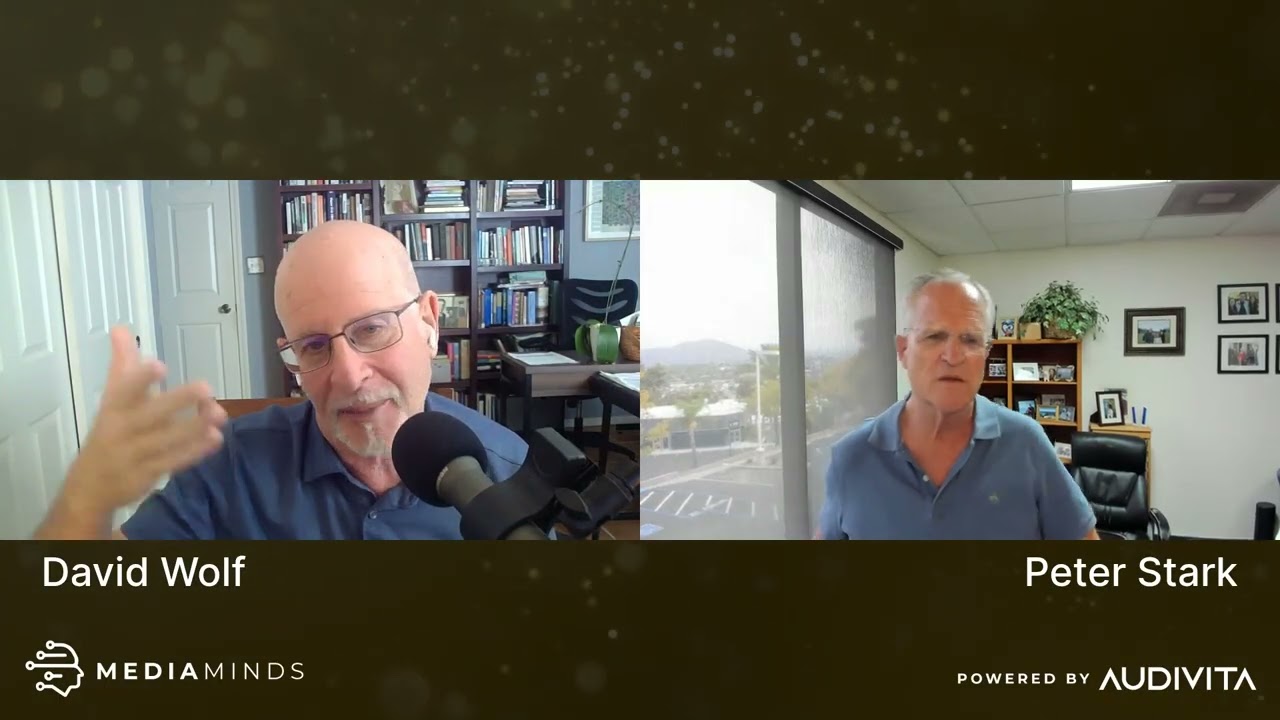
In this Media Minds podcast episode, host David Wolf interviews veteran consultant and author Peter Behrendt‑Stark about his 40‑year career helping leaders navigate relentless change and the rise of AI. Peter recounts his early entrepreneurial venture in commercial printing, his transition to consulting through teaching leadership classes, and how he built a referral‑driven practice without traditional marketing. He explains his core consulting methodology—a structured organizational assessment based on one‑on‑one interviews that serves as an "EKG" of the organization—and notes that this process works for both large enterprises like Aetna CVS and smaller firms. Peter identifies the biggest challenge for leaders today as the unceasing, overwhelming pace of change, amplified by AI, which enables internal customers to bypass traditional departments (marketing, legal, IT) and create their own outputs, putting pressure on those functions and sometimes eroding leader credibility. He discusses the impact of AI tools such as ChatGPT on internal workflows and the future implications for functional teams. Drawing on mentorship from Nido Cobain, Peter describes his business model of expanding service “spokes” (keynotes, assessments, 360s, books) and relying on referrals, as well as his current focus on executive advisory—providing 30‑minute monthly check‑ins and unlimited access to 65‑70 C‑level leaders. The conversation offers practical insights into leadership challenges, AI‑driven change, and sustainable consulting practices.
Chapters
Welcome to Media Minds with your host, David Wolf.
Peter Behrendt-Stark is a nationally recognized consultant, executive advisor, coach, speaker, and author who spent more than 30 years helping leaders build stronger organizations and deliver better results. He's worked with more than 200 leading and very well-known organizations, including the NFL, Aetna, the Phoenix Suns, Lowe's, Kaiser Permanente, the Boston Red Sox, Sony Electronics, Qualcomm, WD-40, and Electronic Arts. It's quite a list, Peter. You're also one of a very select group of speakers to hold both the Accredited Speaker designation from Toastmasters International and also the Certified Speaking Professional designation from the NSA, the National Speakers Association. You're the author of 10 books and more than 500 published articles and over Your career, Peter, you've coached more than 500 executives, managers, and supervisors, helping them strengthen their own communication skills, workplace culture, creating organizations where employees love to work and clients and customers love to do business. Peter, welcome to the program. I'm glad to be here, David. So, uh, we sketched together some notes to kind of guide our conversation, just kind of Just some simple notes to start. How did you start your speaking and consulting business? And maybe you want to give us the run-up into it so we have a little context.
I will. I graduated from San Diego State and stayed in San Diego. One of the greatest decisions I've ever made in my life. And when I came out of the MBA program at San Diego State, I worked for Caterpillar Tractor for one year and had a really bad boss. And one day a printing rep came up to me and said, you know, I've always wanted to open up a commercial printing company. And would you go into business with me? And so I remember calling my dad and saying, Dad, I'm pretty excited. I'm gonna be an entrepreneur. We're starting his own printing company. And he thought Caterpillar was the perfect job for me and that it could be a lifelong career like he had. And he said, just remember, 8 outta 10 new companies fail in their first 3 years. I thought, you know, that wasn't the motivation I was looking for, but it worked. And I did that for 9 years. Right. And at the same time I did that, I taught at San Diego State in their extended studies program. And I taught leadership and negotiation skills on Monday nights. And that's really what gave me the ramp to move into the consulting world because everybody that I taught from 6:30 to 9:30 on Monday night had a job and they were the ones that started bringing me into their business. So on year 7, I went through a buy-sell agreement with my business partner, took 2 years. And from that point forward, I opened up a consulting firm and have been doing it ever since. I don't do any marketing. It's all been based on referrals. But very proud of the business I have created and very proud of the clients I work with.
Well, sure. There's some very interesting names there and all very well-known and well-established companies. Take us to the consulting itself. When you come into a company, what is your approach? If you could— it's a very broad question, but I'm sure you can take me down the journey a bit.
Yeah. Yeah. Almost all of the companies I've worked with today, I started with what I call an organizational assessment. Where I interview one-on-one the group of people that I'm going to be working with and ask really basic questions like, what's going well or right right now in the organization? What do you feel proud about? What are the areas— not wrong or bad, but if you did improve, it'd make you even stronger? Yeah. If you were in my shoes, what would be your recommendations on this project? But I interview usually 10 to 15 people to get the lay of the land. And the reason that model is so successful is because people don't argue with their own data. And so most of the time, by talking to a pretty broad cross-section, I've got a pretty good diagnosis, kind of the EKG of their heart. And that helps me in terms of then customizing what my approach is going to be in working with the clients.
Does the size of the organization matter? Does size matter in terms of your approach?
You know, interestingly enough, from an Aetna CVS, which is probably the largest that I work with, to organizations with under 500 employees, The approach that I take is the same everywhere I go. The process that I take people through works well. Our organization does a lot of employee engagement surveys. And so, a lot of times, we are actually surveying all of the employees in the organization where you can really look at it by leader. But on the projects where I'm coaching or consulting on, most times I'm doing interviews to get the information I need. And it really doesn't matter whether it's a big organization or a smaller one. I'm using the same process.
Okay, cool. Are there certain themes that you find? And this is again kind of a broad question, or you might have a use case or two, but are there certain types of challenges that leaders are facing, let's say today?
Yeah, I think the biggest challenge that I see leaders facing is that the change that people are experiencing today Is it's relentless, it's persistent, and it's not going to stop. In some of the organizations I work with and talking with the leaders, it is just overwhelming in terms of what's being thrown at them on a daily basis and what they need to respond to. Interestingly enough, is when I look at the employee opinion survey data, the employees are doing a lot better than the stress that the managers are under, meaning that if you see that— Interesting. intensify so much more at a management and leadership level than you do at the employee level. But it's overwhelming and it's relentless in terms of, you know, we used to say, well, as soon as this gets done, we're going to have time to breathe. I'm not seeing that anymore.
You're not seeing breathing. Is this— does this relate to the velocity of change given AI, the technology, the new technological revolution that we're all experiencing together? What's driving this intensity?
So interesting that you bring up AI because AI is definitely having an impact on the pace of change. And where I've seen it in organizations is if the internal departments like marketing, compliance, legal, technology, if they can't meet the needs of the internal customers, I'm watching some of these internal customers actually create what they need themselves. So instead of waiting 6 months for marketing to produce a flyer or an ad or a campaign, I'm watching these what I call driver leaders who are just going around them and saying, hey, I just need you to approve this. And that is also putting a lot of pressure on the technology folks, the marketing folks, the compliance folks, the HR folks are seeing it because before we really had to rely on them and we could not move without them. I'm watching people move now. around them.
So now, in effect, they're just using the AI tools, whatever they are, to help them create, in this instance, the marketing assets that are required to take something out to market or whatever the need may be. They can do it themselves without this internal department across the hall.
Exactly. I've been watching them put in the last, like, 30 programs that marketing has created, putting those into a ChatGPT, a closed one, And then telling it what it needs for the new campaign or for the new flyer or for the new ad, um, and, and watching them create it and then taking it to marketing and say, hey, I just need 5 minutes approval.
Wow. Instead of waiting for months. This is a huge shift, internal shift for these folks. And it sort of begs the question, you know, what happens to a marketing department at some point? Uh, I don't know if they're in jeopardy in those sorts of instances or not. One would— it would seem that That could be on the horizon, but I don't know.
The leaders who are able to utilize AI and get good at it, I think they're going to be secure. The ones who have had a system like— marketing is my favorite example. They have a what I call the queue of what they work on. People who get put into the queue are going, this is a 15-minute project that I need to get and I can't get it from them. I'm watching people work around them and I'm also watching leaders lose credibility both on the IT side as well as on the marketing or the legal side when people cannot get the contract approved or written, whatever it may be, and there's long delays on it. So I'm the leaders who are pushing back on this. And my favorite line is, I'm in technology and AI is different for us, or I'm in legal and AI is not ready for what we do yet. When they're pushing back on utilizing it in their departments, I'm watching people struggle.
Let's talk about your business model a little bit. You've 40 years in the business. For folks that may be aspiring to do what you have done with your career, tell us, how did you succeed?
So early on in my career, I was mentored by a person named Nido Cobain, who is the president of High Point University and probably is one of the best visionaries that I've ever worked with or been in the presence of in my lifetime. And when I started my business, I did one thing. I did leadership skills training. And he sat me down on a stage and said, it's been my experience that people in our business who only have one thing that they do don't succeed over long term. And he said, so he drew my initials in a circle and then he put spokes out. He said, you're doing leadership training right now. You could do a keynote on leadership. You could do a leadership assessment or an organizational assessment. Um, you could do a 360 on a leader. Um, you could branch off and take a second topic where I have done— I, I've written 10 books, 2 in negotiation skills that were written, uh, published by Random House or Broadway Books. And yeah, that book really took off, sold a couple hundred thousand copies. And then the other 8 I've written on leadership. But it really is that once I get a client, I really am looking for the next logical step. Because, David, I don't know about you, but I am terrible at marketing. I don't like it. I never picked up the phone and dialed for dollars. I never put out ads trying to find business. I've always just worked off of referrals. And once I get the client and I'm able to build trust and be successful on the project, I'm looking for the next logical step of what else I can do to support them. And that's been a really successful model. Versus trying to go find a new client.
Yeah, I want to go back to the internal and your process a little bit, Peter, if we can. For those just joining, we're visiting with Peter Baron Stark, the Peter Baron Stark Companies, and we're talking about the work he does with many organizations over a 40-year arc. So fascinating. What's the balance between Working with leadership one-on-one and working in groups when you get into the— admittedly, these are fairly large organizations on a relative basis. So, do you work with people individually as you're working through? You get the diagnosis, you get the data, you do the assessments. What's the distribution of your energy through the process?
Right. So, David, early on in my career, the majority was working with groups. It could be with a management team, strategic planning, creative vision, values. It could be team building. or leadership training. Today, probably 80% of what I do is being an executive advisor to about 65 to 70 C-level leaders. And the way that program works is I— my assistant books a time for them for 30 minutes each month, and then they have unlimited access to me. And most of the leaders I work with will reach out to me and say, I have something I want to run by you. And if I actually gave you one, I had one yesterday. They said, I got a pretty nasty email from so-and-so. Um, I've drafted a response. I wanted to run it by you first before I hit send. And, and my only response back to him was not hit send. Okay. Uh, there's a lot of—
It's the email that you're not— it's the thinking out loud email. Yes.
Yeah. Yeah. So this would be a good one to just put in the file and, and pretend like you hit send. But, uh, that's what I do most of the time now is support C-level leaders, CEOs or C-level leaders. in becoming an even better leader, helping them with their executive presence, helping them be effective both on what I call the, the head hard skills as well as the heart in terms of how I build relationships where people are highly motivated to follow in the direction I'm going.
Yeah, beautiful. What a great segment. So many books, we can find them all, I'm sure, on Amazon and elsewhere.
Yeah, Amazon, Audible also.
All the places you've got audiobooks out there as well. Brilliant. Thanks for spending some time with us today. And we can reach Peter at peterstark.com.
Great, David. Thanks for being with me. I really enjoyed being with you. You take care. Thank you.
You've been listening to Media Minds with your host, David Wolf. Media Minds is produced by Audevida Studios, a premier production company Producing audiobooks and podcasts for clients worldwide. Be sure to subscribe wherever you get your podcasts. To learn more about the team at Autovida Studios, visit autovida.com.