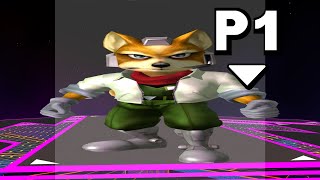
The video presents an alternate‑history scenario in which Nintendo and HAL Laboratory treated the original Super Smash Bros. for Nintendo 64 as a flagship title from the start, extending its development from 1997 to a 2001 release. Backed by Nintendo president Hiroshi Yamauchi, the project receives full corporate support, leading to a four‑year development cycle that produces a vastly expanded game. The hypothetical Smash 64 features a 36‑character roster that includes many third‑party icons (Ryu, Ken, Cloud, Sonic, Banjo‑Kazooie, etc.) secured through negotiations with Capcom, Square, Sega, and others. The roster also adds alternate costumes and split‑out variants (e.g., Star Fox crew). The game offers extensive stage variety with toggleable hazards and movement options, and two single‑player modes: an Arcade mode with random teams and mini‑bosses, and an Adventure mode that delivers a narrative campaign across multiple Nintendo universes. Additional special modes such as All‑Star, Home Run Contest, and Multi‑Man Smash provide extra replay value. Gameplay mechanics are tweaked: players can charge smash attacks, dodge on the ground and in the air, enjoy smoother landings, fast falling, and an on‑screen combo counter, all optional to keep the game accessible yet deep. The video concludes with a showcase of the imagined soundtrack and visual presentation, positioning this version of Smash 64 as the Nintendo 64’s premier multiplayer and single‑player title.
Wai-ai-ai-yah!
Welcome to the first Smash timeline video on this channel focused on Smash 64. A long time coming. If you thought some of my other videos were absurd, well, get ready. In this hypothetical, HAL and Nintendo believed Super Smash Bros. would be a big deal from the start and really saw its potential. Similar story, of course, to the first Blessed Timeline video you may have seen. Seeing the Dragon King fighting game demo, Nintendo's top executives were fully on board. Unlike the blessed timeline scenario, however, the team wouldn't wait to port their efforts to GameCube. They'd expand upon what they already had developed in this Nintendo 64 title. Hiroshi Yamauchi believed a crossover fighting game like this would break game boundaries, even across third parties and competitors. They would reach out to anyone they thought they could get. So with Sakurai's vision and the full backing of Nintendo, starting in 1997, a 4-year-long development journey would begin as HAL Laboratory and Nintendo embarked on their most ambitious project to date. This is the character selection screen. The team would complete an ambitious 36-character roster, including a transforming character Zelda and some bonus alternative costumes and single-player-only bosses. Let's highlight the Smash 64 characters we didn't get in our timeline. Peach, Wario, and Bowser would join the Super Mario reps. King Dedede would join Kirby and Zelda, who could transform into Sheik. Young Link and Ganondorf would join Link to represent the Legend of Zelda series. The rest of Team Star Fox would join Fox, as well as Wolf from the same series. Mewtwo would join the other Pokémon reps, and Marth from Fire Emblem would also make an appearance. Nearly the entire bottom row would be dedicated to third-party characters. To give Smash some fighting game credibility, Nintendo was able to negotiate with Capcom for Ryu and Ken from the Street Fighter series. Not only were they highly recognizable icons in the fighting game genre, but they were also representative of the Street Fighter titles on NES and SNES. Marina from Mischief Makers and Goemon from the Ganbare Goemon series would be featured as they each had recent Nintendo 64 titles released. Beloved Rare icons Banjo and Kazooie and Conker the Squirrel would be included as their popularity was skyrocketing. After negotiating with Enix for Marina, Nintendo was able to reach out to Square to request Cloud Strife as a Final Fantasy rep for the game. Although Squaresoft and Nintendo weren't on the best of terms at the time, Since Square and Enix were in talks to merge, they had invested in more partnership opportunities with each other, and thus this deal ended up working out. Simon and Rector Belmont would be included from the Castlevania series, and were included after negotiating with Konami for Goemon's inclusion. Sonic and Knuckles from the Sonic the Hedgehog series would be the most wildcard inclusions of them all. Yuji Naka knew Sega would be pivoting from the console wars to just publishing games, so wanted to end the Dreamcast era with a bang. Once he heard about the Smash Bros. concept, he reached out to Sakurai and they were able to make the inclusion work. The majority of the roster was built with the popularity of the characters in mind, from fan request submissions, recent games published on the Nintendo 64, and characters the team felt best represented the legacy of Nintendo. Mario had a whole set of Dr. Mario alternative costumes, and Sonic had a classic costume set. Each of the Star Fox crew were originally alternative costumes for Fox, but because each of them became increasingly more distinct with unique body proportions, weapons, etc., the team decided to split them out as their own characters. The team would have so many stage ideas, they created 4 pages worth. They'd also include variation options including toggling hazards, stage movement, and competitive variations. There'd be two single-player modes in this game: Arcade and Adventure. Arcade would be similar to the single-player mode we're all familiar with, but it would have some random elements as well. Teams would be randomized, as would the mini-boss stages. Each would have a break the targets, board the platforms, and race to the finish segment as well. At the end, you confront Master Hand. Adventure would be a narrative-driven single-player campaign complete with cutscenes and unique gameplay elements. The story would take place starting in Mushroom Kingdom, where Mario finds himself fighting Luigi and can't explain why. Meanwhile, in Hyrule Kingdom, mysterious shadowy figures have been popping up, and Link has been trying to protect the nearby towns and villages. Who is behind this shadowy army? As the story progresses, a variety of connected worlds are explored from Kanto to Lylat and everything in between. As if this game's character and stage roster sizes weren't ambitious enough, a sprawling Adventure Mode would make this game the Nintendo 64's premier title in both multiplayer and single-player action. We'd also have a series of special modes like All-Star. This would be unlocked once every single character was unlocked on the roster and you'd fight the whole cast. You'd also have Home Run Contest, where each character would hit sandbags as far as possible, and Multi-Man Smash, where you'd fight an entire Polygon Team army. Now let's check out the gameplay differences. This game allowed players to charge smash attacks, dodge in place on the ground, and dodge in the air. This meant players could better time their hits, had more control over their movement, and were able to execute with more precision. When combined with smooth landing and fast falling, technical players could deliver flashy combos and follow-ups. An in-game combo counter displayed the streak of hits in a row, and the post-game results screen showed statistics from the match. Of course, a lot of these features were optional. The idea was to make the game as accessible as possible, but allow for a level of depth for for any advanced players who wanted to increase their skills in the game. Now, enjoy the sights and sounds of this game, including the soundtrack.
[MUSIC] [Speaker:ANNOUNCER] 3, 2, 1, go! Keep it fire! Mika!
If you like what you see and you'd like to try it out for yourself, I encourage you to look up Smash Remix: The Smash 64 Mod. It should certainly be regarded as a best-in-class mod. It's fantastic. There are also a few other additional add-ons for this mod, which I'll also link in the description, and you can try them out yourself. Also keep in mind I fudged a few things for the sake of this video, and it's its narrative, so not all of it is playable in the way that this video makes it seem like it is. Thank you so much for watching, and God bless.