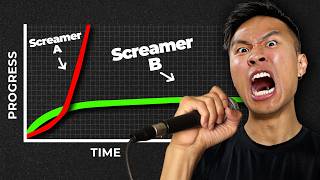
Learn proper breathing for metal screaming, not the diaphragm myths most people believe. The video covers how to control your breath and vocal cords for different scream types, with detailed technique breakdowns for vocalists serious about the craft.
How do you breathe right for screaming? Well, you're probably overthinking and underthinking it at the same time. And in this video I'll go over these misconceptions and the real way to breathe so you can scream like a beast. And this is all backed by my full time experience helping over 2000 screaming students and doing 3000 non student consultations since 2019.
So if you've got the chance to scream for a music project or want to add screams to your music, but can't quite figure out it, this channel's for you. So back when I was learning to scream, everyone spoke about proper breathing for screaming. And they'd spend so long talking about it, they'd all say you gotta use your diaphragm and you gotta push really hard. They'd also say to not breathe with your chest and move up and down your shoulders while you're breathing and instead breathe with your stomach and have that go in and out when you're breathing. And because of how pretty much every tutorial emphasized this, I would spend all day putting my hand on my stomach and making sure that when I breathed in, the stomach would go out and when I breathed out, my stomach would go in. And some past teachers have said that it's even easier to do this if I lay on the floor. So I used to do that all the time. And it was ingrained into me that using my diaphragm was both very counterintuitive to use as well as it was responsible for about 80% of my success during screaming. And that brings me to the first thing I want to share with you. One, it's actually not that counterintuitive to use your diaphragm. For example, just do this and you'll notice your stomach engages and that's pretty much all you gotta make sure you're doing when you're screaming. And I used to stress about the diaphragm a lot when I was teaching. Everyone also says that you need to make sure that your shoulders never move up and down when you're breathing for screaming. And I'm going to show you me breaking that rule and still screaming well, even though my shoulders are moving up and down. And most people make it seem like using your diaphragm is difficult, but I'm actually still using my diaphragm even when I'm trying not to. So that's why people overthink it. This brings me to the next tip. I remember back when I was learning defals chord scream, I was Told to do the deep sigh to unlock my false chords, but the problem was that I was running out of air and I didn't nearly have as much distortion as I wanted to. But since everyone always told me to just practice and use my diaphragm, I would try and fix the problem by pushing as hard as I could with my stomach. And I did this for four to five years actually, with no progress. But that didn't really fix the problem. Using your diaphragm to fix an air loss problem is like having a tire that's leaking air really quickly and thinking maybe I should just pump more air into it instead. You need to close the hole of the tire to fix the root problem. Similarly, if you're running out of air for your false chords, I finally fixed my problem after I learned to close my false cords and vocal cords while screaming, and this sealed up the hole where I'd lose my air. And by the way, if you want to go deeper into doing proper false cores and even fry screams, check out a free training I've left in the description. But back to the video. So my thoughts are that most people have been sold on the idea that using your stomach and diaphragm fixes everything, when in reality it has more to do with what you do in your throat. Pushing from your stomach just powers it. Now here's where people underthink the whole diaphragm thing. Now, I want you to think of what it's like to swing a hammer if you're tapping in a tiny nail to hang in a picture you don't want to swing with full power or else you'll smash the wall. But you. If. But if you're driving in a big nail to build a deck, then yeah, use more force. So different jobs need different amounts of power and it has to be targeted. Similarly, the amount of diaphragmatic force you should use changes depending upon the type of scream you're learning. And on top of that, there's multiple types of fry screams, false chord screams, and there's closed and open arytenoid screams. And not just that. What if I told you that the force should change depending on the pitch and the vowel that you're using? The more rounded and o like the vowels are, the more you need to push, the more tight and bright. The vowels are like E. The less you should push, the lower in pitch you're going with your screams. Generally, the more you should push, the higher in pitch you're going with your screams, the less you should push. Some screams Like a head voice fry scream, you only need to push about a 5 out of 10, a lower place chest fry. Many need to push 10 out of 10 and then going even further. If you're used to pushing really light for some screams and pitches, it can be easy to develop a habit of not pushing the right amount for up other screams. Also, when people say you need to push hard or soft, those are relative terms. If you're pushing 2 out of 10 and someone gives you the advice of oh, you need to push softly. And their interpretation of pushing Softly is pushing three out of 10, then you could easily go in the wrong direction and push 1 out of 10 instead of 3 out of 10. And these are not just all the things that messed me up, but I see that this has messed up a lot of people coming in before they work with me. And once again, I've helped over 2,000 people with their screams. And I've been doing this for full time since 2019. So don't overthink how to use your diaphragm, but think about how much force you should be using for each of these. And for some, this might be a pretty hot take that I have with this whole diaphragmatic breathing thing. But remember, sometimes the things that hold you back from your goals are the beliefs that you never think to question. So sometimes it's worth questioning those beliefs. And the more I did that, the more I unlocked my screams. So remember, don't forget to check out the free training in the description to help you unlock your screams. But also okay, so now you know the nuances of breathing, right? Check out this video to learn about some of the different types of screams you can start to build.