Jan. 2016 Associate's Meeting with David Yoffie
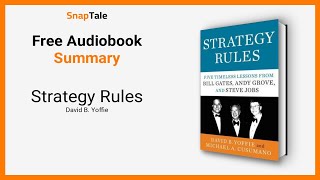
David Yoffie identifies five strategic rules shared by Andy Grove, Bill Gates, and Steve Jobs: look forward and reason back, make bold bets without betting everything, build dominant platforms, exploit leverage through judo and sumo tactics, and shape the organization around the CEO's strengths. He illustrates each with concrete examples like Intel Inside and the App Store.
Questions this video answers
Yoffie explains that in the 80s‑90s the three firms did very few acquisitions; today’s environment with abundant startup activity leads to many more acquisitions (Google, Amazon, etc.). Intel under Grove made only limited bolt‑on purchases, Microsoft made small, strategic acquisitions, and Apple preferred buying specific technologies rather than whole companies. The shift reflects the richer external innovation ecosystem now.
Yoffie says US antitrust agencies are relatively sophisticated but struggle to keep pace with rapid network‑effect dynamics. European regulators are more aggressive, especially on bundling and data practices. Chinese authorities focus on leveling the playing field for domestic firms, often imposing stricter controls on foreign tech giants. He is less optimistic about Chinese antitrust outcomes for U.S. firms.
Yes. Yoffie cites Disney under Bob Iger (big bets without risking the whole company), GE under Jack Welch (look forward, reason back), and Walmart (building a supply‑chain ecosystem). He argues the principles apply to any industry where strategic vision, platform thinking, leverage, and organizational alignment matter.
Gates and Jobs were aggressive in hiring external senior talent, while Grove largely promoted from within. Each CEO also relied on complementary partners: Ballmer for Gates, Craig Barrett for Grove, and Tim Cook for Jobs. Yoffie notes that complements are not always substitutes, and the right mix of internal and external talent was crucial for scaling.
Yoffie admits the lack of comparable women in his study reflects broader industry demographics and historical barriers. He acknowledges the question and suggests that future research should seek out female leaders who exhibit similar strategic mastery, though identifying such figures remains challenging.
Chapters
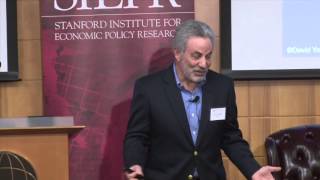
Thanks so much to all of you for coming. I'm really delighted that we are going to have today to hear from David Yaffe from that little place, Harvard Business School, telling us about some insights from his recent book and related topics. David actually has been at HBS ever since he completed his studies here at Stanford. So he has two degrees from Stanford, both in political Science and International Political Economy, which built on his undergraduate degree from Brandeis in Political Science. And despite I'm really tempted, given he has three degrees in political science, to ask him to opine on what's happening with US politics right now. But that is apparently not why he is here today. So, in any case, he has a really interesting background. He actually started out working on topics like trade policy and protectionism, but gradually moved over time to study issues related to business strategy. He's received many, many awards at Harvard for his teaching, for his service, and for his case studies. He's actually published more than 100 case studies, which have sold more than 3 million copies. And he's held many, many important positions, administrative positions at hbs, including things like Senior Associate Dean and Chair of the Strategy Department there. He's actually been a director also of intel since 1989, and he's currently a director at the National Bureau of Economic Research. But please join me. I'm so delighted to welcome Hirna Sieper back to Stanford, some years after completing his studies here. David Yaffe.
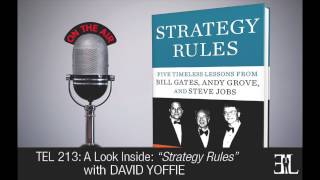
So I'm delighted to be back and I want to use this as an opportunity to talk a little bit about my new book. This is actually the first time I've given this talk in Silicon Valley. So it's the first time I probably have so many people in the room who know the protagonists of the book. And I start the book with the COVID of the picture that was on the COVID which was a picture that was taken at the Time magazine's 75th anniversary in March 1998. And it's the only picture that was ever taken of Grove, Gates and Jobs when they were all concurrently CEOs of the company. Now, the first thing everybody should note is the tuxedos, which is not the way we normally think of them. But if you take a look at this picture for a second, you look at Andy Grove in the center, and I look at that picture and I see a smile that literally goes ear to earth. Now, why is Andy smiling? He's smiling because life has never gotten better for him. About six weeks before that picture was taken, Andy was named Time man of the Year. And if you're an immigrant and you come to this country and you become the time man of the year. As an executive, it literally is the absolute pinnacle of your career. It doesn't get any better than that, which is why he was smiling that way. In about four weeks before this picture was taken, Andy actually calls me up. I was lead independent director, and he says, it's time for me to retire. He literally knew he had reached the absolute pinnacle of his career. Now, if you look at Bill Gates on the right, I see Bill as having a little bit more of a constrained smile. Now, why was his smile a little constrained? Well, Bill knew about four or five weeks after this picture was taken that he was going to be prosecuted by my friend in the room, Doug Melamed, who is at the Department of Justice. And he knew that his life was coming to an end. As he knew it. He was going to be prosecuted. He had a video deposition that literally destroyed his life at that period and then led him to ultimately decide to resign or retire from the CEO job at Microsoft. Now, if you come back and you finally look at Steve Jobs on the left, I call that the classic Steve Jobs smirk. He has this look like he knows something that no one else in the room has any idea about. And of course, you have to remember at this time, only a few months before, Michael Dell had said if he was in Steve's job shoes, he would give all the money back to the shareholders and close down Apple. And of course, what Steve knows is about eight weeks after this picture was taken, he was going to introduce the imac, which was going to fundamentally change the direction of the company. Now, the question that I wanted to answer in this book was, how does a manager, a CEO, an entrepreneur, become a great master strategist? And the way I thought we could learn about this was learn from the masters that we know well. And I had the good fortune of meeting andy in the mid-80s, and he introduced me to both Bill and Steve in 1990. So I had an opportunity to both interact with them and study them for 25 years during their times as leaders in Silicon Valley. And what we try to contend in the book is that Bill, Andy, and Steve may be the three greatest strategists of the modern era. We can all, I think, agree, at a minimum, they redefine what we think of as modern business. Maybe even more important, they redefine modern life. None of us can imagine our lives today without a computer, which required a microprocessor, an operating system, or a smartphone, which, if you think about the smartphone today, it was basically created with the iPhone in 2007. And of course, the CEOs, they built what turned out to be three of the most valuable franchises in the history of the world. World. During their tenure, each one of them became the most valuable company in the world at the time. So that's an extraordinary record, which virtually no other group of people we could imagine would be. Now, the argument of the book is that despite a lot of dissimilarities, there's a lot of commonality in the way they think as strategists. And we talk about what we call five timeless rules. One is that as strategists, they all had the discipline to what we call look forward, reason back, to act like great chess players or great game theorists in the way in which they develop strategy. Second, all three of them made very big bets, but they never bet the company. They were bold, but never reckless. Third, that it's critical if you're going to build great companies in today's world. You have to build platforms and ecosystems and not just products. And as I'll talk about a little bit later, the best platform almost always trumps the better product. Fourth, we talk about what we call exploiting leverage and power, which is mastering what I call judo and sumo tactics. And then finally, part of the question that we try to understand in the book is what allowed them to execute so well. And this had a lot to do with their management style and approach, which we call shaping the organization around what we describe as their personal anchor. Now, in today's talk, I only have about 30 minutes. So the book is about five rules and about 20 principles. Today I'm only going to talk about three of those rules and four principles. In other words, if I get you interested in the subject, you still have to read the book. So let me just start with this slide because when I first started this, I talked to people in the valley. They all thought this was a terrible idea for a book because they couldn't imagine three more different people and they had nothing in common. Again, for those of you who know their background, I don't want to spend any time on it. I mean, we all know Bill was brought up in an upper middle class, or almost upper class family house of privilege. He was the ultimate geek doing programming in high school before that was fashionable. And of course, a dropout from Harvard College Grove, on the other hand, was a Holocaust survivor. He literally walks out of Hungary in 1956, doesn't speak a word of English, makes his way to City College of New York, gets a PhD in chemical engineering and goes on to help start Intel. And of course, Jobs. We all know the story of him. Well, orphan, flower child dropout, dropping acid, among other things. Many things that wouldn't seem to be at all in common with the two other individuals. But having said that, there are certain things that they did share for certain Number one, all three of them harbored outsized ambitions. And this was not just for themselves, but for their organizations. They all believed that they could change the world. And that was an extraordinary part of the way they framed and thought about their missions in life. Second, they cultivated a ferocious work ethic for themselves and their employees. When Bill Gates was asked recently what did he have in common with Steve, one of the few things he said he thought he and Steve really were similar on is that they work super hard. And that created the work ethic that penetrated both Apple and Microsoft. And certainly the same was true at Intel. All three of them also provoked and valued intense debate. People who just responded, yes, in those organizations were never respected. Maybe even more important, they were great intimidators and great motivators that they took no prisoners in their organizations. They were always seen as the smartest people in the room, which has its weaknesses. But in the process, they motivated people to do beyond what they normally would do on any given day. And lastly, I think what they shared was a certain streak of paranoia. Even when all three companies were at the absolute peak of their market power, they were always concerned that something was going to take them down. And that led to a certain type of ethos and approach that allowed the companies to prosper even where other companies have often failed. Now, what was the bottom line of this? The bottom line is you put the three companies together at their peak, during the peak of these three CEOs, they generated $1.8 trillion in value. And as they said, by any measure, that's an extraordinary number which even today with Apple's valuation and the next two companies out there, it's hard to get up to that kind of valuation in today's world. So let me just start and I want to walk through a couple of these basic principles and give you a sense of sort of what the basic thesis of the book is. So the first idea is this idea of what we call look forward, reason back. And the notion is really very simple. The idea is like a game theorist strategy starts by looking towards the end game and then try to figure out what are the steps I need to do to go from where I am today. To that end game. So I need to look forward and then reason back. And in doing this, you have to start to some degree with a vision about where you want to go in the world. Now, many of you may remember Lou Gerstner, who is a famous Harvard Business School graduate, becomes the CEO of IBM. In the very first press conference at IBM. He says, the last thing IBM needs is a vision. Now, what you may also not remember, or may or may not remember from that day, is that Gerstner was excoriated for this comment. It was thought of as the dumbest comment a new CEO had ever made. And by the way, Lou to this day still says he never really meant to say that. But what Lou did say a few years later, 2004, I do agree with. He said, pie in the sky is really irrelevant. Vision is easy. It's so easy just to point to the bleachers and say, hit one over there. What's hard is saying, how do I do that? And that's the basic discipline that we talk about that Andy, Bill, and Steve had. It's this ability to look forward and then ask, how am I going to get there? What are the steps? That's the critical discipline that we often don't see in this world. Now, how do you do this? Now, it's not that hard in many ways. Basically, the vision of a company starts with extrapolation. You've got to extrapolate into the future, and there are lots of ways in which that can be managed. And then you've got to interpret. And interpretation, ultimately is the key. What does that extrapolation actually mean? A vision should be simple, a few key words. It shouldn't be complicated. And then once I have that, then the notion is you reason back to what are the specific actions we take today? So for all three of these guys, what was the extrapolation? It was actually something everyone in this room knows and everyone in the valley knows. It was Moore's Law. And Moore's Law, which Gordon described in 1964, was all about this notion that the processing power of an integrated circuit should roughly double every 18 to 24 months. In the process, you can increase the performance and roughly halve the cost. It's a very powerful vision. And we know we've been able to hold to that extrapolation from 1965 to 2015. We've just had the 50th year anniversary of that extrapolation. So it works. Now, knowing that extrapolation again, where did it start in terms of vision? Well, Bill had a really simple vision. I've always thought this is one of the most powerful, powerful visions that anyone's ever developed. In 1975, he said something really simple. That there would be a computer on every desk in every home running Microsoft software. Now, today, that seems ridiculous. It seems like it's so trivial. You have to remember, in 1975, that seemed like a ridiculous statement. In fact, it was so ridiculous that Ken Olson, the founder of DEC and the CEO at the time, two years after he said this, said there was never any reason that there will ever be a computer in anybody's homes. People just didn't believe it. They didn't see it. And this was all based, again, on a simple extrapolation of Moore's Law. Now, Jobs is really interesting because Jobs Inside Apple in 2001 at Macworld actually says, here's the vision for Apple. He says, what's our vision? Everyone is saying our PC is waning. We don't think the PC is dying. We think it's evolving. The future of computing lay in finding a way to allow users to create and share and add value to the explosion of digital devices. The Mac can become the digital hub of our emerging digital lifestyle, adding tremendous value to our other digital devices. Now, here's what's interesting about this vision. It's wrong. We think of Steve as this great visionary. Well, the Macintosh never became a digital hub of any magnitude. It was never meaningful in terms of what Apple was able to develop. So that is not really what's important here. But Steve said something that he got right, even though he got the basic vision wrong. Anybody know what did he get right? Where did he get right? If you look at this vision, not digital lifestyle. Well, yeah, it was about the explosion of digital devices. What Steve saw in 2000 was that there was going to be an explosion of devices that ultimately would allow what became the ipod, the iPhone, the iPad, and so on and so forth. And as we interviewed all the senior management inside Apple, it was very clear. Once this vision was articulated, what was all the discussion at Apple about? It was, what are the digital devices that are going to surround our products? That's what drove them. And that's what drives ultimately the creation of the ipod, which is what started Apple down its current path. In the case of intel, it was something quite different. And he had a very different interpretation of Moore's Law. His interpretation was that if you're actually going to be able to make Moore's Law happen, there's a certain level of scale you need at every layer in the value chain. And historically, while companies have been able to internalize those economies, with the creation of Moore's Law, that was no longer going to be possible. Therefore, it had to lead to an inevitable horizontalization of the computer business, which Andy was seeing at a time in which it was not at all obvious to everybody else in the world. And so he argued that the vision for intel was that this old world of vertically integrated computers was going to disappear, and that what was critical was this horizontal world where you had to have a big slice of a horizontal layer. And all of that was because of the extrapolation of Moore's Law. Now, that's the easy part. In some sense, the easy part is extrapolation. The hard part is then figuring out, what do you do about it. Now, Gates vision was very clear. It was, we are going to be driving computers through the software layer. Now, what's interesting is Paul Allen, who was Bill's partner, said the world's vertically integrate. Therefore, what is the right thing to do to make this vision happen? Well, Paul wanted to vertically integrate. He wanted to make computers. You can read about it in his book. The great insight or brilliance of Bill was Bill said, no, we're going to go horizontally. We're going to focus on the operating system layer, the tools layer, and eventually the application layer. And so it was that ability to make that interpretation that ultimately is what drives Microsoft's value. Now, we all know, in Steve's case, it was about integrating hardware and software together. In the case of intel, what Andy discovered was intel historically had been focused on being a vertically integrated player. That was the strategy of record. When Andy become CEO, when he comes into this realization that the world's going to go horizontal, he says we've got to change that view. And literally what he says is, forget about the classic semiconductor business. That's not where the value is. But also historically, intel wanted to think about branded computers. They had one of the largest computer companies in the late 1980s people never knew about because it was a white label company. And so the position was, that's now a no, no, we don't do that anymore. And the vision then became, what we're going to do is we're going to focus on this other layer. That's the horizontal layer where value is going to be created. So all three of them focused on this ability to look forward. And then they reasoned back. And again, the key theory in the book is looking forward is the easy part. It's that reasoning back, it's that interpretation and figuring out What I need to do, that's the hard part. Now, the second rule is this idea of making big bets, but without betting the company. And here it's really a simple idea. If you want to be a great strategist and a great CEO, you've got to be willing to take risks and you've got to be bold and you've got to be able to not worry about the implications, that it's going to be stressful to do it. And great strategists often do the non obvious, the difficult and the counterintuitive, in part because they scare the competitors. Now, sometimes these bold moves are financial, sometimes they're competitive, sometimes they're reputational. So for example, I want to focus on two of these ideas here about what was bold about these two guys, these three guys, and it was about making some big bets. And being bold is often equally important to know when to cut your losses. Because everybody makes mistakes. And if I think about the big bets they made, Gates made a very straightforward bet. What was his bet? His bet is he decides to go to war with IBM at a time when IBM was literally 60 times, 60 times Microsoft's revenue. So when at the time, you have to remember 1990, IBM and Microsoft were partners in the development of OS 2 and Microsoft decides they're going to bet on Windows. And that bet on Windows was perceived as the potential nightmare scenario if IBM comes out with all guns blazing. It took a lot of fortitude to make that bet. In the case of intel, intel made both a financial bet and a competitive bet. The big financial bet was they were going to sole source the 8386 microprocessor, and they were going to make all of the critical components that were necessary for the entire world computer industry. Industry. And by the way, IBM says to Andy Grove at the time, if you do this, we're out, we're out. IBM said they would only take 7,500 CPUs to test them. But we're not going to take your strategy if you go alone on the 386. So this was a bet that they could serve the entire computer industry. And IBM, the world's largest computer company, was out. The other big bet was to do intel inside. And here the idea was they were going to brand a product that nobody knew what it was, nobody ever saw one, and nobody ever knew what it did. Other than that it was a great idea. And I can tell you at the time, again, I was on the board at the time, most of the management team and certainly Three quarters of the board thought Andy was totally insane. How could you brand a product that literally nobody knew what it was, nobody had ever seen it. And again, it was a big bet. We spent hundreds of millions, ultimately billions of dollars on this. And we broke industry conventions in the process. In the case of Jobs, he really made two big bets. And it wasn't actually the ipod or the iPhone. Those were actually pretty small bets. The big bet he made first was the decision to switch from intel to the PowerPC. This ultimately was close to a billion dollar bet. It was the biggest financial bet that Steve made. And the other big bet he made was the decision to open Apple retail. Now, he did this at a time in which he had absolutely zero experience in retail and Gateway had just spectacularly failed in retail. And I can tell you, to be honest, that I was quoted in the New York Times at the time saying this had absolutely zero chance of success. Again, if I was looking at it, I could not imagine how an Apple retail store at the time had any chance of success. So that's why Steve is Steve. And I'm here talking today. Now I want to though again emphasize that everybody makes mistakes. And these guys made some pretty big mistakes. But what separated them from your average run of the mill CEO is when they made the mistakes, they figured it out and they changed course. And that's often as important as making these all these other decisions that I talked about. What was Bill's biggest mistake? Well, Bill missed the Internet. I mean, think about it. He missed the Internet now when I was actually at Stanford 1995, and I was spending a day or two a month at Microsoft, so I got to see the whole process going on. And what was very clear is he decides to kill the msn, which was their proprietary online investment like aol, which he had spent hundreds of millions of dollars investing it for years, he just decides to kill it. And he says, I don't care, we're going to kill it. It's the wrong thing to do. Which again, many CEOs are just not willing to do that, not willing to take that step. In the case of Andy, what his biggest mistake was required him to make a big public apology, which was not easy for him. But many of you may remember that in 1994 there was something called the penny and flawed, the floating point error, which was an unmitigated disaster. And as a result of that, we had to make a half billion dollar write off, which was real money back in 1994. And Andy had to make a big public apology. But the process of doing it ended up being one of the best decisions the company had made because it made the Pentium a household name. And suddenly we became the trusted name in the microprocessor business, like Johnson, and Johnson was after Tylenol, because we guaranteed everybody after they had a mistake and a problem with the processor, we would fix it. It was a fantastically good decision in the end. And what many people don't realize is how many really big mistakes Steve Jobs made. Again, he is deified today. We just forget how many big mistakes he made. What was probably the biggest mistake he made? Well, the first one was he absolutely, positively refused to launch the ipod for Witness Windows. So remember, Windows had 90% of the market and Apple had 3. And if the iPod had stuck to 3% of the market, Apple would be a shadow of its current self. It would be nothing compared to what we actually know it today. And it took his staff beating on him time after time after time, until finally, in one meeting, he stepped, he stands up, he screams at everybody here, he yells a profanity and he says, go ahead and do it. You're responsible. I want nothing to do with this decision. And as the story was relayed onto me, everybody in the room looked around and they said, great, and they decide to make the ipod available to Windows. And then eventually, of course, we know what happens. The second mistake that Steve made is equally catastrophic. Steve absolutely refused to allow an app store for the iPhone. When he announced the iPhone, he said, there will never be an app store. Now, if he had held to that position, where would the iPhone be today? The answer is why? Did he say, well, he was just wrong? But no, he said that because that was the standard view of the phone industry at the time, which was you put applications that aren't controlled that would destroy the network. And that's literally what he said in his press interview. And if he had held to that position, BlackBerry would. I mean, iPhone would be BlackBerry. It would be 1% of the market today. And again, Steve eventually figured it out about six months later. And eventually we all know what happened to the app Store. What I give Steve a lot of credit for is he said, I don't care about being right. I care about success. And that ability to change his mind when he recognized overwhelming data, the opposite of what he was suggesting led him to make these changes and do things that were literally 180 degrees. Now, again, I don't want to talk, I'm not going to talk about it today, but in the book, we Talk a lot about the importance of platforms and ecosystems. And again, just want to make the point that what we know in the technology world is that generally the best platform wins. That if you remember VHS versus Beta, all of us who were in that world, the video recorder will all remember, including I bought Betamaxes. They were the best, right? And it became obsolete. No one here in this room thinks that a DOS operating system is better than Macintosh. But one had 90%, one had five. CIS versus RISC is a semiconductor technology I won't get into. But even today, most of us would say iOS is probably in many ways the better operating system versus Android. One has 85%, one has 50. So we talk in this chapter about what we need to know about platforms. In the case of chapter four, it's about the willingness to both be clever when you're small and to be tough and sometimes ruthless when you're large. Now, when I've talked about this in other groups, it does make some people very uncomfortable when you talk about the ruthlessness of Gates, Groves and Jobs. But. But they could be ruthless. They could be extraordinarily tough. I mean, I love this quote from Gates to Steve Case where he says, I can buy 20% of you, or I can buy all of you, or I can go into this business myself and bury you. And that was a fairly typical kind of comment that all three of them would use. So there was a certain toughness verging on ruthlessness that was symptomatic of all three of them. But I want to spend the last part, the last couple of minutes talking about this idea about how do you execute? How do you shape an organization around your personal anchor? And here the notion is that as a CEO, you have certain strengths, and those strengths become anchors for your organization. They're your comparative advantage where you add value as a CEO. But it's also important to realize that none of these three guys were really superman, that they were not, in many ways great managers. In some ways, they were deeply flawed as leaders. I have not one colleague in my organizational behavior group leadership group at Harvard who would say you want to emulate any of these three people, the way in which they treated people, because they treated people often so badly that you would never want to emulate them as leaders in that sense. But here's the key. And again, in Job's case, it took him a while to figure this out. The key is that when you have weaknesses, they will inherently limit an organization unless you can identify what those gaps are in your own skill set. And then find people who fill those gaps. And that was the critical thing that the three of them had in common. So I just want to spend a second then talking about that because one of the things they all did well is they all recognize that whatever I know today is not going to be important for the business of the future. I have to learn new things, and I'm not an expert on everything. I have got to learn those new things. So in the case of Grove, for example, he found tutors internally and externally. He learned computer architecture. He learned marketing and branding, which was about as far from Andy Grove's skill set when he started as you could imagine. He found people who helped him teach, learn about sales management. The very first class he ever taught was he came to my class at Harvard to teach strategy, and he recognized that that was a great way to learn strategy. So he came to Stanford and used Stanford as his way to learn strategy by teaching a strategy course every year while he was CEO. In the case of Bill, why did he learn new things? He had his think weeks. He took a week, at least one week off every year where he cut himself out from the company. He had no email, no phone calls, and he just read. And he often read very broadly, very extensively. And he'd come back and he'd write a memo and say, this is what I've learned, and this is what's important for the future of the business. And his most famous memo that came out in one of these weeks was called the Internet Tidal Wave, where he said, I screwed up. We missed the Internet. The whole company's got a shift, 180 degrees. And it came out of these think weeks. Interesting thing about Jobs is Jobs also was very aggressive at finding tutors. He knew what he didn't know. I should say he figured out over time he knew what he didn't know. And Jobs, early Steve Jobs was not like this. Later, Steve Jobs was particularly good at this. So he found Jimmy Ivine from Beats to help him learn music. He was in a Universal Music ed Capmo in movies. A guy named Avi Tavanian was his software guru. And Ron Johnson, who is a trustee here at Stanford, and he actually happened to be a student of mine in HBS at Harvard. He was the one who taught Steve retail. Let me tell you a quick story, since Ron is on the trustee at Stanford. The way Ron tells it, Ron was recruited by a headhunter, came out to see Steve, met with him. Steve said, write me a memo about what you think Apple should do. So Ron writes a Memo gets a call back a couple weeks later, comes out to see Steve, and Ron says, how'd you like my memo? And Steve said, it was crappy, it was terrible, forget it, but I'm hiring you anyway. And Ron was a Target. He was a senior executive at Target. And this is what Steve said. Then he says, here's how it's going to work. I'll teach you electronics, you teach me retail. Let's go walk the mall. They literally get in their car, they go to the Stanford Shopping Mall, and they spend the next four hours walking around the mall with Ron teaching Steve about merchandising, store displays, store layouts, wall layouts, literally teaching him the ABCs of retail. And that's how the education process begins. Now, the last chapter, I tried to argue that it's not just about Andy, Bill and Steve that we're seeing a lot of the same patterns replicated with Larry Page at Google, Mark Zuckerberg at Facebook, Jeff Bezos at Amazon, or in China, you could look at Pony Ma. But we also, in the last chapter, try to make sure everyone's sensitive, that people, they do make lots of mistakes. And some of these mistakes have had lasting impact. And the one I want to talk about for a second is this idea that what I call complements are not substitutes. What's the biggest problem when you're a legend, when you really become a legend in your own time? The biggest problem is how do you replace yourself? And this was the biggest problem for all three of them, which was their natural tendency was to choose what I call a compliment. Choose the people who got them to be successful. Choose the people who were very close friends of theirs who they had enormous confidence in. The challenge is compliments are not necessarily substitutes. They aren't necessarily the right people to do the things that are needed to take the companies to the next level. So if you look at Microsoft, I think that SIPRA board member Steve Ballmer was the perfect complement to Bill. Bill was the technologist, the strategy guy. Steve was the people guy and the customer guy. At Intel, Craig was the perfect complement to Andy. He focused on manufacturing and operations, while Grove did strategy and sales. And of course, Tim was the absolute perfect complement to Steve. Apple never could have scaled without Tim wouldn't have been possible. So Tim did supply chain operations, sales, while Steve did products marketing and design. Now, I think it's very clear that with Craig and Steve, they were probably not the right choices. It's a difficult thing to admit, but they were probably the wrong choices. With Tim, I think the verdict is still out. It's still out. Apple's enormous success after Steve's death, though, has largely, not largely, almost exclusively been Steve's legacy. It's the iPhone that's what's driving Apple's success. When I say the verdict is still out, there's still one thing we don't yet know with Tim is can he do the next thing? The Apple watch? It doesn't look like it. We'll see whether he makes the next move. So let me wrap up my last slide here. A final thought. I didn't put this in the book, but when I was rereading this not too long ago, I thought there was a wonderful quote from George Bernard Shaw in Man and Superman that I thought is a good way to sort of end this discussion. What he said was, the unreasonable man adapts himself to the world. The unreasonable one persists in trying to adapt the world to himself. Therefore, all progress depends on the unreasonable man. So, you know, maybe you need to be an unreasonable person, which I certainly would think. Bill, Steve and Andy, they were all unreasonable people. But maybe you need to be an unreasonable person to be a true master strategist. So thanks very.
Hearing that, I wonder if John Chauvin read your book before reaching out to me, but I don't think so.
Choosing Successors, you mean?
Yeah.
Are you a compliment or a substitute?
I don't know. I'm like trying to run that through.
My mind right now. So.
It was great. I personally really enjoyed reading the book and it got me back to, as I was saying earlier today, I'm an electrical engineer by training. So hearing about Intels and Intel and semiconductors and so forth was for me a lot of fun. And there's so many questions that. So I'm just going to ask a couple of questions because I want to open it up because there are so many people here with great knowledge. But one thing that I was curious about after reading the book, we hear a lot in Silicon Valley now about Google, Facebook and so forth going into new territory and acquiring, let's say, small startups as opposed to trying to do it within? And I was curious, from your sense, from your studying these three CEOs, did they have a different philosophy about that, about the sort of desirability of trying to go outside the firm to try to identify people who could burst their innovation and so forth, or doing it within?
So just curious, part of what's different today versus during the 80s, 90s and let's say the first decade of 2000, is that the level of startup activity has burst into a new level. So a lot of the creativity that we see in today's Silicon Valley is not being done necessarily inside the Apples or Intels or Microsofts of the world or even in the Googles or the Amazons or the Facebooks. So the consequence of that is there is more creativity being rewarded outside the firm and that leads to more acquisitions. So, you know, it's not unusual. We certainly see a lot more acquisitions by Amazon, a lot more acquisitions by Google than Intel or Microsoft or Apple ever did. Apple liked to buy pieces of technology they didn't like to buy. Companies like to buy pieces of technology and then throw them in. Intel was very, very limited in the acquisitions they did under Andy. And Bill did some acquisitions generally very small, but they were again, bolt on components as opposed to what we see today with Google buying many big firms, much larger numbers or Amazon spreading themselves off to a much, much broader category. But I think that's largely a function of the environment today where that startup creativity creates more opportunities to do.
That's interesting. So just today, also ahead of the talk, I did a little research and these three companies that you compared, the three people, really Page and Zuckerberg and, and Bezos comparing them with the three in your book, I was just curious about how the market cap of those three companies looked relative to the big three studied in yours. And they're just 5% shy as of today, but I hope both numbers are going up a lot in the coming days after the first few weeks of 2016. So my next question though has to do with sort of, and you touch on this a bit in the book. The challenge is a lot of these. All three of the companies sort of push the limits a bit with the organizations such as DOJ and FTC getting concerned about antitrust issues, too much market power and so forth. Whether it was, I mean, with IBM it was more a vertical thing, but to some extent more horizontal with all three of these firms. But bundling and these other issues. And now I think the three other companies that you mentioned, they certainly are under scrutiny, perhaps even more in Europe than in the US and so I'm curious about a. Whether you're optimistic that today's antitrust authorities are well trained to sort of think about the benefits to consumers of big versus more competition. And are you optimistic about that? And do you. So yeah, take that.
Of course. I didn't know that Doug Melamed, who was, he literally was on the team that prosecuted Microsoft.
Okay, maybe he can.
He was the General counsel at Intel. But antitrust is certainly an issue for all of these firms because of the market power that they possessed and they pushed the edge of antitrust throughout their entire tenure. Andy Grove in particular was paranoid about antitrust. So there were a lot of policies internally in the company designed to restrict some of the activity we would do to, to not cross that line. Microsoft and Apple were a little more cavalier about it until they got prosecuted. The challenge in policy today is that in a world where we have network effects, where you get the equivalent of a winner take all outcome, what is the definition of excess market power? And that changes so quickly in the tech world that it's very, very difficult for the DOJ and the FTC to catch up. So 10 years ago, we were all certain Microsoft was going to take over the world. That looks like a much lower threat today compared to the fear we have of Google. And presumably that same talent will continue to go on. But I'm less worried about the US Antitrust authorities, who I think are relatively sophisticated on this subject, and much more worried about the Europeans and much more worried about the Chinese, who generally have other objectives in addition to consumer welfare as they look at these antitrust decisions. So as you say, Google and Amazon are both being looked at in the European community today. Apple is always being looked at by everybody. The Chinese are looking at everybody. And the Chinese seem to have a dual standard of what they would do to American and European companies versus what they do to domestic companies. And yet for any tech company today, you have to compete in China. Therefore, being able to navigate through the Chinese antitrust system is no longer an irrelevant problem. It actually is a very difficult problem that I'm not terribly optimistic about. I think the Chinese will exercise their authority to make the playing field as level as possible for their firms, regardless of the merit of the antitrust policy question.
It's difficult. I mean, with all of these firms, it's sometimes difficult to figure out who are the competitors. So if you're thinking about a merger of two airlines, it's much easier, or between two hospitals. But here it's much trickier.
That's why we talk about it as ecosystems and not industries, because the definitions get very, very muddy at the corners. And yet if you buy something that is not directly in your industry and you have market power and you have the ability to leverage, which of course is, we know, per se illegal, but may not be obvious, it becomes very problematic even in antitrust review to understand what's on going on.
Okay, great. All right, well, Let me open it up now for questions from the audience. Pitch.
Bill Gates was surely the founder, and so was Steve Jobber, founders of their companies. But of course, Andy wasn't. And he came in. I don't know how, but he came in. And both Bob Noyce, Andy, and Gordon Moore were strong intellectually, business leaders, historically, I guess. Why did intel turn to Andy as a leader when they had. Those other guys must have turned to him too. What is the history of that? And how did he become the strategist and the boss? So, yeah, Andy was employee number three. So it was Bob and then Gordon and then Andy. So Andy was not officially a founder, but he was as important in founding and building the company as the original two founders. And Andy was always an operating manager. He wrote a book called High Output Management in the early 1980s, which was all about how does a middle manager manage. Andy was not a strategist, but he. He was in some sense the perfect complement to Gordon Moore because Gordon was a very. What's the best way to. Just very sophisticated engineer and technologist, but not really much of a manager. And Andy was the one who managed the company and made it work. Right, right. And Bob actually understands he doesn't have either the skill or the interest in running the company, and he decides to turn it over only after about five or six years. So it goes to Gordon and then it goes to Andy about 10 years later. But the interesting thing about Andy, and it gets to the last point I made, I didn't think Andy was a great strategist when he first took over the job, but he learned. He actually dedicated himself to thinking much differently about the company, about learning things that had never occurred to him to really learn, like consumer marketing or even computer architecture, never mind thinking about strategy. Andy's great skill was that ability to dedicate himself to learning new things. And I think that's what made him a great strategist, not that he had developed as one. Bill, I think you could argue, was more of a strategist from day one and maybe even Steve. And he had to learn it. And that's what he was very good at. Part of it was learning it just by teaching here at GSB for 10 years, teaching strategy.
Thanks. Next question right here. And then, Kathy, you next.
So based on something you were just talking about before, are these five timeless US Lessons, Are these five timeless US lessons for the high tech business, or is there a universality here that we should talk about? That's a great mobilized world. That's a great question. So number one, I did note that in the last chapter we talk about how the same thing is certainly applying to the new generation of leaders in China. So you can think about Jack Ma at Alibaba or Ponima at Tencent. And so you see exactly the same kind of application of the rules that I was describing. In addition, I'm always asked this question, but usually not in Silicon Valley, about does it apply to the non tech world? So you know, of course, I therefore prepare slides on this, you know, so I have, I talk about what I think Iger did at Disney and actually if you hear or you read some of his quotes, it's exactly along the same kind of lines about making these big bets but never betting the company in the process. Or if you think about what Jack Welch did, the way he talks about the whole approach to General Electric, it was very much along this look forward reason back approach that I described in Building a Vision or I think what Sam Walton did with Walmart was all about building an ecosystem. Walmart's secret is not about Walmart. Walmart is just a discount store, but it's about the supply chain, the relationship with all of its suppliers and manufacturers, the ability to build an ecosystem around it that enabled it to do things that its competitors could never copy. So as you look broadly across many different kinds of firms, whether it be retail or entertainment or industrial, I think you see the same kinds of rules being important to any strategist. I just happened to pick these three because I knew them well.
Great. Kathy.
I think that it's been fascinating to hear you talk about this development in our country, but it seems, it looks to me as if our country has a huge advantage because we don't have a fear of failure. In Europe and maybe other countries also, there's a fear of failure. But you've been talking to us about people who have no fear of failure. I wouldn't say they don't have a fear of failure, but the consequences of failure in Silicon Valley are certainly different. The stigma attached to it is different, particularly in Europe, which is where it's often compared. So when we talk about the desire to do venture in places like France, it's often very hard because that risk takes philosophy is not as acceptable in the culture. Even in the uk, where again, there's a fair amount of innovative activity in the startup world happening, it still is not as prevalent as it is here. So I agree. But on the other hand, we're seeing in China now a lot of risk taking a lot of the same kind of innovation that we saw in Silicon Valley over the last 30 years. So I don't necessarily think it's purely a US phenomena and I'm not even sure it's entirely us. It may be more Silicon Valley, Boston, a few other tech areas, certain in New York, maybe in all other regions. It's not quite as accepted as it is here. So it may be even a little bit more local and a little bit more specific. But I don't think it's us only.
So I have a problem. I'm going to jump the line. I'm curious, when you were doing the putting together, doing the research on all three of them, did you uncover systematic differences between the three of them with respect to sort of their ability to recruit, to retain, to motivate, to mentor the people on their team, or would you say that they were very similar in that respect?
Well, one of the things I mentioned is as leaders they all had their foibles and some of them were pretty bad. And I would say it was particularly true of Steve who tended to be often awful to people and had a fair amount of turnover. On the other hand, when Steve was on, he could be so charismatic that he could convince anybody to do anything. I mean the classic example of John Scully being convinced to look, leave Pepsi because did he want to change the world or sell sugar colored water the rest of his life? So they all had this dual feature of sometimes being awful and sometimes being so compelling that they could attract great people. Now they were also quite different because Bill and Steve were much more aggressive at hiring people outside the company, even at senior levels to come in. And Andy, not so much Andy systematically. Andy's approach was to promote from within very little outside hiring during his entire tenure. So they weren't the same, they were different and they had different styles and different approaches.
So Andy's got the Green Bay packers approach apparently. I learned this week that only two Libby there is from Wisconsin. Two of their 53 players were drafted by other teams apparently. So they Andy Grove is more of the homebrew. Okay. Additional and feel free if you're a student. There are a bunch of students here. Students can ask questions here too. So in any case. Yeah, Winston.
Hi Dave. Around 2000, I guess a lot of people in the PC industry already knew that it's going to switch from PC to notebook to mobile computing. I think Bill Gates show the tablet around 2000, 2001 they had a software for smartphone intel spent a lot of money on mobile microprocessor. How come it takes 2007 for Steve Jobs to be able to push out iPhone and iPad while Everybody for about 10 years tried to do do the same thing. And there's lots of people and they're not able to make it. What's the major difference? Steve's great gift was he did not care about backward compatibility. He didn't care about his existing business. In fact, one way it was described to me is Steve often got bored with the business that they had and was always focused on the next thing. So when the iPhone gets developed, it is not compatible with any other Macintosh products. It's compatible with itunes, but it is not really compatible with the ipod. Well, I guess the ipod actually gets integrated in, but it certainly isn't compatible with the Macintosh. And he was willing to say, I'm going to break with all tradition and figure out how to make mobile easy to use for the ultimate consumer. In the case of intel and Microsoft, as you know, well, Microsoft was controlling the software. Intel was doing the hardware. The hardware wasn't the problem, it was the software. And Microsoft was dedicated to making sure everything had to be compatible with Windows. And what we know, and even Microsoft figured this out much too late, that Windows was not a good way to do mobile. It simply wasn't easy enough to use. It was complicated, it wasn't stable enough. And therefore they kept on trying to make Windows the answer. And Steve said, I don't care about what the answer is. What we're going to do is figure out what's right. And therefore it took until someone was willing to literally say, I don't care about the installed base to develop a product that ultimately would catch the fancy of the world. Now, we did have smartphones before the iPhone. BlackBerry really was a real smartphone, but again, it was not a platform. Come back to what was their mistake is they didn't build the platform. What makes the iPhone such a powerful device and ultimately Android copies it is it became a platform for applications, which then makes it into an exciting mobile computing device. If it was just a mobile phone, it and if it was just the way Steve originally pictured it, we'd still be in that world today. It's that ability to evolve to the platform that became critical.
I think we have time for one more question. Chelsea.
Hi. So I don't think that a single female has been mentioned thus far in your presentation. So if your publishers came to you and said, hey, Dave, you're not appealing to the female section of the market, who would be on your list to add to your book? You know, I hate to admit this, but I get asked that question almost every time I give this talk. And the reason I hate to admit it is I don't have any great answers to the question because it is a great question. I mean, the right. And I'll ask this audience, you know, are there women CEOs who would be of the stature of an Andy Grove, Bill Gates or Steve Jobs that you could do in the next version of this study? Could you help me identify one? And I've struggled. I've debated with people on many possibilities, but it's a struggle to figure out what the right answer. So again, I'm a Harvard professor. The natural thing to ask is, what do you think?
Okay. Well, good. Well, it gives us all. Oh, some more to think about. But please join me in thanking Professor Yaffe one more time.
More from David
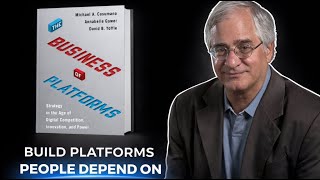
The Business of Platforms - Michael A. Cusumano, Annabelle Gawer, and David B. Yoffie - Book Summary
Robotics for Logistics Startup, Harvard Professor on AI Chip Wars, OpenAI Commerce | Nov 5, 2025

#105 Strategy in the Age of Digital Competition, Innovation and Power feat. David Yoffie