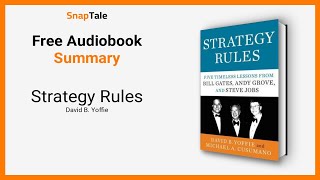
Strategy Rules by David Yoffie TEL 213
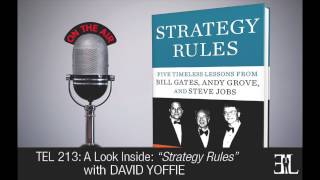
Harvard strategy professor David Yoffie distills lessons from Bill Gates, Andy Grove, and Steve Jobs into five rules: look forward and reason backward, make big bets without betting the company, build platforms not just products, master tactical judo, and shape your organization around the CEO's strengths. Grove's insight: only the paranoid survive.
Chapters
The Entrepreneur's Library Episode 213 welcome to.
The Entrepreneur's Library, the only book centric podcast that reviews all the top selling business books and shares authors perspective firsthand. This is your resource to finding the next great book that will enable you to grow personally and professionally. Welcome your host, Wade Danielson.
Welcome back to the el. Today we have David B. Yaffe, author of Strategy Rules five Timeless Lessons from Bill Gates, Andy Grove and Steve Jobs. Welcome David, and thank you for joining us on the Entrepreneur's Library.
Thank you for having me.
Before we jump into your book, Strategy Rules, will you take just a moment to introduce yourself, tell us a little bit about you personally?
Sure. I've been a professor at Harvard for 34 years and my co author has been a professor at MIT for probably about 30 years. I'm actually not exactly sure. And I've been involved in trying to understand the world of strategy and specifically the world of strategy and technology since the mid-1980s. I had the fortunate experience of joining the Intel Board of directors in 1989, which gave me an opportunity to meet andy Grove in 1987. And then Andy introduced me to Bill Gates and Steve Jobs. And so I had an opportunity to know all these players for a very, very long time. And today I continue to work broadly in this field. I've been working on new industries and new companies, but this has still been the core of my research for most of my career.
That's very interesting. Thank you for sharing that. And now let's jump right into your book, Strategy Rules five Timeless Lessons from Bill Gates, Andy Grove and Steve Jobs, which was, and I forgot to check with you, did this just come out April 14th?
It just came out. So it's been out for 48 hours.
Oh, fantastic. Well, very good. And David, our whole goal here, we're going to move quickly today, but our whole goal is to give the future reader, the listener, a great idea of what the book's all about. So we've come up with some different questions that will allow them to do that. And the first one is what was the inspiration behind writing Strategy Rules?
I wanted to try to understand how an entrepreneur could develop into a leader of a great company and also think about what would lead to great performance. And ultimately, when you think about companies that have done extraordinarily well, the leaders who have done it probably better than anybody else have been Bill Gates, Andy Grove and Steve Jobs. And all three of them, we know their entire history from beginning to end. So there's no questions any longer about whether they have done a great job. We know they have. And so this was an opportunity to really dive deep into three extraordinary individuals.
So, David, what makes your book. This question is so important because you and I talked about beforehand how books are now kind of that needle in the haystack. There's so many coming out. So what makes your book different from others regarding the same or similar topic?
What's really different about our book is that most people who think about these types of individuals write biographies on the individuals or they write histories of the companies. There's almost no book that I'm aware of that dives deep into looking at three CEOs, comparing, contrasting them, and trying to understand what they were able to do in similar ways that produced such extraordinary performance. We think that by looking across companies and across great leaders, you get a deeper insight because it's not about the individual personality traits, it's about what are the ways they think and what are the ways that they deliver performance that they have in common.
So, David, how would you suggest the reader engage with this book? Is this one that they can jump in and jump out, grabbing information as needed, or did you really write it to be read from front to back?
Well, like many books, we have an introduction and a concluding chapter which gives you the high level overview of everything you might want to know at 50,000ft. And then we talk about each of the five rules in great depth. For each rule, we have a single chapter. So for a reader, you can look at the introduction, you can look at the conclusion, get a sense of what are the big areas of interest for you, and then you can pick any one of the chapters and dive into them individually. You don't need to go from front to back all in one sitting.
Perfect, David, now that we know a little bit of the purpose, the background behind the book, let's take a deep dive into the content itself. So we take the next five to eight minutes and really give the listener, the future reader, a great idea of what they can expect to get out of your book.
Sure. So the way we begin the book is by trying to first understand how these individuals were different and how they were similar at a very basic level. They could not be more different as individuals. Obviously, Bill Gates, we know his story, was a classic nerd, but grew up in a wealthy family. Andy Grove was a Holocaust survivor who walked across Hungary to get out of the communist environment and made his way to get a PhD in the United States. And of course, we all know about Bill Gates as the famous college dropout. And flower child. But beyond that, these individuals had some incredibly important similarities, which we think are important for any entrepreneur who wants to be successful. Number one, they were incredibly ambitious. And they were ambitious not just to make money, but to build great companies and to change the world. Number two, they worked incredibly hard. Even Bill Gates, when he compared himself with Steve Jobs, said, what we had in common is we work super hard. They also provoked incredibly searing debates inside the company. Yes, men were never acceptable in any context. And finally, they were all slightly paranoid. They never took such success for granted, even when they were doing extraordinarily well. And all three of these individuals, ultimately, under their tenure, were able to build the most valuable companies in the world. Now, the question then is, how do they do it? And this is where the five rules come in. And the five rules are what we call look forward, reason back. Make big bets without betting the company. Build platforms and ecosystems, not just products, exploit leverage and power, or master judo and sumo tactics. And then finally, to shape the organization around your personal anchor. And the first three of them deal with strategy, and the last two deal with tactics and execution. If you want to be a great strategist, you've got to be able to do things at a high level as well as at a much more micro level, and ultimately be able to execute. So let me give a very, very brief description of the core ideas. The idea of look forward, reason back is that you've got to be able to think several steps ahead into the future, think about strategy much like a chess player or a game theorist does, think several steps ahead, then figure out, what do I have to do today in order to reach that position? And we then break that down into a number of different activities that a great CEO is going to do if they follow these rules. And the first one's probably the most simple one, which is you have to start with some vision of where you want to go. And you think about Bill Gates, for example, who had the concept in 1975 of a PC on every desk in every home running Microsoft software. Or you think about Steve Jobs and the vision to create a digital hub around the explosion of digital devices. Or Andy Grove's vision that he could break down the vertically integrated computer industry and put intel at its center. And this vision becomes critical in driving the success of all of these organizations, which we define in fairly great detail because we had extraordinary access both to the companies and to their documents. The second idea is that you've got to think big and you've got to be willing to make Big, bold bets that potentially change the game. You have to do it without betting the company. Microsoft, for example, goes to war with IBM under Bill Gates. Intel decides to sole source the 8386 microprocessor, even when its biggest customers, including IBM, said they didn't want it. Intel also did something like intel inside, which was branding a product that no one ever understood. They didn't know what it was. They'd never even seen a microprocessor. But they ultimately created one of the greatest brands in the world. But at the same time, all of these bets were made in a way to ensure that the company's financial survival was never at risk. And we go into how they were able to diversify their risks or time their risks or spread their risks over time in order to ensure that none of these bets put the companies at risk. The third big idea is that you have to build platforms and ecosystems, not just products. And this is really, in some sense, an incredibly simple notion. It's the notion that ultimately it's great platforms that win, not great products that always win. So. So if you think back to the old days of Betamax versus VHS or DOS versus Macintosh, or today Android versus iOS, the Apple operating system, ultimately, it's a platform orientation that delivers the great success for a great strategist. The fourth idea is about the tactics. And this is the notion that when you're an entrepreneur, you've gotta be clever, you've gotta stay under the radar, you've gotta employ tactics that we call the puppy dog ploy. Steve Jobs, for example, was a master of this. How was he able to get all of the music companies to sign up for itunes? It was by playing the card of saying, we're only a 3% player in the Macintosh world. Take a risk. What do you have to lose? But at the same time, all three of these individuals were incredibly tough. In fact, so tough that many people would call them ruthless. When they got to the size where they could exert their power, they didn't hesitate. And all three of the companies did run into antitrust issues, some of them more severe than others. The Department of Justice almost broke up Microsoft, and they did punish Apple for publishers for trying to coordinate prices with the book publishers. But nonetheless, I think if you're going to be an incredibly successful CEO, you need to have that toughness or ruthlessness in order to extract the value that's ultimately going to drive the value of your company. And the last critical idea is this idea of how do you execute when you have an organization that's trying to do all these things. Ultimately, this is about the CEO figuring out what they really do that is special, what it is that they have in their own capability set that enables them to do things that give them a comparative advantage to help their organization understand what will be successful. And the notion here is that if you're going to be a successful CEO, a successful entrepreneur, first you have to know yourself, warts and all. You have to know exactly what you can do well and what you don't do well. Bill Gates, for example, understood from the very beginning of the company, when the company was a very small organization, he didn't like operations, he didn't like sales, he didn't like marketing. And he made sure that he compensated for those weaknesses by bringing in the right set of individuals to compensate for the areas that he both didn't like and didn't do well. This is something that Steve Jobs didn't actually do well in his first tenure as CEO, but something he figured out when he came back to Apple in 1997. In addition, one of the things that's critical for any CEO who wants to build a company like Intel, Apple or Microsoft is you have to be willing to learn new domains. Jobs, if you think about his success, was that he looked for mentors. He found people who could teach him many of the new skills that were required to make Apple what it became in the last decade. Gates was very famous for his Think Weeks, where he would take an entire week to do nothing but read and then write memos about what it meant for the future of Microsoft. And Andy Grove actually was very similar to Steve Jobs. He found mentors to teach him marketing, to teach him sales, to teach him computer architecture, things that he never knew anything about until he got to that stage in his career. So all of these rules were actually quite similar across all three CEOs and helped them start as entrepreneurs and ultimately build, as I said, three of the most valuable companies in the history of the world. And during their tenures, each of them actually had the honor of being the most valuable company in the world.
Yeah, that was a ton of powerful content and context behind it. And that's what makes this next question, I think, fairly difficult for an author. And that's if the reader can only take away one concept, principle, or action away from your book or everything that you just shared with us, what would you personally want that to be?
Well, of course, we have two authors on this book, so my co author might say something slightly different since we took primary responsibility for different chapters. But I actually think that the first principle, the idea of what we call look forward, reason back, is the critical idea that ultimately determines what makes a great strategist. It's that ability to look ahead, to have a vision, and then figure out what do I need to do today to get to that particular endgame. It's also about anticipating what customers are going to need tomorrow, not what customers are needing today, and then figuring out what are the capabilities that I have in my organization today that will deliver those customer needs of tomorrow. It's about anticipating competitors and then systematically building into your strategy a set of barriers to entry that reduce the likelihood that competitors will just copy you down the road. So if there's one idea that I would argue is critical in the book, it's being able to understand and think through this process of look forward and reason back.
There's some quote worthy things you just said there. And that does lead into our next question, which is do you have a favorite quote from your book, something that you wrote that you feel like will resonate with the readers? And will you take a minute to explain what that quote means?
Sure. I actually have two quotes, so I'm going to give you two quotes that I like. So one is a quote from Andy Grove where he says, success breeds complacency. Complacency breeds failure. Only the paranoid survive. And I've always thought that captures well this idea that if you're not always on the edge, if you're not always pushing the boundaries, no matter how successful you are at any point in any business, you always put yourself at risk because complacency is probably the great source of failure. The second quote that I actually like is a quote not from Steve Jobs, but a quote about Steve Jobs from Ron Johnson, who built their retail business. And the day that Steve Jobs hired Ron. Steve knew absolutely nothing, absolutely nothing about retail. But he hires Ron, who actually turns out was an MBA student of mine from Target. And what he says is, here's how it's going to work. I'm going to teach you electronics, you're going to teach me retail. Let's go walk the mall. And literally what the two of them did was they drove from Cupertino, Apple's headquarters, to the Stanford Shopping Mall in Palo Alto. And they spent the next four hours with Ron tutoring Steve. What is merchandising? What do displays look like? How do floor layouts in a retail environment work? And I thought that captures the essence of why a CEO, no matter how experienced, no matter how successful has to be able to learn new things and engage in them at a level that they can get an intuitive feel for how they work. I think that Steve did that well.
So we'll put that in the show notes@theelpodcast.com so people can go back and reflect further on that. So thank you for sharing that. And David, if there was only one book you could recommend based on the way that it's impacted your life, maybe created a paradigm shift or a lifestyle shift for you, what would that one book be that you'd recommend?
Well, of course I would love to recommend my own books that I've written before for an entrepreneur. I wrote a book called Judo Strategy, which I think ultimately is about how small companies can take advantage of their larger player size. But in the world of strategy where I've been residing for the last 30 plus years, ultimately it probably gets down to Michael Porter's book called Competitive Strategy, which is really the standard bible about how to think about strategy at a very basic level, written about 35 years ago.
I think that's the first time we've actually had that one recommended. So I appreciate you sharing that. And David, before we depart, can you recommend the best way for our listener to get more information on you and your book strategy rules?
Sure. Well, my website is at the Harvard Business school, which is www.hbs.edu and you can just search for my name. And the critical thing is the spelling, which is yo F, F, I E. And on my webpage there's both information on me, there's information on the book, there's links to Amazon and other places. There's also a webpage@HarperCollins.com which is the publisher of the book. And we hope to have our own webpage very soon, but we've just been a little slow in getting it up and running.
Excellent. Well, David, thank you so much for coming on and sharing your book with us.
Thank you for having me.
Thanks again for listening in today. If you'd like more information on David or his book Strategy Rules, check out the show notes at the EL Podcast.
Looking for your next book idea? Head over to the El Podcast.com where Wade shares his amazing resource, the top 10 business books recommended by over 500 entrepreneurs with you for free. That's the El Podcast.com till the next time, keep it on the Elder.
More from David
The Business of Platforms - Michael A. Cusumano, Annabelle Gawer, and David B. Yoffie - Book Summary
Robotics for Logistics Startup, Harvard Professor on AI Chip Wars, OpenAI Commerce | Nov 5, 2025

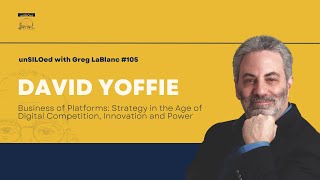
#105 Strategy in the Age of Digital Competition, Innovation and Power feat. David Yoffie