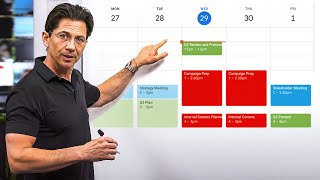
Dean Graziosi teaches practical daily-habit strategies to reclaim control of time and accelerate progress. Key recommendations: schedule your day and "stick to the damn schedule" with hard end-times and deadlines; use focused work blocks (about two hours) separated by breaks; expect roughly five hours of truly productive work per day and prioritize money-making/high-impact tasks into those hours. He frames success around three pillars—mindset, systems, and proactive planning—sharing morning routines (gratitude, nutrition, movement, family routine) and concrete SOPs for turning ideas into training/products (take notes, record voice, transcribe with Rev, edit). The overall aim is to be proactive rather than reactive so the day serves your goals.
Questions this video answers
About two hours.
About five hours per day.
Chapters
Schedule your day. Do not let your day schedule you. So many of us walk around playing offense, we are playing defense. We just let the world take us where it wants to go. Oh, this happened. Let me fix this. We're answering our emails as they come in. Let's fix this as our texts. We're like a robot. Oh, text, let me answer. Oh, email, let me answer. Oh, phone call, let me answer. And all of a sudden, boom, it's five, seven, ten o' clock at night. Day is gone. Schedule your day before it schedules. You ready for this one? This is enlightening. Stick to the damn schedule. Schedule the day. Stick to the damn schedule. Have a hard end. Time. Have a hard end. With deadlines. Right. Again. How do you know you're winning the game unless there's a score? In a basketball game, there's a timer, right? And then the game's over. Baseball game, football game, life. There's a timer, but we don't put a timer on our next level. We want more, but we just let the timer go and just figure it'll happen. No, it doesn't happen unless you put a timer on it. So deadline. Okay, let's get real. About time. If we go more than two hours straight, a lot of times we'll get fried. I don't mean you can't work 10 hours. I. A lot of days. Way over 10 hours. But two hours. Put in hard two hours. I'm going to evolve to this. Thinking. Evolve. Two hours. And then take a break, Go take a walk, meditate, work out, stretch, walk around the block, do yoga, anything. Just take a little break in between two hours, you get drained and you're not working in flow, you're not getting stuff done. It's pretty unsustainable to get more than five hours of really productive work. I'm not saying you can't work 10, 12 hours. I do. But. But I'm talking productive work. Five hours in a day is real. So really, we gotta identify the stuff that we need to be doing that we're just. Let's talk about money today. That's making us money. And the stuff that just does not make us money. And define what can we cram into those hours where we're gonna be most productive. Right. So now you can pull the slide up, Mike, real quick. But, eldrick. Yeah? The 8020 rule. Great book, too. It's always, always on point. Million different ways to skin that. So my secret weapons, mindset systems and proactive planning. Okay, mindset. Every day I create a day setup for Success. Let me just push these slides up. Mike, you can come off the slides for a second here. So there's three types of days we can have. Let's just face it now. We're gonna back up a little bit to give you the momentum. This is like. This is before takeoff for a great day. This is before productivity. Just picture we're on the Runway now, and we want to get this plane to go fast, efficient, no shaking, and right to our destination on where we want to fly. We don't want to go up bumpy and fly over here and then fly over here and then. Oh, let's look at this here. Oh, what's over here? Shiny object. Oh, squirrel. Right. We want a jet that takes off and goes right to our destination. So there's three types of days. One where you can wake up insecure and afraid. We have a lot of those days. Oh, man, I hope this doesn't go wrong. What if this goes wrong? What if I don't have money? What if the time. What if I'm stuck in this job, this life forever? What if I never do a deal? What if I. What if I. We have those days, right? We also have days where you, like, kind of you think you're hovering. Like, that's a pretty good day. You know, I got done what I need to get done. And then we have days that we're on fire. We're courageous. We just want to go to the next level. We have confidence, and we take control. Those days, don't we wish we could have those every day? Well, then set your day up for that. Do whatever it takes to make that day happen. I have my own hacks. I have my own things. I've shared with you guys before. If you're in this. Others, like Dean, will recommend outsourcing. Okay, I'll read these later. So I want to. I want to fill you guys. I want to share with any comments, but let's say you guys can post. I'm gonna. Shiny object. I'm talking about. I'm gonna look away from this, and when we're done today, I will come back. When I'm done speaking, I'll come back and I'll do Q and A. But I set my day up for success. Real simple. Maybe you could find one for you. I put my phone on airplane mode at night so I don't wake up and look at texts or emails, because then immediately that email and that text would be in control. I'd be on defense, and I would be affected by that. I would Be letting the day control me. Me not control the day. As soon as I do that, as soon as I wake up, I try. Don't always do it perfect. I want to tell you something, guys. This is practice. You don't go to the gym once and you're all strong. You got to go every day, right? So I wake up and I try to fill my head first. Couple thoughts with gratitude. It's going to be a nice day today. Oh, my kids are safe and sound in the other room. Oh, last night my daughter hit a home run because she's been practicing and her heart was so filled up, she was so full of joy, you know, today I get to go to practice with my son. Just something simple to be grateful for. Business, the edge. Oh my God, the edge went amazing. You guys. Today I could be grateful for this. Just to be here with you, you being focused on this and hopefully give you one thing today that can help you get more productive and change your life. So I think about that and then I go feed my body. I feel like I fed my head, my soul, I go feed my body. For me, it's a scoop of green drink, it's a whole lemon, it's some MCT oil or XCT oil down a big glass of that. And then I go move. Then I go for my body, I go move, right? I either go climb the mountain or take a jog or go to the gym. And I feel like that sets my day up. And then when I come home, I do a morning routine with my kids. And that routine, I'm done with all of that. They're out of the house by 7:45. That's all done. And man, I don't have perfect days every day, but if I do that right, man, I'm setting up a day for confidence. I'm not setting up a day like, oh, I checked that email and lack and scarcity. We all have issues. It's how we set up the day that helps. So that's the first one. Then systems, figure out the steps. When we talk about systems, it could seem complicated, but I want to ask you this. Figure out the systems, the process or the steps that you have done or you're going to do that, make you money or lead you towards your goal. Right? That's what a system is. Because most of the time systems live in here and we gotta do it ourselves or we feel other people can't do it is good because we haven't created a standing operating procedure. Well, you know, if we create SOPs, standing operators, procedures of the things that make us money, make us happy, or take us to a next life. Then it could be replicated by us. We could fall back on it. Or if we grow a business, we can have other people fall it, follow it. Listen, I have a system when it comes to real estate, to finding deals, selling deals, processing deals, overseeing deals. I don't do any of it now. It's a. It's a system, a standing operating procedure. But I have a system. When I create training. I want to show you something. If you ever, who anybody would listen right now, you could say yes, and I'll try not to look away. Have you ever thought about writing a book? If you have, let me know. Have you ever thought about creating a training system? A training program, teach people how to do whatever it is that you have a passion for or you're good at or an expertise or an experience. Have you ever thought of anything like that? If you did, let me know. If not, that's okay. Well, I have a system. If I had to try to sit down and write a whole book or sit down and write a whole training course or all the things that I'm doing, if I just sat down and had to write the whole thing, it would never happen. Let me tell you what I do. If I am going to create a new program, if I'm going to create a new program, I will think about it obsessively and take notes nonstop and just come over there, think about it nonstop and write notes, write notes, write notes. I want to create a course on the winning state of mind. I want to create course on. I want to do one on influence next. So I will take notes, notes, notes, and then I will record it on my phone. I'm like, oh, the first thing about influence is this. And I'll talk, talk, talk, talk, talk. Then soon as I'm done, here's my system. Think about it. Notes. Step two, record it on my phone. Step three, I push it to Rev R E V.com Rev is an app that gets things transcribed. So I thought about it, I recorded it, I sent it to Rev for pennies. They will. For pennies, they will transcribe it. Then it goes to my nephew Tanner, and he edits it. And then it comes back to me. I clean it up. That section's done. That's a process. If I had to sit down and try to write a course from beginning to end, just wouldn't happen. It's not the way I think now. Maybe that's the way you would do it. But I'm telling you, if you create a system, a standing operating procedure, things go quicker, especially the second and third time you do it. Proactive planning. Spend more time. Just the same thing I was talking about. Spend more time thinking about the plan the. Than actually working on the plan. We sit down and say, okay, time to plan. Time to do the process. Thanks, Mike. Try to do. And what I realize is those moments when you think about it, when you're in the shower, when you're taking a walk, when you're just sitting alone. Take notes. And the more planning you do, the easier it is. It.